Saint Phillis, Clivilius
Saint Phillis is a coastal settlement in Clivilius, founded in January 2018 when Nathan Cowdrey activated his Portal Key and claimed the territory for human habitation. Located 512 kilometres south of Bixbus, Saint Phillis began as every new Clivilian territory does—a blank canvas of dust and silence, devoid of plant or animal life. The Guardians who built it transformed barren cliffs into functioning settlement through methodical work with Clivilius's unique soil systems, particularly the nutrient-rich layer known as The Cradle. The tragedy of London in 2019 scattered those Guardians, but the infrastructure and agricultural systems they created endure, sustaining a small community on this remote stretch of alien coastline.
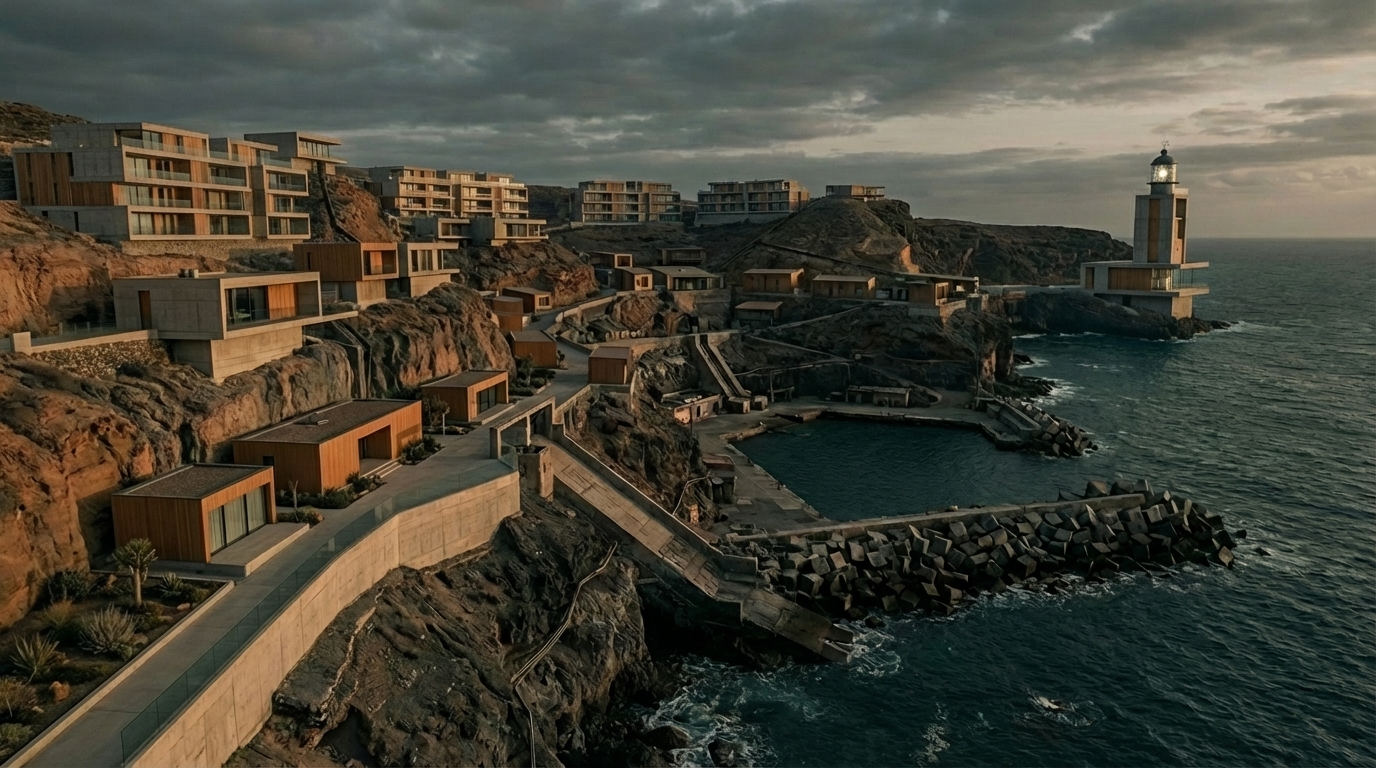
Geography and First Impressions
Saint Phillis occupies a stretch of coastal terrain 512 kilometres south of Bixbus, where red sandstone cliffs rise forty to sixty metres above a sea whose colour shifts between slate grey and deep green depending on atmospheric conditions. The distance from Bixbus is significant—a journey of several days overland through territory that, at the time of Nathan's arrival, contained nothing: no settlements, no roads, no markers of previous human presence. The isolation was absolute.
When Nathan Cowdrey first stepped through his Portal Key on 10 January 2018, he emerged onto a clifftop covered in fine red dust. The silence was complete. No wind stirred the dust. No birds called. No insects moved across the ground. The sea below made no sound that reached the clifftop. Clivilius presented itself as it always does to new Guardians claiming unclaimed territory—a blank canvas waiting for human intention to give it form.
The territory claimed by Nathan's Portal Key activation encompasses roughly eight square kilometres, bounded by the coastline to the west and natural ravines to the north and south. The eastern boundary extends into desert land that, like the clifftop, held no life when Nathan first explored it. The dust covered everything in a uniform layer, obscuring the remarkable soil systems that lay beneath.
The cliffs themselves are layered sedimentary formations, their strata visible in bands of ochre, rust, and pale cream where erosion has exposed the rock face. Near the cliff edges, portions of the surface display an unusual characteristic: smooth, glassy patches that reflect light differently from the surrounding dust. These vitrified areas result from the interaction between salt aerosols from the sea and dormant terraforming enzymes in the soil's upper layers—a crystallisation effect that creates protective coatings in coastal zones. When disturbed, these surfaces sometimes exhibit faint luminescence from residual energy in the terraforming systems, a phenomenon that initially unsettled Nathan before he understood its origins.
The Soil System
Understanding Clivilius's soil became the foundation of everything the Guardians built at Saint Phillis. Beneath the fine red dust—known colloquially as The Veil—lay two additional layers that would prove essential for the settlement's survival.
The Veil itself ranges from a few centimetres to half a metre in depth across the territory. This fine particulate matter serves multiple functions: it protects the layers beneath from environmental exposure, captures moisture from the atmosphere, and insulates against temperature fluctuations. When Nathan first began exploring, he noticed that the dust seemed to settle differently in different areas, accumulating more thickly in sheltered zones and remaining thin where wind exposure was greatest.
Beneath The Veil lies The Shield—a denser, more cohesive layer of compacted minerals and bioengineered binding agents. This transition zone, roughly thirty to ninety centimetres thick, regulates the flow of water and nutrients downward while protecting the vital layer below from disruption. The Shield contains dormant terraforming enzymes encased in protective capsules, designed to activate when conditions change—when moisture levels shift, when pressure alters, when the chemistry of the surrounding material indicates organic activity.
The deepest layer—The Cradle—is where life becomes possible. This rich organic matrix, extending from roughly a metre to nearly two metres in depth, contains the active components of Clivilius's terraforming system: bioengineered soil aggregates, microorganisms, and networks of AI-guided enzymes that continuously optimise conditions for plant growth. The Cradle is, in essence, a living system designed to support Earth-origin vegetation once that vegetation is introduced.
The challenge facing the Guardians was straightforward in concept but demanding in execution: The Cradle could support plant life, but it contained no plant life. No seeds waited in the soil. No dormant roots would sprout with the addition of water. Everything that would eventually grow at Saint Phillis had to be brought from Earth and introduced to a system that was ready to nurture it but empty of anything to nurture.
Amber's Agricultural Work
Amber Styles approached the challenge of establishing agriculture at Saint Phillis with the systematic rigour her academic training had instilled. Her first task was understanding what The Cradle actually contained—analysing soil samples, testing nutrient availability, measuring moisture retention, documenting the behaviour of the terraforming enzymes under various conditions.
What she discovered was encouraging. The Cradle's composition was remarkably well-suited to supporting Earth-origin plants. The mineral content fell within ranges that common food crops could tolerate. The moisture retention exceeded what most agricultural soils could achieve. The AI-guided enzymes actively responded to plant presence, adjusting soil chemistry in real-time to optimise growing conditions.
The system's most striking characteristic was its initial growth acceleration. Seeds planted in The Cradle germinated faster than expected—sometimes dramatically so. Early experiments with coriander showed seedlings emerging within days rather than the week or more that Earth conditions would require. This accelerated germination represented The Cradle's designed response to new organic material: the terraforming enzymes concentrated resources around introduced seeds, creating optimal conditions for rapid establishment.
After this initial burst, growth rates settled into patterns more consistent with Earth agriculture. The acceleration served a specific purpose—helping new plants establish root systems quickly—but sustainable cultivation required the more measured pace that followed. This transition from rapid establishment to steady growth became a key principle in Saint Phillis's agricultural planning.
Amber designed the settlement's cultivation systems around these characteristics. Planting schedules accounted for the initial acceleration phase. Spacing accommodated the robust root development that The Cradle encouraged. Crop selection prioritised varieties that responded well to the soil's particular mineral profile. By late 2018, the first successful harvests demonstrated that long-term food production at Saint Phillis was not just possible but could eventually reduce dependence on Earth-sourced supplies significantly.
The agricultural zone developed on the eastern edge of the settlement, where natural terrain features provided some protection from coastal winds. Raised beds offered precise control during the establishment phase. Greenhouses extended the growing season for crops that couldn't tolerate temperature variations. The systems Amber designed continued to function after her death, maintained by settlers who learned her methods and followed documentation she created.
Weather and Climate Development
When Nathan first arrived, Saint Phillis's weather was remarkably consistent—cool, still, with occasional fog rolling in from the sea. This stability reflected the territory's blank-canvas state: without vegetation, without the transpiration and surface changes that plants create, the local atmosphere remained in a kind of equilibrium maintained by The Veil's insulating properties.
As cultivation expanded and plant cover increased, this began to change. The relationship between vegetation and weather in Clivilius operates as a feedback system: plants release moisture through transpiration, altering local humidity; their presence changes surface reflectivity, affecting temperature profiles; their density creates surface roughness that influences wind patterns. As Saint Phillis's agricultural zones matured, the settlement began developing its own microclimate.
By 2020, the changes were noticeable. The agricultural areas experienced higher humidity than the surrounding terrain. Morning dew formed more readily on cultivated ground. Fog patterns shifted, sometimes concentrating around the greenhouses where moisture release was highest. The wind that had once swept uniformly across the clifftop now eddied around structures and vegetation, creating sheltered zones that hadn't existed before.
This climate development remains ongoing. The scale of Saint Phillis's cultivation is still modest—insufficient to generate the dramatic weather changes that larger, more established Clivilian territories experience. But the trajectory is clear: as plant cover expands, the local environment will continue adapting, eventually creating conditions optimised for whatever vegetation dominates the landscape.
Infrastructure and Settlement Development
Saint Phillis's infrastructure reflects its founding philosophy: sustainability over expansion, resilience over ambition. The settlement was designed for a community that could maintain itself without requiring constant growth—a deliberate contrast to Bixbus's metropolitan development 512 kilometres to the north.
Early construction focused on shelter and essential services. The first permanent structures were prefabricated units transported through Portal Keys, assembled on prepared foundations along the clifftop. Wind resistance dictated design choices; buildings were kept low, with reinforced anchoring and minimal surface area exposed to coastal gusts. The glassy vitrified patches near the cliff edge were left undisturbed—their unusual properties made them unsuitable for construction, and their presence marked the settlement's coastal character.
Power generation combines solar panels and small wind turbines, with battery storage providing continuity during low-generation periods. The constant coastal wind, which makes outdoor work challenging, at least ensures reliable renewable energy. The system includes redundancy that Josh Cowdrey designed after careful analysis of failure scenarios—no single component failure can compromise settlement-wide power.
Water management proved simpler than initially anticipated. The Veil's moisture-capture properties, combined with rainfall collection, provide most of the settlement's needs. Storage tanks maintain reserves for dry periods. A freshwater aquifer discovered approximately two kilometres inland offers additional capacity, though accessing it required infrastructure investment that came later in the settlement's development.
Communication systems connect Saint Phillis internally and, through carefully secured channels, to Guardian operations elsewhere. Saul Carter's security-focused design prioritises encryption and redundancy over convenience—essential precautions given the sensitive nature of Guardian activities. These systems proved crucial after London, when the scattered Guardians relied on communication infrastructure that continued functioning despite the fellowship's fracture.
Housing has expanded gradually from the original prefabricated units to more permanent construction. The architectural style remains functional—low profiles, reinforced structures, designs prioritising durability and energy efficiency over aesthetics. Current capacity accommodates approximately forty permanent residents, with flexibility for temporary population increases when circumstances require additional hands.
Governance and Community
Saint Phillis never developed formal governance structures. The Lead Council, the urban development authority, the institutional frameworks that manage Bixbus's growing population—none of these exist in the smaller, more remote coastal settlement. What emerged instead resembled extended household management: informal decision-making among people who knew each other well enough to resolve disagreements through discussion rather than procedure.
During the period when all five Guardians operated together, leadership was collaborative. Nathan provided vision; the others contributed expertise in their respective domains. Disagreements arose—Nathan's impulsiveness sometimes clashed with Verity's caution, Saul's strategic calculations occasionally frustrated Josh's preference for straightforward solutions—but shared commitment to the settlement's success created space for compromise.
The London fracture disrupted this model. The Guardians scattered, maintaining connection through encrypted channels but no longer collaborating daily. Saint Phillis continued to function, its infrastructure sustaining the small population of settlers who had joined during the earlier period, but leadership became intermittent and distributed rather than concentrated and constant.
Current governance operates through established protocols and ad hoc coordination. Routine matters follow procedures developed during the founding period. Exceptional situations require consultation among whoever can be reached. The system works because the community remains small enough—typically fifteen to twenty-five residents—for everyone to know everyone else, and invested enough in shared survival to resolve conflicts before they escalate.
The Memorial Garden
The memorial garden occupies a prominent position near the settlement's centre. Amber Styles's death left a void that practical arrangements could not fill; the garden represents an attempt to honour her contribution through something living rather than merely commemorative.
The design follows principles Amber established—raised beds, companion planting, integration of food production with aesthetic consideration. The crops grown there are distributed among residents, continuing the work she began. The soil is particularly responsive in this location; The Cradle's terraforming enzymes seem to concentrate activity around areas of regular human attention, as though the system recognises and responds to care.
Gatherings occur at the garden during significant moments—arrivals, departures, anniversaries of events the community chooses to remember. No formal ritual has developed. People come, tend plants, and acknowledge what the space represents. The vegetables and herbs that grow there taste no different from crops grown elsewhere in the settlement, but the act of consuming them carries meaning that nutrition alone cannot provide.







