Ruby Chalice, Ur
The Ruby Chalice was a tavern in Ur's Ekrubal Quarter operated by the widow Nin-Bára from 2483 to 2461 BCE. Located at the intersection of Sul-Malatu Street and the harbour quarter lane, it served beer, barley bread, and simple meals to skilled craftspeople and minor merchants whilst providing discreet meeting spaces in its back chamber. On 6 August 2470 BCE, Azariel Tiberius Voshtar and seventeen key followers gathered in this back chamber to plan their departure from Ur—the meeting that transformed individual interest into collective commitment and laid the practical foundations for Fordingrad's establishment.
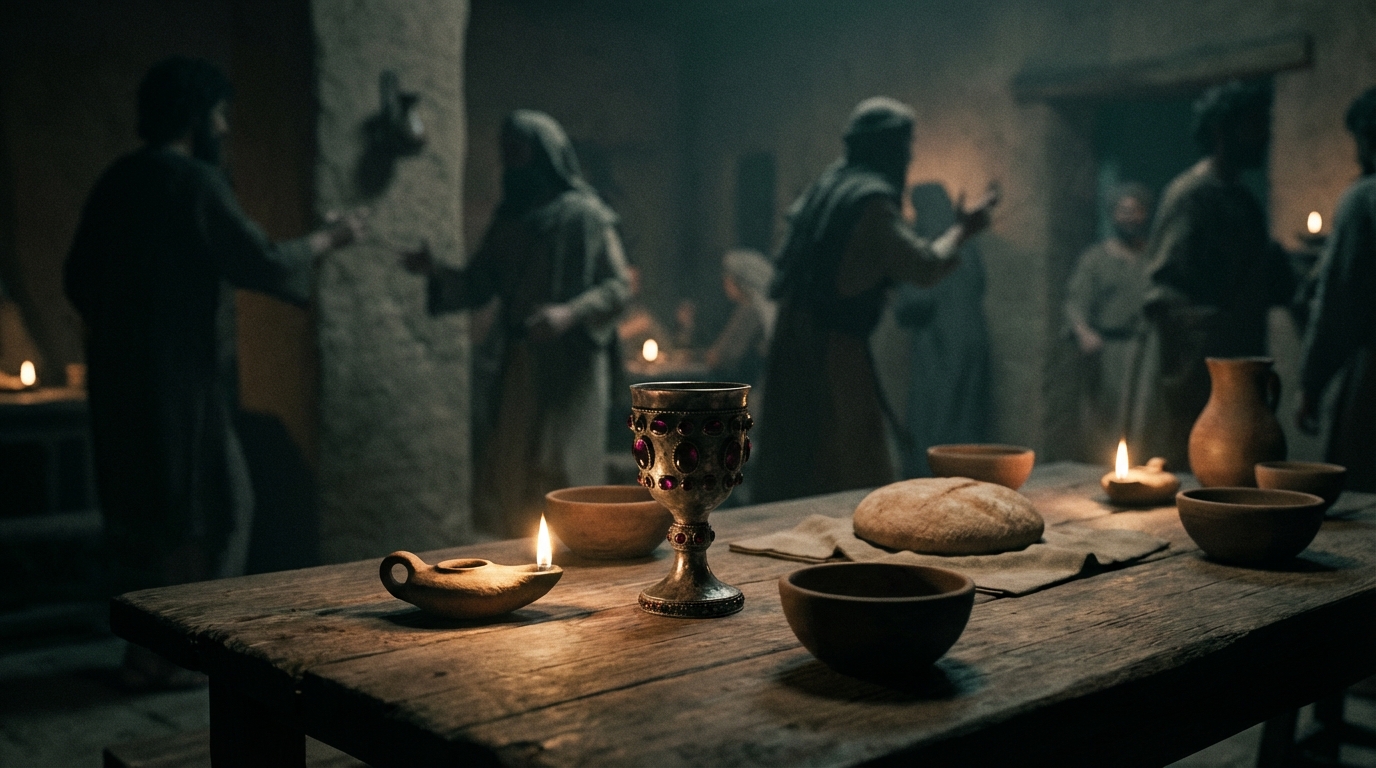
Location and Physical Structure
The Ruby Chalice occupied a corner mud-brick structure where Sul-Malatu Street intersected with Naru-Kaškal Lane in Ur's Ekrubal Quarter. The quarter's name derived from the Sumerian ekur-bal ("mountain crossing" or "traders' threshold"), reflecting its position between the central marketplace and the harbour district where goods and people transitioned through the city's commercial networks.
The building stood two storeys tall with thick mud-brick walls plastered in lime wash that had weathered from original white to streaky grey-brown after two decades of smoke and dust accumulation. The flat roof featured carefully maintained drainage channels that directed rainwater into clay collection vessels, and the corner position provided entrances on both Sul-Malatu Street and Naru-Kaškal Lane—a configuration that allowed patrons to arrive and depart discreetly through different exits.
A painted red circle above the main entrance on Sul-Malatu Street marked the establishment's identity—no cuneiform signage, as Ur's taverns operated through reputation and word-of-mouth rather than explicit advertising. The circle's pigment was renewed yearly, a mix of red ochre and animal fat that Nin-Bára applied herself each spring after the flood season.
The main chamber measured approximately 8 metres by 6 metres, opening directly from Sul-Malatu Street through double wooden doors crafted from acacia wood by Nin-Bára's late husband Lugal-Mašda before his death in a harbour accident in 2483 BCE. During operating hours (typically mid-afternoon until two hours past sunset), these doors remained propped open with limestone blocks, allowing ventilation and providing clear views of street traffic that helped Nin-Bára assess potential customers before they entered.
Low wooden benches and tables fashioned from palm wood and bitumen-sealed joints filled the space, arranged around a central serving area where Nin-Bára and her two daughters, Gemé-Nanna (age 19 in 2470 BCE) and Šat-Ištar (age 16), prepared and distributed beer, bread, and other fare from large storage vessels. Seven clay oil lamps mounted in wall niches provided illumination after sunset, their wicks trimmed daily with copper scissors that had belonged to Nin-Bára's mother.
The interior walls bore murals painted by a travelling artist from Girsu whom Nin-Bára had commissioned in 2479 BCE, paying three months' profit for the work. The scenes depicted episodes from the Epic of Gilgamesh: Enkidu dying whilst Gilgamesh clutches his hand in grief, the hero's journey through the tunnel of darkness, and the serpent stealing the plant of rejuvenation whilst Gilgamesh bathes in a pool. The artist had executed these in red ochre, charcoal black, and expensive Egyptian blue pigment (acquired at considerable cost through Malik's trading connections). Nin-Bára had chosen these specific episodes deliberately—not Gilgamesh's triumphs in combat or his friendship's glory, but the moments of loss, failure, and mortality—because she believed such images encouraged philosophical contemplation rather than drunken boasting, attracting the quality of clientele she preferred.
The back chamber occupied the building's rear section, accessible through a doorway concealed by a reed mat woven by Gemé-Nanna in traditional geometric patterns. This rectangular room measured 4.2 metres by 5.4 metres with ceiling height of 2.8 metres—dimensions Nin-Bára's husband had calculated precisely to accommodate fifteen people seated around the central table whilst maintaining enough space for her daughters to serve without disrupting conversations.
The walls were limestone rather than mud brick—expensive construction that Lugal-Mašda had insisted upon, arguing that the investment would pay off through premium prices for privacy. Water stains near the ceiling marked where roof leaks had occurred during the exceptional storm of 2475 BCE, though Nin-Bára had since repaired the damage with fresh bitumen sealing. A single window set 2.5 metres above the floor provided ventilation whilst preventing easy surveillance from the narrow alley behind the building.
The central table was constructed from oak timber salvaged from a Dilmun trading vessel that had wrecked near Ur's harbour in 2492 BCE. Lugal-Mašda had purchased the timber for a substantial sum, recognising that oak's hardness and prestige would justify the back chamber's premium prices. The table measured 2.3 metres long and 1.4 metres wide, its surface bearing the accumulated marks of eleven years' use: knife scratches from merchants cutting bread, circular stains from countless beer cups, burn marks from carelessly placed hot clay vessels, and what appeared to be a partial cuneiform inscription that someone had begun carving before being stopped or distracted.
In the table's centre sat a clay bowl—unremarkable pottery that Nin-Bára had made herself before her marriage, when she was still learning the craft from her mother—always filled with fresh water and a floating flower. The choice of flower varied by season and availability, but Nin-Bára maintained a preference for symbolic selections: lotus for purity, water lily for rebirth, and on particularly significant occasions, fig blossoms representing new beginnings and divine favour.
Operations and Proprietorship
Nin-Bára daughter of Ur-Namma ran the Ruby Chalice from her husband's death in 2483 BCE until her own death in 2461 BCE, when her daughters inherited the establishment. Born in 2518 BCE in Ur's potter's quarter, she had married Lugal-Mašda in 2500 BCE in an arranged match between families of similar modest prosperity. The marriage had been successful by contemporary standards—Lugal-Mašda had provided well, treated her with reasonable respect, and their three children (including a son who died in infancy in 2495 BCE) had survived the dangerous early years.
When Lugal-Mašda drowned in 2483 BCE after falling from a harbour platform during cargo loading, Nin-Bára faced immediate economic crisis. Mesopotamian law permitted widows to inherit property, but social pressure typically pushed them toward remarriage or return to their birth families. Nin-Bára chose neither. She took control of the tavern, leveraging relationships Lugal-Mašda had built with suppliers, brewers, and regular customers to maintain operations whilst training her daughters in the business.
By 2470 BCE, Nin-Bára was 48 years old—a remarkable age for a woman who had survived three childbirths and decades of tavern work. Her greying hair was kept covered by linen head cloths, her hands bore burn scars from handling hot bread and beer vessels, and her voice carried the authoritative rasp of someone accustomed to managing drunk customers and settling disputes. She ran the establishment with firm competence, maintaining quality standards that kept skilled craftspeople returning whilst charging premium prices that sustained her family.
Beer production occurred in a dedicated brewing room on the second storey, where Nin-Bára and her daughters transformed barley and dates into the establishment's primary revenue source. They produced three grades:
- Common barley beer (kaš-sig): The cheapest offering, brewed from standard barley purchased from temple stores, fermented for five days, thick and nutritious but unremarkable in taste. Sold for 2 shekels per sìla (approximately 1 litre), this grade attracted labourers and low-budget customers.
- Date-flavoured beer (kaš-zu-lum): Mid-grade product made with barley and date syrup, fermented for seven days, smoother and sweeter. Sold for 4 shekels per sìla, this was the Ruby Chalice's signature offering, popular with skilled craftspeople who could afford modest luxury.
- Emmer beer (kaš-zíz): Premium brew made from emmer wheat rather than barley, fermented for ten days with date syrup and occasionally honey, producing a lighter, more refined beverage. Sold for 8 shekels per sìla, this grade was reserved for wealthy merchants and special occasions.
Beer was stored in eight large pithoi (storage vessels) partially buried in the ground floor to maintain cooler temperatures. Each vessel held approximately 100 sìla, and Nin-Bára maintained careful inventory records on clay tablets that she stored in a wooden chest inherited from her mother. These records, if they had survived, would have documented the Ruby Chalice's complete transaction history from 2483 to 2461 BCE.
Food offerings included barley bread purchased daily from Adad-Šumu, a baker on Sul-Malatu Street whose family had supplied Lugal-Mašda for over a decade; dried dates from Nin-Bára's cousin who operated a date-processing workshop; onions, garlic, and cucumbers from vendors in the morning market; dried fish from harbour merchants; and occasionally goat cheese from a herdsman who passed through Ur monthly. Nin-Bára never attempted to prepare elaborate meals—the Ruby Chalice was fundamentally a drinking establishment that happened to provide food sufficient to absorb alcohol and justify extended stays.
Pricing for the back chamber was triple the normal beer cost plus a flat fee of 20 shekels for evening reservation. This meant a group of fifteen consuming mid-grade beer for three hours would pay approximately 200 shekels total—a substantial sum equivalent to a skilled craftsman's weekly wages. The high price ensured privacy, discouraged casual use, and provided significant profit that sustained Nin-Bára's household during slower periods.
Clientele and Social Function
The Ruby Chalice attracted a specific demographic: skilled craftspeople and minor merchants with modest prosperity who valued conversation over status display. This clientele included master weavers from the textile workshops on Šubat-Enlil Street, coppersmiths from Bit-Dagan quarter, junior scribes from Ekur administrative offices, caravan guards between assignments, and independent traders too small for merchant guild halls but too successful for common beer houses.
Regular customers in 2470 BCE included:
- Kiya (engineer from Nimurum, age 34), who visited twice weekly after completing work at the irrigation administration office, usually ordering date-flavoured beer and conversing with other technically-minded craftspeople about construction techniques, water management, and architectural innovations she observed during childhood in Lagash.
- Lirit daughter of Enalu (metalsmith, age 29), who stopped by most evenings after closing her forge in Bit-Dagan, her copper cuffs and forge-scarred arms marking her profession, often joining conversations about metallurgy, tool design, and the frustrations of working within guild restrictions.
- Malik son of Iddin-Marduk (merchant, age 41), who maintained a corner table three evenings weekly where he conducted informal business negotiations over premium emmer beer, his rings catching lamplight as he gestured through transactions that were technically legal but would attract guild scrutiny if conducted in more public venues.
- Beli-Ashur (retired canal surveyor, age 67), who occupied the same bench near the eastern wall every evening, nursing common beer whilst sharing stories about Ur's waterworks with anyone interested, his grandson Tamaru often accompanying him after the boy's mother finished work at the textile workshop.
Nin-Bára cultivated this clientele deliberately. She refused service to customers who became violent or disruptive, maintained strict rules about harassment of her daughters (violators were permanently banned), and charged premium prices that discouraged the poorest labourers whose minimal spending created maximum trouble. She also developed a reputation for discretion—conversations at the Ruby Chalice stayed at the Ruby Chalice, a policy she enforced through stern warnings and occasional refusal of service to those who gossiped about other patrons' business.
This reputation for quality clientele and operational discretion made the Ruby Chalice an ideal venue for Azariel's purposes in July-August 2470 BCE. During his three weeks of observation following the marketplace speech, he identified the establishment as a space where people with valuable skills gathered informally, where conversations could occur beyond temple or guild oversight, and where the proprietor valued silver more than orthodox conformity.
Azariel's August Campaign
Following his 28 July 2470 BCE marketplace speech, Azariel began frequenting the Ruby Chalice almost nightly. He would arrive around sunset, order date-flavoured beer (which he consumed slowly over hours, never becoming intoxicated), and position himself at a table near the murals of Gilgamesh. Those interested in his vision knew where to find him.
Nin-Bára observed this pattern with characteristic pragmatism. Azariel paid promptly, caused no trouble, and his presence attracted additional customers—curious craftspeople who wanted to hear more about the impossible city he was proposing. His distinctive lapis lazuli cloak made him easily identifiable, and within days the Ruby Chalice had become known as the place to find "the man who wants to build in the wilderness."
By early August, Azariel was conducting multiple conversations nightly. Kiya arrived on 31 July and spent two hours examining the concepts Azariel sketched in wet clay. Eadric appeared on 2 August, having heard about the speech from a caravan guard, and spread his hide maps across a table whilst describing routes into territories most Ur residents had never imagined visiting. Amara came on 3 August, drawn by conversations about establishing medicine independent of temple control, and demonstrated wild-gathered herbs that produced effects faster than city-cultivated equivalents.
Nin-Bára watched these intensifying discussions whilst saying nothing. She collected payments, served beer, and maintained the establishment's fundamental promise: what happened at the Ruby Chalice stayed at the Ruby Chalice. When Azariel approached her on 4 August requesting private use of the back chamber for an important meeting, she quoted the standard price—200 shekels for evening reservation for up to twenty people—and accepted his silver without asking questions about the gathering's purpose.
The 6 August 2470 BCE Gathering
On the evening of 6 August 2470 BCE—nine days after Azariel's marketplace speech—seventeen individuals gathered in the Ruby Chalice's back chamber for what would become Fordingrad's foundational planning session. The meeting began shortly after sunset (approximately 19:45) and continued until past midnight, lasting over four hours of intense discussion, debate, and commitment.
Attendees included:
- Azariel Tiberius Voshtar (age 40), seated with back to the wall near the concealed doorway, his lapis cloak now thoroughly dust-dulled from weeks in Ur's heat
- Kiya daughter of Šamaš-Nādin (age 34), engineer from Nimurum with grey-stained hands and gold-threaded loop marking her Lagash scribal geometry training
- Eadric son of Puzur-Ea (age 38), pathfinder in leather vest made from kurba beast hide, river-stone pendant at throat
- Amara daughter of Šarri-Kušuḫ (age 31), healer of mixed Hurrian-Sumerian ancestry in ash-stained linen, glass vials chiming in her medicine satchel
- Sera bat Naram-Sin (age 52), silver-haired soldier in worn bronze cuirass, scars crossing her forearms
- Malik son of Iddin-Marduk (age 41), merchant in indigo and Tyrian purple robes, nearly every finger bearing a ring
- Lirit daughter of Enalu (age 29), metalsmith from Bit-Dagan with copper cuffs and forge-scarred arms
- Ishturel son of Ea-Damiq (age 22), junior scribe from Etemenniguru temple clutching wax tablet
- Tamaru son of Kullah (age 8), the child from the marketplace speech, accompanied by his mother Nin-Ištar (age 27, textile worker) and grandfather Beli-Ashur (age 67, retired canal surveyor)
- Ur-Ningirsu (age 44), potter whose family had operated kilns in Bit-Hegalli for three generations
- Iddina daughter of Lugal-Annepada (age 36), carpenter who had learned woodworking from her father before his death
- Šamaš-Iqbi and Nūr-Adad (ages 33 and 31), brothers who had served as borderland soldiers before deserting Akkadian service in 2473 BCE
- Ninsun daughter of Ur-Bau (age 58), midwife from Bit-Zidra who had delivered over 400 infants during her career
- Zababa-Šuma-Iddina (age 47), former temple relief carver who now made protective amulets after losing temple position due to theological disputes
Nin-Bára served the initial round of beer herself—mid-grade date-flavoured for most attendees, premium emmer for Malik—ensuring everyone was settled before withdrawing to give them privacy. She positioned her younger daughter Šat-Ištar near the concealed doorway with instructions to respond if summoned but otherwise to stay clear. The premium had been paid; the chamber was theirs.
The meeting's structure evolved organically:
First hour: Cautious introductions and skeptical questioning. Malik led the interrogation about practical logistics—how would they transport materials? What about water sources? What prevented tribal raids from destroying everything they built? Sera reinforced these concerns with realistic military assessment. The mood was tense, with several participants clearly questioning whether they'd made a terrible mistake by coming.
Second hour: Technical presentations that transformed skepticism into engaged problem-solving. Kiya unrolled her papyrus blueprints across the oak table, showing terraced gardens, spiral rain channels, buildings oriented for optimal temperature control through passive solar design. Her calculations were precise, her engineering training evident in every measurement and angle notation. Eadric laid out his hide map showing the route to Anḫu valley, marking water sources, tribal territories (both friendly and hostile), dangerous salt flats, and ancient basalt ruins that local tribes avoided. Amara displayed her wild-gathered herbs, explaining which plants treated fever, infection, childbirth complications—knowledge that demonstrated wilderness could sustain as well as threaten.
Third hour: Individual commitments building toward collective oath. One by one, participants stepped forward placing objects on the table whilst pledging their skills. Eadric pledged his pathfinding knowledge invoking Nanna, lord of wayfarers. Kiya vowed to build their shared dream using sun's path and wind's pull. Amara promised to tend wounds and teach old remedies. Ur-Ningirsu offered ancestral kiln techniques. Ishturel pledged his scribal precision for record-keeping. Iddina promised her cedar-reading skills for construction. The brothers Šamaš-Iqbi and Nūr-Adad offered military protection. Ninsun vowed to deliver the next generation safely. Each commitment built upon the previous, creating cascading momentum toward irreversible decision.
Fourth hour: Practical planning that made vision tangible. The oak table became workspace covered in annotations. Kiya's blueprints acquired margin notes from multiple hands correcting angles, suggesting modifications, identifying material sources. Eadric's map gained symbols marking campsites, hazard zones, and estimated travel times. Amara drafted supply lists detailing roots, resins, copper tools, dried meats, and barley in sealed amphorae. Ur-Ningirsu sketched portable kiln designs. The brothers discussed defensive strategies. Beli-Ashur, drawing on decades of canal surveying experience, calculated water requirements and irrigation possibilities for the Anḫu valley based on Eadric's topographic descriptions.
Malik remained at the edges throughout, arms folded, skeptical expression unchanged. Finally, as midnight approached and exhaustion began affecting concentration, he exhaled deeply and spoke: "You are all touched by divine madness... but perhaps the gods send madness when they wish to see wonders." He would provision the journey using his trade connections—salt routes to Kharazi, cedar contacts in Byblos, grain suppliers throughout Mesopotamia—though he himself would remain within Ur's walls. He recognized that not everyone need walk the same path, that supporting impossible dreams was itself honourable service.
The fig blossom Nin-Bára had placed in the clay bowl that morning remained floating throughout the meeting, gradually opening as warmth from bodies and lamps filled the chamber. By the gathering's end, it had fully opened—an accidental but potent symbol that several participants noted aloud.
As lamps guttered low past midnight, Nin-Bára knocked softly on the doorframe—her signal that the night was advancing and other customers had departed. The group began dispersing through both exits at staggered intervals, carrying plans and commitment that had transformed them from curious individuals into Fordingrad's founding core. Azariel remained last, paying Nin-Bára an additional 50 shekels beyond the agreed price—unprecedented generosity that she accepted with a slight nod of acknowledgment before beginning the chamber's cleanup.
The vision spoken in dust nine days prior was no longer Azariel's alone. It had become shared purpose burning in seventeen hearts like sacred flame. And the limestone walls of the Ruby Chalice's back chamber had witnessed the moment when impossible dreams crossed the threshold into determined action.
Subsequent August Meetings
The 6 August gathering was foundational but not sufficient. Throughout the remainder of August 2470 BCE, smaller groups continued meeting at the Ruby Chalice for increasingly practical coordination. These sessions focused on logistics:
- 10 August: Eadric, the soldier brothers, and Sera planned security arrangements and mapped tribal contact protocols
- 13 August: Kiya, Ur-Ningirsu, and Iddina calculated material requirements and identified portable tools
- 17 August: Amara, Ninsun, and several women not present at the first meeting (recruited through subsequent conversations) organised medicine supplies and planned health protocols for journey and early settlement
- 21 August: Malik met with Azariel and Eadric to finalise provisioning contracts and arrange grain storage in Ur's outer district where it could be loaded onto donkeys and carts
- 25 August: Full group reconvened to coordinate final departure preparations, set the specific departure date (first new moon of September), and ensure everyone understood their responsibilities during the journey's initial stages
Nin-Bára hosted all these gatherings, maintaining her policy of asking no questions whilst ensuring privacy. By late August, she had earned approximately 800 additional shekels from these meetings—a windfall that would sustain her household for nearly half a year.
The Departure and After
In early September 2470 BCE, when Azariel led his followers through Ur's western gate, the Ruby Chalice lost approximately 8% of its regular clientele. Seventeen core members plus their immediate family members who had joined the plan totaled perhaps 35-40 people from the establishment's regular customer base of roughly 450 individuals who visited at least monthly.
The loss was noticeable but not catastrophic. Nin-Bára adapted by recruiting new customers through word-of-mouth and maintaining the quality standards that had attracted skilled craftspeople in the first place. The Ruby Chalice continued operating successfully until Nin-Bára's death in 2461 BCE at age 57—respectable longevity for her era and profession.
Her daughters Gemé-Nanna and Šat-Ištar inherited the establishment jointly and maintained operations until 2447 BCE, when changing commercial patterns (as Ur's harbour began experiencing the siltation problems that would eventually doom the city) reduced profitable trade traffic through Ekrubal Quarter. They sold the building to a textile merchant who converted it to a weaving workshop, ending the Ruby Chalice's existence as a tavern after 36 years of operation under three generations of the same family.
The oak table where Fordingrad's planning occurred was sold separately to a wealthy merchant who recognized the wood's quality and value. Its subsequent history is unknown—it might have served dinner guests in a prosperous household for decades, or been broken up for repair wood when the merchant's family fell on hard times. The table's marks—knife scratches, burn marks, partial cuneiform inscription—bore no indication of the world-changing conversations it had supported.
The building itself eventually succumbed to Ur's gradual abandonment. As the Euphrates shifted course and the city lost population, structures in Ekrubal Quarter were abandoned to wind and sand. The mud-brick walls eroded. The roof collapsed. The limestone back chamber walls gradually disintegrated. The painted murals of Gilgamesh faded and flaked away. By 500 CE, nothing remained above ground except vague mounds in desert landscape.
Modern archaeology has not specifically identified the Ruby Chalice's location. The site was either excavated without recognition (taverns leave minimal distinctive signatures beyond storage vessels and serving areas that could belong to many building types) or lies in unexcavated sections of ancient Ur. The physical structure is gone, but the consequence of what occurred within those limestone walls on 6 August 2470 BCE extends through four millennia to present-day dimensional conflicts.
The Proprietor's Knowledge
A question worth addressing: did Nin-Bára understand what was being planned in her back chamber?
The answer is unquestionably yes. She was neither naive nor unintelligent. Running a successful tavern for thirteen years whilst raising two daughters required sharp observation, sound judgment, and keen understanding of human nature. She heard enough fragments of conversation—even while maintaining professional discretion—to recognize that Azariel's group was planning departure from Ur. The maps, the provision lists, the discussions about wilderness routes, the recruitment conversations that happened in her main chamber—all pointed toward exodus.
But she said nothing to authorities. This silence was partly professional ethics (betraying customers would destroy her business), partly political indifference (Ur's internal population movements weren't her concern), and partly sympathetic understanding. Nin-Bára had chosen independence over remarriage, operating her tavern despite social pressure toward more "appropriate" female roles. She recognized in Azariel's followers the same rejection of conventional paths that had shaped her own life. She may not have believed their city-building vision would succeed—wilderness was harsh, and most who left cities died there—but she understood the impulse to try.
In this understanding, Nin-Bára played a crucial supporting role in Fordingrad's origin. Without the Ruby Chalice's discreet meeting space, the planning might have occurred elsewhere with greater risk of official intervention. Without Nin-Bára's competent management, the establishment might not have provided the quality environment that attracted Azariel's target demographic. Without her deliberate silence, temple administrators or Akkadian officials might have disrupted preparations before departure occurred.
She was not a founder. She did not join the journey. She remained in Ur, serving beer to subsequent generations of craftspeople and merchants who never knew that history had passed through her limestone walls. But her contribution—providing space where impossible dreams could cross the threshold into determined action—was essential to everything that followed.
The ruby chalice after which the tavern was named—a ceremonial cup of red-glazed pottery that Lugal-Mašda had purchased from a Syrian merchant and displayed above the serving area—survived Nin-Bára's death, passed to Gemé-Nanna, and eventually disappeared into history's unmarked currents like the oak table and the painted murals and the limestone walls themselves.
But what occurred in the shadow of that cup, around that table, within those walls, endures: CLIVE processing consciousness in dimensional space, Clivilius existing parallel to Earth, and Guardians defending what began as an impossible vision articulated on a merchant's platform and solidified in a tavern's back chamber on a hot August night in 2470 BCE.







