Rosebank Estate, Parramatta
Rosebank Estate is a Georgian homestead overlooking the Parramatta River floodplain in New South Wales, constructed in the early 1820s by retired military surveyor Major Hugh Linley and later acquired by the Blackwood family in 1839. Under the stewardship of Thomas Erasmus Blackwood and his wife Emily, the estate became a centre of legal thought, philanthropic reform, and colonial intellectual life before passing through decline, subdivision, and eventual heritage restoration in the twentieth century.
Origins and Construction
Rosebank Estate was constructed in the early 1820s on a modest rise overlooking the Parramatta River floodplain, upon land that the Burramattagal people of the Darug nation had inhabited for thousands of years before European dispossession. The property emerged from the vision of Major Hugh Linley, a retired military surveyor who had served in the colonial administration before turning his attention to the pastoral opportunities that the expanding settlement of Parramatta offered. Linley named the property for the wild rose hips that bloomed in profusion along the creekline that bordered the estate's southern boundary, their pale blossoms providing unexpected delicacy amidst the harsh eucalypt landscape.
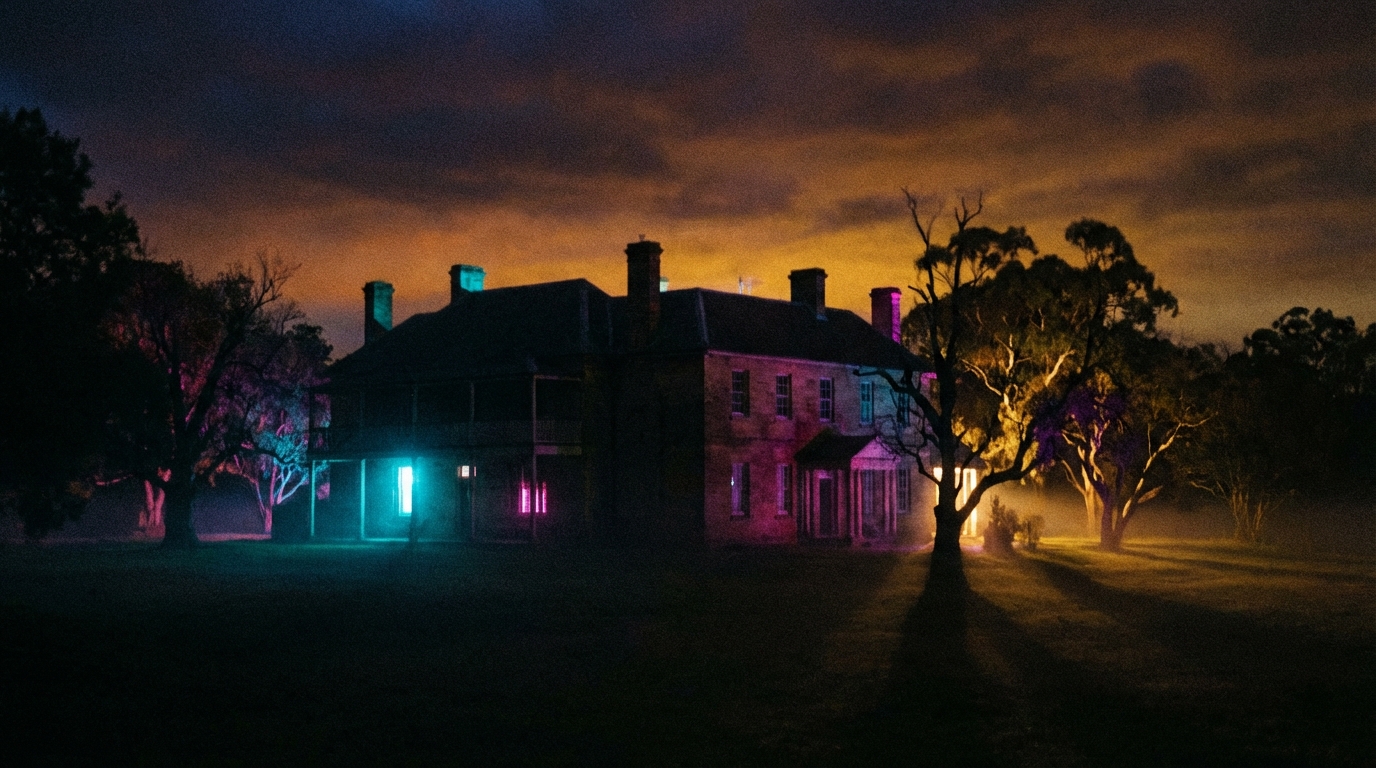
The house itself was built from locally quarried sandstone in the Regency-Georgian style that colonial architects favoured during the 1820s. Its symmetrical façade presented a formal face to the carriage approach, with deep-set sash windows flanking a central doorway whose proportions announced English sensibilities transplanted to antipodean soil. A wrap-around veranda, shaded by grapevines that Linley had trained along hand-wrought iron supports, provided the environmental concession that the Australian climate demanded — offering shade and air circulation that the enclosed Georgian floor plan alone could not achieve. Louvred shutters on every window permitted airflow whilst excluding the harsh afternoon sun, and a kitchen wing was constructed as a separate structure connected by a covered walkway, the fire precaution that colonial builders had learned through hard experience to observe.
Inside, the house was arranged around a high-ceilinged central hall designed for heat dispersal, the passage creating a natural draught that drew cooler air through the lower rooms and expelled warmth through upper ventilation. The principal rooms — a drawing room, a dining room, a study, and a morning room — opened off this central corridor, their proportions generous by colonial standards though modest compared to the English country houses they aspired to emulate. Plaster cornices and ceiling roses, executed by convict tradesmen whose skills had earned them assignment to private households, provided decorative refinement that distinguished Rosebank from the rougher dwellings that characterised much of early Parramatta.
The surrounding grounds were shaped in accordance with the Picturesque ideal then fashionable in Britain, with native trees selectively retained for visual effect rather than cleared wholesale as agricultural practice would have demanded. A gently sloping drive led from the public road to a carriage loop flanked by clipped hedgerows, the formality of the approach deliberately contrasting with the studied informality of the grounds beyond. An imported white rose from Kent, reportedly a gift from the wife of Governor Sir Thomas Brisbane, was planted near the front entrance and survived for decades, its English blossoms a stubborn assertion of metropolitan identity in colonial earth.
The Linley Years
Major Hugh Linley occupied Rosebank for approximately seventeen years, during which the estate functioned as both gentleman's residence and modest pastoral holding. Linley maintained a small herd of dairy cattle on the river flats below the house, supplemented by an orchard of stone fruit and citrus that he established on the northern slope where the soil was deepest and the drainage most favourable. A vegetable garden, managed by convict labour assigned through the government's ticket-of-leave system, provided for the household's domestic needs and occasionally produced surplus for the Parramatta market.
Linley's surveying background informed his approach to the property's development. He mapped the creeklines, the flood-prone areas, and the soil variations across the estate with a precision that exceeded mere agricultural necessity, creating records that subsequent owners would find invaluable. His knowledge of terrain and drainage shaped decisions about where to plant, where to build outbuildings, and where to leave the landscape undisturbed — the last category including the grove of river red gums along the waterfront that would become one of Rosebank's most distinctive features.
By the late 1830s, Linley's advancing age and declining health prompted him to seek a buyer for the property. The estate had matured into an attractive proposition — a well-maintained Georgian residence with established gardens, productive orchards, and river frontage, situated within easy reach of both Parramatta's township and the growing city of Sydney. The sale, when it came, would deliver the property into hands that would transform it from comfortable pastoral retreat into something altogether more consequential.
Blackwood Acquisition and Transformation
In 1839, Rosebank was acquired by Thomas Erasmus Blackwood, an Oxford-educated barrister and commercial strategist who had returned to Sydney five years earlier after completing his education at Balliol College. Thomas, the eldest son of Erasmus Percival Blackwood — founder of Blackwood Enterprises, one of the colony's most prominent mercantile firms — sought in Rosebank both a dignified family residence and a base from which to pursue his expanding legal and commercial interests. The property's proximity to the colonial courts at Parramatta and its relative seclusion from the noise and congestion of central Sydney suited a man whose temperament favoured focused industry over metropolitan distraction.
Thomas was twenty-seven years old at the time of purchase, unmarried, and recently promoted from his apprenticeship at Blackwood Enterprises to a more substantial role overseeing legal affairs and trade negotiations. He recognised in Rosebank the potential for a residence that could serve dual purposes — private retreat and professional salon, a place where domestic comfort and strategic hospitality might coexist. The modifications he commissioned during his first two years of ownership reflected this vision: the study was expanded and fitted with bespoke shelving for his growing legal library, the drawing room received new furnishings imported from London, and the carriage house was upgraded to accommodate the heavier vehicles that regular travel between Parramatta and Sydney demanded.
Emily's Arrival and the Flowering of Rosebank
The transformation of Rosebank from bachelor's residence to centre of colonial intellectual life began with the arrival of Emily Eleanor Harrington Blackwood on 9 March 1841. Emily, whom Thomas had married at Bath Abbey on 12 October 1840, had voyaged from England aboard the merchant vessel Catherine Roy, departing Portsmouth in late November 1840 and arriving at Port Jackson after a passage of more than one hundred days. The woman who crossed Rosebank's threshold that March evening was twenty-two years old, the daughter of Dr Charles Edward Harrington of Bath — a respected physician and lecturer in anatomical sciences — and Lydia Eleanor Harrington, an accomplished landscape painter. Emily brought with her an education that combined scientific rigour with artistic sensitivity, a temperament that would reshape the estate's purpose and character.
Emily approached colonial life with characteristic resolve. Where many Englishwomen of her background might have recoiled from the roughness of New South Wales society, she recognised opportunity where others saw only deficiency. Within weeks of her arrival, she had begun to assess the household's needs and the community's gaps, her physician father's empirical habits manifesting in a systematic approach to understanding the world into which she had been transplanted. The drawing room at Rosebank, previously utilised for little more than after-dinner conversation, became under Emily's direction a space of purpose — the venue for regular salons that drew together the colony's most engaged minds.
These gatherings, held fortnightly throughout the cooler months, brought poets, surgeons, botanists, and social reformers to Rosebank's table. Guests were offered preserved fruits and strong Darjeeling, the hospitality deliberately understated so that conversation rather than display remained the evening's purpose. Among the regular attendees was Robert Atwood of the Australian Herbarium Society, a naturalist whose unpublished letters describe Emily's "sharp eye for flora and female injustice alike." Visiting clergy, colonial administrators, and the occasional newly arrived professional sought invitations to evenings that offered something rare in the colony — sustained intellectual exchange conducted in an atmosphere of genuine inquiry rather than social performance.
It was from these fireside discussions that Emily's most significant public contribution emerged. Conversations regarding the rising number of widowed or abandoned women in the colony, women whose circumstances left them without either means or institutional support, crystallised into action. In 1842, Emily co-founded the Sydney Women's Relief Society, an organisation reportedly conceptualised in the parlour at Rosebank during a series of autumn evenings that year. Her approach — to offer practical aid without religious stipulation — was considered audacious in circles where charitable work remained tightly bound to denominational affiliation. The Society provided direct assistance to women in need, organising accommodation, employment referrals, and basic education without requiring attendance at services or adherence to any particular faith.
Household and Domestic Life
Despite its intellectual and philanthropic ambitions, Rosebank was no stranger to the contradictions that characterised colonial society. The household that Emily managed operated within structures of class, race, and power that her reforming instincts could question but never entirely escape. Records from 1845 list six full-time staff: a coachman, two maids, a cook, a gardener, and a nursemaid. The household's dependence on domestic labour, much of it drawn from populations whose circumstances offered limited alternatives, illustrated the tensions between progressive aspiration and practical complicity that defined the lives of even the most reform-minded colonists.
The nursemaid, Alice Wintle, was a mixed-race girl of just fourteen years, assigned to tend the Blackwood children — Robert Cornelius, born on 10 March 1845, and later his younger siblings Eliza Margaret, born on 5 February 1848, and Henry Jonathan, born on 15 July 1852. Alice's name appears once more in the surviving records — in a letter from Thomas Blackwood to his brother in London, describing her "difficult temperament" and subsequent relocation to a cousin's estate near Camden. Her fate thereafter went unrecorded, her presence in the household leaving only the trace of a name and a characterisation whose implications the Blackwoods apparently saw no need to examine further.
The estate was built on dispossessed land — territory belonging to the Burramattagal people whose connection to the Parramatta River and its surrounding country extended back millennia. Whilst Thomas Blackwood rarely acknowledged this reality, Emily demonstrated at least partial awareness of what colonisation had displaced. She is known to have sketched an elderly Aboriginal woman named Binda, possibly a survivor of earlier frontier violence, whose presence near the estate spoke to the persistence of Indigenous connection to country even after dispossession. Emily's watercolour portrait of Binda hung in Rosebank's drawing room for years, a presence that guests would have encountered alongside the English landscapes and botanical illustrations that decorated the house. Following Emily's death in 1876, the portrait was removed from the drawing room; its subsequent fate remains unknown.
The Blackwood Children and Family Life
The three Blackwood children — Robert, Eliza, and Henry — grew up at Rosebank amidst an atmosphere that combined their father's legal precision with their mother's cultural breadth. Emily took an active role in their upbringing, ensuring that each child received education that reflected both the intellectual standards she had inherited from her own parents and the practical demands of colonial life. Private tutors were engaged for subjects ranging from Latin and mathematics to natural history and drawing, the curriculum deliberately broader than what conventional expectation would have prescribed.
Robert Cornelius, the eldest, showed early aptitude for the law that would define his professional life. He accompanied his father to the Parramatta courts from a young age and developed the analytical temperament that would later serve him as head of Blackwood and Associates, the firm his father would establish in Hobart in 1866. Eliza Margaret inherited her mother's philanthropic sensibilities and artistic interests, becoming active in women's education and charitable work in her own right. Henry Jonathan, the youngest, gravitated toward politics and public administration, pursuing a career in colonial governance that would see him advocate for social equity and infrastructure reform.
The household that shaped these children operated according to rhythms that reflected both the formality of the colonial elite and the particular character Emily had impressed upon Rosebank's domestic life. Mornings began with structured study; afternoons permitted exploration of the estate's grounds and the river frontage that offered both recreation and natural education. Evenings, when the salon calendar permitted, exposed the children to conversations that ranged across politics, science, literature, and the moral questions that Emily regarded as inseparable from intellectual inquiry. The education they received at Rosebank, informal yet rigorous, would prove as formative as any schoolroom instruction.
Thomas's Expanding Ambitions
Throughout the 1840s and 1850s, Thomas Blackwood divided his time between Rosebank and the expanding commercial and legal interests that drew him increasingly toward Sydney and, eventually, toward Hobart. His role at Blackwood Enterprises grew more substantial, the firm's diversification into shipping, warehousing, and mercantile arbitration requiring his legal expertise and strategic oversight. In 1846, he enrolled at the University of Sydney Law School, completing his formal legal qualifications in 1848 and establishing a private practice focused on commercial and maritime law that served clients from shipowners to estate planners.
In 1856, Thomas was promoted to Senior Partner at Blackwood Enterprises, overseeing not only legal affairs but also major infrastructure projects, including the construction of shipping docks in both Sydney and Hobart. His attention increasingly turned southward, drawn by opportunities in Van Diemen's Land — by then renamed Tasmania — where the Blackwood name carried associations dating back to his father's early colonial ventures. In 1866, Thomas founded the independent law firm Blackwood and Associates in Hobart, a practice that quickly became known for its rigour and integrity, specialising in commercial, property, and maritime law.
These expanding professional commitments meant that Thomas spent increasing periods away from Rosebank, his absences placing greater responsibility upon Emily for the management of both the household and the estate's social functions. She bore this burden with the same methodical competence she brought to her philanthropic work, maintaining the salon calendar, overseeing the children's education, and managing the property's domestic affairs with an efficiency that visitors frequently remarked upon. Rosebank, during the decades of Thomas's most active professional expansion, was effectively Emily's domain — shaped by her tastes, animated by her energy, and sustained by her determination that the house should serve purposes greater than mere habitation.
Emily's Final Years and Death
Emily Eleanor Blackwood died on 14 January 1876 in Sydney, at the age of fifty-seven. The decades she had spent at Rosebank represented her most productive years — the period during which she established the Sydney Women's Relief Society, hosted hundreds of salon evenings, raised three children who would each make distinctive contributions to colonial public life, and maintained a personal commitment to watercolour painting that produced landscapes of the Australian bush praised for their emotional depth and technical accomplishment. Her works, often depicting the country surrounding Parramatta and the broader Sydney basin, had been exhibited in local galleries throughout the 1850s and 1860s.
Her death diminished Rosebank in ways that the physical structure could not express. The salons ceased. The intellectual energy that had animated the drawing room dissipated. The portrait of Binda was removed, its absence leaving a space on the wall that no subsequent occupant thought to fill. Thomas, whose professional life had by then centred firmly on Hobart, visited Rosebank with decreasing frequency in the years that followed Emily's passing. The house continued to function as a family property, but the purpose Emily had given it — as a place where ideas mattered more than comfort and inquiry outweighed display — faded with her.
Decline and the Blackwood-Knox Years
Thomas Erasmus Blackwood died on 10 October 1880 in Hobart, Tasmania, at the age of sixty-eight. The passing of Rosebank's second master brought the question of the estate's future into sharp focus. The house passed to his daughter Miriam Blackwood-Knox, a reclusive woman whose temperament differed markedly from both her parents' public-minded engagement. Miriam harboured deep suspicion of industrialisation and the modernising impulses that were transforming colonial society in the final decades of the nineteenth century. She refused to allow gas lines to be laid on the estate, preferring oil lamps and hand-pumped water long after her neighbours had embraced the conveniences that infrastructure development made available.
Miriam's interests ran toward spiritualism rather than philanthropy, her evenings occupied by séances and correspondence with mediums rather than the intellectual salons that her mother had hosted. The drawing room that had once welcomed naturalists and reformers now received clairvoyants and table-rappers, the room's character altered not by physical modification but by the nature of the conversations conducted within it. Visitors to Rosebank during Miriam's tenure reported an atmosphere of quiet intensity, the house maintained to a standard of cleanliness that bordered on obsession whilst the grounds gradually retreated toward wildness as the garden staff was reduced and the Picturesque formality of Linley's original design gave way to untended growth.
Miriam Blackwood-Knox died in 1911, her passing marking the end of continuous Blackwood family occupation at Rosebank. The estate she left behind reflected decades of deliberate withdrawal from the modern world — a house preserved in something approaching its mid-nineteenth-century condition not through conscious heritage practice but through the simple refusal to change anything.
Subdivision, Neglect, and Restoration
The decades following Miriam's death brought the forces of twentieth-century development to Rosebank's gates. The interwar years saw the estate subdivided, the orchard lands that had produced stone fruit and citrus since Major Linley's time sold for suburban housing that advanced steadily toward the main house. The carriage loop was paved over, the hedgerows that had flanked the approach drive were removed to accommodate road widening, and the property's boundaries contracted to encompass little more than the house itself and its immediate surrounds. The broader landscape that had given Rosebank its setting — the river views, the groves of native trees, the creekline where wild roses once bloomed — was progressively absorbed by the residential expansion that Parramatta's growing population demanded.
The main house survived through a combination of neglect and luck. Its sandstone construction proved more durable than the timber dwellings that had flanked it, and the property's ownership passed through a succession of hands whose indifference to the building's heritage value paradoxically preserved it from the renovations and modernisations that might have destroyed its colonial character. Rooms were used for storage, floors accumulated decades of dust, and the garden retreated to a state of nature that would have horrified the Picturesque sensibilities of its original designer.
Recognition of Rosebank's heritage significance came in 1972, when the property was listed as a heritage site following a sustained campaign by the Parramatta Historical Society. The listing provided legal protection against demolition and imposed requirements for any modifications to respect the building's historical character. Restoration efforts commenced in the 1980s, returning parts of the estate to their nineteenth-century configuration through careful research into the original fabric and fittings. The principal rooms were restored to something approaching their appearance during the Blackwood era, with period-appropriate furnishings and reproduction wallpapers recreating the atmosphere that Emily had cultivated.
The servants' wing and coach house, however, remained in poor condition — their restoration deferred by limited funding and the practical challenges of working with structures whose foundations had deteriorated over more than a century and a half. These outbuildings stood as reminders that heritage preservation is necessarily selective, the resources available rarely sufficient to maintain every element of a property whose significance extends beyond its most visible features.
Rosebank in the Present
The house that Major Hugh Linley built from local sandstone in the 1820s served in its later years as a mixed-use site: part historical archive, part artist's retreat. Small exhibitions documented the Blackwood family's contribution to colonial intellectual and philanthropic life, whilst studio spaces in the upper rooms provided working environments for painters and writers whose presence maintained a thread of creative continuity with the salons that Emily had hosted a century and a half earlier.
The past was felt most vividly in the light that fell across the drawing room floor at mid-morning — the same light that had illuminated Emily's watercolours, that had caught the faces of reformers and naturalists debating the colony's future over Darjeeling, that had touched the portrait of Binda before it was quietly removed. The sandstone walls retained their honey warmth, the sash windows still admitted the river breeze, and the grapevines on the veranda — descendants, perhaps, of those Linley had first trained along the ironwork — continued to provide the shade that the Australian climate required of any dwelling that aspired to comfort.
Rosebank endured not because it had been grand but because it had been purposeful. The ambitions that built it, the intellects that animated it, and the contradictions that troubled it were all woven into stone and mortar, timber and glass, in ways that survived the decades of neglect and the pressures of suburban encroachment. The house stood as testimony to what colonial society aspired to become and what it could never quite resolve — a place of cultivation built on dispossession, of reforming energy sustained by domestic service, of intellectual generosity bounded by the assumptions that even its most progressive inhabitants could not entirely transcend.







