Rosalind May Harris (née Winters)
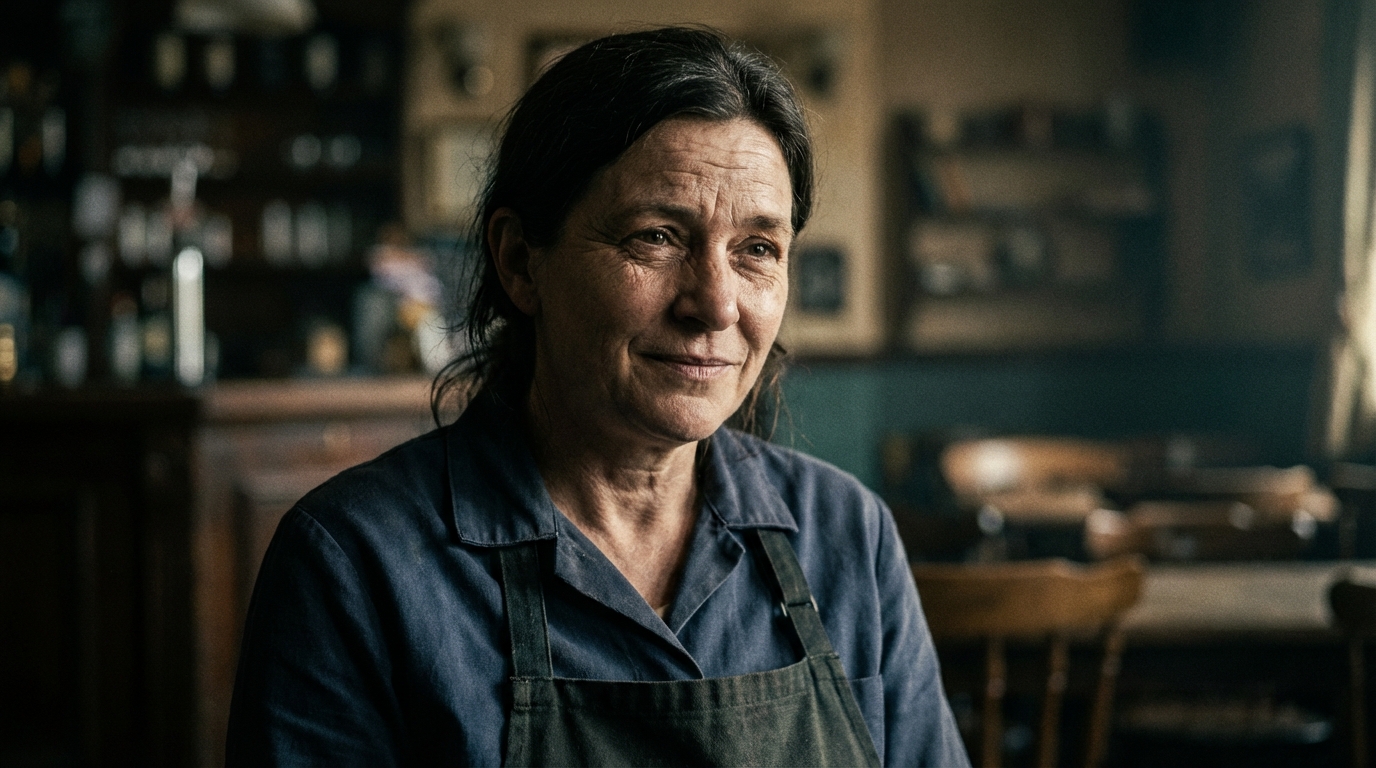
Rosalind May Harris (née Winters) was born on 22 June 1947 in Gawler, South Australia, the daughter of orchardists Harold and Dorothy Winters. Her childhood on her family's apple and pear orchard instilled a practical competence and appreciation for seasonal rhythms that would later define her management of the Kingsford Smith Pub's kitchen. After training in domestic science at Adelaide Technical College and a brief position at Gawler District Hospital, Rosie—as she has been known since childhood—married her schoolyard sweetheart Alfred Harris on 12 April 1969. For over five decades, she has transformed the pub's culinary offerings whilst raising two children within its walls, her shepherd's pie and adapted bread-and-butter pudding becoming as integral to the establishment's identity as the mural of Kingsford Smith's trans-Pacific flight.
Early Life and Family
Rosalind May Winters was born on 22 June 1947 at Gawler and District Hospital, South Australia, the second child and only daughter of Harold Ernest Winters and Dorothy May Winters (née Cartwright). Her brother, Kenneth Harold Winters, had been born three years earlier in 1944. The family operated Winters Orchard, a twelve-acre property on Gawler's southern outskirts that had been established by Harold's father in 1912 and passed down through the generations.
The orchard produced primarily apples and pears, with smaller plantings of apricots and plums that ripened in the summer months. Harold Winters was a methodical man whose life revolved around the horticultural calendar—pruning in winter, pest management in spring, the concentrated labour of harvest in autumn. Dorothy managed the household, maintained the orchard's accounts, and operated a small roadside stall during harvest season where passing motorists could purchase fruit directly from the property.
Rosalind's childhood was shaped by this agricultural rhythm. She learned to identify apple varieties before she could read—Jonathan, Granny Smith, Red Delicious, each with distinct colouring, texture, and optimal uses. She understood the difference between fruit suitable for eating fresh and that destined for cooking or preserving. She absorbed her mother's approach to domestic economy: the careful bottling of surplus fruit, the transformation of bruised or imperfect specimens into jams and chutneys, the principle that nothing edible should ever be wasted.
The Winters household operated on modest means but comfortable sufficiency. Harold's orchard produced reliable if unspectacular income; the family never experienced genuine hardship but equally never enjoyed luxury. Rosalind wore clothes handed down from cousins or sewn by her mother from fabric purchased at Gawler's drapery shops. Holidays meant day trips to the Barossa Valley or occasional weekends at relatives' farms rather than distant travel. This upbringing instilled in Rosalind both practical competence and contentment with simple pleasures—qualities that would serve her well in the decades ahead.
Education and Adolescence
Rosalind attended Gawler Primary School from 1953 to 1959, where she proved a diligent if unremarkable student. Her strengths lay in practical subjects—handwriting, which she developed into elegant cursive that would later grace the Kingsford Smith's menu boards; arithmetic, particularly the mental calculations required for market transactions; and the domestic arts lessons that introduced her to cooking and sewing in structured educational contexts.
Her path crossed Alfred Harris's during these primary school years, though their friendship deepened only later. Alfie was two years her senior, which in childhood represented a significant gulf; they moved in adjacent but separate social circles, aware of each other's existence without particular intimacy. This would change during her secondary education.
Rosalind enrolled at Gawler High School in 1960, the same institution Alfie was then attending. The reduced age gap that came with adolescence—combined with the smaller social pool of a country high school—drew them into closer orbit. By 1962, when Alfie was in his final year and Rosalind in Year 10, they had begun the courtship that would define both their lives.
Their early relationship unfolded in the modest venues available to Gawler teenagers: Saturday afternoon pictures at the cinema on Murray Street, milkshakes at the café near the railway station, and increasingly frequent visits to the Kingsford Smith Pub, where Alfie's grandfather Jack O'Connor observed his grandson's attachment to the Winters girl with evident approval. Jack died in September 1962, before the relationship had fully formalised, but Rosalind remembered him clearly—a weathered man with kind eyes who had pressed a ten-shilling note into her hand on her sixteenth birthday with instructions to "buy something pretty."
Training and Early Career
Rosalind completed her secondary education in 1964, achieving her Intermediate Certificate with solid results in English, mathematics, and domestic science. The question of further education required careful family deliberation. University was not seriously considered—few girls from orcharding families pursued tertiary degrees in that era—but some form of vocational training seemed appropriate for a young woman of evident capability.
Adelaide Technical College offered a two-year diploma in domestic science, combining advanced instruction in cookery, nutrition, household management, and food preservation with practical experience in institutional settings. Harold and Dorothy Winters agreed to fund this education, recognising that the qualification would serve their daughter regardless of whether she pursued paid employment or managed her own household.
Rosalind enrolled in February 1965, commuting to Adelaide by train three days weekly whilst continuing to help at the orchard during busy periods. The course proved demanding but rewarding. She learned techniques beyond her mother's competent but limited repertoire: the principles underlying successful pastry, the science of emulsification that made sauces stable, the proper management of kitchen workflows to feed large numbers efficiently. Her instructors noted her methodical approach and reliable execution, qualities that compensated for any lack of creative flair.
The diploma also required practical placement in an institutional kitchen. Rosalind completed this requirement at the Royal Adelaide Hospital during the winter of 1966, spending three months assisting with meal preparation for wards housing hundreds of patients. The experience was eye-opening—the sheer scale of institutional catering, the logistics of timing dozens of dishes to emerge simultaneously, the challenge of producing palatable food within strict budgetary constraints. She would draw on these lessons for decades.
Upon completing her diploma in late 1966, Rosalind secured a position in the kitchen at Gawler and District Hospital. The role was junior—she assisted the senior cook rather than leading meal preparation—but it provided income, experience, and the convenience of employment close to home. She worked at the hospital throughout 1967 and into 1968, gradually assuming more responsibility as her competence became apparent.
Courtship and Marriage
Throughout these years of training and early employment, Rosalind's relationship with Alfie Harris continued deepening. The courtship was conducted with the measured propriety expected in 1960s rural South Australia: chaperoned outings, Sunday dinners with each other's families, public acknowledgment of their status as a couple without inappropriate physical intimacy. Both families approved the match—the Harrises recognising in Rosalind the practical temperament suited to pub life, the Winterses appreciating Alfie's steady employment and evident devotion to their daughter.
By 1968, the question of marriage had become a matter of timing rather than uncertainty. Alfie, now twenty-three and managing the Kingsford Smith Pub for three years, had established himself sufficiently to support a wife. Rosalind, twenty-one and earning her own income, was ready to transition from the hospital kitchen to the different challenges the pub would present. The proposal came in September 1968, during a picnic beneath the oak tree in the Kingsford Smith's beer garden—a location that seemed inevitable given how central the establishment had become to their shared life.
The wedding took place on 12 April 1969 at St George's Anglican Church, Gawler. Rosalind wore a gown her mother had sewn from white satin purchased in Adelaide, with lace trim salvaged from Dorothy's own wedding dress. Her brother Kenneth served as an usher; Alfie's sister Elizabeth was among the bridesmaids. Approximately 150 guests attended the reception at the Kingsford Smith, where Alfie's uncle Michael returned from Adelaide to help manage the bar whilst the groom celebrated with his bride.
The couple initially resided in a small cottage on Jacob Street, rented from an elderly widow who appreciated having responsible young tenants. The property was modest—two bedrooms, a kitchen that Rosalind immediately recognised as inadequate, a small garden where she planted herbs within weeks of moving in—but it provided the domestic space separate from the pub that she believed essential for a healthy marriage.
The Pub Kitchen
Rosalind's integration into the Kingsford Smith's operations began immediately after the honeymoon—a four-day trip to the Adelaide Hills that represented the longest either had been away from their respective workplaces. She resigned from the hospital kitchen and assumed responsibility for the pub's food service, inheriting a situation that offered both foundation and opportunity.
Evelyn O'Connor, Alfie's grandmother, had established certain traditions during her decades managing the pub's kitchen: lamb roasts on Sundays, meat pies purchased from the local bakery for daily service, and a bread-and-butter pudding whose recipe she had refined over thirty years. Evelyn had died in 1989, but in 1969 she was still living, aged seventy-one, and Rosalind approached her with appropriate deference—seeking guidance on the recipes patrons expected whilst gently introducing improvements where she identified opportunities.
The collaboration between the two women proved productive. Evelyn appreciated having assistance after years of managing alone; Rosalind valued access to institutional memory and established relationships with suppliers. The bread-and-butter pudding recipe transferred formally during a single afternoon session in Evelyn's cottage, with Rosalind taking careful notes that she would consult for years afterward. The essential formula remained unchanged—bread, butter, sultanas, custard, a hint of nutmeg—but Rosalind's training allowed her to refine the custard's consistency, achieving a silkier texture that patrons noticed without being able to articulate.
The menu expanded gradually under Rosalind's management. Her shepherd's pie, introduced in 1971, became a Thursday evening institution—the dish appearing on that specific day because Thursday represented the week's midpoint, when farming families were most likely to visit town for supplies and welcome a substantial meal before the weekend's reduced hours. The recipe was her own creation: lamb mince from the Gawler butcher, vegetables from local suppliers when available, a mashed potato topping that she insisted on preparing fresh rather than from powder.
Other additions followed: chicken schnitzel (introduced 1973), fish and chips (improved from the previous frozen-battered offering in 1975), and a rotating selection of seasonal dishes that reflected whatever fruits and vegetables were abundant. Her orchard upbringing proved invaluable here—she understood growing seasons instinctively, knew which suppliers could be trusted, and maintained relationships with local producers that ensured quality whilst supporting the community.
Motherhood and Domestic Life
The purchase of a larger property on Adelaide Road in 1972 preceded the arrival of children by less than a year. The house—a solid 1920s brick residence with three bedrooms, a substantial kitchen, and a garden large enough for vegetables and fruit trees—represented the couple's first significant investment. The deposit came from three years of combined savings; the mortgage would take fifteen years to discharge.
Emily Rose Harris was born on 3 March 1973 at Gawler and District Hospital, the same institution where Rosalind had once worked. The pregnancy had been uncomplicated, the delivery straightforward, and the transition to motherhood smoother than Rosalind had anticipated—her practical temperament adapted readily to the demands of infant care, approaching nappies and feeding schedules with the same methodical competence she brought to kitchen management.
Balancing motherhood with pub responsibilities required careful organisation. During Emily's infancy, Rosalind reduced her hours at the Kingsford Smith, focusing on preparation work that could be completed during morning hours whilst a hired helper managed evening service. As Emily grew old enough to be safely contained in a playpen, then supervised in the beer garden, Rosalind gradually resumed fuller involvement. The pub's extended family—regular patrons who had known Alfie since childhood, staff members who became honorary aunts and uncles—provided the informal support network that made this balance possible.
Jack Ronald Harris arrived on 17 August 1976, completing the family. Named for Alfie's grandfather, the boy would grow up absorbing pub life just as his sister had, though his eventual path would lead toward education rather than hospitality. Rosalind raised both children with the same practical philosophy that had shaped her own upbringing: clear expectations, consistent boundaries, useful work appropriate to their ages, and the understanding that the family business required everyone's contribution.
Character and Contribution
By the mid-1980s, Rosalind had managed the Kingsford Smith's kitchen for fifteen years, establishing patterns and standards that would persist for decades. Her approach combined the institutional efficiency learned at Adelaide Technical College with the domestic warmth absorbed from her mother's orchard kitchen. Meals emerged on schedule, properly portioned, consistently prepared—yet each plate carried evidence of individual attention rather than assembly-line production.
Her relationship with patrons differed from Alfie's but proved equally important to the pub's atmosphere. Where Alfie engaged through conversation and storytelling, Rosalind connected through food—remembering that Harold Bradbury preferred his steak well-done despite fashionable trends toward rarer preparations, that young Ben Sheppard would eat anything placed before him provided it came with chips, that the Hutchinson widow who visited every Thursday took comfort in the predictability of the same meal served at the same time. These attentions, invisible to casual observation, wove threads of care through the establishment's fabric.
Her physical presence in the kitchen rather than behind the bar meant Rosalind witnessed the pub's social dynamics from a different vantage than her husband. She observed without participating, forming impressions of patrons' circumstances from the meals they ordered—whether finances were tight (counter meals rather than steaks), whether celebrations were occurring (requests for her bread-and-butter pudding with cream), whether troubles weighed heavily (food ordered but barely touched). These observations she shared with Alfie during their evening hours at home, contributing to the comprehensive awareness of community circumstances that made the Harris partnership so effective.
The Evening of 29 October 1987
On the Thursday evening that would prove significant to events far beyond anyone's knowledge, Rosalind occupied her customary position in the Kingsford Smith's kitchen. The dinner service had proceeded normally—shepherd's pie moving steadily as expected for that day, several orders for fish and chips, the occasional steak. She had noticed the stranger's arrival only peripherally, registering an unfamiliar face at the bar before returning attention to the lamb mince browning in her largest pan.
The spilled beer incident reached her awareness as commotion filtered through from the main bar—nothing alarming, merely the minor disruption of accident and recovery. Alfie's competent handling required no intervention from the kitchen. She continued her work, plating meals, supervising the young woman who assisted during busy evening shifts, maintaining the steady rhythm that decades of practice had made automatic.
When closing time approached and the kitchen's demands diminished, Rosalind emerged briefly to help with cleanup, noting that young Cody Jennings remained at the bar with the stranger she had observed earlier. The scene struck her as unremarkable—Cody was a regular patron from a farming family she had known for years, and travellers occasionally passed through Gawler on business that kept them late. She exchanged goodnights with Alfie, confirmed the morning's supply delivery schedule, and retired to their home on Adelaide Road while her husband completed his closing procedures.
Later Years
The Kingsford Smith Pub's kitchen continues operating under Rosalind's influence, though advancing years have necessitated gradual adjustment of her role. She trained several younger staff members in her methods during the 1990s and 2000s, ensuring that standards would persist even as her own capacity for the physical demands of kitchen work diminished. Her daughter Emily, who assumed increasing management responsibility for the pub's overall operations, inherited sufficient culinary knowledge to maintain quality oversight even when not personally preparing meals.
The bread-and-butter pudding recipe—now approaching sixty years of continuous service since Evelyn O'Connor first developed it—remains unchanged in its essentials, the refined custard technique that Rosalind contributed having become simply part of the tradition. Her shepherd's pie continues appearing on Thursday evenings, prepared now by staff she trained but following the method she established in 1971. These continuities represent her legacy: not dramatic innovation but the steady maintenance of quality that transforms meals into institutions.
Her relationship with Alfie has deepened across five decades of partnership, their complementary temperaments proving as compatible in their eighties as in their twenties. She remains the practical counterbalance to his romantic inclinations, the organised foundation that enables his sociable expansiveness, the quiet presence whose contributions are felt rather than announced. Their home on Adelaide Road—mortgage discharged decades ago, garden now tended by a local youth she pays in meals rather than cash—continues as the domestic anchor that has balanced their public lives at the pub.
Of the extraordinary events connected to their establishment—the meeting that transformed Cody Jennings from restless farm boy to inter-dimensional Guardian, the significance of the Kingsford Smith Pub as a threshold between worlds—Rosalind Harris knows nothing and suspects less. Her concerns remain practical: whether supplies will arrive on schedule, whether staff are maintaining standards, whether the bread-and-butter pudding served to this week's patrons matches the quality that Evelyn O'Connor would have approved. In these attentions, consistently applied across decades, lies a different kind of significance—the quiet maintenance of community space that makes possible the extraordinary encounters she will never know occurred.







