4338.208 · July 27, 2018 AD
Roots Along the River
Karen finds Chris at the riverbank where he has spent the afternoon breaking through the hard crust with a stolen tent peg, mapping how far the living soil extends beneath the dust. Together they plant their dwindling supply of coriander seeds and watch the instantaneous germination repeat itself beside the water. What begins as wonder sharpens into method: location data, broader seed varieties, controlled conditions. Their first deliberate experiment in Clivilian soil.
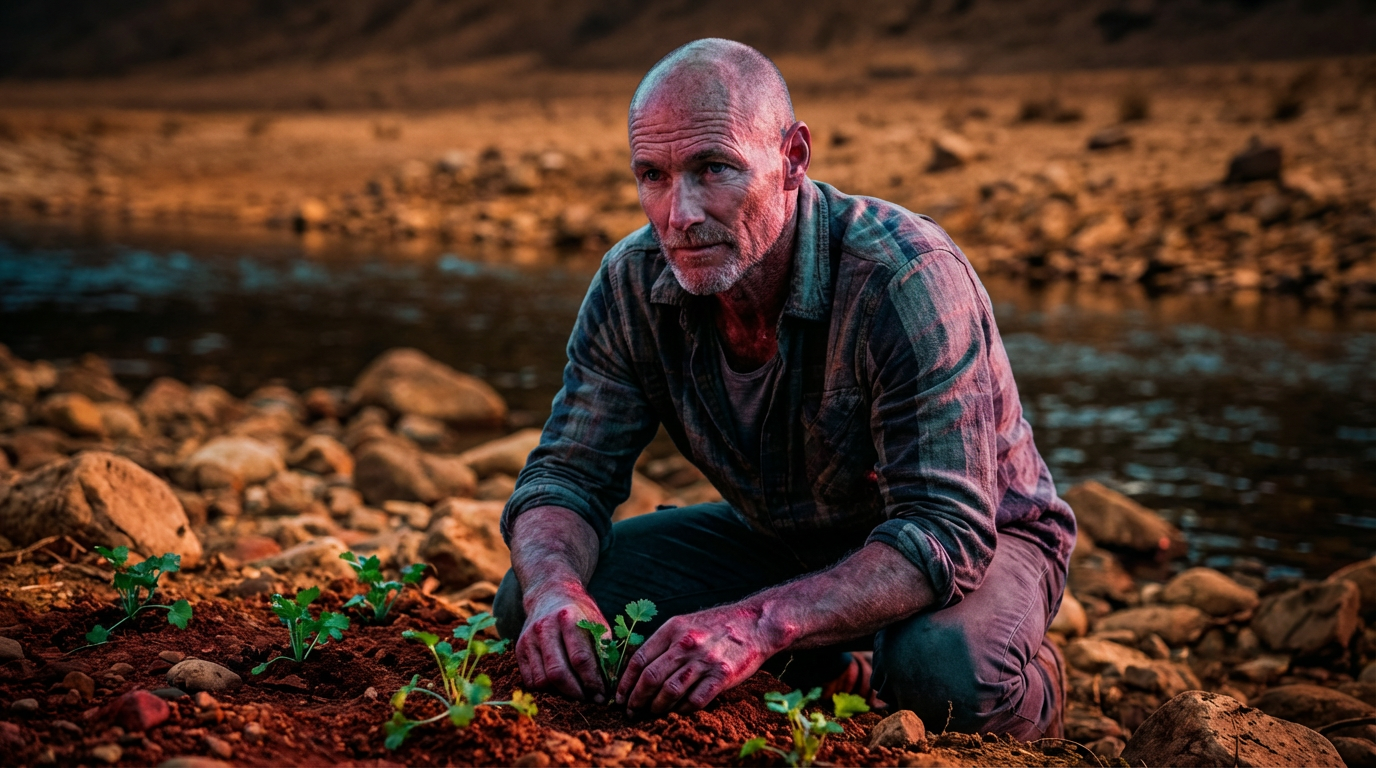
Chris Owen had been at the riverbank for the better part of the afternoon by the time Karen found him. He had taken the tent peg he had appropriated from the construction site and used it to systematically breach the hard crust that lay beneath the loose upper layer of Clivilian dust, punching test holes at intervals along the water's edge to determine whether the living soil they had discovered near the tent was localised or something more extensive. The answer, written in the pattern of dark earth exposed at each breach point, was encouraging. The soil was not an anomaly confined to a single patch. It ran beneath the crust along the riverbank in what appeared to be a continuous seam, hidden under the same featureless dust that blanketed everything in Bixbus and gave the land its appearance of absolute sterility.
His hands bore the evidence of the work. The skin across his palms was raw and reddened, blisters forming where the tent peg's blunt head had pressed repeatedly against flesh not yet hardened to this particular kind of labour. Chris had spent decades working with Tasmanian soil, but the crust of Clivilius demanded a different order of force, a sustained pressure that left its mark even on hands long accustomed to physical work. He had not stopped to rest. The discovery had hooked something in him that overrode the body's complaints, that singular absorption Karen had observed in him for twenty years on field sites and in their Collinsvale garden, the tunnel vision that made him simultaneously admirable and infuriating depending on whether you needed his attention for something else.
Karen arrived from the tent site where she and Glenda had finished raising the new shelter without him. She found Chris crouched at the water's edge, so still and focused he appeared to have become part of the landscape. The river murmured beside him, unhurried and constant, its surface catching the late sun in ripples of molten gold. She announced her presence with characteristic directness and was rewarded by watching him nearly pitch forward into the water from surprise.
Together they planted seeds from Karen's dwindling supply of coriander, pressing them into the freshly exposed soil with the careful deliberation of two scientists who understood they were no longer conducting an accident but an experiment. The germination repeated itself exactly as it had near the tent. Shell cracked, root descended, stem rose, leaves unfurled. The same impossible velocity, the same defiant green against the red-brown earth. The repetition did not diminish the wonder. If anything, the consistency of the result deepened its significance. This was not a fluke of one particular patch of ground. The soil along the riverbank possessed the same extraordinary generative capacity, suggesting that whatever mechanism drove the instantaneous growth was a property of the Clivilian earth itself rather than a localised anomaly.
The implications settled over both of them with the weight of professional recognition. Karen's mind was already reaching toward methodology: they needed to record location data for each planting site, establish controlled conditions, request a broader range of seed varieties from Luke so they could test whether the soil responded to all terrestrial plant life or only certain species. Legumes for nitrogen fixing. Root vegetables for subsistence. Pollinator attractors, if insect life could be brought from Earth and observed for adaptation. The protocols unfurled in her thoughts with the practised architecture of a researcher who had spent her career designing field studies, now applying those instincts to a substrate that should not have existed.
Chris counselled the same measured approach he had maintained since the first discovery. More holes first. More data points. A map of how far the soil extended before they committed their remaining seeds to experiments they could not yet frame properly. They had been in Clivilius for less than a day. The scientific method did not promise answers, only process, and the process demanded patience that the thrill of discovery made difficult to sustain.
Karen noticed something else as they worked. A sensation in her hands when they made contact with the exposed soil, faint and persistent, like the static that precedes a storm. It travelled through her palms and up her wrists, not painful but unmistakably present, as though the ground beneath her fingers carried a current that responded to touch. She mentioned it to no one. It was too inchoate to report, too strange to articulate without sounding unhinged. But the sensation lingered after she withdrew her hands, and the awareness it produced stayed with her as she carried the newly sprouted seedlings back toward the tent to join the others they had planted earlier in the shade of the canvas.
The seed supply was running low. What had been a forgotten pocket of coriander intended for Jane Lathom's windowsill garden was now the foundation of the settlement's first agricultural investigation, and the irony was not lost on either of them. Karen resolved to ask Luke for more seeds when he next appeared, though when that might be remained one of the many questions Clivilius had not yet consented to answer.
Chris remained at the riverbank, tent peg in hand, continuing his survey of the crust. Karen walked back toward the camp carrying seedlings and the beginning of a conviction that was still forming itself in the space between observation and belief. The soil of Clivilius was not dead. It was waiting. It responded to terrestrial seeds with a generosity that defied every model of germination she had ever studied, and the consistency of that response suggested design rather than chance. What kind of design, and whose, and at what cost, were questions that would require more than coriander to answer.
But they had begun. Two environmental scientists, stranded in an alien dimension with a handful of herb seeds and a stolen tent peg, had conducted their first experiment on Clivilian ground and recorded their first results. The soil listened. The seeds answered. And somewhere beneath the dust, something was growing that neither of them could yet measure or name.







