
Robert Thomas Dallow
Robert Thomas Dallow (born 1945) is a dedicated miner and family man from Broken Hill, New South Wales, whose life has been defined by resilience, hard work, and enduring loss. The son of a mining family, he married Evelyn Ashcroft and raised two daughters, Violet and Jasmine. The tragic murder of Violet in 1988 and the sudden death of Evelyn in 2008 profoundly shaped his later years. Now retired, Robert represents the quiet strength of working-class Australia, carrying grief with stoic dignity.
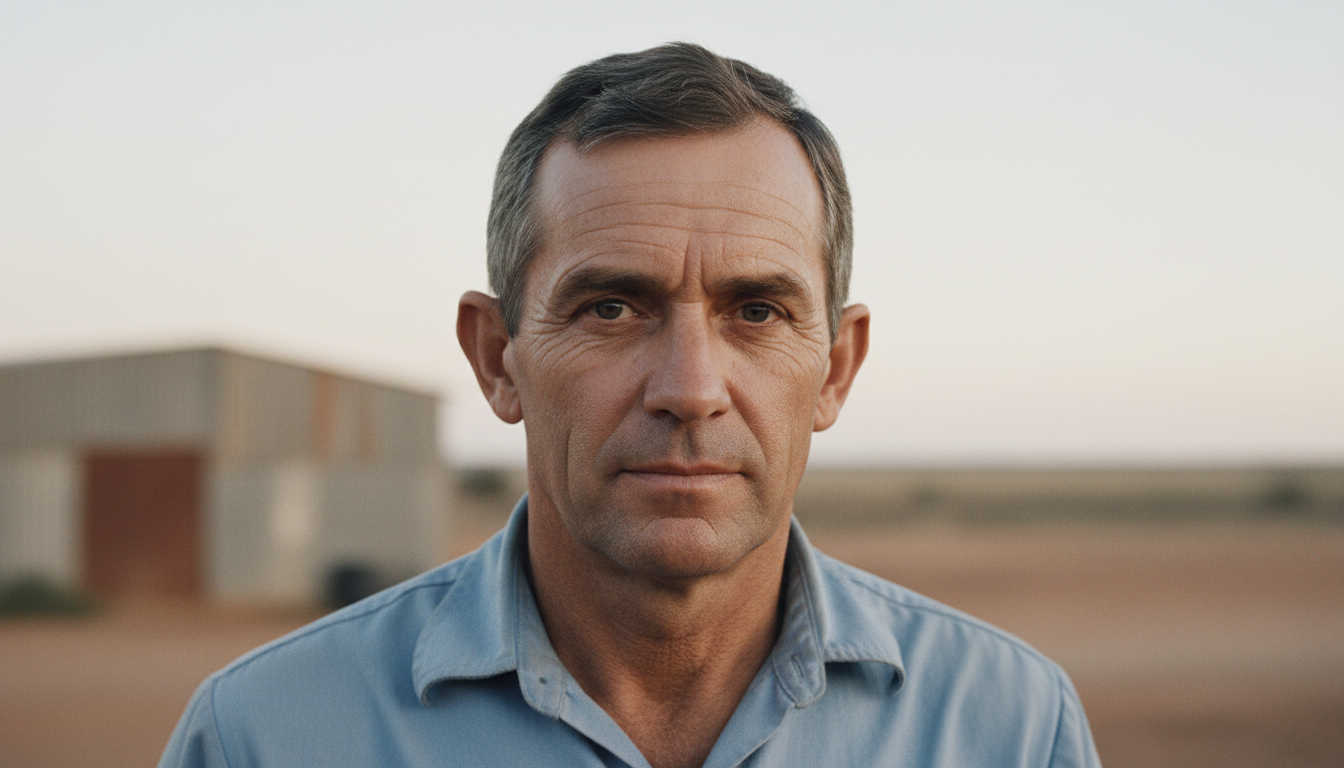
Birth and Early Childhood
Robert Thomas Dallow was born on 7 March 1945 at Broken Hill District Hospital in New South Wales, the third child of George Edward Dallow and Alice Mary Dallow (née Whitmore). His arrival came during the final months of the Second World War, a period when the remote mining town of Broken Hill maintained its essential contribution to the war effort through mineral extraction whilst families waited anxiously for news from distant battlefields.
The Dallow household into which Robert was born was modest even by Broken Hill's working-class standards. His father George, born in 1904, had spent his entire adult life working underground in the silver, lead, and zinc mines that defined the town's economy and character. By the time of Robert's birth, George carried in his body the accumulated toll of twenty years in the mines—scarred lungs from dust exposure, a slight limp from a cave-in that had nearly claimed his life in 1938, and the kind of bone-deep weariness that comes from decades of physically punishing labour.
Alice Mary Whitmore, born in 1911, had come from a family of English immigrants who had sought opportunity in Australia's interior. Her father Harold Whitmore had worked on the railways, whilst her mother Margaret Benson had served as a midwife, attending births across the isolated communities that dotted the region. Alice had inherited her mother's practical competence and her father's quiet determination, qualities that would prove essential in raising five children on a miner's uncertain wages.
The Dallow home was a weatherboard structure on the outskirts of Broken Hill, surrounded by the harsh beauty of the Outback—red earth stretching to distant horizons, eucalyptus trees twisted by wind and drought, and the ever-present mullock heaps that marked the landscape of mining country. It was a place of extremes: scorching summers where the corrugated iron roof turned the house into an oven, bitter winter nights when desert cold crept through every gap in the walls, and dust storms that painted everything the colour of rust.
Family Dynamics and Sibling Relationships
Robert grew up as the middle child in a family of five siblings, though he would ultimately know only four of them. His eldest sister Margaret, called Maggie by the family, had died in 1933 at the age of four from pneumonia—a common childhood killer in the dust-heavy mining environment. Though Robert never met her, Maggie's death cast a long shadow over the family, visible in his mother's overprotectiveness and his father's occasional retreats into melancholy silence.
Edward Dallow, called Eddie, was born in 1931 and served as Robert's earliest male role model beyond their father. Fourteen years older than Robert, Eddie embodied the mining tradition that ran through the Dallow men like a seam of ore through rock. Eddie followed their father into the mines and became an active union organiser, fighting for better safety conditions and fair wages. His passionate advocacy for workers' rights made him both admired and, in some quarters, distrusted. The brothers' relationship was marked by Eddie's protective mentorship and Robert's admiration for his older brother's courage.
Helen Margaret Dallow, born in 1948, was three years younger than Robert. Unlike the mining-focused men in the family, Helen inherited their mother's skill with needle and thread, becoming a talented seamstress. She would later marry a railway engineer and move to Adelaide, maintaining contact with the family through letters and occasional visits until her death from cancer in 2005. Helen and Robert shared a particular closeness, their similar ages allowing for the kind of sibling friendship that transcends mere blood relation.
The youngest Dallow child, John, called Jack by everyone who knew him, arrived in 1952. Seven years separated the brothers, placing Robert in the position of protector and mentor to the youngest family member. Jack's childhood coincided with Robert's teenage years and early adulthood, creating a relationship that blended brotherly affection with almost parental responsibility. The loss of Jack would later become one of the defining tragedies of Robert's young adulthood.
Growing Up in Mining Country
Robert's childhood unfolded against the backdrop of Broken Hill's unique culture—a working-class community forged by the demands and dangers of mining. The town operated according to the rhythms of shift work, union meetings, and the ever-present awareness that every day men descended into the earth might be the day they did not return.
From his earliest memories, Robert understood that mining was not simply his father's job but the family's entire reality. George's shifts dictated the household schedule: early morning departures before dawn, returns home exhausted and covered in the fine dust that no amount of washing could entirely remove, and days off spent recovering rather than resting. The family's financial security rose and fell with the mines' fortunes, with strikes, accidents, and market fluctuations directly impacting whether there would be meat on the table or whether Alice would need to stretch the week's groceries further than seemed possible.
Despite the hardships, the Dallow home maintained warmth and stability. Alice proved herself a skilled manager of scarcity, making nutritious meals from limited ingredients, mending clothes until they could be mended no more, and creating small moments of celebration even when money was tight. George, though often exhausted, remained emotionally present with his children, sharing stories of the mines' history, explaining the geology that made Broken Hill one of the world's richest mineral deposits, and instilling in his sons the values of honest labour and solidarity with fellow workers.
Young Robert spent his free time much as other Broken Hill children did—exploring the vast Outback that surrounded the town, fossicking in the mullock heaps for interesting rocks, swimming in the rare waterways during summer, and creating games from imagination and whatever materials came to hand. He developed an intimate knowledge of the landscape, learning to read the subtle signs of weather changes, understanding which plants could provide shade or water in the desert environment, and acquiring the kind of environmental literacy that came from living in a place where nature's power demanded respect.
The community beyond the Dallow household provided an extended network of support and shared experience. Neighbours looked after each other's children, miners' wives supported one another through the anxious hours when their husbands worked underground, and the town's social life revolved around the union hall, the churches, and the pubs where men gathered to decompress from the physical and psychological demands of mining work.
Education and the Path to Mining
Robert began his formal education at St. Matthew's Primary School in 1951, joining classes with other children from Broken Hill's working families. He proved to be a competent student—not brilliant in the academic sense, but solid, reliable, and particularly interested in practical subjects. His best marks came in arithmetic, which he could visualise in concrete terms, and in the natural sciences, where lessons connected to the physical world he knew from exploring the Outback.
Reading was a struggle initially, the abstract nature of letters and words feeling disconnected from his experience of the world. But Alice, drawing on her mother's patient teaching methods, worked with Robert each evening, helping him decode the mysterious symbols until they yielded their meanings. By the third year of primary school, he had developed functional literacy, though he would never be a passionate reader in the way some of his classmates were.
The subjects that truly captured Robert's interest were those involving the land itself. When teachers discussed geology, mining history, or the way human communities adapted to challenging environments, Robert's attention sharpened. He asked questions that revealed genuine curiosity rather than mere compliance with classroom expectations. Teachers noted his particular aptitude for understanding three-dimensional spatial relationships—a skill that would prove invaluable in his future career underground.
In 1957, at the age of twelve, Robert transitioned to Broken Hill High School. The secondary school years coincided with increasing maturity and a growing awareness of his probable future. Whilst some of his classmates harboured ambitions of leaving Broken Hill for university or careers in distant cities, Robert recognised that his path would likely follow the pattern established by his father and brother. The mines would be his workplace, mining would be his trade, and Broken Hill would be his home.
This recognition did not come with resentment or resignation but rather with a kind of practical acceptance. Robert understood the value of mining work—it was honest labour that produced tangible results, it paid better than many alternatives available to young men without university education, and it offered the possibility of advancement through skill and experience rather than formal qualifications. Moreover, it connected him to his family's history and the community's shared identity.
His secondary education reflected this practical orientation. Robert excelled in manual arts, geography, and earth sciences—subjects that provided useful knowledge for mining work. He participated in the school's environmental club, learning about land management and the impact of industrial activity on fragile desert ecosystems. He also took part in community service projects, helping to maintain the town's infrastructure and learning the satisfaction of contributing to collective welfare.
Apprenticeship and Entry into Mining
In 1963, at the age of eighteen, Robert completed his secondary education and entered an apprenticeship with the Broken Hill Proprietary Company, commonly known as BHP. The company dominated the region's mining industry, operating multiple shafts and employing thousands of workers. For young men like Robert, a BHP apprenticeship represented the gold standard of mining education—combining hands-on experience with formal technical training and offering the prospect of stable, well-paid employment upon completion.
The apprenticeship was physically demanding and occasionally dangerous. Robert learned the fundamentals of underground work under the mentorship of experienced miners who had spent decades in the industry. These men taught him not from textbooks but from accumulated wisdom earned through near-misses, accidents witnessed, and the intimate knowledge of how rock behaves under different conditions. They showed him how to recognise the subtle signs of unstable ground, how to operate and maintain the complex machinery that had revolutionised mining in recent decades, and how to work efficiently whilst maintaining the constant vigilance that safety demanded.
The work itself was gruelling. Days began before dawn with the descent into the earth—a journey that took miners hundreds of metres below the surface into a world of darkness broken only by the lamps they carried. The temperature underground remained constant regardless of the season above, the air heavy with dust and the smell of diesel from machinery. The noise was relentless—drills shattering rock, machinery grinding, the occasional explosive report of controlled blasting, and the constant rumble of ore being transported to the surface.
Physical danger was an omnipresent reality. Rock falls, equipment failures, explosive malfunctions, and simple human error could result in injury or death within seconds. Robert witnessed his first serious mining accident during his apprenticeship—a support beam failure that crushed a veteran miner's leg. The man survived but never worked underground again, his mining career ended by a moment's bad luck. The incident impressed upon Robert the essential importance of safety protocols and the need for constant vigilance.
Alongside the practical training underground, Robert attended technical courses at Broken Hill Technical College. The classroom instruction provided theoretical knowledge to complement his hands-on experience: mine engineering principles, mineral extraction techniques, safety regulations, equipment maintenance, and the geology of the Broken Hill deposits. Robert approached this formal education with the same steady competence he brought to practical work, understanding that knowledge and skill must work together for success in mining.
By 1968, at the age of twenty-three, Robert completed his apprenticeship and secured a position as a junior miner with BHP. He had acquired the skills, knowledge, and temperament necessary for mining work, and he carried forward the values instilled by his father and brother—honest labour, solidarity with fellow workers, and a commitment to safety that valued life above production quotas.
Personal Tragedies and Their Impact
The year 1969 brought devastating loss when Robert's youngest brother Jack was killed in action in Vietnam. The news arrived by telegram, that most dreaded form of communication that had signalled grief for Australian families since the First World War. Jack had enlisted in the Australian Army at seventeen, motivated by a complex mix of youthful idealism, desire for adventure, and perhaps an unconscious need to escape the predetermined path of mining that seemed to await Dallow men.
Jack's death devastated the family, but particularly their mother Alice. Having already lost her eldest daughter Maggie three decades earlier, the loss of her youngest child proved almost unbearable. She retreated into a grief so profound that it visibly aged her, the light behind her eyes dimming as though a part of her spirit had accompanied Jack into whatever lies beyond death. George, stoic by nature and temperament, absorbed his grief silently, but those who knew him well could see how it weighed upon him, adding to the physical burdens already carried from years of underground work.
For Robert, Jack's death represented not only the loss of a beloved brother but also a kind of survivor's guilt. He had remained in Broken Hill, following the safe and predictable path of mining, whilst his younger brother had sought something different and paid the ultimate price. The tragedy reinforced Robert's commitment to family and his determination to provide whatever stability he could in a world that had proven itself capable of sudden, devastating loss.
Nine years later, in 1978, another tragedy struck when Eddie was killed in a mining accident. A support beam collapse during a routine shift claimed his life instantly, the kind of sudden disaster that mining families perpetually feared. Eddie's death was particularly bitter because it occurred doing the work he had spent years trying to make safer through his union advocacy. He had fought for better conditions, more rigorous safety protocols, and equipment improvements, yet ultimately fell victim to the very dangers he had dedicated himself to preventing.
Eddie's death transformed Robert's understanding of mining work. Whilst he had always known the dangers intellectually, experiencing the loss of his brother made them viscerally real. It also strengthened his commitment to safety advocacy, following Eddie's example by becoming active in workplace safety committees and never compromising on protocols regardless of production pressures. In honouring Eddie's memory, Robert ensured that his brother's advocacy work continued through his own actions.
Marriage and Building a Family
In 1970, amidst the shadows of family loss, Robert found light in his marriage to Evelyn Margaret Ashcroft. The couple had known each other casually for years—Broken Hill was small enough that most young people moved in overlapping social circles—but their romantic relationship developed gradually, built on friendship before evolving into something deeper.
Evelyn, born in 1950, came from a railway family and had established herself as a skilled seamstress. She possessed qualities that complemented Robert's character: warmth where he tended toward reserve, expressiveness where he preferred quiet, creativity where he valued practicality. Yet they shared fundamental values—commitment to family, belief in hard work, and dedication to their community. Their relationship offered Robert emotional refuge from the losses that had marked his twenties, whilst Evelyn found in Robert a steadiness and reliability that promised a secure foundation for the future.
The wedding was a modest affair, celebrated with family and close friends at St. Matthew's Church. Robert wore a suit borrowed from his father, whilst Evelyn's dress, naturally, was her own creation—a simple but elegant design that reflected her skill and taste. The reception, held at the local union hall, featured food prepared by family members and music provided by local musicians. It was the kind of celebration that working-class communities specialised in: limited in financial resources but rich in shared joy and communal participation.
The couple established their home in a small weatherboard house on the outskirts of Broken Hill—modest but theirs, a place where they could build the family life they both desired. Robert's mining income provided basic security, whilst Evelyn supplemented their finances with her seamstress work, taking commissions from local families for dressmaking, alterations, and repairs. The house gradually became a home through their combined efforts: Robert handling repairs and maintenance, Evelyn creating comfortable spaces filled with her handmade curtains, cushions, and decorative touches.
On 12 May 1972, their first daughter Violet was born, transforming the couple into a family of three. Robert approached fatherhood with the same steady commitment he brought to all his responsibilities, determined to provide for his daughter whilst also being emotionally present in ways that his father's exhaustion had sometimes prevented. He delighted in Violet's fierce personality from infancy, recognising in her spirit something untamed and precious that deserved nurturing rather than breaking.
Two years later, on 27 August 1974, Jasmine arrived, completing the family. The two girls would prove to have markedly different temperaments—Violet wild and adventurous, Jasmine more cautious and studious—but Robert loved them equally and absolutely. His daughters became the centre of his emotional life, the reason for his daily descent into the earth, and the source of his hopes for a future better than the past had sometimes been.
Career Advancement and Professional Identity
Throughout the 1970s and 1980s, Robert steadily advanced within BHP's mining operations. His combination of technical skill, reliability, and commitment to safety made him a natural candidate for supervisory positions. By the late 1970s, he had been promoted to oversee a small crew, responsible not only for his own work but for the performance and safety of the men under his supervision.
Robert's leadership style reflected his character: quiet, competent, and focused on practical results rather than dramatic gestures. He led by example, never asking his crew to undertake risks he would not take himself, and maintaining the same rigorous safety standards regardless of production pressures. His men respected him because he respected them, treating them as skilled professionals rather than mere labour, and standing up to management when safety concerns arose.
He became actively involved in safety committees, advocating for equipment upgrades, protocol improvements, and better training programmes. This work felt like a continuation of Eddie's legacy, transforming personal tragedy into practical action that might prevent other families from experiencing similar losses. Robert understood that every safety improvement, every prevented accident, every worker who returned home safely to his family, represented a small victory against the dangers inherent in mining work.
By the mid-1980s, Robert had reached the position of senior supervisor, overseeing multiple crews and playing a significant role in operational planning. His responsibilities extended beyond daily work to include strategic decisions about resource allocation, equipment deployment, and workforce management. The position brought increased pay, which helped support his growing daughters' needs, but also increased stress as he balanced the demands of production targets with his unwavering commitment to worker safety.
Despite the professional advancement, Robert remained fundamentally a working miner rather than management. He continued to spend time underground, maintaining his practical skills and his connection to the men whose work he supervised. He attended union meetings, supported workers' rights initiatives, and maintained the solidarity with fellow miners that had been part of his identity since his apprenticeship. For Robert, mining was not merely a job but a culture, a community, and a way of life that deserved respect and protection.
The Loss of Violet
On 30 September 1988, Robert's world shattered when Violet disappeared during a Girl Guides camping trip to Silverton. The initial phone call brought disbelief followed quickly by the cold dread that comes from understanding that something terrible has occurred. Robert immediately left his shift at the mine, driving through the night to Silverton where search operations were already underway.
The days and weeks that followed blurred together into an endless nightmare of searching, waiting, hoping, and gradually losing hope. Robert joined search parties, combing the unforgiving Outback terrain for any sign of his daughter. He slept little, ate sporadically, and seemed to age years within weeks. The not-knowing was perhaps worse than any certain outcome could have been—hope and despair warring within him as each day passed without discovery.
When Violet's body was finally found in late October, strangled and abandoned in a remote location, the confirmation of her murder brought a kind of terrible closure whilst simultaneously opening a wound that would never fully heal. Robert had lost his beloved daughter, his wild and brilliant Violet, to violence so senseless that his mind struggled to comprehend it. The practical man who had spent his life solving concrete problems found himself confronting a situation that defied solution, a loss that could not be fixed, and a grief that no amount of work or will could diminish.
The investigation into Violet's murder, eventually linked to the notorious Silverton Strangler, failed to bring resolution. No arrests were made, no one held accountable, no justice served. For Robert, this failure compounded the tragedy. Not only had he lost his daughter, but the person responsible remained free, perhaps to harm other families as he had harmed the Dallows. The injustice of it gnawed at him, adding anger to the grief that had taken up permanent residence in his heart.
The murder transformed Robert in visible ways. The quiet man became quieter still, his natural reserve deepening into something approaching isolation. The spark that had animated him—evident in his love for his family, his commitment to his work, his engagement with the community—dimmed to a barely visible ember. He continued to function, to work, to fulfil his responsibilities, but a part of him had died with Violet in the Outback, buried in the red earth alongside his daughter's body.
Aftermath and Continued Life
In the wake of Violet's death, Robert and Evelyn made the difficult decision to send fourteen-year-old Jasmine to boarding school in Adelaide. The choice was motivated by love and protective instinct—a desire to give their surviving daughter a chance at a life not entirely overshadowed by tragedy, to remove her from the constant reminders and media attention that made Broken Hill unbearable. Yet the practical necessity of the decision did not diminish its emotional cost. The family that had been four was now effectively reduced to two, with Jasmine's absence adding another layer of loss to the grief that already consumed them.
Robert threw himself into work with renewed intensity, using the physical demands and mental focus required by mining to create distance from the pain that threatened to overwhelm him. He took extra shifts, volunteered for the most demanding assignments, and drove himself to the point of exhaustion. Work became refuge, the underground darkness a place where the demons that haunted him above ground could be temporarily escaped. His colleagues understood, offering silent support through their presence and accepting his need for the kind of distraction that hard labour provided.
Yet despite the all-consuming nature of his grief, Robert maintained his commitment to safety and his responsibilities as a supervisor. He never allowed his personal anguish to compromise the welfare of the men under his supervision, maintaining the same rigorous standards and protective vigilance that had defined his leadership. In this consistency, there was a kind of nobility—a refusal to let tragedy destroy the values and principles that had guided his professional life.
The 1990s and early 2000s brought continued professional advancement. Robert was promoted to head of operations at one of BHP's major mining sites, overseeing strategic planning, resource management, and operational efficiency across multiple shafts. The position represented the pinnacle of his career, recognition of decades of competent service and leadership. Yet the achievement felt hollow without Violet there to share in his success, without the daughter who would have been proud of her father's accomplishments.
Second Tragedy and Widowhood
On 14 April 2008, Robert suffered another devastating loss when Evelyn died suddenly from a heart attack. The morning had begun ordinarily enough—Robert preparing for his shift, Evelyn in her sewing room working on a commission. Then came Evelyn's cry, the sound of her body hitting the floor, and Robert's desperate attempt to revive her whilst simultaneously calling for emergency services.
Despite his efforts and those of the paramedics who arrived within minutes, Evelyn could not be saved. She was pronounced dead at the hospital, leaving Robert alone in a way he had never imagined possible. The woman who had been his partner for nearly four decades, who had shared his grief over Violet whilst maintaining hope for the future, who had filled their home with warmth and creativity—she was gone, and Robert was left to navigate a world that suddenly felt incomprehensibly empty.
The loss of Evelyn, coming two decades after Violet's murder, brought Robert's accumulated grief to a crushing weight. He had survived the first tragedy by clinging to Evelyn's presence, finding in their shared sorrow a kind of connection that sustained them both. Now that anchor was gone, and Robert found himself adrift in a life that seemed to have taken everything that mattered whilst leaving him, inexplicably, still breathing.
Jasmine, now a successful entrepreneur with her own life in Adelaide, returned to Broken Hill for her mother's funeral and remained for several weeks, concerned about her father's ability to cope with such profound loss. She found him functioning mechanically—attending to necessary tasks, maintaining the house, eating enough to survive—but emotionally absent, as though the vital spark that animated him had finally been extinguished.
Retirement and Reflection
Robert retired from mining in 2010, at the age of sixty-five. The decision was partly practical—his body bore the accumulated damage of nearly five decades of underground work—but also emotional. Without Evelyn, the house he returned to after each shift felt less like a home and more like a museum of loss. The rhythms of mining work that had structured his adult life no longer provided the purpose they once had.
Retirement brought both relief and disorientation. The physical toll of mining—the aching joints, the persistent cough from decades of dust exposure, the injuries that had accumulated over the years—became more manageable without the daily demands of underground work. But the mental space created by retirement allowed grief and memory to rush in with overwhelming force. Without work to provide distraction, Robert found himself confronting the full weight of his losses in ways that active employment had previously prevented.
He maintained the Dallow Residence with the same quiet competence he had brought to every task throughout his life. The house stood as a monument to the family that once filled it with life: Violet's room preserved much as she had left it, Evelyn's sewing room containing her machines and fabrics, photographs marking the progression of years and the faces of those now gone. Robert moved through these spaces like a curator in a museum of his own life, maintaining order whilst being slowly consumed by memory.
His relationship with Jasmine remained strong, though complicated by distance and by the shadow of their shared losses. She visited when her business commitments allowed, bringing news of her success and photographs of the Collins Boutique Hotels that bore testament to the ambition and determination she had inherited from both parents. Robert took pride in Jasmine's accomplishments, particularly in the Violet Fund she had established to honour her sister's memory. Yet their time together was always bittersweet, marked by the awareness of who was absent, the conversations that would never occur, and the future that had been stolen from them all.
In his retirement, Robert had become something of a local fixture in Broken Hill—a quiet man who walked the town's streets, sat in its parks, and occasionally stopped at the cemetery where both Evelyn and Violet were buried. He spoke little, but those who knew his story accorded him a respectful distance, understanding that his silence carried the weight of losses that words could not adequately express. He had become, in a sense, a living monument to the resilience and endurance that characterised working-class Australia—a man who had survived what seemed unsurvivable whilst maintaining his dignity and his commitments even as his heart broke again and again.







