Robert Samuel Aldridge
Robert Samuel Aldridge (1776–1852) was a Kentish master builder and one of Brierly's five founding Guardians. The son of a carpenter and a weaver, he was recruited by Jonathan Blackwood after a London engineering conference and crossed to Clivilius in 1810 to raise the settlement's first shelters from barren ground. Over four decades he gave Brierly its physical fabric — its homes, its town hall, its vineyard trellises — and was known too for his fine furniture and his guitar. He was the third Guardian to die.
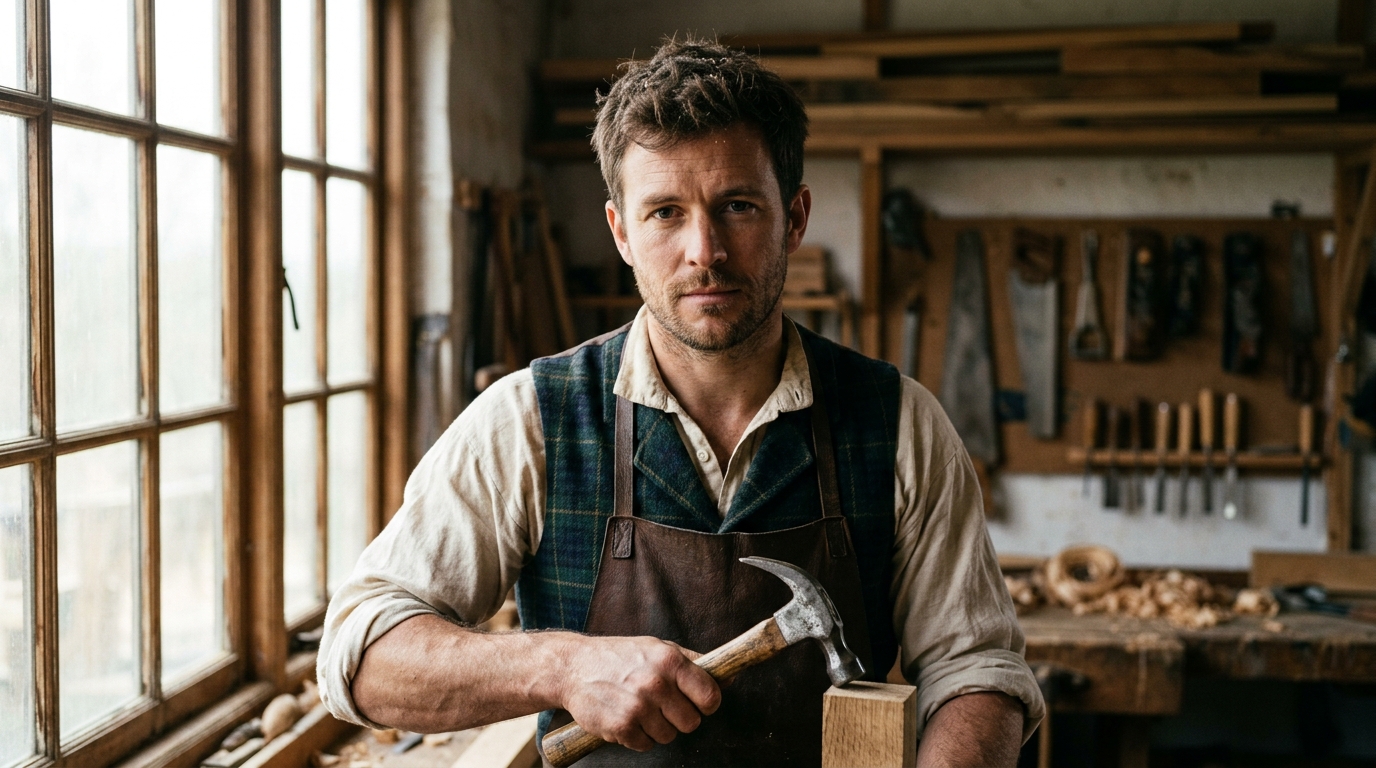
A Kentish Workshop
Robert Samuel Aldridge was born on 20 June 1776, in the small Wealden town of Tenterden in Kent, where the timber-framed houses and the broad main street spoke of generations of careful building. He was the eldest son of Samuel Aldridge, a master carpenter of local renown, and Lydia Aldridge, a weaver whose skill at the loom was as quietly admired as her husband's at the bench. Between the two trades, the household ran on craftsmanship, and from his earliest years Robert breathed the smell of cut wood and the rhythm of the shuttle.
He took naturally to his father's side of it. Where his younger brother and sister, Thomas and Mary, found their own paths, Robert was drawn to the workshop, to the logic of joint and load and grain. His formal schooling went no further than the local parish school, but his real education came from the bench beside his father, and it was a thorough one.
By the age of twelve he could already handle the full range of tools with confidence and had begun to grasp the principles beneath the practice — why a frame stood or failed, how weight found its way to the ground. In whatever hours he could spare he filled paper with detailed sketches and built small models of his own devising, working out in miniature the structures he could not yet build at scale. The aptitude was unmistakable, and his father, recognising it, gave it room to grow.
Margaret and the Growing Household
In 1798, at the age of twenty-two, Robert married Margaret Turner, the daughter of a Tenterden baker. She brought to the match a practicality and a head for organisation that balanced his more meticulous, absorbed temperament; where he could lose himself for hours in a single joint, she kept the wider household and its accounts in order. It proved a durable pairing, founded as much on the complement of their natures as on affection.
Children followed in steady succession. Samuel was born in 1799, Lydia in 1801, Thomas in 1803, and Elizabeth in 1805, and the Aldridge home filled with the noise of a young family set against the familiar percussion of Robert's hammer. He was a present and industrious father, and the household he and Margaret kept was a busy, secure one, rooted in the same Kentish soil that had held the Aldridges for generations.
Through these years Robert's reputation grew well beyond Tenterden. He became known not merely as a competent carpenter but as an inventive builder, a man with an eye for structures that were at once sound and pleasing to look at, and his name began to carry weight in wider circles than a country town usually reached.
Family Tree
The London Conference
That growing reputation bore unexpected fruit in 1808, when Robert was invited to present his work at an engineering conference in London. For a self-taught builder from the Weald, it was a considerable honour, a sign that his ingenuity had been noticed by people accustomed to judging the best. He went, and he made his mark.
It was there that he met Jonathan Blackwood. Blackwood moved easily through intellectual and scientific circles, an influential and somewhat opaque figure whose real purposes were not always apparent to those he charmed, and he was drawn at once to Robert's combination of vision and grounded skill. The two fell into conversation, and what began as professional admiration deepened, over the course of their acquaintance, into something far stranger — an invitation Robert could never have anticipated.
What Blackwood was offering, he revealed by degrees: a place among the founders of a settlement in Clivilius, an untouched land that held every promise and as yet held no life at all. He wanted a builder, and not merely a competent one. He wanted someone who could raise a community's whole physical fabric from nothing.
The Decision and the Key
The proposal asked Robert to weigh his settled, prosperous life against something without precedent. He discussed it long and seriously with Margaret, for it was not a choice any man could make alone — it meant carrying a Portal Key bound to his own blood into an unknown world, and in all likelihood never returning to the country of his birth.
Yet the very magnitude of it spoke to him. The chance to build a world from its foundations, to set down the first true structures of a place that had none, answered both his adventurous streak and the deepest ambition of his craft. No builder is ever offered a wholly blank canvas; Robert was being offered exactly that. After much deliberation, he accepted.
The decision set him among the five who would become the Guardians of Brierly — Thomas Ainsworth, who would lead them and map the land; Elizabeth Carrington, who would coax it green; George Whitmore, who would plant its vines; Mary Fairchild, who would keep its people alive; and Robert, whose hands would give the settlement its shape, its shelter, and its walls.
Building from Nothing
Robert crossed into Clivilius with the founding party on 10 May 1810, arriving with the main body of settlers and his fellow Guardians at the barren ground that would become Brierly. The landscape that met them was severe and unbroken, offering none of the seasoned timber and dressed stone a Kentish builder took for granted, and the challenge of it would have daunted most men of his trade. Robert's resolve held.
His first task was the most urgent one: shelter. The settlers needed roofs that would hold against the unfamiliar weather of a new world, and he set himself to designing and raising them at once, learning the local materials as he went and bending his Earth-taught techniques to what Clivilius actually provided. The first buildings of Brierly rose under his direction, plain but sound, made to endure.
In those earliest months the Guardians laboured side by side to lay down the settlement's basic infrastructure, and much of its tangible form — the dwellings, the stores, the works that turned a patch of empty ground into a place where people could live — came from Robert's hand and eye. He was, in the most literal sense, the maker of the settlement's body.
The Family Crosses
Only once Brierly had reached something like stability did Robert send for his family. In 1812 Margaret and their four children made the crossing to join him, and their arrival marked a new chapter both for the household and for the work, restoring to Robert the domestic anchor he had left behind in Kent.
Margaret's steadying competence and the children's ready adaptability proved real assets to the growing settlement. As they came of age, the children found their places within it: Samuel inherited his father's feel for engineering and building; Lydia took after her grandmother, working the loom with the family's old weaving skill; and Thomas and Elizabeth, younger, lent their hands wherever they were needed, often at their father's projects.
The Aldridges became, in this way, a family woven into the fabric of Brierly itself — not merely residents of the settlement but contributors to its making, their various trades feeding the common effort that kept a small and isolated community whole.
The Shape of the Settlement
Across the decades that followed, Robert gave Brierly its enduring form. The most prominent monument to his work was the town hall, begun in the winter of 1816 under his direction and in close partnership with Thomas Ainsworth, who as the settlement's leader saw the need for a civic heart. The hall became exactly that — the place where Brierly gathered to meet, to decide, and to celebrate, a building at the centre of the community's life as much as its map.
His craft touched nearly every corner of the settlement. He worked alongside George Whitmore to raise the trellising that carried the vineyard's first vines, marrying his joinery to the vintner's husbandry. He taught the rudiments of construction to the younger men coming up, passing on the trade as his own father had passed it to him.
That teaching carried its share of grief. Among those who took to building was George Whitmore's younger son, Henry, drawn to mechanism and structure as Robert himself had been; and when Henry was killed in 1835, crushed by a collapsing beam as he raised new fermentation buildings, the loss struck hard at a man who had given so much of his life to making structures that held. The danger of the craft was something Robert knew intimately, and it had taken one of his own.
In gentler service, it was Robert who fashioned the wooden leg that carried Charles Sinclair through the last two decades of his life after the amputation of 1837, and who built the sturdy lecture chair from which the ageing naturalist held forth. The settlement's comfort, as much as its shelter, bore the mark of his tools.
Woodwork and Music
Beyond the great civic works, there was a more intimate side to Robert's craft. In his own hours he turned his hands to fine woodworking, shaping intricate pieces of furniture that found their way into homes across the settlement and became cherished possessions, handed down and pointed out as an Aldridge piece long after he was gone.
He was also a musician. He played the guitar with real feeling, and at the settlement's gatherings he would entertain his neighbours with folk tunes and the occasional classical piece, lending the evenings a warmth that the hard work of frontier life made precious. His own favourite was to play out under the open Clivilian sky after dark, the music drifting over a settlement he had largely built.
In those moments something of the whole man showed — the meticulous builder and the easy companion in one, the maker of walls who also made the sounds that filled them. To his neighbours he was both the architect of their shelter and a source of the small joys that made the shelter a home.
The Maker's Rest
Robert Samuel Aldridge died in 1852, at the age of seventy-six, the third of Brierly's Guardians to pass, after George Whitmore and Elizabeth Carrington, who had both gone two years before. He had lived long enough to see the settlement he arrived to find barren grown into an established community, its halls and homes and workshops standing as the plainest possible record of his life's work.
He was mourned by a settlement that lived, quite literally, inside his legacy — that met in the hall he had raised, dwelt in the houses he had framed, and sat in the furniture he had shaped. Margaret and their children, long woven into Brierly's life, grieved a husband and father who had brought them across worlds and built them a home at the far end of the crossing.
They laid him to rest in the ground of the settlement he had made, among the structures that would outlast him by generations. Of all the Guardians, Robert left the most visible monument: not a memory or a tradition but the very fabric of the place, the walls and roofs and beams that went on sheltering Brierly long after the hands that raised them were still.







