Robert Angus Stewart
Born on 14 September 1742, Robert Angus Stewart was the illegitimate son of Edinburgh blacksmith Angus Stewart and scholar Helen Montgomery, making him the unacknowledged half-brother of the four Stewart Sisters who would become Guardians. Orphaned when his mother died in 1746 and his father in 1754, Robert became a merchant, historian, and genealogist devoted to preserving hidden Jacobite histories and tracking erased Stewart lineages—including investigating his half-sisters' mysterious 1762 disappearance, never learning they had crossed to Clivilius. His marriage to Isobel Fraser produced four children, and through daughter Margaret's union with James Campbell, his archives found permanent sanctuary at Campbell Estate.
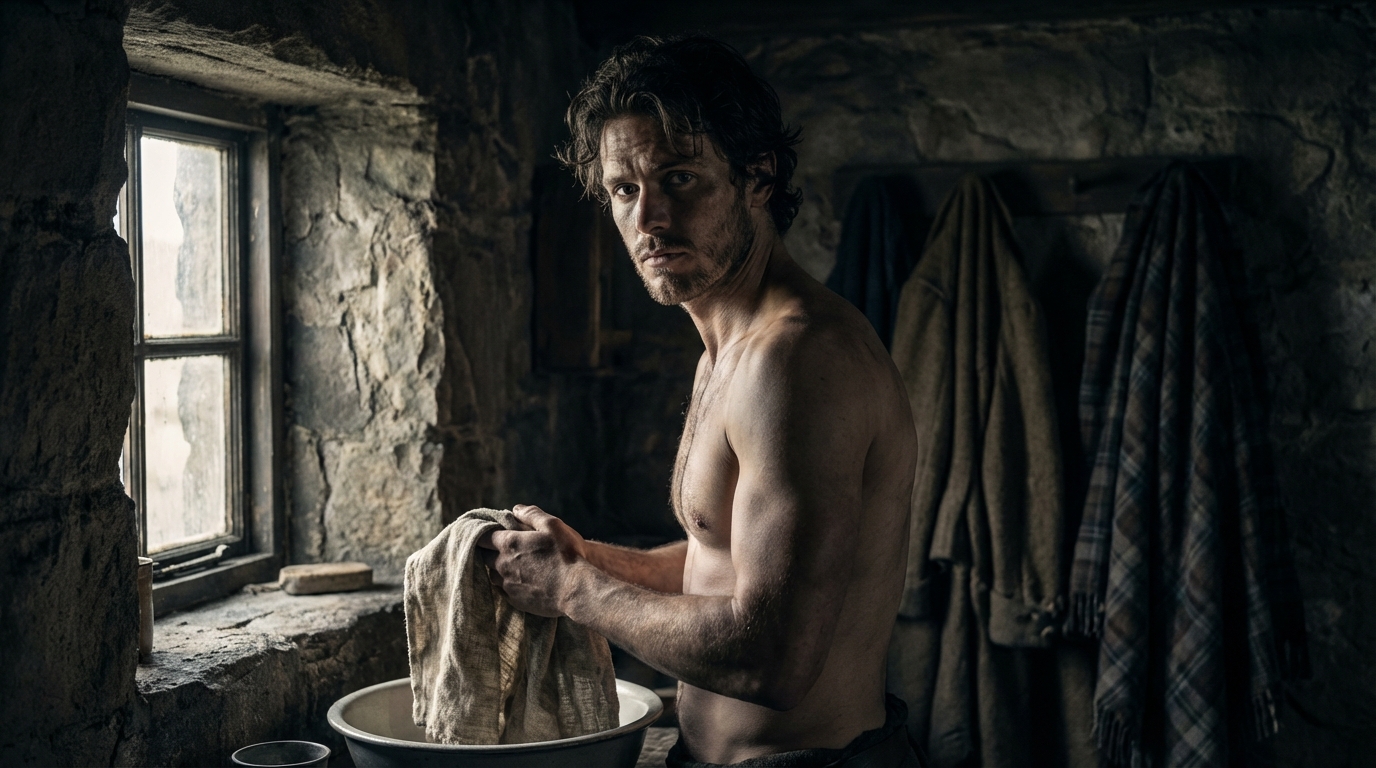
The Shadow Son
Robert Angus Stewart entered the world on 14 September 1742 in Edinburgh, bearing a name that proclaimed his parentage to those who knew how to read it. His mother, Helen Montgomery, chose that middle name deliberately—a quiet assertion of connection to the man who would never publicly acknowledge the child they had created together. His father, Angus Callum Stewart, was by then a respected blacksmith with a wife and four daughters, the eldest barely four years old, the second born just weeks before Robert himself drew first breath.
The circumstances of Robert's conception belonged to a chapter of Angus Stewart's life that the blacksmith kept sealed with the same stoic silence he had learned from his own father in the Highland glens. Helen Montgomery, six years Angus's junior, had come into his orbit sometime around 1740—a young woman of fierce intelligence and independent spirit who had rejected conventional paths to pursue knowledge of medicine and natural philosophy. Their connection, intellectual at first then deeper, had produced consequences neither could openly acknowledge in the respectable circles where Angus conducted his trade.
The affair ended before Robert's birth, though whether by mutual agreement or Helen's choice, no record survives to tell. What is certain is that Helen never demanded recognition, never sought to disrupt the Stewart household, and raised her son with the assistance of her own Montgomery kin. Angus, for his part, provided what discreet support he could manage—funds channelled through intermediaries, arrangements made through trusted associates—whilst the secret sat heavy in his chest like unworked iron, a weight he would carry to his grave.
Mother's Legacy
Robert's earliest memories centred on his mother—her voice reading to him from texts no child his age should have comprehended, her hands preparing remedies in their modest lodgings, her eyes that seemed to perceive depths in ordinary things that others missed entirely. Helen Montgomery had been born into a family of Edinburgh merchants with connections that stretched into circles where Jacobite sympathies ran strong, and she had inherited both their intellectual curiosity and their instinct for discretion.
She taught her son to read before his third birthday, recognising in him an aptitude that mirrored her own. The books that filled their home ranged from natural philosophy to Scottish history, from Latin primers to Gaelic poetry—an education far broader than Robert's nominal station should have permitted. Helen believed that knowledge was the only inheritance she could guarantee her son, the one gift that creditors could not seize nor circumstances diminish.
The Jacobite Rising of 1745 cast its shadow across Robert's infancy, though he was too young to comprehend the upheaval that swept through Scotland. Helen's family connections meant that whispered conversations occurred in their home—discussions of who had marched with the Prince, who had been taken after Culloden, whose lands had been seized under the new dispensations. These early impressions, absorbed before Robert could articulate them, planted seeds that would later flower into his life's work.
On 8 September 1746, four days before Robert's fourth birthday, Helen Montgomery died. The precise cause was never recorded in terms Robert would later be able to discover—fever, some said, though others whispered of complications from a pregnancy that had ended badly. Whatever the truth, Robert found himself suddenly orphaned of the parent he had known, thrust into the care of Montgomery relatives who regarded him with a mixture of duty and uncertainty.
The Montgomery Household
Helen's brother, Thomas Montgomery, and his wife Catherine took Robert into their Edinburgh household following his mother's death. They were childless themselves, their own attempts at family having ended in sorrows they did not discuss, and they approached their guardianship with conscientious care if not demonstrative affection. Thomas worked as a clerk for a legal firm with connections to several Highland estates—connections that would later prove significant to Robert's own career.
The Montgomery home offered stability and education, if not warmth. Robert was tutored alongside the sons of Thomas's employers, gaining access to instruction that would otherwise have been far beyond an illegitimate child's reach. He proved an apt pupil, his mother's early teaching having prepared him for rigours that challenged boys from far more advantaged backgrounds. Languages came easily—Latin, then Greek, then the Gaelic that connected him to a Highland heritage he knew only through books and his mother's stories. History fascinated him, particularly the complex narratives of Scottish families whose fortunes had risen and fallen with political tides.
Throughout these years, Robert remained aware of his anomalous position. He was neither servant nor quite family in the Montgomery household, neither fully claimed nor entirely rejected. The whispers about his parentage persisted in Edinburgh's close-knit merchant community—those who looked closely could see something of Angus Stewart in the boy's features, in the set of his jaw and the intensity of his gaze. Robert learned early to notice who knew and who suspected, developing an instinct for reading unspoken knowledge in others' eyes that would serve him throughout his life.
The Father He Never Knew
Robert was eleven years old when Angus Callum Stewart died on 21 June 1754. The news reached the Montgomery household through the same channels that carried all Edinburgh gossip—a forge accident, they said, hot metal and burns that festered beyond any healer's skill. The blacksmith had lingered three days before death claimed him, his wife and four daughters keeping vigil whilst the son he had never acknowledged remained ignorant of the crisis until it was already over.
Thomas Montgomery, uncertain how to address the situation, chose silence. Robert learned of his father's death as he might have learned of any notable tradesman's passing—through overheard conversation, through notices in the papers, through the general murmur of a city processing local news. He understood, even then, that he was expected to receive this information without visible reaction, to maintain the fiction that Angus Stewart had been nothing to him but a name sometimes whispered by those who thought themselves unobserved.
Privately, the death carved a wound that would never fully heal. Robert had harboured hopes, never quite articulated even to himself, that someday circumstances might change—that his father might find a way to acknowledge him, that they might speak as father and son rather than as strangers passing in the street. Angus's death foreclosed that possibility forever, leaving Robert with questions that could never be answered and a grief he could not openly express.
In the aftermath, Robert began quietly gathering what information he could about the Stewart family. He learned of the four daughters—Elspeth, Effie, Katrina, and Violet—who were his half-sisters in blood if nothing else. He learned of their mother Morag, the widow who now struggled to maintain her household against the debts Angus had concealed. He learned of the cramped circumstances into which the legitimate Stewarts had fallen, and he wondered what it might mean to have sisters who did not know he existed.
Finding His Path
By his late teens, Robert had developed the skills and inclinations that would define his adult life. His education, though unconventional in its origins, had equipped him for roles in law, trade, or scholarship—or some combination of all three. Thomas Montgomery, recognising his ward's capabilities, secured him a position as a clerk with the same legal firm where he himself had spent decades, handling matters related to Highland estates whose ownership had become complicated in the post-Culloden dispensation.
This work exposed Robert to the hidden architecture of Scottish property law—the ways in which estates had been seized, redistributed, claimed and counter-claimed in the decades since the Rising. He saw how families who had supported the wrong cause found themselves stripped of ancestral lands through legal mechanisms designed to appear just whilst serving political ends. He witnessed the quiet resistance of those who preserved records, hid documents, and maintained claims that official channels had extinguished.
Gradually, Robert's professional duties merged with personal calling. He began collecting documents that crossed his desk—not stealing, precisely, but copying, preserving, ensuring that certain records existed in more than one location. He cultivated relationships with families whose histories had been officially erased, offering his services as consultant and archivist to those who wished to maintain knowledge of what had been lost. This work brought modest income and, more importantly, access to networks of trust that operated beneath the surface of respectable Edinburgh society.
By the time he established himself as an independent merchant and estate consultant in his mid-twenties, Robert had developed expertise that made him valuable to a particular clientele. Families with Jacobite connections, whose fortunes had been reduced but not entirely destroyed, sought his assistance in preserving what remained and documenting what had been taken. His discretion was absolute; his knowledge, extensive; his loyalty to those who trusted him, unshakeable.
The Sisters' Disappearance
The year 1762 brought an event that would haunt Robert's investigations for the rest of his life. His half-sisters—all four of them—vanished from Edinburgh within the span of a few months. First Elspeth, then Effie, Katrina, and finally Violet, each departing under circumstances that official records rendered frustratingly vague.
Robert learned of these disappearances through the same networks that kept him informed of Edinburgh's undercurrents. The Stewart sisters had been working, he discovered, at Moira MacKenzie's Emporium of Fashion—at least Elspeth had, with the others presumably connected through family circumstance. Then, between April and July of that year, they simply ceased to appear in any records he could access. No deaths were registered. No marriages were recorded elsewhere. No notices appeared seeking missing persons. The four daughters of Angus Stewart had seemingly dissolved into air.
Their mother, Morag, remained in Edinburgh for some years afterward—Robert observed her from careful distance, never approaching, never revealing himself—before she too departed the city. Where she went, he could not immediately determine, though her absence left another gap in the tapestry of Stewart history he was quietly assembling.
The mystery consumed him for years. He pursued every avenue his professional connections afforded, traced every rumour that touched upon the Stewart sisters' fate, and accumulated a file of documents and suppositions that never quite resolved into clarity. Some whispered of scandal—four young women disappearing suggested possibilities that respectable society preferred not to contemplate aloud. Others mentioned a mysterious old woman named Lizbeth Wilson, whose connection to the Stewarts seemed to predate their troubles, but whose own history proved equally elusive upon investigation.
Robert never found definitive answers. The Stewart sisters had vanished into a silence so complete that it seemed almost supernatural—which, had he known the truth, would have been precisely accurate. His half-sisters had crossed into Clivilius, had become Guardians of a realm he would never learn existed, had built lives in a world beyond his most extravagant imaginings. He spent decades preserving the hidden histories of Jacobite Scotland, never knowing that his own family had made history of a kind that transcended anything his careful archives could contain.
Isobel Fraser
In 1769, Robert married Isobel Fraser, a woman whose background complemented his own as precisely as a well-fitted joint in fine cabinetry. Isobel came from a Highland family with deep roots in the oral traditions and covert communications networks that had sustained Jacobite sympathies through decades of official suppression. Her father had served as a messenger during the '45, carrying dispatches through territory that official maps did not acknowledge, and had survived the aftermath through a combination of luck, discretion, and the protection of families who remembered his services.
Isobel had inherited her family's instincts for preservation and concealment. She understood, as Robert did, that certain knowledge required protection rather than publication—that truth, in a world where power determined what could be spoken aloud, sometimes survived only in shadow. Their courtship had been built on recognition of shared values rather than romantic passion, though affection grew steadily through years of partnership.
Their marriage was both personal union and professional alliance. Isobel's connections to Highland networks expanded Robert's reach beyond Lowland legal circles, whilst his archival expertise provided systematic structure to the oral traditions her family had maintained. Together, they created a household where history was preserved through multiple channels—written records, yes, but also stories told to children, songs sung at the hearth, codes embedded in ordinary correspondence that only the initiated could decipher.
The partnership proved fruitful in every sense. Their home became a quiet node in networks that stretched across Scotland and beyond, a place where displaced families could deposit memories for safekeeping, where documents too dangerous to retain openly could be preserved against future need. Robert and Isobel asked few questions of those who sought their assistance, offered no judgements on political positions that had become costly, and maintained the discretion that made their services invaluable.
Four Children
Between 1774 and 1783, Robert and Isobel welcomed four children into the household they had built. Each would inherit, in different ways, the legacy of preservation that their parents had devoted their lives to maintaining.
Margaret Catherine, born on 8 June 1774, proved the most devoted inheritor of Robert's archival passion. From early childhood, she demonstrated the same aptitude for languages and historical detail that had distinguished her father, spending hours in his study absorbing the documents and methods that would later make her invaluable to Scottish historiography. She became Robert's primary assistant during his final years, understanding the significance of materials that casual observers would have dismissed as mere old papers.
Alexander Robert, born in 1776, inclined toward the practical application of his father's expertise. He studied law, specialising in the land claims and estate protections that had been Robert's professional foundation. Where his father had worked from the margins, Alexander would operate within established institutions, using legitimate channels to pursue ends that served families whose histories had been officially erased.
Eleanor Isobel, born in 1779, inherited her mother's gift for languages alongside her father's scholarly discipline. She became expert in Gaelic and in the coded texts that Jacobite sympathisers had developed to communicate safely under hostile observation. Her translations would later prove crucial for preserving materials that might otherwise have remained inaccessible to future generations.
James Fraser, the youngest, born in 1783, chose a path that surprised his scholarly parents. He pursued military service, eventually becoming an officer whose later career may have involved intelligence work during the Napoleonic Wars. Whether he deployed his family's instincts for discretion and information management in service to the Crown that had once oppressed Jacobite Scotland, or whether he found ways to serve multiple loyalties simultaneously, Robert did not live long enough to fully know.
All four children were raised in a household where history was treated as something precious and fragile, requiring active protection against the forces—political, social, economic—that constantly threatened its erasure. They learned to read documents for what they concealed as well as what they revealed, to maintain silence about knowledge that could endanger its sources, and to understand that their family's work served purposes larger than personal advancement.
The Campbell Connection
The most significant consequence of Robert's life work would emerge through his eldest daughter's marriage. In 1797, Margaret Catherine Stewart wed James Douglas Campbell, heir to an estate in the Highlands that had survived the post-Culloden upheavals through a combination of careful politics and fortunate geography. The Campbell family, whilst not Jacobite themselves, had maintained relationships with neighbours and connections of various political persuasions, and James proved willing to make his estate a permanent repository for the archives Robert had spent decades accumulating.
Campbell Estate—already home to extensive family records stretching back generations—became the new sanctuary for materials that Robert could no longer adequately protect in his Edinburgh lodgings. Margaret oversaw the transfer personally, ensuring that documents were properly catalogued and housed in conditions that would preserve them for centuries to come. The estate's remoteness provided security that urban locations could not offer; its established archives provided cover that made the addition of new materials unremarkable.
Through this arrangement, Robert's life work achieved the permanence he had always sought for it. The hidden histories of Jacobite families, the erased genealogies of dispossessed clans, the records of seizures and resistances that official histories had suppressed—all found sanctuary in Campbell Estate's vaults, awaiting future generations who might find value in truths that Robert's contemporaries preferred to forget.
Among these documents, preserved but never fully understood by those who inherited them, lay Robert's investigations into the Stewart sisters' disappearance. His notes on Elspeth, Effie, Katrina, and Violet—the half-sisters he had never met, the family he had never claimed—passed into Campbell keeping alongside hundreds of other files. There they would remain, a mystery within a mystery, awaiting discovery by descendants who might someday possess the keys to decode what Robert himself had never been able to comprehend.
Final Years
By the mid-1790s, Robert Angus Stewart had begun the inevitable withdrawal that age and accumulated exhaustion impose upon even the most dedicated scholars. His health, never robust, had been further compromised by decades of sedentary work in poorly lit rooms, poring over documents whose secrets he alone knew how to extract. His eyes, which had served him so well in deciphering faded inks and cramped hands, grew unreliable in their final years, forcing him to rely increasingly on Margaret's assistance for detailed work.
He spent these final years organising his materials for transfer to Campbell Estate, ensuring that his daughter understood the significance of each collection, the relationships between documents that might appear unrelated, the codes and conventions that would unlock their meanings for those who came after. It was painstaking work, this transmission of a lifetime's accumulated knowledge, but Robert approached it with the same methodical thoroughness he had brought to every task.
The question of his Stewart heritage—the secret that had shaped his entire existence—remained unresolved at the end. He had never publicly claimed his connection to Angus Stewart, never approached his half-sisters during the brief period when they had been accessible, never sought recognition from a family that had never acknowledged him. Whether this represented acceptance, resentment, or simply the practical recognition that illegitimacy carried consequences best avoided, even Isobel never fully knew. Robert kept his own counsel on matters of the heart as absolutely as he kept his clients' secrets.
Death
Robert Angus Stewart died on 3 May 1799, in the same Edinburgh where he had been born fifty-six years earlier. The city had transformed during his lifetime—new building spreading across what had been open ground, the New Town rising in Georgian elegance across the valley from the medieval Old Town—but certain things remained constant. The networks of whispered knowledge still operated beneath respectable surfaces. The memories of what had been lost still passed from generation to generation among those who cared to remember. The work of preservation continued, carried forward now by those Robert had trained and trusted.
His funeral was modest, attended by family and a surprising number of associates whose presence might have puzzled casual observers. These visitors came from across Scotland, representatives of families whose histories Robert had helped preserve, whose secrets he had guarded, whose trust he had never betrayed. They stood together in Greyfriars Kirkyard—not far from where Angus Stewart had been buried forty-five years earlier—and witnessed the interment of a man who had devoted his life to ensuring that certain truths would survive.
Isobel outlived her husband by four years, dying in 1803 after seeing Margaret firmly established at Campbell Estate and the other children settled in their various paths. She was buried beside Robert, their graves marked with simple stones that revealed nothing of the complex work they had accomplished together.







