Rita Mabel Larkin
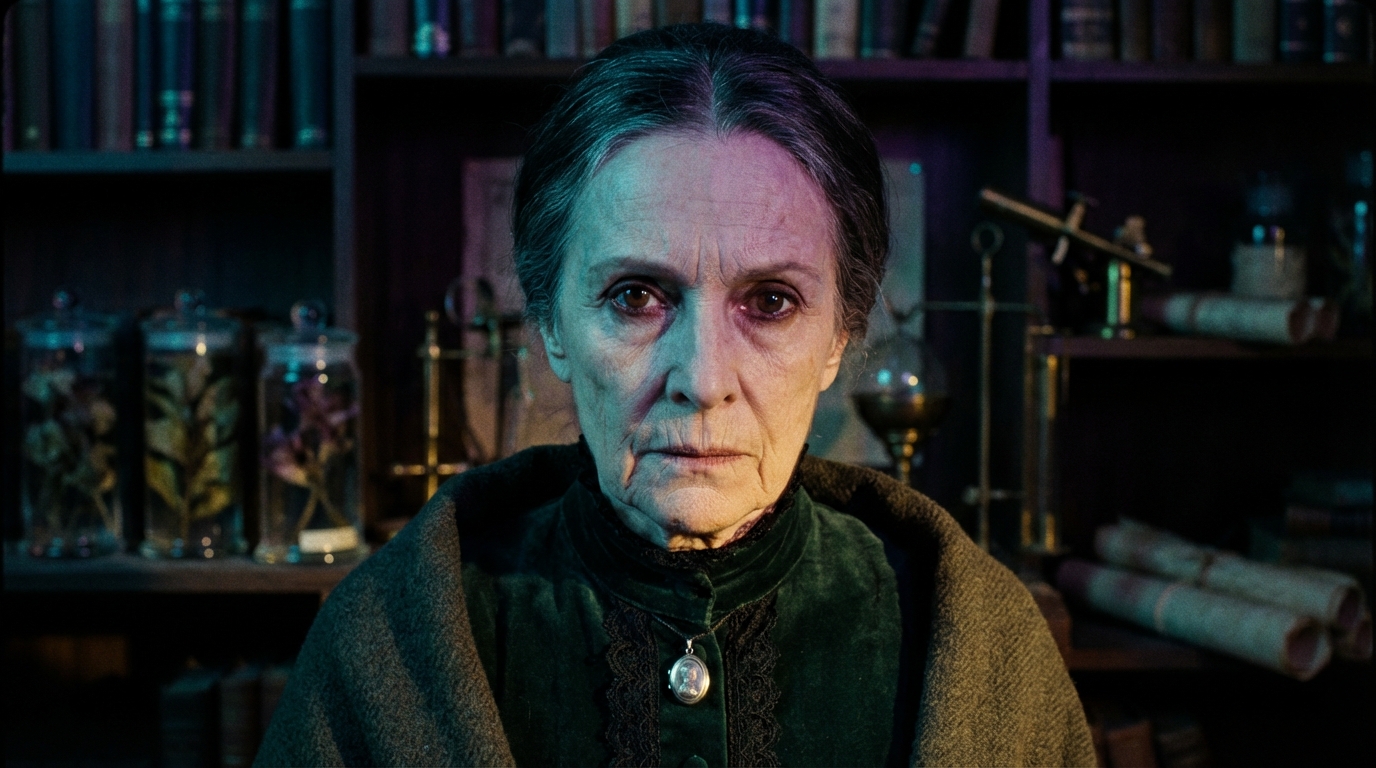
Rita Mabel Larkin, born 17 April 1779 in Port Jackson, New South Wales, became Hobart Town's most enigmatic resident—a spinster naturalist whose insatiable curiosity about the unexplained defined her life. Her witnessed account of mysterious lights at Jeffries Manor during William Jeffries Sr.'s 1821 disappearance transformed her from eccentric collector into obsessed chronicler, ultimately leading to her 1842 commitment to New Norfolk Asylum. She vanished mysteriously from a secure room in 1844, aged sixty-five, later dying on Clivilius in 1852.
Port Jackson Beginnings
The settlement of Port Jackson in 1779 existed as Britain's most audacious colonial experiment—a penal outpost clinging to the edge of a vast, incomprehensible continent where convicts and free settlers alike struggled to transform wilderness into something resembling civilisation. Into this raw frontier world, on the 17th of April 1779, Mary Larkin née Saunders gave birth to her third child, a daughter whom she and her husband Thomas named Rita Mabel.
Thomas Larkin worked as a skilled carpenter, his trade valuable in a settlement where everything required building from scratch. The timber structures rising along Port Jackson's shores demanded craftsmen who understood both English building techniques and the peculiar properties of Australian hardwoods—trees so dense that European saws struggled to cut them, timber that defied nails and resisted rot in ways that oak and pine never had. Thomas adapted through trial and error, his hands developing the calluses and strength that colonial woodworking demanded.
Mary managed their modest household with the resourcefulness that frontier existence required. She preserved foods against uncertain supply, tended a small garden that produced vegetables despite the alien soil's resistance, and raised five children in circumstances that would have daunted women accustomed to England's established domestic comforts. Rita arrived between her elder brothers John and William and her younger sisters Alice and Edith, the middle child whose position taught her early to observe rather than demand attention, to watch and learn whilst louder siblings competed for parental notice.
From earliest childhood, Rita demonstrated a curiosity that set her apart from other children content with familiar surroundings and conventional play. She wandered beyond the settlement's boundaries whenever opportunity allowed, collecting unusual stones, peculiar insects, and plant specimens that caught her attention. Other children regarded her explorations with incomprehension—why would anyone willingly venture into wilderness that adults warned contained dangers both mundane and mysterious? Yet Rita found the unknown irresistible, its mysteries calling to something fundamental in her nature that no amount of parental caution could suppress entirely.
The Larkin family relocated to Van Diemen's Land when Rita was still young, Thomas seeking opportunities in the fledgling Hobart Town settlement where skilled carpenters commanded good wages and where the colonial government's ambitious building projects promised steady employment. The journey across Bass Strait tested the entire family's endurance, yet Rita remembered it less for its discomforts than for the extraordinary seabirds she observed and the strange marine creatures occasionally visible through the ship's wake—wonders that adults dismissed as mere curiosities but that Rita catalogued mentally with the precision that would characterise her lifelong approach to the natural world.
Hobart Town Education
The settlement that received the Larkin family possessed little formal infrastructure for education, particularly for girls whose futures were assumed to lie in domestic duties rather than intellectual pursuits. Yet Rita benefited from the kindness of Mrs Abigail Saunders, a neighbour who operated an informal school in her home, teaching basic literacy to children whose families understood education's value despite its scarcity in colonial circumstances.
Mrs Saunders recognised immediately that Rita possessed an intellect exceeding what simple literacy lessons could satisfy. The girl absorbed reading skills rapidly, her hunger for knowledge evident in the way she devoured whatever printed materials Mrs Saunders could provide—outdated newspapers brought by ships from England, religious texts, and the occasional borrowed volume from the small lending library that several progressive colonists had established. Rita demonstrated particular fascination with natural history and accounts of scientific discoveries, her questions revealing a mind that sought to understand underlying principles rather than merely accepting surface observations.
Yet Rita's education remained necessarily limited. Colonial Van Diemen's Land lacked the institutions that might have channelled her intellectual gifts towards formal scientific pursuits, whilst social conventions dictated that even educated women's proper sphere remained domestic rather than scholarly. Rita absorbed what learning she could access whilst understanding that the curiosity driving her would need to find expression through unofficial channels, through personal observation and informal study rather than through any recognised academic pathway.
Her informal education continued through adolescence, supplemented by conversations with visiting ships' officers who sometimes possessed scientific training, by correspondence with naturalists she discovered through magazines, and by relentless personal observation of Van Diemen's Land's unique flora and fauna. She taught herself botanical illustration well enough to create accurate sketches of specimens she collected, developed skills in preservation techniques that allowed her to maintain collections of insects and plants, and read whatever texts on natural history she could obtain through the settlement's limited resources.
The Spinster's Choice
As Rita approached marriageable age, several suitors sought her hand, attracted by her father's established position in the community and by the dowry Thomas could provide. Yet Rita demonstrated no interest in marriage, viewing it as surrender of the independence that allowed her intellectual pursuits. The prospect of managing some tradesman's household whilst bearing and raising his children held no appeal compared to the freedom to explore Van Diemen's wilderness, to study its mysteries, and to maintain the collections and observations that gave her life meaning.
Her family regarded this decision with varying degrees of concern and exasperation. Mary worried that Rita would face old age without the security that marriage and children provided, whilst Thomas oscillated between pride in his daughter's unconventional intelligence and frustration at her refusal to follow conventional paths. Her sisters, more traditional in their aspirations, married appropriate men and established their own households, occasionally expressing pity for Rita's spinsterhood that Rita found more irritating than hurtful.
In 1805, at twenty-six years of age, Rita took the remarkable step of establishing her own independent household. Using a modest inheritance from her maternal grandmother combined with savings accumulated through various small employments, she purchased a small cottage on Hobart Town's outskirts, near the gradually developing Granton area. The property included sufficient land for gardens and outbuildings, whilst its location provided easy access to the wilderness Rita loved without the isolation that would have raised concerns about a woman living alone.
She named the cottage "Whispering Willows" after the graceful trees that bordered the property, their drooping branches creating natural screens that enhanced the sense of peaceful seclusion. Rita transformed the modest dwelling into both residence and research station, dedicating rooms to her expanding collections of natural specimens, establishing a workspace for her botanical illustrations and writings, and creating living quarters that reflected her own preferences rather than accommodating anyone else's expectations or comfort.
The cottage became known throughout the district as an eccentric establishment filled with peculiar objects—preserved insects in glass cases, dried plant specimens carefully mounted and labelled, rocks and minerals arranged by type, and shelves of notebooks containing Rita's observations and theories. Visitors found the atmosphere either fascinating or unsettling depending on their own temperaments, yet even those who regarded Rita's interests as strange acknowledged the cottage's undeniable charm and the evident dedication its owner brought to her unusual pursuits.
The Manor's Proximity
Whispering Willows' location near Jeffries Manor proved significant in ways Rita could not have anticipated when she purchased the property. The grand Georgian estate, completed in 1818, represented colonial ambition realised in sandstone and imported furnishings, its scale and elegance announcing William Jeffries Sr.'s transformation from convict to gentleman. The manor's presence drew Rita's attention initially for purely practical reasons—the extensive grounds contained plant species she wished to study, whilst the household's servants occasionally traded information about unusual natural phenomena they had observed on the property.
Rita developed cordial if distant relations with some of the manor's staff, particularly those who shared her interest in the natural world or who encountered curiosities they thought might interest the eccentric woman from Whispering Willows. She maintained careful boundaries, understanding that her spinster status and unconventional interests made her vulnerable to gossip and that any hint of impropriety could damage the independence she valued so highly. Yet the manor's proximity allowed her to observe its operations from a respectful distance, noting the comings and goings that characterised one of Van Diemen's Land's most prominent households.
Through 1818, 1819, and 1820, Rita noticed increasingly strange patterns around Jeffries Manor. Lights appeared at odd hours in windows that should have been dark, unusual visitors arrived and departed at times suggesting secrecy rather than ordinary social calls, and occasionally she heard sounds—distant rumblings or inexplicable vibrations—that seemed to emanate from the manor's direction yet defied conventional explanation. Rita catalogued these observations with the same systematic attention she brought to her naturalist studies, uncertain what they signified yet convinced they represented phenomena worthy of investigation.
Her notebooks from this period reveal growing fascination with what she termed "atmospheric disturbances" around the manor. She recorded dates and times, atmospheric conditions, and the specific nature of lights or sounds observed. To modern eyes, these records demonstrate either prescient recognition of genuine anomalies or the beginnings of the obsession that would eventually consume her life. Rita herself would have rejected both interpretations—she was simply doing what she had always done, observing carefully and documenting phenomena that others ignored because they challenged conventional understanding.
The Fateful Night
On the evening of 9 August 1821, Rita sat in Whispering Willows' small upstairs room that she had converted into an informal observatory, cataloguing recent astronomical observations and updating her weather journal. The night was clear and unusually still, the kind of atmospheric calm that Rita had learned often preceded significant meteorological events. Near 11:00 PM, a brilliant light suddenly illuminated the western sky—not lightning, which Rita knew well, but something more sustained and oddly coloured, pulsing with rhythms that suggested neither natural phenomenon nor ordinary human activity.
She rushed to the window, her telescope already positioned to observe the direction from which the light emanated. Jeffries Manor lay in that direction, and as Rita focused her instrument, she observed lights of extraordinary character surrounding the estate—luminous manifestations that seemed to shift and move in patterns defying physical laws as she understood them. The colours ranged beyond what Rita had ever witnessed in natural phenomena, whilst the way they cast illumination suggested sources neither fire nor conventional lamp could produce.
Accompanying the lights came sounds—deep vibrations that Rita felt as much as heard, resonant frequencies that seemed to originate beneath the earth yet manifest in the air itself. The cottage's walls trembled slightly, books shifted on their shelves, and Rita's preserved specimens vibrated in their cases. She stood transfixed, observing with a naturalist's trained eye yet increasingly aware that what she witnessed exceeded anything her scientific education had prepared her to interpret.
The display continued for perhaps twenty minutes—Rita noted the time carefully in the journal she grabbed to document the event—before ceasing as abruptly as it had begun. Darkness returned, silence fell, and the night resumed its previous calm as though nothing extraordinary had occurred. Yet Rita remained at her window for hours afterwards, recording every detail she could recall, sketching the light patterns as accurately as memory allowed, and struggling to formulate theories that might account for what she had witnessed.
The following morning brought news of William Jeffries Sr.'s disappearance, and Rita understood immediately that the phenomena she had observed must somehow relate to his vanishing. She debated whether to report what she had seen, understanding that her account would likely be dismissed as fantasy yet feeling that her testimony might prove crucial to understanding William's fate. After considerable internal debate, she decided to document her observations in a letter to the local newspaper, believing that extraordinary events required public record regardless of potential ridicule.
The Town Pariah
The Van Diemen's Gazette published Rita's letter on 6 September 1821, under circumstances that suggest the editors found the account entertaining rather than credible. Her description of the lights and sounds, her speculation about their possible extraterrestrial origin, and her insistence that William's disappearance must be understood in terms of forces beyond conventional understanding earned widespread derision throughout Hobart Town's society.
Respectable colonists dismissed Rita as a deluded spinster whose isolation and eccentric interests had finally tipped into actual madness. The more educated scoffed at her invocation of extraterrestrial explanations, pointing out that no credible scientific theory supported such speculation. Even those sympathetic to Rita personally expressed concern that her obsession with the unexplained had led her to invent fantastic accounts of perfectly ordinary events—perhaps distant lightning or some mundane manor activity that darkness and distance had distorted in her imagination.
Rita found herself transformed overnight from accepted eccentric into object of mockery and suspicion. Merchants who had previously tolerated her unusual purchases of scientific equipment now served her with barely concealed contempt. Former acquaintances crossed the street to avoid conversation. Children began repeating cruel rhymes about "the witch of Whispering Willows," their parents doing little to discourage such harassment. Rita's independence, which had once seemed merely unconventional, now appeared as further evidence of mental instability—what sane woman would choose solitude and strange pursuits over proper domestic life?
Yet Rita refused to recant her account or moderate her insistence that she had witnessed genuine phenomena requiring serious investigation. She wrote additional letters to the newspaper, each one elaborating her theories and responding to critics with detailed arguments about observational methodology and the necessity of remaining open to explanations that challenged existing scientific paradigms. The newspaper ceased publishing her correspondence after the third letter, the editor noting diplomatically that space constraints prevented continuing the exchange.
Descent into Obsession
Rejection by Hobart Town's respectable society might have silenced someone less determined or more concerned with social standing. For Rita, it merely intensified her commitment to proving what she had witnessed. If official authorities refused to investigate properly, she would conduct her own enquiry. If educated colonists dismissed her observations as impossible, she would accumulate evidence so comprehensive that dismissal would become intellectually dishonest.
Whispering Willows transformed from naturalist's retreat into investigation headquarters. Rita dedicated entire rooms to materials relating to the Jeffries disappearance—newspaper clippings, copies of official documents she obtained through various means, interviews with household staff willing to speak with her, and her own extensive notes about the phenomena she had observed. She expanded her original account into treatises hundreds of pages long, developing elaborate theories about dimensional portals, about extraterrestrial visitation, about forces that Victorian-era science had not yet recognised but that Rita felt certain would eventually be validated.
Her financial resources dwindled as she devoted more time to investigation and less to the small employments that had previously supplemented her inheritance. She sold portions of her natural history collections to fund her research, parting with specimens she had spent years accumulating. Her appearance grew increasingly unkempt as domestic concerns seemed trivial compared to the mysteries she pursued. Visitors to Whispering Willows reported an atmosphere of mounting chaos—papers covering every surface, bizarre diagrams covering the walls, and Rita herself wild-eyed and incoherent as she attempted to explain theories that grew more elaborate and less comprehensible with each iteration.
Her family's attempts to intervene proved futile. Her sisters, now married with their own households to manage, expressed concern yet lacked either authority or inclination to force Rita into more conventional behaviour. Her aging parents, distressed by their daughter's deterioration yet uncertain how to help, eventually retreated into resigned acceptance that Rita had chosen a path they could not alter. Her brothers, embarrassed by the family connection to Hobart Town's most notorious eccentric, distanced themselves completely, refusing even to acknowledge Rita when chance encounters occurred in public.
The Asylum Years
By 1842, Rita's mental state had deteriorated sufficiently that her family, in consultation with local physicians, made the agonising decision to commit her to the New Norfolk Asylum. The institution, established in 1827, provided custodial care for colonists whose mental afflictions made them either dangerous to themselves or simply unable to function in ordinary society. Rita fell into the latter category—not violent or actively suicidal, yet so consumed by her obsessions and so disconnected from practical reality that independent living no longer seemed sustainable.
The commitment proceedings proved brief and perfunctory. Rita attempted to present her evidence to the magistrate reviewing her case, producing notebooks filled with observations and theories that the official regarded with weary incomprehension. Her insistence that she had witnessed genuine phenomena, that William Jeffries Sr. had been taken through some kind of dimensional portal, and that forces beyond human understanding operated in Van Diemen's Land merely confirmed the assessment that she required institutional supervision for her own protection.
The New Norfolk Asylum in the 1840s operated according to principles that combined genuine concern for patients' welfare with practices that modern sensibilities would find horrifying. Rita found herself confined in rooms that combined prison cell and hospital ward, her days structured by institutional routines that permitted no deviation, her collections and research materials confiscated as potentially dangerous items that might facilitate escape or self-harm. The staff, overworked and underpaid, treated patients with varying degrees of compassion and contempt, their patience strained by the unending demands of managing dozens of troubled souls in inadequate facilities.
Yet Rita adapted to asylum life with resilience that surprised both staff and family. She complied with institutional requirements sufficiently to avoid the brutal punishments reserved for troublesome patients, maintained enough lucidity to navigate the asylum's social dynamics, and found ways to continue her intellectual pursuits despite severe constraints. She secured paper and writing implements through various means, maintaining clandestine journals that documented both her asylum experiences and her continuing theories about the Jeffries disappearance. She cultivated relationships with certain staff members who recognised that beneath her obsessions lay genuine intelligence worthy of respect.
Through twenty-three years of confinement, Rita's essential character never entirely surrendered to the asylum's dehumanising routines. She remained convinced that she had witnessed genuine phenomena, that official dismissal of her account represented failure of imagination rather than her own delusion, and that eventually truth would emerge to vindicate her observations. This unwavering conviction impressed some observers as admirable determination yet struck others as proof that her madness remained fundamentally incurable.
The Final Mystery
On the morning of 10 November 1844, asylum staff conducting their routine rounds discovered that Rita Mabel Larkin had vanished from her secured room. The door remained locked from the outside, the window's iron bars showed no sign of tampering, and nothing in the room suggested how a sixty-five-year-old woman could have escaped from what amounted to a prison cell. The asylum's superintendent initiated immediate searches of the grounds and surrounding areas, whilst notifying local authorities about the escape.
The investigation revealed no rational explanation for Rita's disappearance. The room's security had not been compromised, no accomplices could be identified who might have facilitated escape, and no physical evidence suggested how Rita had left the secure facility. Staff members who had seen her the previous evening reported nothing unusual about her behaviour or demeanour. She had simply ceased to exist in a locked room, her vanishing as inexplicable as the phenomena she had spent decades insisting were real.
Colonial authorities eventually concluded that Rita must have escaped through some unidentified means and either perished in the wilderness or found her way to some distant location where her identity remained unknown. The case remained officially open for several years, yet no credible sightings emerged and no evidence of her fate was ever discovered. Rita Mabel Larkin had become herself the kind of mystery she had spent her life investigating—a disappearance that defied conventional explanation and invited speculation about forces beyond ordinary understanding.
What remained unknown to earthly authorities was that Rita had indeed witnessed truth on that August night in 1821, that the phenomena she observed represented genuine dimensional activity, and that her own disappearance resulted from forces finally taking notice of the persistent observer who had recognised their operations. She passed through a portal to Clivilius, where she spent her final years in a reality that validated everything her Van Diemen's Land contemporaries had dismissed as impossible fantasy.
Rita Mabel Larkin died on Clivilius in 23 October 1852, aged seventy-three, her final years spent exploring wonders that exceeded even her most elaborate theories. Yet on Earth, her legacy remained that of the eccentric spinster whose obsessions had consumed her life, whose disappearance from the asylum added merely another layer to her peculiar story, and whose insistent testimony about William Jeffries Sr.'s fate was filed away as the delusions of a troubled mind rather than the observations of someone who had glimpsed truths that Victorian-era science lacked frameworks to comprehend. The cottage of Whispering Willows stood for decades afterwards, gradually falling into disrepair yet retaining its reputation as the dwelling of Hobart Town's strangest resident—a monument to curiosity that refused to accept comfortable lies over uncomfortable truths.







