Rita Larkin's Cottage, Granton
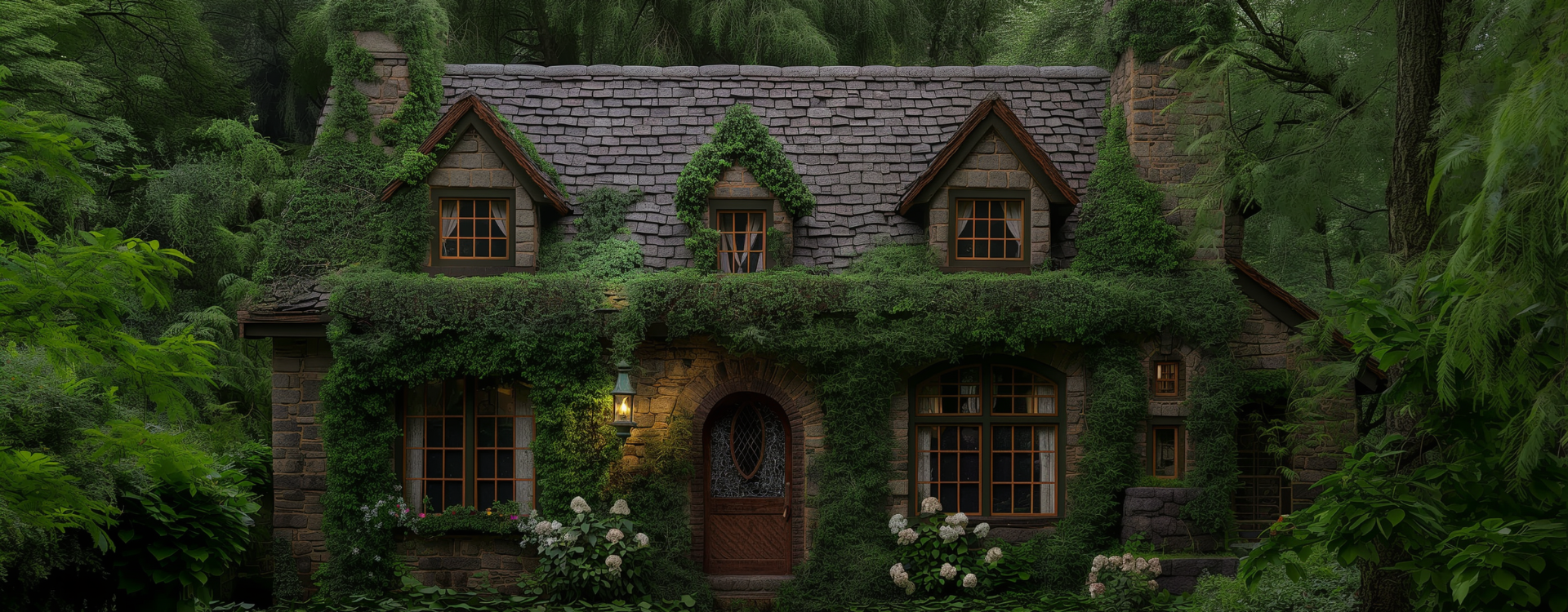
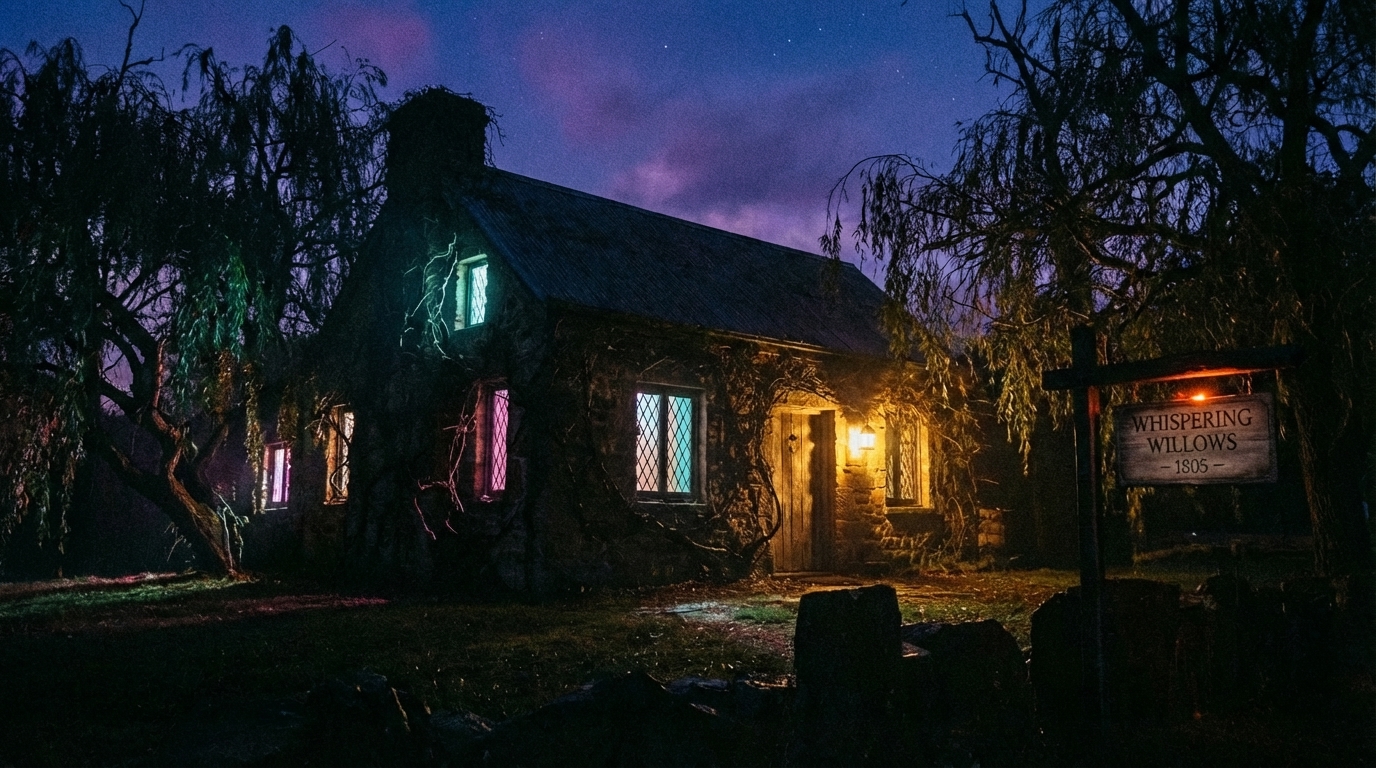
Whispering Willows, built in 1805 on Granton's outskirts by stonemason Edward O'Connell, became Tasmania's most enigmatic residence when Rita Mabel Larkin transformed the modest cottage into her sanctuary of curiosities and astronomical observations. The ivy-clad stone dwelling, flanked by ancient willow trees, witnessed Rita's transformation from naturalist collector to obsessed investigator following her 1821 observations of mysterious lights at nearby Jeffries Manor. After Rita's 1844 disappearance, the cottage fell into neglect before eventual restoration as a cherished historical monument.
Foundation and Early Years
In the autumn of 1805, stonemason Edward O'Connell completed construction of a modest cottage on a two-acre parcel situated roughly half a mile from Granton's developing centre, along the rutted track that wound towards the agricultural lands bordering the Derwent River. O'Connell had secured the commission from a merchant named Samuel Pratt, who intended the dwelling as rental property for settlers arriving in Van Diemen's Land's expanding colonial enterprise. The specifications required nothing elaborate—merely a solid structure capable of withstanding Tasmania's occasionally fierce weather whilst providing comfortable accommodation for a small family or an individual seeking modest independence.
O'Connell approached the work with the thoroughness that had earned him reputation as one of Hobart Town's most reliable craftsmen. He sourced sandstone from a nearby quarry, selecting pieces whose irregular shapes would lock together with minimal mortar whilst creating walls thick enough to provide insulation against both summer heat and winter cold. The cottage's footprint measured twenty-four feet by eighteen feet, its single storey topped by a steeply pitched roof originally thatched with reeds gathered from the river's marshy edges. Four rooms composed the interior—a main living area with hearth, two smaller chambers suitable as bedrooms, and a scullery for food preparation and washing.
The timber components—roof beams, door frames, window casements, floorboards—came from local hardwoods that O'Connell's carpenters shaped with considerable effort, the dense Tasmanian timber resisting saws and planes in ways that European woods never had. Yet the difficulty produced durability, the hardwood elements proving remarkably resistant to the rot and insect damage that plagued structures built with softer materials. The cottage's windows, small by later standards yet generous for the period, featured imported glass panes that represented significant expense yet provided illumination essential for domestic tasks.
Samuel Pratt's investment proved sound initially. The cottage attracted a succession of short-term tenants through its first fifteen years—a clerk from the colonial administration who stayed eighteen months, a widow and her two daughters who occupied it for three years, a surveyor who used it as base for his mapping expeditions into the interior. Each tenant found the dwelling adequate if unexceptional, its solid construction and rural location offering advantages that balanced the inconvenience of distance from Hobart Town's more established amenities.
Yet by 1820, the cottage stood vacant, Pratt struggling to secure reliable tenants willing to commit to the property's somewhat isolated position. The expansion of Granton's more developed areas had shifted settlement patterns, making the cottage seem more remote than its actual distance warranted. Pratt contemplated selling the property, understanding that its value as rental income had diminished whilst its maintenance costs continued accumulating.
Rita's Transformation
When Rita Mabel Larkin approached Samuel Pratt in early 1805 about purchasing the vacant cottage, the merchant regarded the proposition with initial scepticism. A spinster woman, approaching her mid-twenties and proposing to establish an independent household in a relatively isolated location—the arrangement struck Pratt as unconventional bordering on improper. Yet Rita presented herself with quiet determination that impressed him despite his reservations, demonstrating both the financial means to complete the purchase and a practical understanding of the property's condition and requirements.
The price they eventually negotiated reflected both the cottage's solid construction and its less desirable location—fifty pounds, a sum that consumed most of Rita's modest inheritance yet left her sufficient reserves for necessary improvements and furnishings. The transaction concluded in April 1805, making Rita the cottage's first owner-occupant and establishing her independence in ways that scandalised some colonists whilst earning grudging respect from others who recognised her courage if not her wisdom.
Rita's first decision as owner involved naming the property, understanding that a house gained character through such designation. She chose "Whispering Willows," inspired by the two magnificent willow trees that bordered the track leading to the cottage's entrance. The trees, likely planted decades earlier by someone unknown, had matured into graceful specimens whose drooping branches moved with even slight breezes, creating rustling sounds that Rita found both peaceful and somehow communicative, as though the trees conversed in languages human ears could barely detect.
The cottage's interior transformation began immediately and continued throughout Rita's years of residence. What had been simple rooms suitable for conventional domestic life evolved into something altogether more peculiar—a combination of natural history museum, astronomical observatory, and research station dedicated to investigating phenomena that most colonists considered either imaginary or irrelevant. The main living area became repository for her collections of preserved insects, each specimen mounted in glass-fronted cases arranged by taxonomic classification. Shelves lining the walls held jars containing botanical specimens suspended in alcohol, rocks and minerals organised by type and origin, and bird eggs carefully preserved to demonstrate the extraordinary variety of Tasmanian avian species.
The larger bedroom Rita converted into a library and study, its walls eventually holding several hundred volumes accumulated through years of patient acquisition. Natural history texts predominated, yet Rita's collection also included astronomical treatises, philosophical works exploring the nature of reality and perception, accounts of exploration and scientific discovery, and volumes on subjects that Victorian-era respectability considered dubious—mesmerism, spiritualism, and theories about forces beyond conventional scientific understanding. The oak writing desk positioned near the room's single window became Rita's command centre, where she documented observations, developed theories, and composed the letters and essays that would eventually contribute to her reputation as both eccentric intellect and dangerous fanatic.
The Hidden Observatory
The cottage's most remarkable feature remained concealed from casual visitors, accessible only to those Rita trusted sufficiently to reveal it. Behind a wooden panel in the scullery, disguised to appear as merely another section of wall planking, a narrow staircase ascended to the attic space beneath the cottage's roof. What had been conceived as simple storage for household goods Rita had transformed into an astronomical observatory equipped with instruments whose quality and expense would have shocked anyone aware of their existence.
The attic's transformation required considerable structural modification. Rita hired a carpenter to install proper flooring across the joists, to create a dormer window that could be opened to provide unobstructed views of the night sky, and to reinforce the roof's structure to support the weight of the telescope she had imported from England at ruinous expense. The instrument—a brass refractor with three-inch aperture and four-foot focal length—represented perhaps the finest astronomical equipment in Van Diemen's Land, its optical quality permitting observations that revealed celestial details invisible to the naked eye or lesser instruments.
Rita spent countless nights in her hidden observatory, mapping the southern sky visible from Tasmania's latitude, tracking the motions of planets against the background stars, and documenting atmospheric phenomena—auroras, meteors, unusual cloud formations—with the systematic attention she brought to all her natural investigations. She maintained detailed journals recording her observations, her neat handwriting filling page after page with data about celestial positions, atmospheric conditions, and the various puzzling phenomena she witnessed yet struggled to explain through conventional astronomical theory.
The attic also housed Rita's growing collection of maps and charts—some purchased, others created through her own observations. Star charts showing the southern constellations covered one wall, whilst another displayed maps of Van Diemen's Land showing topographical features, settlement patterns, and notations marking locations where Rita had observed what she termed "atmospheric disturbances" or "terrestrial anomalies." To modern eyes, these maps reveal either prescient recognition of geological and meteorological patterns or the developing obsession that would eventually consume her life.
The Fateful Proximity
Whispering Willows' location proved fateful in ways Rita could not have anticipated when she purchased the property. The cottage sat roughly three-quarters of a mile from Jeffries Manor, the grand Georgian estate that William Jeffries Sr. completed in 1818. The manor's prominence and scale made it visible from Rita's observatory window, its illuminated windows at night providing reference point she used when orienting her astronomical instruments towards different sectors of the sky.
The proximity initially struck Rita as merely convenient—the manor's household staff occasionally traded information with her about natural phenomena they observed on the estate's extensive grounds, and the property's gardens contained plant species Rita wished to study. Yet as years passed and William Jeffries Sr.'s behaviour grew increasingly strange, Rita found herself observing the manor with attention that transcended botanical interest. Strange lights appeared in windows that should have been dark, unusual visitors arrived at odd hours, and occasionally she detected sounds—distant rumblings or inexplicable vibrations—that seemed to emanate from the manor's direction.
Rita documented these observations with characteristic thoroughness, unsure what they signified yet convinced they represented phenomena worthy of investigation. Her observatory journals from 1818 through 1821 reveal growing fascination with what she termed the "Jeffries Manor anomalies," her entries becoming increasingly detailed as the peculiarities accumulated. She noted correlations between unusual lights at the manor and atmospheric disturbances she observed through her telescope, patterns suggesting connections between terrestrial events and celestial phenomena that conventional science offered no framework to explain.
On the night of 9 August 1821, Rita sat in her attic observatory conducting routine celestial observations when brilliant light suddenly illuminated the western sky. The luminous manifestation clearly originated from Jeffries Manor's direction, and Rita immediately turned her telescope towards the estate. What she witnessed through that instrument—pulsing lights of extraordinary colours, patterns of illumination defying physical laws as she understood them, and accompanying vibrations that made even Whispering Willows' solid walls tremble—convinced her absolutely that something beyond ordinary human activity was occurring at the manor.
The cottage's structure absorbed and preserved that extraordinary night in ways both literal and metaphorical. The trembling vibrations Rita experienced left no visible damage, yet she remained convinced that Whispering Willows itself had witnessed phenomena that most colonists would dismiss as impossible. The telescope that had shown her the inexplicable lights, the journals where she recorded every detail, the cottage's very walls that had felt the mysterious vibrations—all became evidence in Rita's growing conviction that forces beyond conventional understanding operated in Van Diemen's Land, and that she had been positioned by circumstance or design to observe their manifestations.
The Investigation Headquarters
Following Rita's public testimony about what she had witnessed, Whispering Willows transformed from eccentric naturalist's retreat into investigation headquarters dedicated to proving the impossible. Rita devoted entire rooms to materials relating to the Jeffries disappearance, her natural history collections gradually displaced by newspaper clippings, copies of official documents, interview notes from household staff willing to speak with her, and her own increasingly elaborate theories about what had truly happened to William Jeffries Sr.
The cottage's main living area became a workspace that visitors found either fascinating or deeply unsettling depending on their temperaments. Papers covered every horizontal surface, whilst the walls bore diagrams attempting to chart relationships between various pieces of evidence, timelines reconstructing the events of 9 August 1821, and maps showing geographical relationships between Jeffries Manor, Whispering Willows, and locations where other witnesses claimed to have observed unusual phenomena. Rita's elegant handwriting filled margins with annotations, cross-references, and questions whose answers eluded her despite years of persistent investigation.
Her library expanded to include works on subjects that respectable colonists considered dubious at best and dangerous at worst—treatises on mesmerism and animal magnetism, accounts of spiritualist phenomena, theories about dimensional portals and extraterrestrial visitation that existed at the fringes of Victorian-era scientific discourse. Rita read voraciously, seeking any framework that might explain what she had witnessed, any precedent that might validate her observations against the dismissive ridicule that Hobart Town's educated class directed towards her theories.
The cottage's atmosphere grew increasingly chaotic as Rita's obsession deepened. Domestic order, never her primary concern, deteriorated entirely as investigation consumed time and energy she might once have devoted to maintaining her home. Dishes accumulated unwashed, floors went unswept, and the garden that had once displayed her horticultural interests succumbed to weeds and neglect. The ivy that had always covered portions of the cottage's exterior walls spread unchecked, eventually obscuring much of the stone facade and creating the appearance of a dwelling gradually being reclaimed by nature whilst its occupant remained oblivious to anything beyond her consuming quest for truth.
The Investigator's Visit
On 18 August 1821, Investigator Tobias Lockhart arrived at Whispering Willows accompanied by Constable Benjamin Blackwood, seeking to interview Rita about her published account of the mysterious lights. Lockhart approached the cottage with considerable scepticism—his experience investigating crimes in London had taught him that witnesses often convinced themselves they had seen things that objective evidence could not support, and Rita's reputation as an eccentric made her testimony inherently suspect.
Yet the cottage itself impressed Lockhart in ways he had not anticipated. The evident intelligence behind Rita's collections, the systematic organisation of her natural history specimens, and the quality of her astronomical instruments suggested capabilities far exceeding what Hobart Town's dismissive gossip had led him to expect. This was not the dwelling of a simple-minded fanatic but rather the workspace of someone who approached investigation with method and rigour, even if the conclusions she drew struck conventional minds as absurd.
The interview that followed, conducted in the cottage's cluttered main room, revealed tensions between Rita's genuine intellectual capabilities and her conviction that she had witnessed phenomena defying rational explanation. Lockhart pressed her repeatedly about the possibility of misinterpretation—might the lights have been distant lightning, might the sounds have originated from mundane manor activities magnified by darkness and imagination? Rita responded with frustration born from months of such questioning, insisting that her observational skills and her intimate familiarity with Tasmania's atmospheric phenomena made misidentification impossible.
The cottage witnessed this confrontation between metropolitan scepticism and colonial conviction, between professional investigator and amateur naturalist who believed absolutely in her own observations. Lockhart departed Whispering Willows without reaching definitive conclusions about Rita's testimony, yet also without dismissing it entirely as he had initially intended. The cottage and its owner had forced him to consider possibilities that his London training had never prepared him to contemplate.
Descent and Abandonment
Through the 1820s and 1830s, Whispering Willows mirrored Rita's deteriorating mental state. The cottage that had once represented independence and intellectual freedom gradually became prison of obsession, its rooms filled with accumulating evidence of investigations that never produced satisfying answers, theories that grew more elaborate yet never more conclusive. Visitors who had once found the dwelling charming in its eccentricity now regarded it with concern bordering on alarm, recognising that the cottage's chaos reflected its owner's declining grasp on practical reality.
By the time Rita's family arranged her commitment to New Norfolk Asylum in 1842, Whispering Willows had become nearly uninhabitable by conventional standards. Rooms overflowed with papers, collections lay neglected beneath dust and cobwebs, and the building's maintenance had been deferred so long that structural problems requiring attention threatened the cottage's basic integrity. Rita's final departure from the property she had occupied for thirty-seven years proved wrenching despite her mental state—she understood at some level that she was leaving the only space where her investigations and obsessions had been permitted to flourish unconstrained by others' judgements or limitations.
The cottage stood vacant following Rita's institutionalisation, slowly succumbing to neglect and nature's patient reclamation. Samuel Pratt's heirs, who had inherited title to the property when Rita's commitment resulted in her assets being managed by colonial authorities, debated whether to invest in repairs or simply allow the structure to decay until demolition became necessary. The ivy that had always decorated the walls now threatened to damage the stonework, whilst the roof's condition deteriorated from lack of maintenance, allowing water infiltration that damaged interior elements.
Yet Whispering Willows retained sufficient structural integrity to survive decades of abandonment. O'Connell's solid stonework endured despite neglect, the thick walls and hardwood timbers demonstrating the durability that proper craftsmanship provided. The cottage became local legend—children dared each other to approach the "witch's house," whilst adults told stories about the eccentric woman who had once lived there and the strange events that had consumed her final years of freedom.
Restoration and Legacy
When Rita vanished mysteriously from New Norfolk Asylum in 1844, public interest in her story revived briefly, and with it came renewed attention to Whispering Willows. Several colonial newspapers published accounts describing the cottage and speculating about whether Rita might have somehow returned to her former home. Searches of the property revealed nothing, yet the publicity generated conversation about whether the cottage's historical significance warranted preservation rather than demolition.
By the late nineteenth century, attitudes towards Whispering Willows had shifted considerably. What had been dismissed as merely an eccentric woman's dwelling came to be recognised as representing something more significant—evidence of colonial Van Diemen's Land's intellectual diversity, testament to one individual's passionate pursuit of knowledge despite social constraints, and material connection to one of Tasmania's most enduring mysteries. The Granton Historical Society, formed in 1887, identified the cottage as worthy of preservation and mounted fundraising campaign to purchase and restore the property.
The restoration work, completed in 1891, attempted to return Whispering Willows to its condition during Rita's occupancy whilst stabilising the structure for long-term preservation. Craftsmen repaired the stonework, replaced the deteriorated roof with proper slate tiles, and restored the interior elements that decades of neglect had damaged. Where Rita's actual possessions could be recovered—some astronomical instruments, preserved specimens, and notebooks that her family had removed and stored—they were returned to the cottage and displayed in arrangements approximating their original positions.
The attic observatory received particular attention during restoration. The hidden staircase was reinforced, the dormer window carefully rebuilt, and Rita's telescope—miraculously surviving in her family's possession—was returned to its original position. The charts and maps that had covered the attic walls were recreated based on surviving examples and descriptions from those who had visited during Rita's lifetime, providing visitors with sense of the space where Rita had conducted her astronomical observations and witnessed the phenomena that transformed her life.
Whispering Willows opened to the public in 1892 as a museum dedicated to Rita Mabel Larkin's life and to the broader history of natural history investigation in colonial Tasmania. The cottage attracted steady streams of visitors—some drawn by curiosity about Rita's eccentric story, others interested in the astronomical and natural history aspects of her work, and a persistent minority convinced that the cottage held clues to mysteries that official investigations had never adequately resolved.
Through the twentieth century and into the twenty-first, the cottage has remained one of Granton's most distinctive landmarks, its ivy-covered walls and flanking willow trees creating picturesque scene that has been photographed and painted countless times. The Granton Historical Society continues managing the property, maintaining both the building's physical condition and its collections whilst interpreting Rita's story for successive generations of visitors who discover in her tale themes that remain remarkably contemporary—the challenges facing women who pursue intellectual interests outside conventional boundaries, the tensions between conventional knowledge and anomalous observations, and the fine line between dedication and obsession.
The cottage stands today much as Rita knew it, yet also transformed by its evolution from private residence to public monument. Visitors can explore the rooms where she maintained her collections, climb the narrow staircase to the attic observatory where she witnessed phenomena that changed her life, and examine the notebooks where her elegant handwriting documented both systematic natural history observations and increasingly desperate attempts to prove the impossible. The willow trees that gave the cottage its name still flank the entrance, their branches still whispering in the breeze, still seeming to guard secrets that their human observer carried with her when she vanished into mysteries as inexplicable as those she had spent her life investigating.
Whispering Willows endures as testament to one woman's remarkable life, as monument to curiosity that refused to accept comfortable orthodoxy over uncomfortable possibility, and as tangible connection to events that remain Tasmania's most enigmatic historical puzzle. The cottage that Edward O'Connell built as simple rental property in 1805 has become, through Rita Mabel Larkin's extraordinary occupation, a structure whose significance extends far beyond its modest physical dimensions—a place where the boundaries between natural and supernatural, between observation and obsession, between documented history and persistent mystery remain as permeable and troubling as they were on that August night in 1821 when Rita witnessed lights that conventional explanation could never adequately address.







