Richard Harrison Thornton
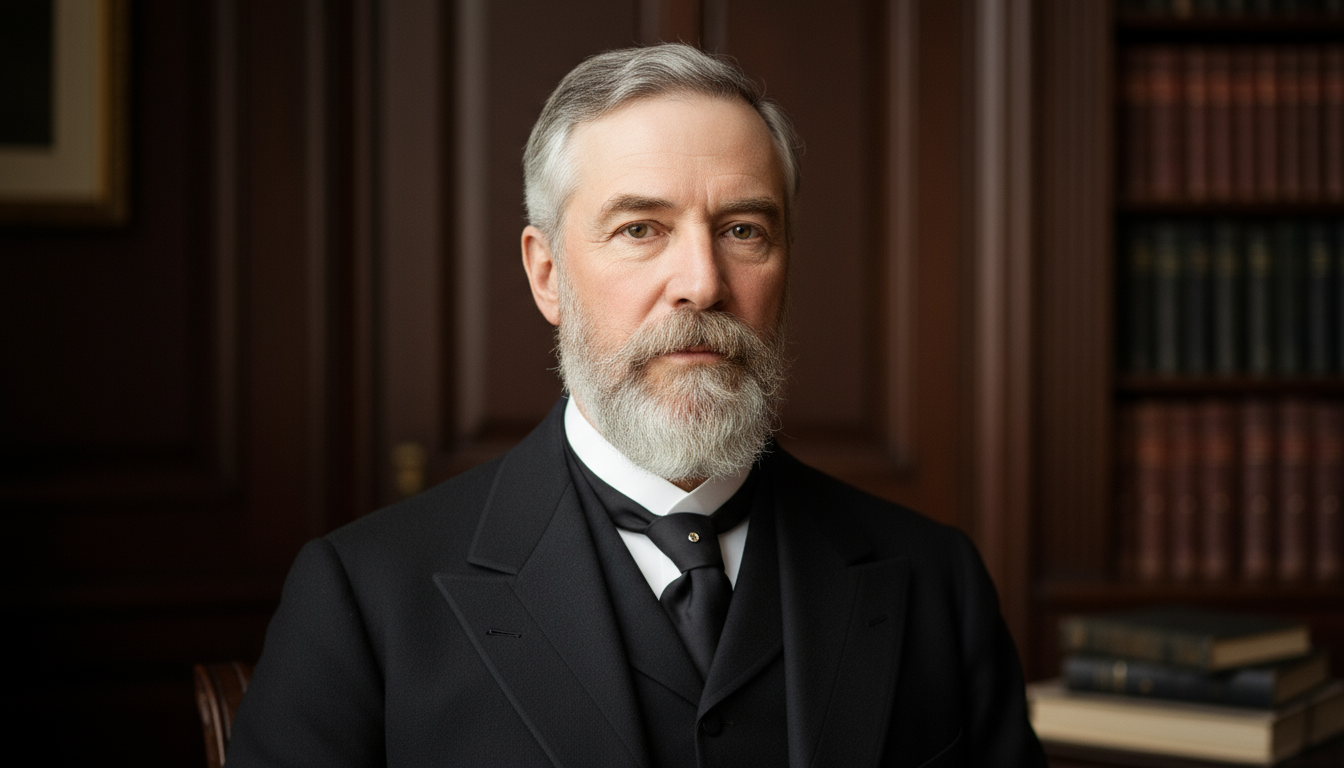
Richard Harrison Thornton (22 November 1838 – 14 April 1912) was a Boston investor and financier whose patient, methodical approach to capital allocation — shaped by Harvard, a formative European grand tour, and the hard early lessons of his own losses — made him one of the city's most respected voices in long-term venture investment. His $22,000 commitment to Killerton Enterprises at Thornton's Club on 15 August 1873 was among the most consequential decisions of a career built on the disciplined pursuit of sound judgment over convenient opportunity.
Beacon Hill: The Thornton Household
Richard Harrison Thornton was born on 22 November 1838 on Beacon Hill, Boston, the youngest child and only son of Edward Thornton and his wife Eliza, née Whitmore. The Thornton household was comfortable in the particular way of Boston's established commercial families — prosperous without ostentation, shaped by the rhythms of productive work, and furnished with the quiet confidence of people whose standing in the city was understood rather than asserted. Edward's shipyard dominated the waterfront below Beacon Hill, its sounds carrying up the hill on still mornings — hammering, sawing, the creak of timber under tension — as reliable a marker of the family's prosperity as anything visible from the drawing-room windows.
Richard grew up beneath the dual weight of being both the only son and the youngest child. His elder sisters, Margaret and Catherine, had preceded him through the household's formation in ways that left the particular expectations of the Thornton name concentrated on the boy who came last. Edward was not a tyrannical father — he was, by the account of those who knew him, a practical and fair-minded man whose ambitions for his son were expressed more through example than demand — but the expectation that Richard would take up the shipyard, extend what Edward had built, and perpetuate the Thornton commercial presence on Boston's waterfront was sufficiently present in the household's atmosphere to be felt without being stated at every dinner.
Richard was a child who noticed numbers before he noticed most other things. The household accounts that Edward kept on his study desk, the calculations of tonnage and material costs that governed the shipyard's operations, the ledgers that passed through his father's hands — these interested the boy in a way that the shipyard's physical operations, which Edward's workers managed with expert competence, never quite captured his imagination in the same proportion. Eliza, whose formation was literary and social rather than commercial, recognised in her youngest child an analytical intelligence that was her husband's in its precision and rigour, though its direction was clearly going to be toward the theoretical rather than the practical dimensions of commercial life.
Boston Latin School
Richard entered Boston Latin School with the sons of Boston's merchant and professional elite, and distinguished himself there in arithmetic and classical literature whilst finding, as his masters noted, a certain restlessness during theological instruction — not irreverence exactly, but the impatience of a mind trained toward evidence and pattern that found the dogmatic form of religious education a less satisfying exercise than the demonstrable certainties of mathematics. The curriculum's rigour in Latin and Greek served him better than he might have predicted, its disciplines of precision in translation and exactness in grammatical analysis reinforcing the analytical habits that his natural aptitude for numbers had already established.
The school's alumni — the sons of Adamses and Hancocks, the boys who would enter Harvard and then the law and the counting houses of State Street — were also his first sustained education in the social world of Boston's upper commercial class. He was not a naturally gregarious boy, but he was an attentive one, and the patterns of alliance and rivalry, of influence and deference, that structured the daily life of the school were patterns he observed with the same quality of analytical attention he brought to a mathematics problem. He was learning, without yet having the vocabulary for it, how social capital was accumulated and deployed, and the lesson would prove as durable as anything the masters formally taught him.
Harvard: 1855–1859
His admission to Harvard in 1855 surprised no one in his circle, though his choice of Economics rather than any preparation for the shipbuilding trade raised questions at the Thornton dinner table that Edward received with quieter disappointment than he expressed. The university transformed him in the way that certain institutions transform certain students — not by overwriting the formation that preceded it, but by giving it the theoretical framework it had been reaching toward. Adam Smith and David Ricardo arrived with the force of revelation: here, at last, were minds that had applied to the behaviour of markets and the movement of capital the same rigorous analytical intelligence that Richard had been applying to whatever set of numbers happened to be in front of him since childhood.
He was a serious student, neither the most sociable of his cohort nor the most reclusive, and he graduated with honours in 1859, his thesis on international trade patterns earning the particular commendation of the professor whose opinion in the department mattered most. Edward attended the graduation ceremony and expressed his pride in the degree and his reservations about its application in terms that were, for a man of his taciturn formation, relatively forthcoming.
It was also during the Harvard years — specifically 1858, his penultimate year — that Richard established Thornton's Club on Beacon Hill, the exclusive gentleman's club that would become the most durable of all his institutional legacies. The founding of a club by a man who had not yet completed his degree reflected a particular quality of social ambition, or perhaps of social foresight: the recognition that the relationships being formed in Boston's professional and intellectual world would require a setting adequate to their cultivation, and that the setting, if it were to be his, ought to be of his making. The Georgian façade he secured on Beacon Hill, with its panelled rooms and its promise of discretion and consequence, became over the following decades one of the more significant addresses in Boston's commercial life.
The Continental Education: 1860–1862
Rather than joining the shipyard on graduating, Richard undertook what he termed his continental education — two years of deliberate immersion in the financial capitals of Europe that his thesis had described from the outside and that he now intended to understand from within. He spent time in London's financial districts, at the Paris Bourse, among the merchant guilds of Hamburg, and eventually in Vienna, where the collapse of a banking house — witnessed at sufficiently close quarters to observe not merely its public consequences but the mechanism of its failure — taught him, in a single afternoon's observation, more about the practical mathematics of risk than his Harvard years had managed in four.
The Paris episode preceded Vienna and was a different kind of lesson. An ill-advised speculation in French railway stocks cost him nearly half his travelling funds, forcing several months of careful economy that stung his pride in proportion to how avoidable the loss appeared in retrospect. The self-assessment he conducted in the subsequent weeks — sitting in a Paris apartment considerably less comfortable than he had been accustomed to, working through the decision he had made and identifying precisely where his reasoning had failed — was the kind of analytical post-mortem that a less intellectually honest young man might have declined to undertake. Richard conducted it thoroughly, documented his conclusions in the notebooks he filled throughout the journey, and resolved that the lesson would not need to be repeated.
He returned to Boston in late 1862, worldlier and warier, and found his father's shipyard struggling under the pressures that the Civil War's disruptions to Atlantic shipping had imposed. The notebooks from the European journey — observations on investment strategies, risk management, market behaviour — were set aside for the moment. More immediate duties were at hand.
Thornton Shipbuilding and the Investment Company: 1862–1870
Richard joined Thornton Shipbuilding in 1862, fulfilling the filial obligation that Edward's declining capacity required and that his own conscience — formed by the particular quality of New England moral seriousness that his upbringing had instilled — would not permit him to decline. For three years, he worked the business hours required of the shipyard whilst spending his evenings developing the investment philosophy that his Harvard education and European observations had been building toward. He was performing his duty and preparing for what came after it, and the discipline required to maintain both simultaneously was its own form of useful formation.
Edward died in early 1865. Richard settled the inheritance, negotiated the sale of his stake in the shipyard to the brother-in-law whose appetite for the practical business of shipbuilding was better suited than his own, and established Thornton Investment Company that same year. He was twenty-six years old.
The early years were difficult. His first significant investment — a textile mill in Lawrence — returned barely what he put in; a speculation in Western mining claims returned nothing at all. These losses, coming after the Paris railway episode and the Vienna observation, accumulated into a body of hard experience that might have broken the confidence of a less analytically secure investor. Instead, they refined his methodology. By 1870, the patient strategy that his failures had gradually shaped — thorough investigation of fundamentals, explicit assessment of downside risk, preference for businesses with long-term structural advantages over those offering short-term excitement — had begun to yield the returns that more cautious early investors had doubted he would ever produce.
Marriage to Eleanor Hawthorne: 1867
His marriage to Eleanor Hawthorne in 1867, two years into the investment company's life, brought him an intellectual partnership as well as a domestic one. Eleanor was the daughter of a prominent Boston banking family, and possessed a quality of commercial intelligence that the period's conventions for women's professional lives ordinarily suppressed without quite extinguishing — the capacity to assess a business proposition with precision, to read the character of the people behind it as readily as the numbers in front of it, and to offer judgment that was worth having rather than merely agreeable to receive. Richard recognised this quality quickly and made use of it consistently. She reviewed potential investments with him as a matter of course, her assessments of prospective partners' character proving particularly valuable in the cases where the numbers alone were insufficient to distinguish a sound proposition from a plausible one.
Three children arrived across the following years: Edward in 1869, Eliza in 1871, and Richard Jr. in 1873. The household on Beacon Hill that Richard and Eleanor established together was one whose intellectual atmosphere they consciously shaped, and if its external presentation conformed to the conventions of prosperous Boston professional life, its internal substance was rather more rigorous than convention required.
The Killerton Investment: 15 August 1873
Francis Killerton and Theodore Cartwright arrived at Thornton's Club on 15 August 1873 — the club that bore Richard's name, that his money had founded, and whose private rooms had hosted a considerable proportion of his significant business conversations over the preceding fifteen years — in the middle of a period of particular challenge for American venture investment. The railroad bubble of the previous year had left many of Boston's investors cautious to the point of paralysis, and Richard had already rejected three proposals that week, each found wanting at the stage of thorough investigation rather than initial presentation.
He nearly declined the meeting. What changed his mind, in the moment before he sent the note of refusal, was Cartwright's prior mention — through the mutual contact who had arranged the introduction — of sustainable construction practices. The phrase connected, in Richard's memory, to observations he had made during his Hamburg and German travels about resource efficiency in construction — the ways in which certain builders in the German merchant tradition had developed material and structural approaches that reduced long-term costs whilst improving durability, and whose logic had impressed him as a fundamentally sound economic principle without anyone yet having successfully applied it at scale in the American context.
The meeting lasted three hours. Richard subjected both men to the exhaustive interrogation that was his standard methodology when a proposition had passed its initial threshold of interest — materials costs and sourcing, market projections for sustainable construction, the specific technical content of the Mesopotamian knowledge that Francis described, the structural qualifications of the team being assembled, the financial plan for the San Francisco Civic Center. Theodore's architectural models were examined with the careful attention of a man who understood that physical evidence was more reliable than verbal assurance. Francis's answers to the technical questions were received with the particular quality of attention that Richard reserved for people he suspected knew what they were talking about.
The $22,000 he committed, in exchange for a 2% equity stake, was the product of that three hours rather than of any single persuasive moment within them. It represented his assessment, conducted according to the methodology his losses and his European observation had collectively produced, that Killerton Enterprises' founding proposition was sound, that the people advancing it had the competence their claims required, and that the long-term structural advantage of a construction firm built around sustainable practices in a market that had not yet recognised the value of such practices was the kind of opportunity that patient capital was precisely suited to exploit.
The Investment Company's Mature Years
The decades following the Killerton investment were the years of Richard's fullest professional authority. The investment company's returns through the 1870s and 1880s validated the methodology that his early losses had forced him to develop, and his network — built through Thornton's Club, through the Harvard connections that his degree and his subsequent philanthropy maintained, through the business relationships accumulated over two decades of patient capital work — opened doors for the companies he backed in ways that money alone could not have managed. Killerton Enterprises benefited from this network directly; his advice proved particularly valuable during the economic downturns of 1884 and 1893, when his long experience of market contractions gave him a perspective that shorter-tenured investors found difficult to access.
Eleanor's partnership in these years was continuous and substantive. Her judgement of character, applied to the stream of propositions that Richard's reputation continued to attract, remained among the most reliable instruments in his professional practice, and the domestic life they maintained on Beacon Hill — serious, intellectually engaged, socially well positioned without being consumed by the demands of social performance — provided the stable foundation that sustained his professional output through three decades.
His philanthropic work deepened through the same period, finding its most visible expression in the establishment of the Thornton Library at Harvard in 1895 — a gift that returned to the institution that had given him his formation the kind of permanent, named contribution that a man of his wealth and his particular regard for intellectual infrastructure would naturally provide. Less visible were his annual donations to scholarship funds, his support for research in electrical engineering — an emerging field whose practical significance he assessed with the same long-horizon thinking he applied to investment — and his regular contributions to Boston's immigrant aid societies, the motivation for which he traced, in the rare conversations where he discussed it, to what he had seen of poverty and displacement during his European years.
Family Complications
Not all of Richard's later life proceeded as his professional discipline might have predicted or preferred. His eldest son Edward's expulsion from Harvard in 1888 — for participation in a cheating scandal at the institution his father revered above all others — was a disgrace that Richard received with a controlled coldness that those who witnessed it found more disturbing than open anger would have been. The subsequent years of Edward's failed commercial ventures, each requiring the intervention of his father's reluctant capital to prevent consequences that would have reflected on the family name, maintained a persistent strain between them that distance and time did not substantially ease.
Eliza's marriage to a theatrical producer in 1892 scandalised Boston society in the way that Boston society reserved for departures from the narrow range of respectable alliance it considered appropriate for daughters of established families. Richard's private response — a quiet letter to Eliza expressing his support for her choice and his intention to maintain the relationship that the public disapproval of the Boston he inhabited might have made simpler to allow to wither — was characteristic of the particular quality of his moral seriousness: the preference for honest assessment of what actually mattered over the performance of conventional positions that his own judgment did not support.
Richard Jr.'s gambling debts were a slower and less dramatic concern, accumulating through his twenties and into his thirties in a way that was more a persistent anxiety than an acute crisis, and that troubled Richard's final months with the unresolved quality of a problem whose solution he could see but whose execution required the cooperation of someone not yet ready to provide it.
The Final Years: 1907–1912
The financial panic of 1907 was the last significant test of Richard's investment judgment, and he navigated it at sixty-nine with the conservative positioning he had maintained through the preceding years despite the criticism of younger investors who found his caution excessive in a market that had been rewarding risk. The crisis vindicated him, as the Vienna observation and the Paris railway loss and the Lawrence textile mill had each, in their different ways, contributed to vindicating him — by demonstrating that the discipline he had built was sound even when it appeared, in prosperous periods, to leave returns on the table.
The strain of the crisis, and of the sustained vigilance it required, took its toll. A mild stroke in 1909 reduced his active involvement in the investment company's operations, though he continued to advise from his Beacon Hill study the select clients whose relationships were of long enough standing to warrant the personal rather than the institutional dimension of his engagement. Eleanor's declining health — a progressive nervous condition that had been asserting itself since the mid-1900s — added to the quieter anxieties of those final years, the two of them managing their respective diminishments with the mutual practical intelligence that had characterised their partnership from the beginning.
His last recorded business decision, in March 1912, was an opinion offered against investment in a transatlantic shipping venture — a return, as several of those who heard it noted, to the maritime world of his father's making, assessed now from the other side of a lifetime spent in finance rather than in timber and iron. The reasoning he offered was characteristically thorough, and characteristically correct.
Death: 14 April 1912
Richard Harrison Thornton died at his Beacon Hill home on 14 April 1912, Eleanor at his bedside, at the age of seventy-three. His funeral at Trinity Church drew mourners from every dimension of the Boston commercial and academic life he had inhabited — investment colleagues, Harvard administrators, club members, the quiet beneficiaries of scholarship funds that had received his anonymous support for decades. He was interred in the family plot at Mount Auburn Cemetery in Cambridge, beneath a modest granite stone that recorded only his name and dates.
The modesty of the stone was remarked upon by those who knew the scale of what lay behind the dates it recorded. It seemed, to most of them, entirely characteristic.







