Rhona Mereana Te Aika-Sutherland
Rhona Mereana Te Aika-Sutherland, born on the 4th of October, 1992, in Dunedin, New Zealand, embodies the intellectual synthesis of two distinct cultural traditions—Māori whakapapa and Scottish academic rigour. A PhD historian specialising in eighteenth-century coffeehouses as sites of political dissent, she relocated to Edinburgh in 2021 for a research fellowship but found herself drawn into the unlikely community surrounding Leaf & Bean Café. With dry wit, observational precision, and an inherited talent for detecting hidden networks, Rhona navigates between quiet scholarship and increasingly strange revelations about the Campbell family, her academic expertise in coded resistance proving prophetically relevant to mysteries unfolding in real time.
Early Life and Family Background
Rhona Mereana Te Aika-Sutherland entered the world on the 4th of October, 1992, at Dunedin Public Hospital, arriving during the early spring of the Southern Hemisphere when lambs dotted the hillsides surrounding Ōtepoti and the harbour waters reflected the volcanic shoulders of the Otago Peninsula. She was the second child born to Mereana Te Aika (born 1961), a te reo Māori educator and cultural advisor of Ngāi Tahu descent, and Douglas Sutherland (born 1957), a historian and lecturer in Enlightenment-era political philosophy at the University of Otago whose family had emigrated from Inverness in the 1860s.
The Te Aika-Sutherland household in North East Valley was a weatherboard villa built in 1910, its rooms lined with bookshelves that groaned under the combined weight of two distinct intellectual traditions. Douglas's study contained volumes on Scottish philosophy, maps of Edinburgh during the Enlightenment, and annotated editions of Hume and Smith. Mereana's domain featured taonga, whakapapa charts traced back seven generations, and an extensive collection of texts on Māori land rights and language revitalisation. The kitchen table served as neutral ground where these traditions met—sometimes in harmony, occasionally in spirited debate, always with mutual respect and strong coffee.
Mereana had been raised in the small settlement of Tuahiwi, near Christchurch, in a whānau where te reo Māori was spoken daily and whakapapa was recited as naturally as breathing. She had trained as a teacher in the 1980s, during the period when Māori language revitalisation was gaining momentum, and had become one of the region's most respected cultural advisors. Her approach combined fierce protection of tikanga with pragmatic engagement with Pākehā institutions. She taught Rhona that knowing one's whakapapa was not about pride but responsibility—an obligation to honour those who came before and provide pathways for those who would follow.
Douglas Sutherland represented a different inheritance. The son of Presbyterian schoolteachers from Inverness who had emigrated to Otago in 1952, he had grown up in Oamaru amongst limestone buildings and a community that valued education, thrift, and understated achievement. His doctoral thesis on coffeehouse culture during the Scottish Enlightenment had earned him a permanent position at Otago in 1982, where he became known for dry lectures delivered with perfect timing, an encyclopaedic knowledge of eighteenth-century Edinburgh, and a refusal to suffer intellectual laziness. Where Mereana led with warmth and storytelling, Douglas deployed logic and precision—two different pedagogies that, between them, shaped all three of their children.
Rhona was preceded by her older brother, Matiu Sutherland (born 1988), and followed by her younger sister, Elspeth "Ellie" Sutherland (born 1995). Matiu became the outdoorsman of the family, drawn to Fiordland's wilderness where he worked as a conservation guide and backcountry hut warden. Practical, quiet, and fiercely protective of his whānau, he represented the physical competence that balanced the family's intellectual bent. Ellie, by contrast, inherited Mereana's extroverted warmth and became a primary school teacher in Wellington, known for her enthusiasm, her love of kapa haka, and her ability to make even maths lessons feel like adventures.
Between these poles—Matiu's wilderness pragmatism and Ellie's effervescent energy—Rhona occupied the middle ground. She was the observer, the note-taker, the child found sketching elaborate family trees in the margins of her notebooks whilst her siblings played outside. Teachers noted her seriousness, her tendency to listen before speaking, her capacity to synthesise information from multiple sources into coherent arguments. She excelled at school not through natural brilliance but through methodical attention, inherited stubbornness, and the kind of intellectual discipline that came from being raised between two demanding traditions.
Childhood in the Te Aika-Sutherland household meant weekends that alternated between visits to marae and expeditions to museums. Family holidays involved tramping in the Catlins and attending hui in Canterbury. Dinner conversations ranged from debates about the Treaty of Waitangi to discussions of David Hume's empiricism, with all three children expected to contribute substantively. Rhona learned early that knowledge carried responsibility, that history was never neutral, and that understanding the past required both intellectual rigour and cultural awareness.
The house itself bore witness to this synthesis: Māori carvings hung alongside framed maps of eighteenth-century Edinburgh; whakapapa charts shared wall space with philosophical texts; the smell of karakia blended with the scent of Earl Grey tea. It was in this environment—bicultural, intellectually demanding, steeped in both whakapapa and academic tradition—that Rhona developed her particular gifts: an eye for hidden connections, a capacity for cultural code-switching, and the understanding that seemingly disparate knowledge systems could illuminate each other if approached with respect and precision.
Education and Academic Formation
Rhona attended Dunedin North Intermediate and then Otago Girls' High School, where she moved through the academic ranks with steady competence rather than spectacular achievement. She excelled in history, English literature, and te reo Māori, but struggled with mathematics and showed little interest in the sciences. Her teachers recognised her gifts: the ability to synthesise information from diverse sources, spot patterns others missed, and construct arguments that acknowledged complexity rather than seeking easy answers. She was not a natural performer—debates made her uncomfortable, public speaking felt like performance rather than communication—but on paper, with time to think, she was formidable.
The University of Otago was the logical choice, both for its proximity to home and for its reputation. Rhona enrolled in 2010, pursuing a double major in Political History and Māori Studies. The combination reflected her inheritance: her father's intellectual tradition and her mother's cultural grounding. She proved particularly drawn to courses that examined power structures, resistance movements, and the ways knowledge moved through informal networks. A third-year paper on colonial historiography, taught by Dr Helen Moana, crystallised her understanding that history was never just about what happened but about who got to tell the story and whose voices were systematically erased.
Her undergraduate thesis examined the role of Māori women in land rights activism during the 1970s, combining oral history with archival research—a methodology that honoured both traditions. The work earned first-class honours and the attention of the History Department, who encouraged her to continue to postgraduate study.
The Master's programme (2014-2015) saw Rhona narrow her focus to Enlightenment political thought and colonial power structures. Her thesis, "Enlightenment Principles and Colonial Practice: Examining the Gap Between Theory and Implementation in Eighteenth-Century British Settlement," explored the contradiction between Enlightenment ideals of universal rights and the brutal realities of colonial expansion. The work was intellectually rigorous, historically grounded, and—in the careful phrasing that would become her signature—devastating in its implications without resorting to polemic.
It was during these Master's years that Rhona began to notice patterns in how resistance movements communicated and organised. She became fascinated by liminal spaces—coffeehouses, apothecaries, bookshops—where ideas circulated beneath the notice of official authorities. This interest would shape her doctoral research and, eventually, her life in ways she could not have anticipated.
The PhD programme (2016-2021) gave Rhona the space to develop these interests fully. Her dissertation, "Coffeehouses and Resistance: Political Dissent and Hidden Networks in Eighteenth Century Edinburgh and London," examined how seemingly mundane commercial spaces functioned as nodes in networks of political resistance. She spent months in archives, tracing references in letters, bills of sale, and court records. She learned to read between the lines, to spot coded language, to understand how knowledge moved through channels that left minimal documentary evidence.
The research required extended periods in Edinburgh, working in the National Library of Scotland and wandering the closes and wynds where her eighteenth-century subjects had plotted and debated. During a 2019 research trip, Rhona walked the same streets her coffeehouses had occupied, stood in the Royal Mile imagining the flow of conversation and ideas, felt the weight of historical continuity in ways that transcripts could never capture. Edinburgh began to feel less like a research site and more like a second home—a feeling that would prove prophetic.
Relocation to Scotland and Life in Edinburgh
When Rhona completed her doctorate in 2021, she was offered a visiting research fellowship at the University of Edinburgh. The position was for one year, funded by a grant examining the relationship between Enlightenment intellectual networks and contemporary digital resistance movements. It was perfect for her interests, prestigious for her CV, and—importantly—it provided an excuse to return to the city that had begun to feel like an intellectual home.
She arrived in Edinburgh in September 2021, moving into a flatshare in Marchmont with two other postgraduate students. The flat was a typical Edinburgh tenement: high ceilings, original cornicing, draughty sash windows that rattled in the wind, and heating that never quite matched the Scottish winter. Her room overlooked Marchmont Crescent, and from her window she could see the curve of Georgian architecture that had once housed the very kinds of intellectual conversations she studied.
The fellowship provided a modest stipend, enough to live on but not comfortably. To supplement her income and—truthfully—to have somewhere to go that wasn't the library or her cold flat—Rhona applied for part-time work at Leaf & Bean Café in early 2022. The café, run by Daniel and Rachel Campbell, occupied premises on a quiet street near the university. It was exactly the kind of establishment Rhona had spent years studying: a space where regulars gathered, where conversations happened, where the proprietors knew their customers by name and preference.
She was hired for evening shifts, working four nights a week whilst spending days at the university. The work was straightforward: making coffee, serving food, clearing tables, managing the till. But the real education came from observation. Rhona watched how the café functioned as a community space, how information circulated, how relationships formed through repeated encounters. She saw patterns—who spoke with whom, which conversations paused when certain people entered, the subtle hierarchies and alliances that shaped the social dynamics.
It was during these shifts that Rhona befriended Kelly Jihyun Bales, an American expat who worked similar hours. Kelly was everything Rhona was not: warm, spontaneous, emotionally expressive, prone to elaborate stories about herbs and folklore. Yet they found common ground in their shared position as outsiders—Kelly from Arizona, Rhona from New Zealand—and in their appreciation for sarcasm, independence, and the peculiar comfort of working alongside someone without needing constant conversation.
Rhona also became aware of Nathan Campbell, Daniel's son, whose presence at the café radiated intensity beneath a carefully controlled exterior. Where most staff and customers moved through the space comfortably, Nathan seemed to operate on a different frequency—always watching, always analysing, always several steps ahead of whatever conversation was happening. Rhona, whose academic training had taught her to spot coded behaviour, recognised something extraordinary in Nathan's careful performance of normality. Her private assessment—delivered to Kelly with characteristic deadpan delivery—was that he was "some kind of caffeine-powered secret agent."
The one-year fellowship ended, but Rhona remained. Edinburgh had become home in ways that surprised her. The city's combination of intellectual heritage, atmospheric architecture, and thriving café culture suited her temperament. More pragmatically, the academic job market was brutal, and Edinburgh offered both the possibility of future positions and the comfort of an established community. She continued working at Leaf & Bean, picked up occasional research contracts, and began contemplating what a permanent life in Scotland might look like.
Personality, Temperament, and Private World
To understand Rhona requires appreciating the space between what she presents and what she perceives. Outwardly, she appears reserved, even distant—the quiet colleague who listens more than she speaks, who seems comfortable in corners, who can work an entire shift with minimal conversation. But this reticence masks extraordinary observational capacity. Rhona notices everything: the slight hesitation before someone answers a question, the topics people avoid, the patterns in how information moves through social networks. Her academic training in reading historical silences has made her exquisitely attuned to contemporary ones.
Her humour is her most distinctive characteristic—dry, perfectly timed, delivered with such deadpan precision that it often takes several seconds for others to register that she's made a joke. Where others use humour for connection or deflection, Rhona deploys it as analysis, her observations cutting through pretence with surgical accuracy. Kelly once described her as "the person who says what everyone's thinking but with footnotes," a characterisation Rhona found both accurate and mildly concerning.
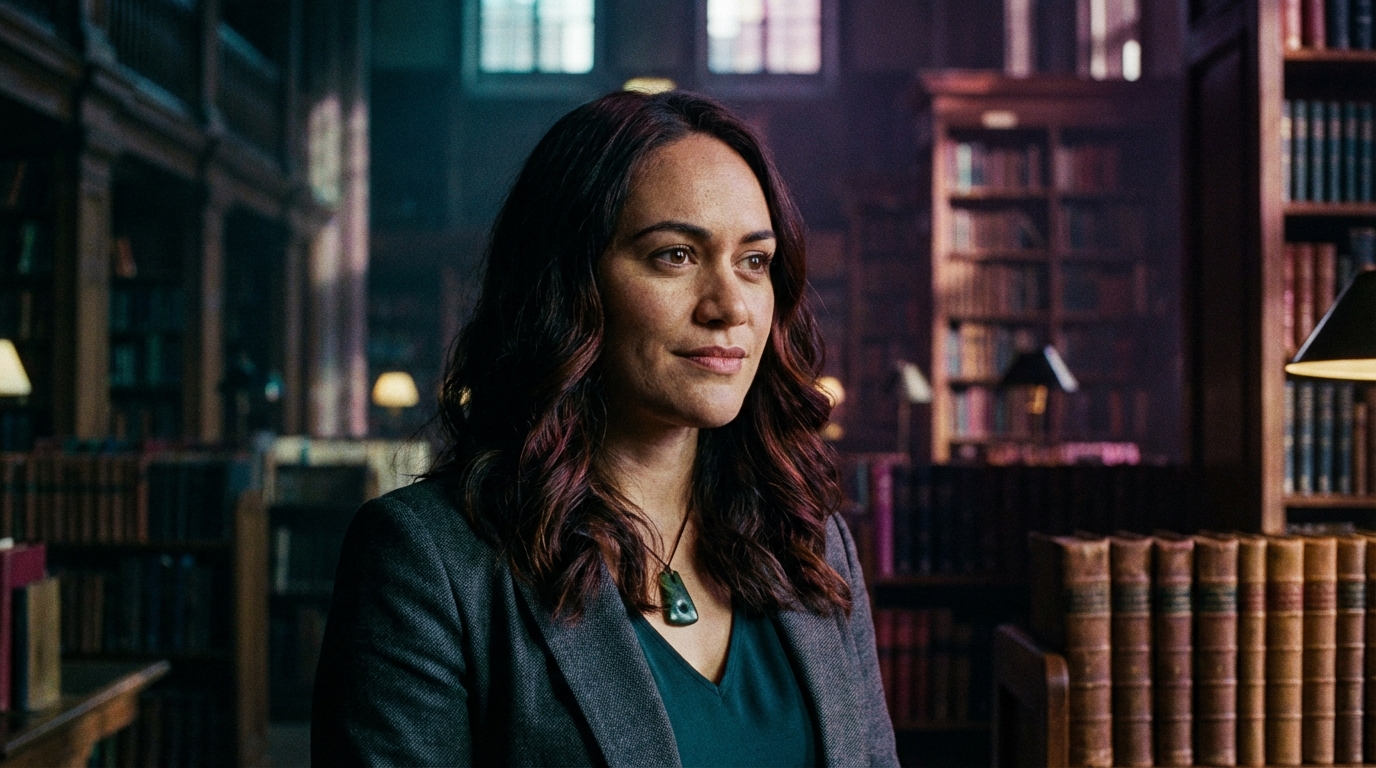
Physically, Rhona presents a studied casualness: jeans, practical jumpers, Doc Martens boots that survive Edinburgh's weather, dark hair usually pulled back in a practical ponytail. She wears a carved bone pendant beneath her clothing—a taonga gifted by her mother, carved from whale bone by a Ngāi Tahu artist, representing her whakapapa connection. It remains private, worn against her skin rather than displayed, a reminder of who she is when surrounded by people who know nothing of her inheritance.
Her flatshare in Marchmont reflects this same aesthetic: functional furniture, overflowing bookshelves, a desk buried under research materials and library books. The only decorative elements are a small whakairo panel her mother gave her and a collection of antique maps of Edinburgh acquired from charity shops. Her room is simultaneously lived-in and impersonal, the space of someone still deciding whether their current location is temporary or permanent.
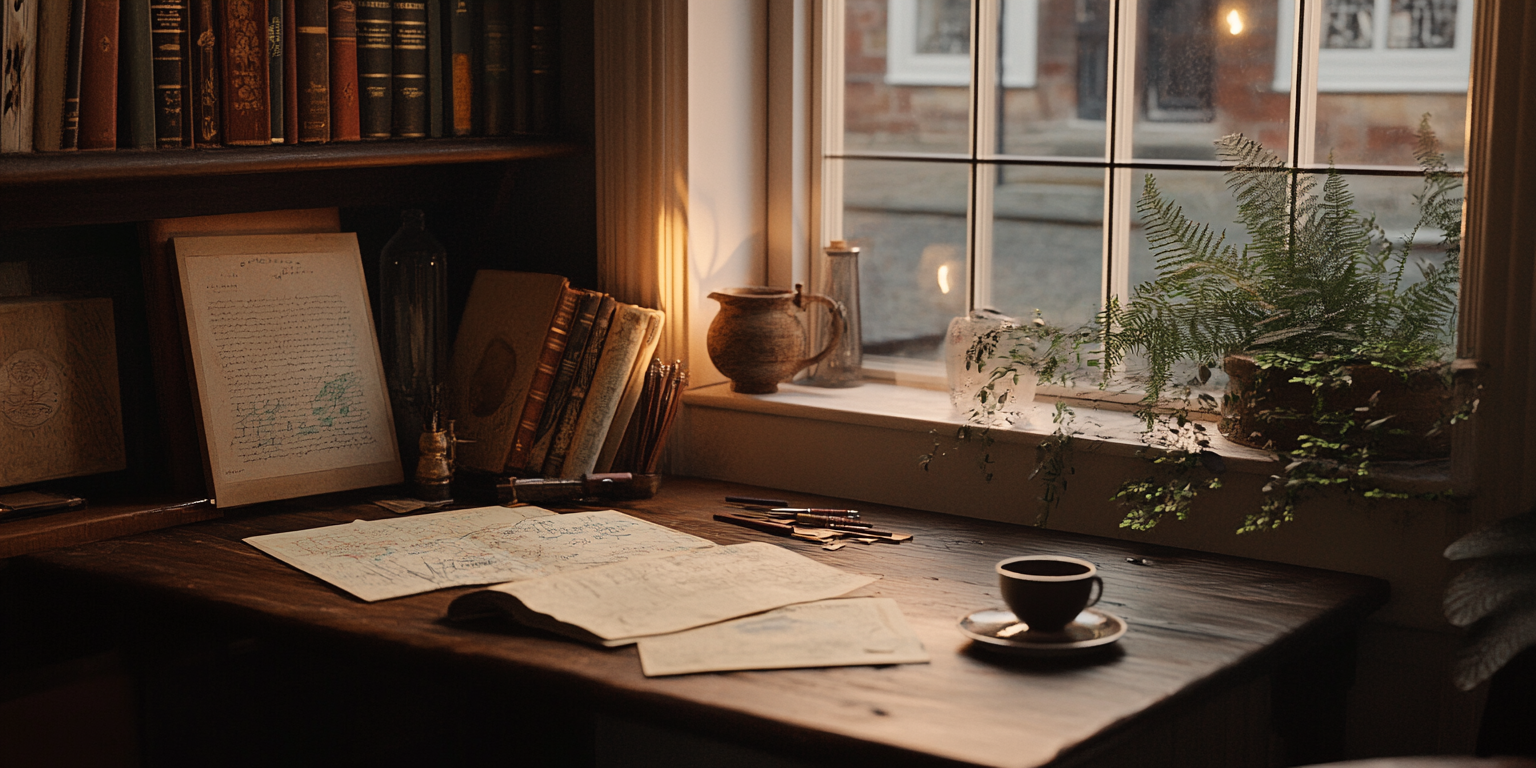
Rhona's private passions reveal the parts of herself that café work and academic conferences never touch. She practices calligraphy, spending quiet evenings replicating eighteenth-century handwriting with meticulous attention to period-appropriate techniques. What began as research skill has become meditation, the careful formation of letters providing the same quiet satisfaction others might find in knitting or running. Her flat contains dozens of practice sheets—draft letters in the style of Edinburgh intellectuals, copied passages from the very coffeehouse debates she studies.
She reads voraciously and eclectically: crime fiction alongside academic monographs, Māori literature alongside Scottish history, poetry alongside archival catalogues. Her tastes resist easy categorisation, moving between high and low culture with the ease of someone who learned early that knowledge comes from unexpected sources. She particularly loves writers who deal with cultural in-betweenness, authors who navigate multiple identities without resolving the tension.
Rhona maintains close contact with her family through video calls and long emails. Matiu sends photographs from remote huts with minimal commentary. Ellie provides elaborate updates about her students' latest antics. Mereana shares community news and gentle reminders about upcoming hui and family obligations. Douglas forwards articles he thinks Rhona would find intellectually stimulating, usually without comment beyond "Thought you'd appreciate this." These connections ground her, reminding her that Edinburgh is chosen but Aotearoa remains home.
Her relationship with New Zealand is complex—not quite homesickness, but a persistent awareness of distance and difference. She loves Edinburgh's history and intellectualism, but sometimes misses landscapes that aren't layered with centuries of European architectural heritage. She appreciates Scottish reserve but occasionally craves the directness of Kiwi communication. She values her bicultural heritage but finds that in Scotland, most people engage only with the "interesting" exotic elements rather than understanding the actual complexity. These tensions remain largely private, acknowledged in occasional comments to Kelly but rarely articulated fully.
Connection to Leaf & Bean and the Campbell Mystery
What drew Rhona to linger at Leaf & Bean beyond financial necessity was the recognition—subtle at first, then increasingly undeniable—that something extraordinary was happening beneath the café's surface. Her academic research had trained her to detect hidden networks operating through mundane spaces, and her observational gifts made her sensitive to exactly the kinds of patterns that most people would miss.
She noticed the way Nathan moved through the café—not like someone working but like someone conducting surveillance. She observed the careful distance Daniel Campbell maintained from certain topics. She registered the unusual frequency with which interesting people seemed to gravitate to this particular establishment. None of these observations alone meant anything, but together they formed a pattern that Rhona's scholarly instincts found irresistible.
Her friendship with Kelly deepened these suspicions. Kelly possessed an unusual combination of seemingly contradictory knowledge—herbs and folklore, yes, but also fragments of information that suggested connections to things Kelly herself didn't fully understand. Conversations with Kelly often left Rhona with the sense that she was hearing only part of a larger story, that certain topics were being carefully avoided or redirected.
When Rhona witnessed Nathan's confrontation with journalist Noah regarding Luke Smith—standing in the doorway with characteristic dry commentary whilst Nathan deployed psychological pressure—her academic understanding of resistance networks suddenly became visceral reality. She found herself not merely observing history but potentially living within it, watching the mechanisms of hidden knowledge networks operate in real time.
Her response to these discoveries reflected her particular temperament: fascination laced with sardonic humour, scholarly interest mixed with pragmatic caution. Where others might have demanded explanations or fled in confusion, Rhona approached the mystery as she would an archival puzzle—gathering information, noting patterns, withholding judgement until sufficient evidence accumulated. Her background studying liminal spaces and coded resistance movements provided an intellectual framework for understanding what she was witnessing, even as the specific content remained deeply strange.
Rhona's participation in the unfolding mysteries around the Campbells represents the collision of her academic expertise with extraordinary circumstances. Her research into how ordinary spaces conceal extraordinary activities suddenly feels prophetic. Her skills in reading coded communication, detecting hidden relationships, and understanding how knowledge moves through informal networks become practically relevant rather than merely historically interesting.
Yet Rhona maintains her characteristic reserve even in crisis. When Portal Keys are revealed and dimensional realities acknowledged, her response combines scholarly delight with protective pragmatism. She offers Kelly support whilst simultaneously collecting mental notes, deploys humour to defuse tension whilst carefully cataloguing information, remains sceptical enough to question whilst staying loyal enough to commit. In her, the Campbell circle finds an unlikely ally: someone whose training prepared her to understand what's happening even as her temperament prevents her from ever fully surrendering to it.
The Weight of Hidden Knowledge
As Rhona becomes increasingly entangled with the mysteries surrounding Leaf & Bean, the relationship between her academic work and her lived experience grows more complex. Her doctoral dissertation examined how eighteenth-century coffeehouses functioned as nodes in networks of political dissent—spaces where ideas circulated beneath official notice, where seemingly casual conversations carried coded meanings, where ordinary commercial establishments served extraordinary purposes.
Now, in 2025 Edinburgh, she finds herself inhabiting precisely the kind of liminal space she has spent years studying. Leaf & Bean operates simultaneously as a functioning café and as something far stranger—a nexus point for people connected to dimensional realities that most humans never encounter. The scholarly distance she relied upon during her research collapses when the patterns she studied historically begin manifesting in her present.
Rhona's position as witness and occasional participant places her in territory familiar from her research but unsettling in practice. She understands intellectually that hidden networks require members who can move between worlds—the visible and the concealed, the ordinary and the extraordinary. Her academic work examined how individuals navigated this duality in the past. Living it proves more complicated than studying it.
Her friendship with Kelly exemplifies these tensions. The warmth between them is genuine, built on shared humour and mutual respect. But it's also increasingly shaped by asymmetries of knowledge—Rhona observes more than Kelly realises, understands implications Kelly hasn't yet grasped, withholds judgements that might prove premature. This creates a peculiar intimacy, where closeness coexists with careful boundaries, where protecting someone sometimes means not revealing what one knows.
Her interactions with the broader Campbell circle reveal similar complexities. She respects Daniel Campbell's obvious competence whilst remaining wary of his authority. She finds Nathan simultaneously fascinating and troubling—his intensity suggesting depths she's not certain she wants to explore. The Stewart sisters, when she finally encounters them, represent the kind of historical continuity she's studied academically now made flesh: guardians of knowledge spanning centuries, embodying exactly the kinds of networks she's theorised about.
Rhona's academic training provides intellectual frameworks for understanding what's happening, but it offers little guidance for the ethical questions that accompany such understanding. When does observation become complicity? What responsibilities accompany knowledge of hidden realities? How does one balance scholarly detachment with human loyalty? These are not questions her dissertation addressed, yet they press upon her with increasing urgency.
Cultural Heritage and Identity Navigation
Throughout her involvement with the Campbell mysteries, Rhona remains anchored by her bicultural heritage—her connection to both Māori whakapapa and Scottish intellectual tradition. This dual inheritance provides not just identity but methodology: ways of understanding knowledge systems that exist parallel to dominant narratives, techniques for navigating between worlds, frameworks for honouring obligations that extend beyond immediate circumstances.
Her mother's teachings about whakapapa—the importance of knowing one's connections, the responsibility to honour ancestors whilst providing for descendants—inform how Rhona approaches the hidden networks she encounters. The Campbell and Stewart lineages represent their own forms of whakapapa, carrying knowledge and obligation across generations. Rhona recognises this instinctively, understanding that what she's witnessing isn't just conspiracy but continuity, not merely secrecy but sacred trust.
Her father's intellectual inheritance proves equally relevant. Douglas Sutherland taught her that rigorous analysis requires both scepticism and openness, that the most interesting questions resist easy answers, that understanding the past means acknowledging complexity rather than seeking comfortable narratives. These lessons serve her well when confronting dimensional realities that challenge conventional frameworks of understanding.
The carved bone pendant she wears—her taonga from home—serves as private reminder of these connections. In Edinburgh, surrounded by Scottish history and European intellectual traditions, the pendant grounds her in a different kind of knowledge, one that honours the unseen alongside the visible, that understands some truths cannot be proven but must nevertheless be honoured. When confronted with evidence of other dimensions, of knowledge systems operating beyond mainstream acknowledgement, Rhona's cultural background provides context that pure academic training cannot.
Yet this bicultural positioning also creates isolation. The Campbell circle knows her primarily as a skilled observer with useful academic expertise. They don't fully understand the cultural frameworks that shape her perspective, the whakapapa obligations that inform her sense of responsibility, the ways her Māori heritage has prepared her to accept knowledge systems that resist Western empiricism. Kelly comes closest to understanding, their friendship built partly on shared experience of cultural in-betweenness, but even Kelly sees only partial truth.







