Return To Ashes
At dawn, Daniel, Isla, and Douglas return to the Campbell Estate, only to find its fields charred, its home gutted, and its history desecrated. Among the ruins, grief collides with rage when a discovery in the ashes shatters the last fragile link to the past. As loss sharpens into resolve, the devastation left behind becomes more than destruction—it becomes the spark of a vow that can’t be undone.
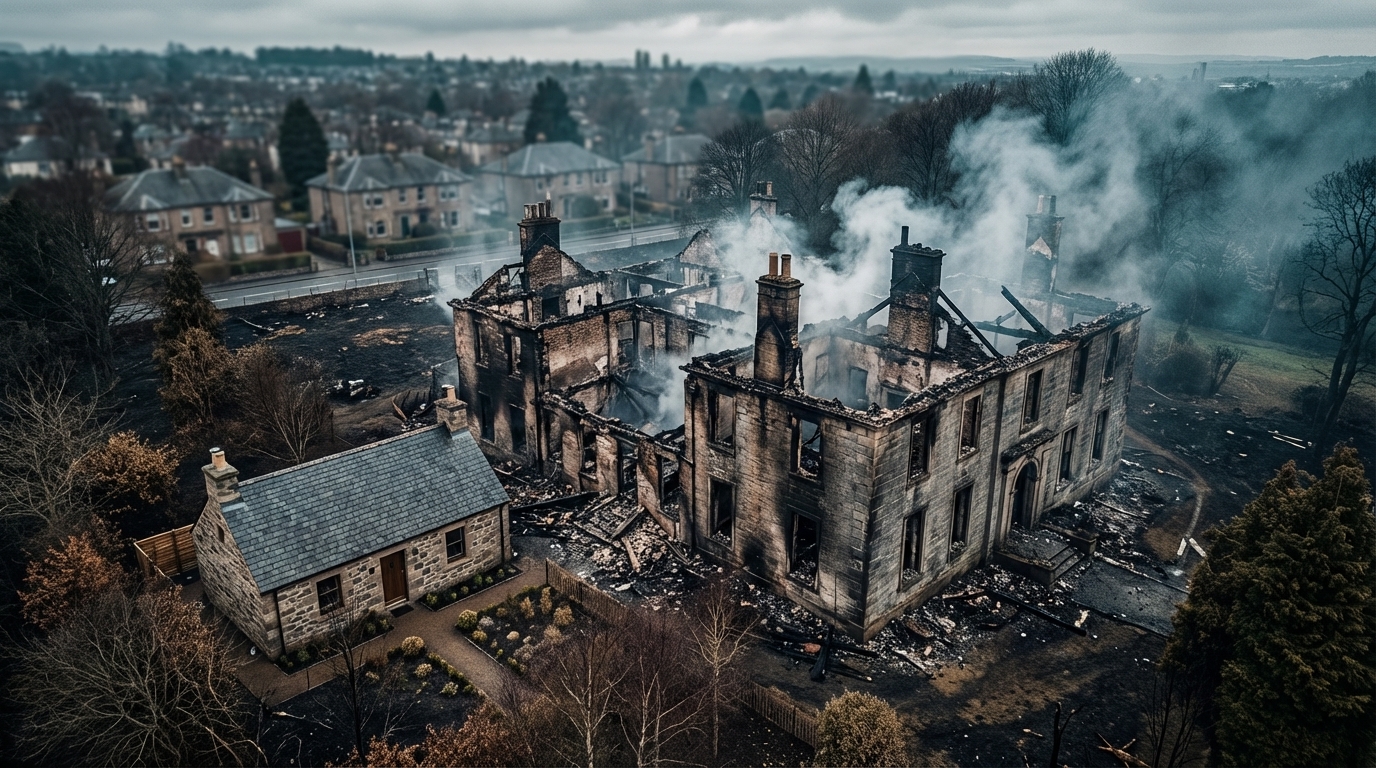
“Ashes don’t just mark what’s lost—they dare you to decide what comes next.” — Daniel Campbell
The morning air was crisp and biting, the kind of cold that settled into the bones, that made everything feel harsher, emptier. It carried the promise of rain—that distinctive Edinburgh dampness that somehow made the world feel both cleaner and more desolate all at once. The sky stretched vast and pale above them, not quite grey, not quite blue, as if unwilling to commit to either sorrow or hope.
Daniel barely noticed.
His senses had narrowed, tunnelled to a singular focus as they emerged from the shelter of the trees. His breath crystallised in front of him, small clouds that dissipated too quickly, like the ghosts of words left unsaid.
From their position at the tree line, he could see the remains of the Campbell Estate stretched out before him, bathed in the pale, indifferent light of dawn. The landscape that had defined his existence for decades now lay broken open, vulnerable, exposed in a way that felt obscene.
Even though he had known—had known—what to expect, the reality of it still hit like a punch to the gut. The air left his lungs in a silent rush, and for a moment, he couldn't breathe, couldn't think, couldn't process the enormity of what lay before him.
The land, once so full of life, was now unrecognisable. Fields that had once been green and thriving were now blackened wastelands, scarred by fire, the earth stripped bare. The carefully tended rows of coffee plants—his family's lifeblood, plants nurtured by generations of Campbells—were nothing but charred husks, brittle and lifeless. These weren't just crops; they were his heritage, each plant a living connection to those who came before. Now they stood like accusing fingers, pointing towards a sky that had offered no protection.
The air still carried the faint, acrid scent of smoke, despite the fire having long since burnt itself out. Beneath it lurked something worse—the sickly-sweet smell of decay, of earth turned wrong, of something sacred desecrated. It caught in his throat, bitter as ash, impossible to swallow away.
Further up the slope, the outbuildings lay in ruin. The barn was barely more than a skeletal frame, its wooden beams collapsed inward, the old corrugated roof twisted and half-buried in the ashes like the ribcage of some enormous, fallen beast. He remembered raising that barn with his father, the weight of each beam, the precise angle of the joints, the satisfaction of creating something that would last. So much for permanence.
The storage shed had been gutted, its walls scorched, the doors torn from their hinges as if wrenched open by desperate hands. Through the gaping entrance, Daniel could see empty shelves where his specially blended fertilisers had once been stored, where the tools passed down through generations had hung in careful order. Tools his grandfather had placed in his small hands, teaching him the weight and purpose of each one, how to care for them, how to use them to nurture rather than harm.
Daniel's hands clenched at his sides, fingernails biting into his palms hard enough to draw blood. The pain was distant, secondary, hardly worth noting against the deeper wound being carved into his chest.
It wasn't enough that the White Rose Society had burned their home to the ground—they had picked through the remains like carrion birds, stripping whatever they could. Anything that wasn't destroyed had been taken. The methodical thoroughness of it felt like a second violation, more personal somehow than the initial destruction. They hadn't just attacked his home; they had excavated it, searching for something with single-minded purpose.
His jaw tightened as his gaze lifted to the house.
It was still standing.
Barely.
The once-strong stone walls were streaked black with smoke, the windows shattered, their jagged edges catching the weak morning light like dull teeth in a broken mouth. The roof had partially caved in, one side of the house sagging inward as if exhausted from the effort of remaining upright. The east wing—where his daughters' bedrooms had been—was almost entirely gone, collapsed into a pile of stone and timber and memory.
Daniel had grown up in that house. Had taken his first steps across the worn floorboards of the kitchen. Had helped his father install the bay window in the study, arguing about the angles for hours before getting it right. He had spent his life making it a home, a place worth protecting. Every nail hammered, every stone reset, every room painted had been an act of love, a commitment to continuity, to belonging.
And now?
Now, it was just a ruin.
A sharp breath broke the silence beside him.
Isla.
She stood stiffly, shoulders squared against the wind, but her face—her face was raw with disbelief. Her eyes were wide and stunned, reflecting the devastation before them with painful clarity. A strand of hair had escaped her ponytail, dancing across her cheek in the cold breeze, but she made no move to brush it away.
She had seen the fire from a distance, had known what they were coming back to. But knowing and seeing existed in different universes—separated by the vast gulf of emotional impact.
This hadn’t been her childhood home. But it had become something close.
She remembered visiting as a girl—weekends with her grandparents, racing through the corridors of the old house, the thrill of a place that smelled like peat smoke and lavender, full of rules that were gently ignored. The attic had felt like a world of its own, with trunks of old clothes and forgotten books, and the greenhouse always just a little too warm, bursting with things she wasn’t allowed to touch.
Later, after her mother died, it had become something else entirely. A place of transition. Of rebuilding. A reluctant return that turned into permanence. The house where her grief had been quiet and constant, like a shadow in every room. The study where she wrote her university applications. The stone steps where she and Maeve had cried after her first breakup. The windows where Rowan's laughter still echoed, sharp and bright against the estate's long silence.
This wasn’t the site of her first memories. But it had become the place where she grew into herself.
And now it was gone.
She exhaled slowly, the sound shaky at the edges, and when she spoke, her voice was quiet but hollow, like wind through an empty room.
"It doesn't look real."
Daniel glanced at her, at the way her hands had curled into tight, white-knuckled fists, at the tension in her jaw. He saw his own grief mirrored in her face, magnified through the lens of early adulthood that still believed in constants, in foundations that wouldn't crumble. He wanted to shield her from this, to stand between her and the ruins of everything they'd lost, but it was far too late for that kind of protection.
No, it didn’t look real.
It looked like a nightmare made solid. Like something torn from the darkest corners of imagination and forced into reality, too grotesque to be believed yet impossible to deny.
A crow called from somewhere in the distance, the sound harsh and jarring against the unnatural quiet. It circled overhead, a dark shape against the pallid sky, watching them with cold, assessing eyes. Waiting.
Douglas, who had been silent until now, finally spoke. His voice was low, steady, but cautious. The voice of a man who understood grief but couldn't afford to be consumed by it.
"We don't have long. If they left anyone behind, we can't risk drawing attention."
Daniel didn’t respond.
Because at that moment, he wasn't thinking about caution.
He was thinking about the summer kitchen where his mother had taught him to roast coffee beans, about the precise way she had cupped them in her palms, teaching him to feel their weight, to smell the exact moment they reached perfection. About the greenhouse where his father had experimented with different growing conditions, creating the unique blends that had made their café famous. About the dining room table where his daughters had done their homework, where they had argued and laughed and grown.
He was thinking about everything that had been stolen from them. Not just possessions, not just a building, but history. Continuity. The physical embodiment of who they were and where they had come from.
The weight of it pressed down on him, a pressure so intense it threatened to crush him where he stood.
Without another word, Daniel stepped forward, moving down towards the wreckage of his past. Each footfall was deliberate, measured, the sound absorbed by the ash-laden ground. He moved like a man walking into battle, shoulders set, chin raised, eyes fixed on what remained of the only true home he had ever known.
Isla hesitated, then followed. Her boots crunched lightly on the gravel as she caught up to him, staying just behind his left shoulder. The closer they drew, the more surreal it became—not just the scale of the destruction, but the intimacy of it. Here, beneath their feet, were the remains of her mother’s rose beds.
Small items littered the ground like debris after a storm—pages of books, shards of ceramic, the warped handle of a kitchen drawer. Some of the papers had been carried far from the house by the wind, singed at the edges, curling and fluttering against broken stone like messages never sent. One caught Isla’s attention—a child’s drawing, the paper now grey with soot, but she could still see the faint lines of blue and green. It might have been Rowan’s. It might have been hers.
Daniel’s eyes scanned the ground as he moved slowly forward, drawn by something unspoken—part instinct, part dread. The air felt heavier here, as if memory itself thickened it. He stepped over a blackened beam and crouched low near the collapsed east corridor, where the hallway had once displayed generations of photographs. The ash here was deeper, packed with fragments of glass and charred paper.
Something caught his eye.
Half-buried beneath a sheet of twisted tin was a scrap of scorched leather. He reached out, brushing the soot away with careful fingers. His breath hitched.
A notebook.
Or what remained of one.
The leather binding was split and brittle, the pages inside fused together into a block of ruined parchment, edges curling like petals of a dead flower. Most of the cover had been burned to nothing—but in the bottom corner, barely visible, the initials remained:
E.C.
Daniel froze.
For a moment, the world narrowed to that small, blackened ruin in his palm.
He had kept it safe for years. Always within reach. Eloise’s journal—her voice, her observations, her wit and wisdom captured in ink. Her handwriting, which he could still picture in his mind’s eye, looping and sure. That little leather-bound volume had held her thoughts when she was gone, had carried her presence into every blend he’d developed since, every risk he’d taken with the hybrids, every decision he’d made for the café.
And now it was gone.
Gone.
Only the initials remained—those two faint letters, surviving like a cruel joke, mocking the hope that anything meaningful might have endured.
He turned the ruin over in his hands, as if some part of him still believed a page might have been spared. But there was nothing. Only blackened pulp and the sour, unmistakable scent of destruction. Ash and old leather and everything he could never get back.
Isla, noticing his stillness, stepped to his side. Her gaze dropped to what he held, and she recognised it instantly.
Her breath caught.
"Mum’s journal?"
He didn’t answer.
Couldn’t.
His grip tightened around it—too tight—and the ruined pages gave way with a soft, crumbling sound, disintegrating into powder between his fingers.
That was when the rage came.
Not sudden, not explosive—but rising, like something ancient and volcanic. A silent, searing heat that spread through his chest and up into his throat, tightening every muscle, clouding every thought.
He had protected this place. Had spent a lifetime turning it into something worthy of the people he loved. He had saved that journal during the worst of his grief, had reached for it in the dark when he needed to hear her voice, had promised himself he’d share it with the girls—when the time was right.
And now there would be no time. No voice. No comfort. Only ash.
He stood, jaw clenched so tightly it ached. The journal—what remained of it—fell from his hand and landed with a soft thud in the soot at his feet.
Behind him, Isla watched him with wide eyes, but said nothing. There was nothing to say.
Douglas, a few paces back, understood immediately. His posture shifted—subtle, steadying. Not stopping the grief. Just bracing for what might come of it.
Daniel stared at the wreckage—at the collapsed greenhouse, the shattered windows, the bones of his home laid bare—and the grief twisted into something harder.
Purpose.
He turned away from the ruins, fists clenched at his sides, the imprint of those initials still burning in his palm.
No more waiting.
No more silence.
They had taken her voice.
Now he would make sure his own was heard.







