Reliance (Transport Ship)
The Reliance was a government-contracted transport ship that carried convicts, soldiers, and free settlers from England to the Australian colonies during the early nineteenth century. Built in the Deptford shipyards on the Thames around 1798, she was a sturdy three-masted vessel of approximately 450 tons, designed for the gruelling voyage to the opposite side of the world. In March 1807, the Reliance departed Bristol carrying a mixed complement of convicts bound for New South Wales and free settlers destined for Van Diemen's Land—among them Samuel Hartley and his pregnant wife Catherine, whose death during the voyage would set in motion a chain of grief and consequence that shaped colonial commerce for decades.
Construction and Early Service
The Reliance was constructed in the Deptford shipyards on the Thames in 1798, one of scores of vessels commissioned to meet the growing demand for transportation to the Australian colonies. Her design reflected the grim practicalities of her intended purpose: a three-masted, full-rigged ship of approximately 450 tons burden, with holds configured to carry human cargo in conditions that prioritised capacity over comfort. Her hull was copper-sheathed to resist the worm and weed that plagued vessels in tropical waters, and her timbers were seasoned English oak, built to withstand the rigours of a voyage that would take her through some of the world's most treacherous seas.
During her first decade of service, the Reliance completed six voyages to New South Wales, carrying convicts, marines, and the stores necessary to sustain the struggling settlement at Sydney Cove. Her reputation among those who sailed in her was neither particularly good nor particularly bad—she was simply one of many transport ships that made the gruelling passage, delivering their human cargoes with the same impersonal efficiency as they might deliver barrels of salt pork or bolts of cloth.
By 1807, the Reliance had been chartered to carry a mixed complement to the colonies: convicts bound for assignment in New South Wales, soldiers rotating to garrison duty, and a small number of free settlers who had paid for cabin passage to Van Diemen's Land. The latter group, separated from the convict decks by locked hatches and the rigid hierarchies of shipboard life, enjoyed accommodations that were merely uncomfortable rather than hellish—small cabins, access to the quarterdeck for fresh air, and rations that approximated actual food.
The 1807 Voyage
The Reliance departed Bristol on 15th March 1807 under the command of Captain James Aldridge, a veteran of the transportation trade who had made the voyage to New South Wales seven times previously. Her manifest listed 187 convicts (153 male, 34 female), 42 soldiers of the New South Wales Corps, and 23 free passengers bound for various colonial destinations. Among the latter were Samuel and Catherine Hartley, a Bristol merchant and his wife who had liquidated their English holdings to seek their fortune in Van Diemen's Land.
The first weeks of the voyage passed without notable incident. The Reliance made good time down the Atlantic, catching favourable winds that carried her past the Canary Islands and toward the equator. The convicts in the holds suffered the usual privations—cramped quarters, stifling heat, inadequate sanitation—but no epidemic broke out to decimate their numbers, and the daily ration of water and provisions, however meagre, kept them alive.
For the free passengers on the quarterdeck, the voyage offered tedium rather than terror. Samuel Hartley occupied himself with plans for his colonial enterprise, filling journals with calculations and projections that would prove irrelevant to the grief awaiting him. Catherine, three months pregnant when they departed, struggled with persistent seasickness that left her weakened and pale, though she maintained outward composure in the company of their fellow passengers.
Tragedy at the Cape
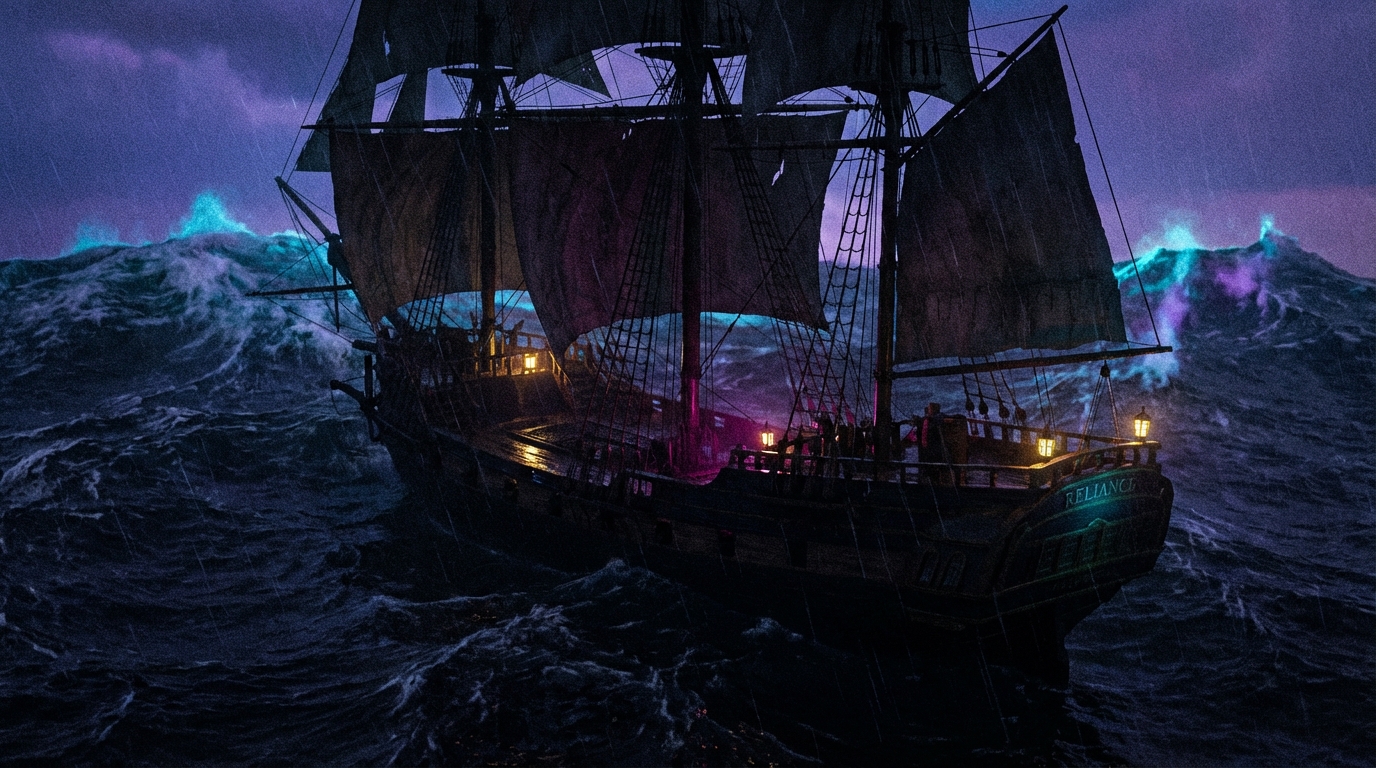
The Reliance rounded the Cape of Good Hope in mid-June, entering waters notorious for sudden storms and mountainous seas. On 15th June, a gale struck without warning—the kind of tempest that veterans of the southern ocean knew to fear, when the sky turned black at midday and the wind shrieked through the rigging like something alive and malevolent.
For three days, the Reliance battled conditions that tested her timbers and her crew to their limits. Waves broke over the bow with enough force to sweep men from their feet; the pumps ran constantly to clear water from the holds; the convicts below decks endured darkness and chaos, chained in place while the ship rolled and pitched beneath them.
On the second night of the storm, Catherine Hartley went into premature labour.
The Reliance carried no surgeon—merely a naval rating named Hobbs who had received rudimentary medical training and served as the ship's closest approximation to a physician. Hobbs had delivered babies before, in circumstances nearly as desperate, but Catherine's labour was complicated from the start. The child was positioned badly; Catherine, weakened by months of seasickness and the stress of the storm, had little strength remaining for the ordeal ahead.
The birth took eighteen hours. Samuel Hartley remained at his wife's side throughout, holding her hand while the ship groaned and shuddered around them, helpless to do anything but witness her agony. The child—a boy—emerged alive but struggling to breathe, his lungs not yet developed enough for the world he had entered too soon.
Catherine haemorrhaged badly. Hobbs did what he could, which amounted to almost nothing. She died on the morning of 17th June 1807, aged twenty-eight, while the storm still raged outside and her husband held her cooling hand.
She was buried at sea the following day, when the weather had calmed enough to permit the ceremony. Captain Aldridge read the service from the Book of Common Prayer while the surviving passengers and such crew as could be spared from their duties stood witness. The canvas-wrapped body slipped over the rail and disappeared beneath grey waves that offered no comfort and kept no memory.
Aftermath and Arrival
The infant, christened Edmund in a hasty ceremony performed by Captain Aldridge, survived the remainder of the voyage through the devoted care of Mrs Alderton, a fellow passenger who had recently weaned her own child and was able to serve as wet nurse. Samuel Hartley withdrew into a grief so profound that his fellow passengers learned to leave him alone, avoiding the cabin where he sat for hours staring at nothing, eating only when food was placed directly before him.
The Reliance reached Sydney Cove on 18th August 1807, her convict cargo delivered to the authorities for assignment and distribution. Samuel Hartley and his infant son disembarked into a world that bore no resemblance to the one they had left behind, carrying with them the documents, capital, and letters of introduction that had been meant to launch a prosperous colonial enterprise. The wife who should have shared that enterprise lay somewhere in the cold waters off the Cape, her grave unmarked by anything but the ship's log and a husband's shattered heart.
Samuel continued on to Hobart Town aboard a coastal vessel, the Sophia, arriving in late August to begin the life that Catherine's death had rendered meaningless. The infant Edmund survived another three months before succumbing to fever in November 1807, leaving Samuel entirely alone in a harsh and distant land.
Later Service and Fate
The Reliance continued in the transportation trade for another decade, completing four more voyages to the Australian colonies before being deemed unseaworthy in 1817. Her final years were spent as a hulk in Portsmouth harbour, her masts removed and her holds converted to storage, a floating warehouse stripped of the dignity of sail and sea.
She was broken up in 1820, her timbers salvaged for firewood and her copper sheathing melted down for other purposes. No memorial marks her service; no record preserves the names of the thousands she carried across the world to whatever fates awaited them. She was simply one of many vessels that fed the insatiable colonial appetite for labour and settlement, her history absorbed into the larger narrative of empire and transportation.






