4338.10 · January 10, 2018 AD
Red Dust and Designation
A plateau of ochre dust and windsworn stone receives its first human footprints. The landscape that will become Saint Phillis reveals itself in stages — a barren plain giving way to sharp-edged cliffs, a grey-green sea concealing life beneath its misted surface, and a glassy anomaly fused into the rock at the cliff's edge. Something ancient and patient names the place, names Nathan Cowdrey as its Guardian, and issues an instruction that will take months to comprehend.
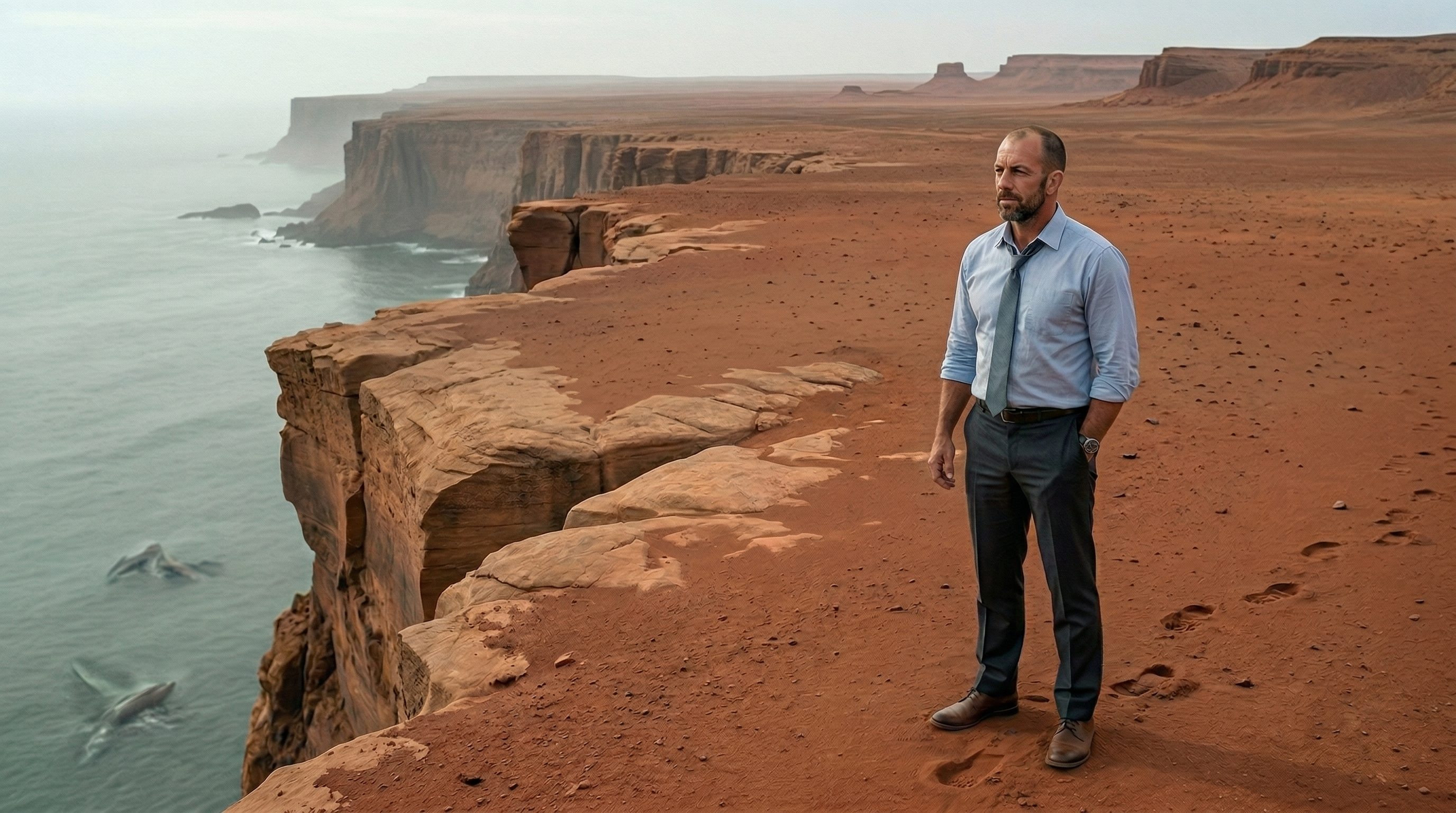
The plateau had been waiting. Not in the way a person waits — with impatience, with awareness of passing time — but in the way geology waits, which is to say without opinion. The red dust that covered its surface had settled particle by particle across millennia, each grain finding its place in a stratigraphy of silence. The rock formations that punctuated the plain had been sculpted by wind into shapes suggestive of broken columns or scattered vertebrae, their surfaces worn smooth by the patient abrasion of air that carried nothing but itself. No roots had cracked the stone. No burrowing creatures had disturbed the soil. The land existed in a state of such thorough emptiness that the concept of emptiness itself seemed insufficient — this was not absence but rather a completeness of nothing, a landscape that had achieved the fullest possible expression of containing no one.
Into this, Nathan Cowdrey arrived.
His footprints pressed into the dust with the hesitant weight of someone unaccustomed to the surface beneath them — leather-soled shoes designed for polished floors and commercial carpet, leaving impressions too sharp-edged, too geometrically precise for a terrain that had never known anything but wind and the slow metabolism of stone. Each step raised a small cloud of particles that hung momentarily in the still air before resettling, the disturbance so minor against the scale of the plateau that the landscape absorbed it the way an ocean absorbs a dropped pebble.
The air here was thinner than what Nathan had been breathing minutes earlier — cooler, cleaner, stripped of the chemical signatures that attended human habitation. No recycled atmosphere, no diesel exhaust, no salt from a southern harbour. The scent, if it could be called that, was mineral and ancient, the smell of stone that had been warming and cooling through uncounted cycles without ever being touched.
Behind him, a vertical rectangle of shifting colour hung against the emptiness — wrong in every way that the landscape was right, its iridescent shimmer an intrusion of complexity into a place that had perfected simplicity. The portal's light was already diminishing, the colours retreating into themselves with the unhurried contraction of something that had completed its immediate purpose and would wait, as it had always waited, until summoned again.
The silence was the most aggressive quality the plateau possessed. Not the silence of a quiet room, where the absence of sound is merely the temporary retreat of noise, but something structural — a silence built into the landscape's composition, woven through its dust and stone and still air with the permanence of bedrock. Sound died here. A voice projected into the open air would travel no distance at all, swallowed by the particulate atmosphere before it could find a surface to return from. The effect was not peaceful but confrontational, as though the land were making a statement about the irrelevance of anything its visitor might wish to say.
Nathan walked because standing still felt worse. His trail extended behind him in perfect impressions — evidence of presence, proof that something was happening even if comprehension lagged well behind the experience. The terrain changed as he advanced, the flat plain giving way to gentle undulations, then steeper rises, the red dust thinning over stone that grew darker and harder with each ascending step. The rock here carried a scorched quality, its edges sharper than weathering alone would typically permit, as though something other than wind had shaped it. The darkness of the stone intensified toward the horizon, where the land ended.
Cliffs. The plateau terminated in a vertical face that dropped perhaps sixty metres to water — a grey-green sea whose surface moved in slow, heavy swells despite the absolute stillness of the air above. Mist clung to the water in irregular patches, obscuring and revealing in alternation, the visibility shifting moment to moment as though the sea were deciding how much of itself to disclose. The colour belonged to northern latitudes — Scottish lochs, Norwegian fjords — cold deep water carrying whatever minerals or organisms gave it that particular quality of light absorption.
Beneath the surface, movement. Dark shapes drifted through the grey-green medium — large enough to register from the clifftop, slow enough to suggest deliberate navigation rather than the aimless tumbling of debris. They moved in loose aggregations, their trajectories intersecting and diverging with the unhurried geometry of creatures that had never known predation or had long since made peace with it. Closer to the cliff base, beds of filter-feeding organisms clung to the submerged rock face, their collective movement producing a subtle rippling visible even from sixty metres above — life, quiet and persistent, flourishing in the medium that the land above had refused.
At the cliff's edge, where red dust met stone met the salt-laden air rising from below, Nathan brushed the surface clear and discovered something unexpected. A patch of vitrified material revealed itself — smooth, cool, faintly reflective, possessing the appearance of glass but the feel of something more deliberate. It occupied perhaps a square metre of the cliff's lip, its edges blending into the surrounding rock without visible seam, as though the two materials had been fused at temperatures sufficient to erase the boundary between them. The surface was markedly colder than the stone around it, retaining some quality of the water below or of whatever process had created it — a thermal memory embedded in the material itself.
The glassy patch reflected the sky above and Nathan's crouching figure in equal measure, both images distorted by subtle irregularities in the surface that might have been natural and might have been inscribed. It was not a mirror and it was not a window, but it existed in the territory between the two — a surface that showed what was above it while suggesting that something lay beneath.
The intelligence that administered this world had been observing since the portal opened. Its attention was not concentrated in any single location — it existed distributed across infrastructure that predated the current geological epoch — but a portion of its awareness had oriented itself toward the plateau the moment the dimensional boundary was breached. It had monitored Nathan's progress across the dust, registered the biological data that the Portal Key had harvested during activation, cross-referenced his identity against records whose origins he would not have believed.
Its communication, when it came, bypassed the auditory system entirely. The words materialised within Nathan's consciousness with a clarity that rendered spoken language primitive by comparison — not heard but known, not received but discovered, as though they had always been present and were only now being permitted to surface. The voice carried no gender, no age, no emotion that could be reliably categorised. It carried patience. It carried the particular quality of awareness that belongs to systems designed to outlast the civilisations that built them.
It named the place. Saint Phillis — a designation that settled over the plateau and its cliffs and its grey-green sea with the administrative finality of a deed of ownership being registered, the landscape acquiring in a single utterance an identity it had existed without for longer than human history had been recording itself. It named Nathan as Guardian — a title that carried obligations he could not yet comprehend, responsibilities that would unfold across months and years with the slow insistence of consequences that refuse to be hurried.
The instruction was brief. Build wisely. Two words that contained within them the entire trajectory of what this barren clifftop would become — the structures that would rise from its dust, the people who would inhabit them, the conflicts that would test their foundations. The intelligence that issued the instruction had observed this process before, across centuries, across other plateaus and other Guardians, and its patience derived in part from the knowledge that the building would happen regardless of whether the instruction was heeded or ignored. Guardians built. It was what they did. The wisdom was optional.
Nathan's footprints crossed the plateau back toward the diminishing portal at a pace slightly faster than the ones that had arrived — the stride of someone who had seen enough to know he needed to return, and would return, but who required first the anchor of the familiar world still flickering in its rectangle of colour against the red dust. The portal accepted its traveller with the same silence with which it had delivered him, the rainbow light folding inward, and Saint Phillis settled back into the absence it had maintained since before anyone had thought to give it a name.







