Raymond Jennings
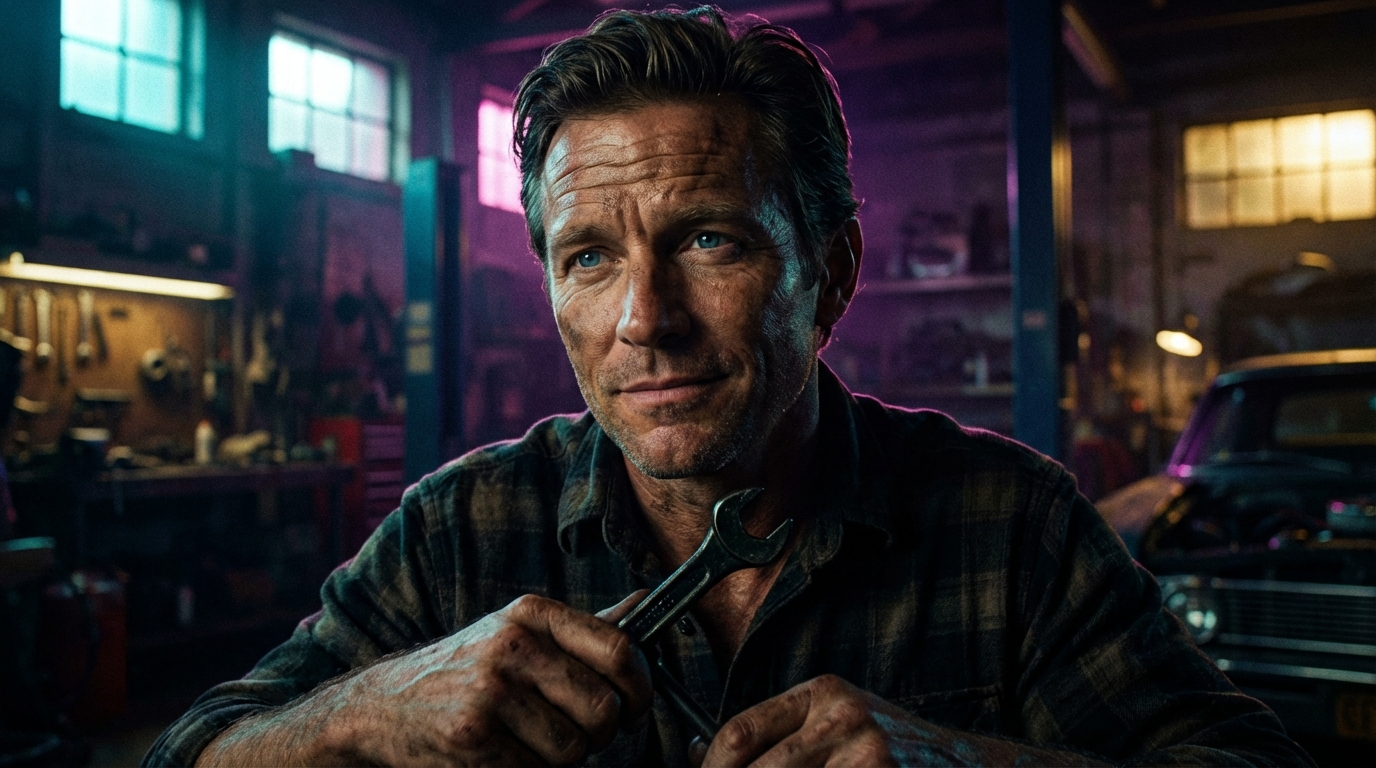
Raymond Jennings, born on 3 June 1980 at the Hutchinson Hospital in Gawler, South Australia, was the sixth of seven children born to Brian Edward Jennings and Patricia Anne Jennings (née O'Connor). A gifted mechanic who inherited his father's aptitude for engines, he built a respected classic car restoration business in Gawler whilst raising a family with his wife, Emily Lawson. Raymond was killed in a road accident on 14 February 2023, aged forty-two.
Early Life and a Childhood Between Paddocks and Workshops
Raymond Jennings was born on 3 June 1980 at the Hutchinson Hospital in Gawler, South Australia, the sixth of seven children born to Brian Edward Jennings, a farmer and gifted mechanic, and Patricia Anne Jennings (née O'Connor), a former education student turned matriarch of one of the district's most established farming families. The Jennings Family Farm, situated on the outskirts of Gawler approximately forty kilometres north of Adelaide, had been in continuous operation since 1889, when Brian's paternal grandparents, William and Margaret Jennings, had carved it from scrubland bordering Stockwell's Scrub after emigrating from County Clare, Ireland.
Raymond arrived into a household already bustling with five older siblings: Cody Brian (born 1968), Anne Elizabeth (born 1970), Catherine (born 1973), Janice Marie (born 1975), and Kenneth Oliver (born 1978). His younger sister, Tania, would complete the family in December 1982. The twelve-year gap between Raymond and eldest brother Cody meant the two inhabited different chapters of childhood under the same roof—Cody was already a teenager helping their father with heavy farm work by the time Raymond was learning to walk—yet the bond between the siblings, forged through shared meals at the long farmhouse table and summer evenings spent together in the paddocks, remained close throughout their formative years.
Raymond's earliest memories were of the farm workshop. Where other children might have gravitated towards the animals or the open fields, Raymond was drawn to the shed where his father Brian spent hours repairing and maintaining the property's machinery. Brian, who possessed a natural mechanical intelligence that expressed itself through patient, methodical problem-solving, recognised a kindred spirit in his sixth child almost immediately. By the age of four, Raymond was trailing his father through the workshop, handing him spanners and watching with wide-eyed concentration as engines were dismantled, diagnosed, and reassembled. Brian, a man who communicated more readily through action than words, welcomed the company. The workshop became a place of quiet apprenticeship, where Raymond absorbed principles of engineering and repair that no classroom would later replicate.
Patricia's influence was equally formative, though it expressed itself differently. An avid reader who had sacrificed her own teaching ambitions to marry into rural life, she insisted that all her children engage with books and ideas alongside their farm duties. Raymond, who would later struggle with English and history at school, nonetheless developed an appreciation for his mother's quiet intellectualism, even if he could never quite share it. He was closer to Patricia than he sometimes admitted, inheriting her stubborn loyalty and her habit of expressing affection through practical gestures rather than spoken sentiment.
School Years and the Pull of the Practical
Raymond attended Gawler Primary School from 1986, entering a small community school where several of his older siblings had preceded him. He was a sociable child with an easy, laconic manner that made him popular among his peers, though his teachers noted early that his attention wandered during lessons that required sustained reading or abstract reasoning. He was not unintelligent—far from it—but his intelligence was resolutely physical, expressing itself through spatial awareness, mechanical intuition, and a dogged persistence when confronted with practical problems. He could strip a bicycle chain and reassemble it before most of his classmates could spell the word, and he treated broken things with a tenderness that bordered on reverence, as though every malfunction were a puzzle waiting to be solved.
The transition to Gawler High School in the early 1990s confirmed the pattern established at primary level. Raymond excelled in woodworking and metalwork, producing work of a standard that impressed his teachers and occasionally startled them. A wooden toolbox he built in Year Nine was displayed in the school's front office for several years afterwards—a sturdy, unpretentious piece of craftsmanship that reflected its maker's personality with uncanny accuracy. In metalwork, he demonstrated an instinct for welding and fabrication that placed him comfortably at the top of his year group.
His performance in other subjects was less distinguished. English remained a source of quiet frustration, and history felt distant and abstract to a boy whose understanding of the past was rooted in family stories told over dinner rather than textbook chronologies. Mathematics he managed competently when applied to practical problems—calculating measurements, working out gear ratios—but found bewildering when it drifted into pure theory. His school reports were a study in contrasts: glowing assessments in practical subjects paired with diplomatic references to "untapped potential" in academic ones. Raymond bore these assessments with good humour, neither troubled by them nor motivated to prove them wrong.
The mid-1990s brought changes that reshaped the family dynamic profoundly. In February 1986, when Raymond was five, his brother Kenneth Oliver had departed the farm to attend a prestigious music programme at the Sydney Conservatorium of Music, moving to Sydney to live with his maternal aunt and uncle, Margaret and Thomas O'Connor. Kenneth's departure—a gifted pianist leaving at the age of eight to pursue a talent that farm life could not accommodate—created an absence that Raymond felt keenly, though he lacked the vocabulary to articulate it at the time. The two brothers had shared a room, and Raymond remembered the sudden quiet after Kenneth left, the empty bed across the room that seemed to grow larger in the dark.
The Loss of Brian Jennings
On 18 November 1997, Raymond's world fractured. Brian Edward Jennings, whilst working on the farm he had tended for over thirty years, suffered a massive heart attack and died. He was fifty-two years old. Raymond was seventeen, in his final year at Gawler High School, and the news reached him through a phone call to the school office that pulled him out of a metalwork class he would never return to complete.
Brian's death was devastating for the entire family, but for Raymond it carried a particular cruelty. He had been the child most like his father—the one who shared Brian's mechanical instincts, his preference for doing over talking, his quiet satisfaction in solving problems with his hands. The workshop where they had spent hundreds of hours together became, overnight, a place of unbearable absence. Raymond struggled to enter it for weeks afterwards, and when he finally did, he found Brian's tools arranged exactly as his father had left them, a half-dismantled engine still sitting on the workbench, frozen in a moment of repair that would never be finished.
The funeral was held at St Peter's Anglican Church in Gawler, the same church where Brian and Patricia had married thirty years earlier. The community turned out in force. Raymond, dry-eyed and rigid in a borrowed suit, stood beside his mother and siblings and tried to understand how a man so physically vital could simply stop existing. His eldest brother Cody, then twenty-nine and carrying burdens the family could not have imagined, attended the service but left abruptly afterwards—a departure that confused and hurt Raymond, who could not know that Cody's life had been consumed by responsibilities that defied ordinary explanation.
Raymond sat his remaining school examinations in a fog of grief and completed his secondary education at the end of 1997 with results that reflected both his natural abilities and the trauma of the preceding weeks. His practical marks were strong; the rest were forgettable. He accepted them without complaint and turned his attention to what came next.
Trade Training and Early Career
In early 1998, Raymond enrolled in an automotive mechanics course at the Regency Institute of TAFE in Adelaide, commuting daily from Gawler on the train. The decision surprised no one who knew him. He had been working towards this since childhood, and the formalisation of his mechanical education felt less like a new beginning than the continuation of something his father had started years earlier in the farm workshop.
Raymond proved an exceptional student. His instructors noted not merely his technical competence—which was considerable—but his diagnostic instinct, an ability to listen to an engine and identify its ailment with an accuracy that usually came only with decades of experience. He topped his cohort in practical assessments and earned a reputation as the student other students approached when they were stuck. His theoretical coursework was adequate rather than brilliant, but his hands-on capabilities more than compensated, and he completed his Certificate III in Light Vehicle Mechanical Technology in 2000 with a distinction that reflected the practical weighting of the programme.
During his training, Raymond also worked part-time at Barossa Valley Motors, a small independent garage in Nuriootpa run by a veteran mechanic named Graham Hutchins. Hutchins, a laconic man in his sixties with tobacco-stained fingers and an encyclopaedic knowledge of pre-1980 Australian and British vehicles, became an informal mentor to Raymond. Under Hutchins's tutelage, Raymond developed a particular fascination with classic car restoration—the art of returning neglected, rusted, and forgotten vehicles to something approaching their original condition. It was painstaking, occasionally tedious work that demanded patience, precision, and a willingness to spend hours sourcing obscure parts, and Raymond loved every moment of it.
Patricia's Death and the Fracturing of Family
In the years following Brian's death, Patricia Anne Jennings held the family together with the resilience and determination that had characterised her entire married life. But her own health was failing. In 2001, she was diagnosed with cancer, and the illness progressed with a swiftness that left the family reeling. Patricia died on 5 September 2002 at the age of fifty-five, five years after her husband.
For Raymond, then twenty-two, the loss of his mother compounded the grief of losing his father and opened a period of quiet struggle that he rarely discussed openly. Both parents gone before he had reached his mid-twenties—it was a weight that settled into him and never entirely lifted. He channelled his grief, as he channelled most emotions, into work, spending long hours at the garage and taking on additional restoration projects that kept his hands busy and his mind occupied.
The family dynamic shifted irreversibly after Patricia's death. Cody, the eldest, had grown increasingly distant in the years since Brian's funeral, and shortly after Patricia's passing he sent a letter to his siblings expressing love but instructing them not to search for him—a bewildering communication that left Raymond angry and confused in equal measure. Anne, the second eldest, returned from agricultural research work in the Riverina to take over stewardship of the Jennings Family Farm. The remaining siblings—Catherine in Adelaide, Kenneth in Sydney, Raymond in Gawler, Tania beginning her university studies—maintained contact but were scattered in ways the family had never been during Brian and Patricia's lifetimes.
Emily Lawson and the Building of a Family
In 2002, not long after his mother's death, Raymond met Emily Lawson, a young nurse who had recently taken a position at the Gawler Health Service after completing her training in Adelaide. Emily was a quiet, capable woman with a dry sense of humour and an emotional steadiness that Raymond, still raw from loss, found deeply comforting. Their courtship was unhurried—Emily later joked that Raymond had asked her to inspect a gearbox before he had asked her to dinner—but the connection between them was genuine and grounded, built on mutual respect and a shared preference for practical demonstrations of affection over grand romantic gestures.
They married on 19 March 2005 at St Peter's Anglican Church in Gawler, in a ceremony attended by the surviving Jennings siblings, Emily's parents, and a wide circle of friends from the Gawler community. Kenneth Oliver Jennings travelled from Sydney for the occasion, performing a piano piece during the ceremony that moved several guests to tears. The reception was held at the Kingsford Smith Pub, where Raymond's speech—brief, self-deprecating, and unexpectedly tender—revealed a warmth that he usually kept shielded behind his laconic exterior.
The couple settled in a modest weatherboard house on Murray Street in Gawler, close enough to the farm that Raymond could visit Anne and help with machinery maintenance, but far enough to establish an independent household. Their first child, Levi Raymond Jennings, was born on 11 April 2007 at the Lyell McEwin Hospital in Elizabeth. Their daughter, Amelia Patricia Jennings—named for Raymond's mother—arrived on 22 August 2010, also at the Lyell McEwin.
Raymond embraced fatherhood with an enthusiasm that surprised those who knew him primarily as a reserved, mechanically minded man. He was a patient and attentive father who took Levi and Amelia camping along the Murray River, taught them to identify birds and wildflowers in the scrubland near the farm, and spent Saturday mornings building cubby houses and go-karts with materials scavenged from the workshop. He coached Levi's junior football team at the Gawler Central Sporting Club for three seasons, proving himself a capable if occasionally bemused manager of small children, and attended every school concert and sports day with the quiet pride of a man who understood that showing up was its own form of love.
Jennings Restorations and Professional Life
In 2010, the same year Amelia was born, Raymond opened his own business, Jennings Restorations, in a converted workshop space on Nineteenth Street in the light industrial area south of Gawler's town centre. The garage specialised in classic car restoration and high-performance modifications, with a particular focus on Australian-made vehicles from the 1960s and 1970s—Holden Monaros, Ford Falcons, Chrysler Valiants—as well as British marques including MGs, Triumphs, and Austin-Healeys.
The business grew steadily through word of mouth rather than advertising. Raymond's reputation for meticulous workmanship, honest pricing, and a refusal to cut corners attracted clients from across South Australia and, eventually, from interstate. Collectors in Melbourne and Sydney shipped vehicles to Gawler for Raymond's attention, trusting his judgement on everything from panel beating and chrome rechroming to engine rebuilds and upholstery sourcing. He employed two apprentices over the years—young men from the local area whom he trained with the same patient, hands-on methodology his father had used with him—and a part-time bookkeeper, though Emily handled much of the administrative work in the business's early years.
Raymond's perfectionism, whilst admirable, was not without its costs. He was slow to delegate, reluctant to release a vehicle until he was entirely satisfied with the result, and occasionally frustrated clients with timelines that stretched beyond initial estimates. He was aware of this tendency and self-deprecating about it, once telling a customer that he had inherited his father's work ethic but not his father's ability to know when something was finished. The remark was typical of Raymond—honest, wry, and carrying a deeper truth about the connection between his craft and his grief.
Community Life and the Sibling Bond
Raymond remained deeply embedded in the Gawler community throughout his adult life. He volunteered regularly with the Gawler Show, helping to set up and dismantle equipment with the same quiet efficiency he brought to everything practical. He donated his time and skills to local charities, repairing vehicles for people who could not afford workshop rates, and contributed to fundraising events organised through St Peter's Anglican Church and the Gawler Civic Centre.
The Jennings siblings, despite their geographical dispersal, maintained a bond that expressed itself through regular gatherings at the family farm. On 15 August 2008—what would have been Cody's fortieth birthday—the surviving siblings gathered to honour the memory of their eldest brother, who had by then been absent from their lives for years. The reunion was bittersweet, marked by shared stories and unresolved questions about Cody's disappearance. Raymond, who had idolised Cody as a boy and been deeply hurt by his withdrawal, found the occasion difficult but was glad to be surrounded by his sisters and brother.
The death of Cody Brian Jennings on 31 July 2018, and the circumstances that eventually came to light surrounding it, struck the family with a force that reopened old wounds. A memorial service was held on 5 November 2018 at the Jennings Family Farm, an intimate gathering attended by the siblings and a small circle of people connected to Cody's extraordinary life. The presence of Detective Inspector Sienna Blackwood and members of the Hobart Police Department at the service hinted at complexities that Raymond grasped only partially, but his grief for the brother he had never fully understood was uncomplicated and profound.
Less than a year later, on 8 November 2019, Janice Marie Jennings died at the age of forty-four after contracting a rare form of meningitis. Janice, a Clinical Nurse Specialist at the Royal Adelaide Hospital, had been the sibling closest to Raymond in both age and temperament—a quiet, devoted person who expressed her compassion through service rather than words. Her death, coming so soon after Cody's, left Raymond visibly diminished. Friends and colleagues noted a heaviness in him during the months that followed, a withdrawal into work and family that spoke of a man struggling to absorb yet another loss in a life that had contained too many.
Death
On the evening of 14 February 2023, Raymond Jennings was driving home from his workshop on Nineteenth Street when his vehicle was struck by an oncoming car that had crossed onto the wrong side of the road. The other driver, later found to have been significantly over the legal blood alcohol limit, survived the collision. Raymond did not. He was forty-two years old.
The accident sent shockwaves through Gawler. Raymond had been a fixture of the community—a man whose workshop was a gathering place, whose generosity with his time and skills had touched dozens of families, whose quiet presence at school events and sporting matches and church functions had been so constant that his absence seemed physically impossible. The funeral, held at St Peter's Anglican Church, drew mourners from across the district and beyond, many of them former clients who spoke of Raymond's integrity, his patience, and the care he brought to everything he touched.
Raymond was survived by his wife, Emily, their children, Levi, then fifteen, and Amelia, twelve, and by his siblings Anne, Catherine, Kenneth, and Tania. The Jennings family, no strangers to grief, rallied around Emily and the children with the fierce protectiveness that had sustained them through decades of loss. Levi and Amelia remained in the family home on Murray Street, supported by a community that understood what it meant to lose a man like Raymond Jennings—not a famous man, not a powerful man, but a good one.







