Randal Thomas Klein
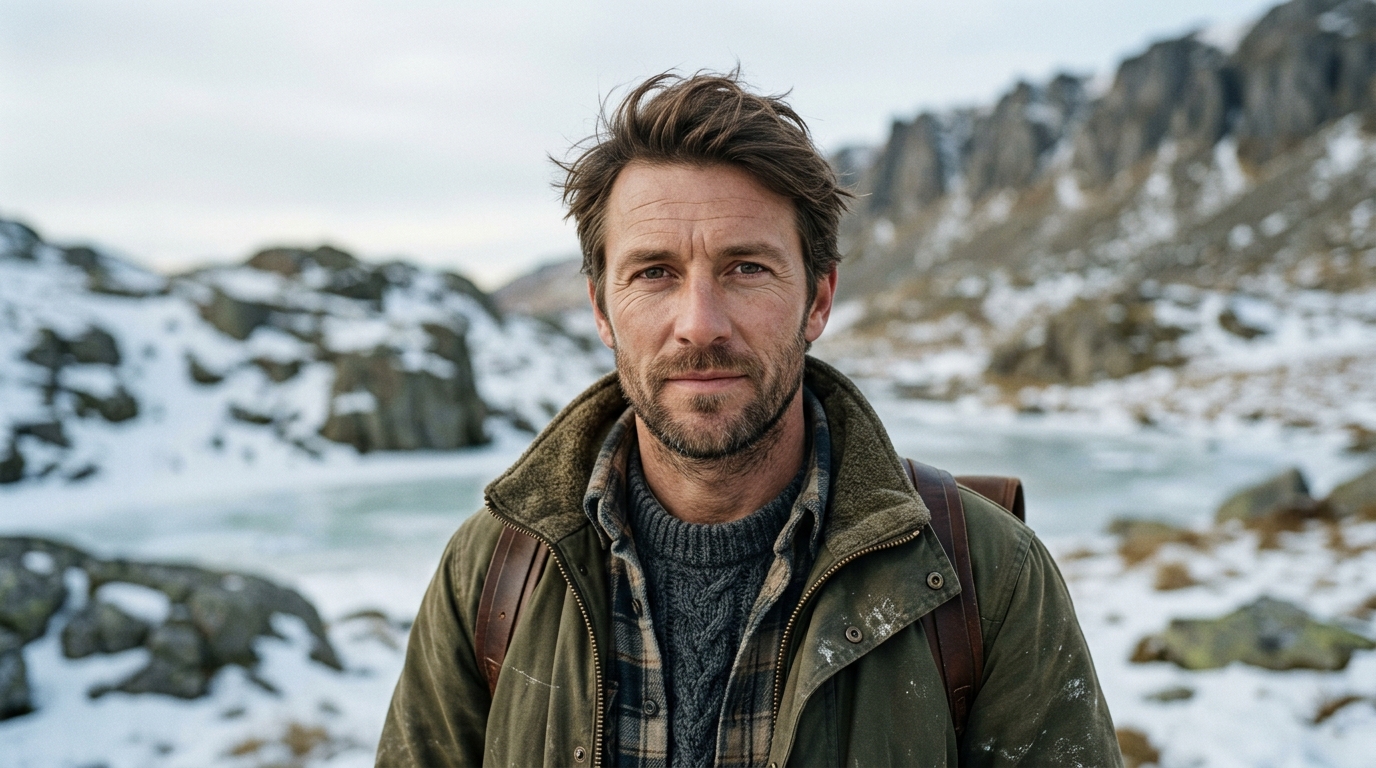
Randal Thomas Klein (1954–1988) was the second Guardian of Belkeep, a solitary English tradesman who had spent his life building infrastructure alone in hard, remote country. Recruited by Jeremiah Atkins and given the second of the settlement's Portal Keys, he crossed into Clivilius on 13 December 1987 and threw himself into the founding settlement's brutal early work. He died barely three months later, on 16 March 1988, lost in a whiteout at Wren's Pass — the first Guardian to die in Belkeep.
Thirty Brackmount Lane
Randal Thomas Klein was born on 9 February 1954 in Lewes, East Sussex, the eldest of three sons of Stuart Edwin Klein (1921–1994), a foundry machinist and Second World War veteran, and Margaret Louise Klein, née Partridge (1926–1987), a grammar-school secretary and former shorthand typist. The family lived on a modest terraced row at 30 Brackmount Lane, its back windows giving onto a narrow strip of allotments and a cluster of disused rail sidings.
It was a household of quiet, postwar order. Stuart kept a regimented tool shed and a garden ledger and expected his sons to finish what they started; Margaret managed the money and nursed a private love of local history, borrowing thick-bound monographs from the Lewes library that no one else in the house ever opened. Feelings were not aired at the dinner table. Shoes were polished, tasks were completed without being asked twice, and warmth, where it existed, was left unspoken and assumed.
His father shaped him most, though never through anything so direct as affection. Stuart had come back from the war with a habit of silence and a conviction that a man was measured by what he could do rather than by what he could say, and he ran his household and his tool shed on the same principle. Randal learned early that competence was the currency of the house—that a job done well and without fuss earned a nod, and that a nod was as much as was on offer. He grew into a man who expected little more from anyone, and who gave, in return, exactly what he had been taught to give: reliable work, and no explanations.
He took to that ethic more completely than either of his brothers. From about the age of ten he began shadowing his father through small domestic repairs, first watching and then working alone, and by twelve he could bring a rusted hinge back to full working order with nothing but scrap wire, soap, and patience. He preferred the company of a task to the company of people, and the preference only hardened as he grew. If there was warmth in him, it went to the quiet, methodical business of making broken things work again—and to his mother, whose inwardness he shared and whose borrowed histories he was the only one of the boys ever to read.
His brothers took different roads. Paul Leonard Klein, two years his junior, trained as a refrigeration technician and settled into an ordinary domestic life in Worthing; the youngest, Trevor James Klein, was dogged by ill health for most of his life and died in 1996 of complications from undiagnosed epilepsy. Randal was never close to either of them in adulthood, and the distance was of his own keeping as much as anyone's.
At Priory School, which he attended from 1965 to 1970, he earned unremarkable marks in most subjects but stood out at technical drawing, woodwork, and metal fabrication. His teachers found him quiet, industrious, and solitary—a boy who rarely sought a friend but who could be trusted with the equipment lockers, the stock logs, and any small repair the classroom needed. He joined nothing, and after his third year he vanished from the school photographs entirely. He left at sixteen with two O-Levels and a quiet recommendation toward a local apprenticeship, and asked for nothing more.
The Solitary Trade
He entered the trades at sixteen as a mechanical apprentice and, over the following decade, made himself into something more particular: a builder of infrastructure in hard, empty country. He moved into agricultural construction and terrain logistics, taking contracts first across rural Sussex, then in Devon, and eventually up into the Scottish Borders, and he came to specialise in the unglamorous engineering of survival in exposed places—windbreaks, frost-resistant foundations, the makeshift scaffolds that carried water across broken ground. It was work that rewarded patience, self-reliance, and a tolerance for discomfort, and Randal had all three in unusual measure.
What set him apart was less his skill than his appetite for isolation. Where other men on the same contracts wanted the nearest town and a bed with a roof they didn't have to mend, Randal sought out the placements furthest from anywhere—the ones with straightforward expectations, hard physical work, and no one to answer to once the light went. By the mid-1980s he was working almost entirely alone, contracted for seasonal repairs in upland country, without a fixed address, living between a converted van and whatever bothy or outbuilding came with the job. He kept his tools immaculate and his quarters spare, and he could go a fortnight in the hills without needing to speak to a soul, and be the better for it.
He was not reckless in that country, whatever his solitude might suggest. He was, if anything, the opposite—careful to the point of severity, because a man alone in bad terrain has no margin for carelessness, and Randal understood that better than most. More than once over those years he sat out a storm in a snow hole or a broken byre that would have killed a less patient man, waiting it through with the flat composure of someone who had never expected the weather to be kind, and walking out when it cleared. He had come through worse than most of what the Borders could throw at him, and had come to trust, quietly, that he always would.
He formed no lasting attachments in those years and seemed to want none. There was no wife, no partner, no standing circle of friends; the shape of his life was a series of solitary postings in cold, remote places, each chosen at least in part for how few people it obliged him to see. Those who hired him found him wholly reliable and almost entirely unknowable—a man who did precisely what he had contracted to do, took his pay, and moved on to the next empty valley without leaving a forwarding address.
If the solitude cost him anything, he never named it, and perhaps by then he no longer felt the price. He had arranged his life so completely around his own company that the ordinary furniture of a life—a partner, a settled home, people who would notice an absence—had simply never been built. It made him free in a way few men are, and it made him, in the same measure, a person the world could mislay without quite noticing. Both things were true of him at once, and he appeared to have made his peace with both.
Nothing to Hold Him
In the autumn of 1987, two things happened within a few weeks of each other. In October, Margaret Klein died—the one member of his family to whom Randal had been quietly, wordlessly attached, the reader of local histories whose temperament he had inherited more than he knew. And in the weeks that followed her funeral, he was approached by a man named Jeremiah Sebastian Atkins.
Jeremiah had heard of Randal through a shared contact in the Whitmoor Boundary Research Circle—of his work ethic, his competence, and above all his aptitude for logistical independence, for going into hard country alone and coming back with the job done. He was assembling a group of Guardians to sustain a settlement in a place he called Clivilius, and he offered Randal one of five newly created Portal Keys, along with a one-way passage into a world almost no one on Earth knew existed. He did not soften what he was asking. The crossing was permanent for ordinary settlers, and even for a Guardian it meant giving the whole of one's life over to a cold and unfinished place at the very edge of survival.
For most people such an offer would have been unthinkable—too much to surrender, too many ties to cut. Randal had little to surrender and few ties left to cut. His mother was newly buried, his father distant, his brothers all but strangers; he owned no home and belonged to no one. The prospect of a remote, unpeopled world in which his particular skills were not merely useful but essential found him at precisely the moment nothing was holding him to this one. He accepted, as he did most things, without ceremony.
On 13 December 1987, from a disused pumping station near Rothbury in Northumberland, with Jeremiah present to oversee the crossing, Randal activated his Portal Key and stepped through alone, without a farewell to anyone. He was the second person to make that crossing under Jeremiah's stewardship, after Cody Jennings, and he became, on the far side of it, the second Guardian of Belkeep.
The Second Guardian
He arrived into a place that was barely a place at all: a frozen cavern, a scatter of half-built shelters, a handful of settlers, and Cody Jennings—the young man who had founded the settlement and activated the first of its keys. Belkeep in December 1987 was the most isolated posting Randal had ever taken, and in a sense the one his whole life had been tending toward: a world in which he owed nothing to anyone and could work with his hands at the very edge of what a person could survive.
His focus fell, as it always had, to the practical. He built shelter frames, secured walkways, reinforced the natural hazards that ringed the settlement, and tested the stability of the ground around its margins. He was one of the few who would volunteer to scout untracked country, and he took the coldest shifts without protest, because the cold and the solitude were, to him, the smallest part of the job. Though he kept himself apart from the others, he earned their trust in the only way he ever had—by being consistent, by never complaining, and by doing carefully and exactly what he had said he would do.
He and Cody Jennings made an unlikely pair to be holding a world together—Cody young, driven, full of the Earth he had left and the promise he believed Belkeep was building toward; Randal older, closed, indifferent to promises and interested only in whether a given wall would hold. But the two men needed little from each other beyond competence, and competence each had in full. They fell into a kind of wordless division of labour, Cody carrying the settlement's hopes and Randal its foundations, and if they were never friends in a way either would have named, they trusted one another's hands entirely, which in Belkeep counted for a great deal more.
When Sylvie Sprake came through the Portal on 23 December, ten days behind him, to take up the third key, she found a settlement already leaning hard on Randal's labour and a man already worn thin by it. There were fewer than thirty souls in Belkeep that first winter, and the work of holding them against the weather fell heavily on its two working Guardians. Randal did not spare himself; he had spent his whole life seeking exactly this kind of hard, solitary, necessary work, and he gave himself to it as though the survival of the settlement were a private contract he had signed alone and meant to honour to the letter.
Much of what he did in those weeks was reconnaissance—walking the untracked country beyond the settlement's edge to learn what was passable and what was not, testing the ice, marking the hazards, and setting down in Belkeep's early ground register the hard geography on which the settlement's safety would depend. The notes he made were precise enough that they were still being consulted long after he was gone. It was solitary, exacting, dangerous work, and it suited him precisely; he had become, in a matter of weeks, the first true surveyor of Belkeep's own deadly ground.
Wren's Pass
On 16 March 1988, Randal led a four-person team out to scout potential western egress routes from the settlement—the untracked, dangerous reconnaissance he habitually reserved for himself. Some distance out, near a defile the settlers had come to call Wren's Pass, the party was overtaken by a sudden whiteout, and in the blindness of it they became separated. Two of the four eventually found their way back. Randal and a recent settler named Maël Leron did not.
His body was recovered the following morning, half-buried in drift against a fractured stone ledge, not far from where the group had lost sight of one another. He had been in Clivilius a little under three months, and had died doing the very work he was best at in all the world—pushed, this once, a step too far, in weather that turned faster than any man could read.
His was the first death of a Guardian in the settlement's short history, and it struck the small community hard; a place of fewer than thirty could not lose two of its number, one of them a Guardian, without feeling the ground shift beneath it. Much of the planning and labour Randal had shouldered passed now to Sylvie Sprake, who took it up without comment and held Belkeep through the rest of that first brutal winter.
He was buried on 17 March 1988 at the edge of the ice shelf, beneath a slab of slate carved by a settler named Eoin Darrin, marked only with his initial and surname, Maël Leron's set beside it, and the place and date the two had been lost. There was no one on Earth to whom word could be sent who would have come.
The settlement grieved him as best it could, though it was an awkward grief; few in Belkeep had known Randal as anything more than a reliable pair of hands and a closed face, and there was little in the way of stories to tell over the slate. What they mourned, as much as the man, was the steadiness they had come to depend on and now had to manage without. It was, in its way, the loneliest possible epitaph for someone who had spent a life earning exactly that regard and no other—valued without question for what he did, and known by almost no one for who he was.
Randal Klein had made himself into a man who could disappear into hard country and trouble no one, and in the end that was very nearly how he went: alone, in the white, at the far edge of the furthest place he had ever gone, doing the solitary work he had always preferred to the company of the living.







