Quantum Superposition
Quantum superposition is the principle that a quantum system can exist in multiple states simultaneously until the act of measurement forces it into a single definite outcome. Far from a theoretical abstraction, superposition has been experimentally verified with particles, atoms, molecules, and even macroscopic systems, and it underpins the operational basis of quantum computing, quantum cryptography, and quantum sensing.
Overview
Superposition is one of the most fundamental and counterintuitive principles of quantum mechanics. It states that a quantum system — an electron, a photon, an atom, or in principle any physical system governed by quantum mechanics — does not possess definite values for its measurable properties until a measurement is performed. Instead, the system exists in a combination of all possible states simultaneously, described mathematically by a wave function that encodes the probability of each possible outcome.
This is not a statement about human ignorance. It is not the case that the system is "really" in one state and we simply do not know which. The superposition is the physical reality. The system genuinely occupies multiple configurations at once. This has been confirmed through decades of experimental evidence, most directly through interference experiments in which the simultaneous existence of multiple states produces measurable effects that could not occur if the system were in only one state at a time.
Superposition is destroyed by measurement — a process in which the system transitions from a combination of states to a single definite state. This transition, governed by the Born rule, is probabilistic: the probability of each outcome is determined by the square of the amplitude of the corresponding component in the superposition. The mechanism by which this transition occurs remains the central unsolved problem in quantum mechanics — the measurement problem.
Mathematical Description
In the mathematical formalism of quantum mechanics, the state of a system is represented by a vector in a Hilbert space. If |ψ₁⟩ and |ψ₂⟩ are two possible states of a system, then any linear combination α|ψ₁⟩ + β|ψ₂⟩ is also a valid state, where α and β are complex numbers called probability amplitudes. This is a direct consequence of the linearity of the Schrödinger equation, which governs the time evolution of quantum states.
The probability of measuring the system in state |ψ₁⟩ is |α|² and the probability of measuring it in state |ψ₂⟩ is |β|², with the constraint that |α|² + |β|² = 1 (the total probability must equal one). Crucially, the amplitudes α and β are complex numbers, not ordinary probabilities. This means they can interfere — adding constructively or destructively — producing observable effects that have no analogue in classical probability theory.
For a system with more than two possible states, the superposition generalises naturally: |ψ⟩ = Σᵢ cᵢ|ψᵢ⟩, where the sum runs over all possible states and the coefficients cᵢ are complex amplitudes satisfying Σᵢ|cᵢ|² = 1. This formalism extends to continuous variables (such as position), where the sum becomes an integral and the state is described by a continuous wave function Ψ(x).
The Double-Slit Experiment
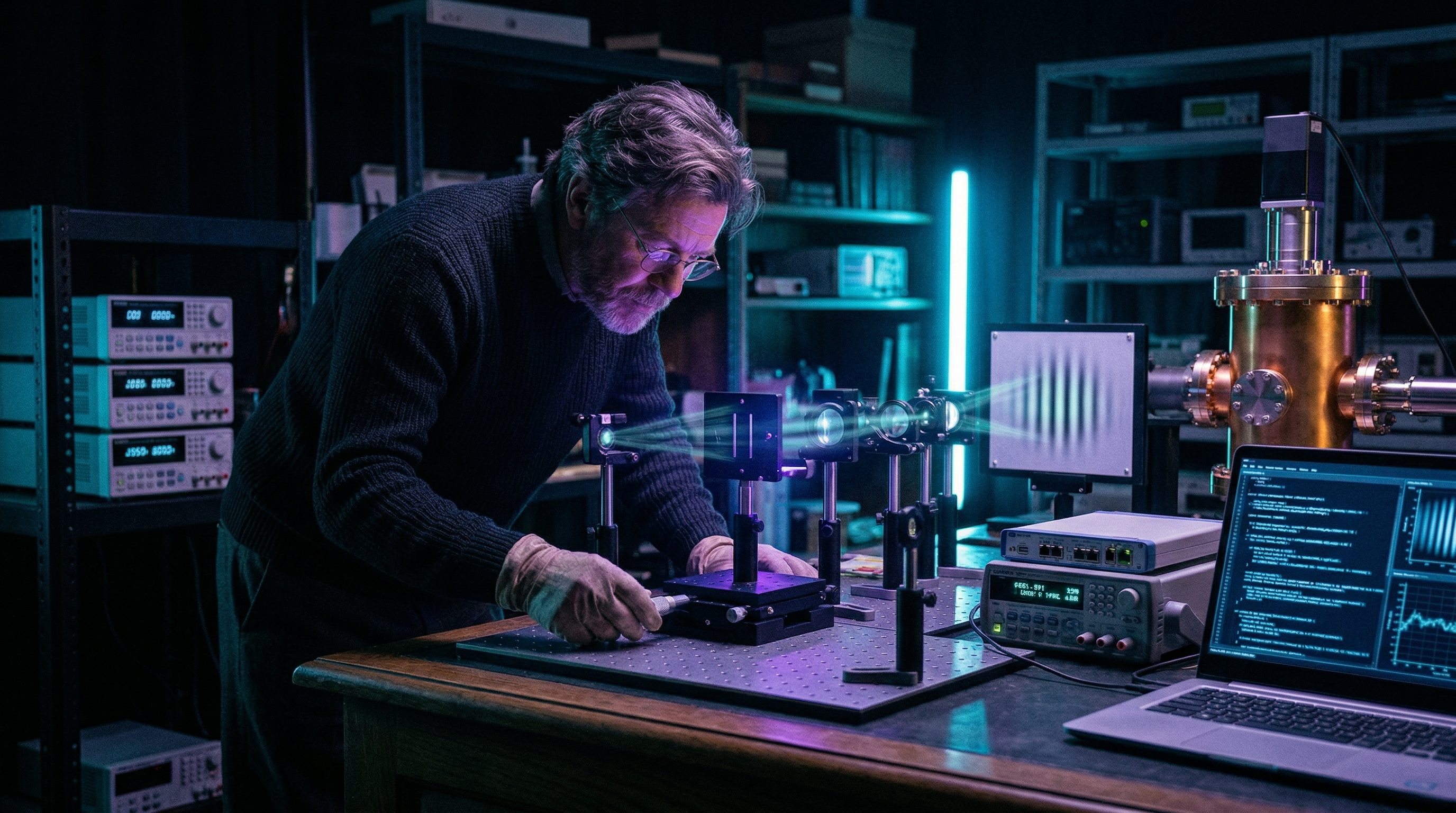
The double-slit experiment is the most celebrated demonstration of superposition and remains one of the most important experiments in the history of physics. In its quantum form, individual particles — photons, electrons, neutrons, or even large molecules — are fired one at a time toward a barrier containing two narrow slits. A detector screen behind the barrier records where each particle arrives.
If particles behaved as classical objects, each particle would pass through one slit or the other, and the pattern on the screen would be the simple sum of two single-slit patterns — two overlapping bands. Instead, the pattern that emerges over many individual detections is an interference pattern: alternating bands of high and low intensity that can only be produced by waves passing through both slits simultaneously and interfering with each other.
The critical feature is that this interference pattern appears even when particles are sent one at a time, ruling out the possibility that it arises from interactions between multiple particles. Each individual particle must somehow pass through both slits simultaneously — existing in a superposition of "passed through slit A" and "passed through slit B" — and interfere with itself.
If a detector is placed at the slits to determine which slit the particle passes through, the interference pattern disappears. The act of measurement destroys the superposition, collapsing the system into a definite state (passage through one specific slit), and the classical two-band pattern is recovered. This demonstrates that superposition is not merely a mathematical convenience but a physical reality that is altered by the act of observation.
Richard Feynman famously described the double-slit experiment as containing "the only mystery" of quantum mechanics — the essential phenomenon from which all quantum strangeness derives.
Superposition of Quantum Bits (Qubits)
In quantum computing, the fundamental unit of information is the qubit — the quantum analogue of the classical bit. A classical bit can be either 0 or 1. A qubit can be in a superposition of both: |ψ⟩ = α|0⟩ + β|1⟩, where |α|² is the probability of measuring 0 and |β|² is the probability of measuring 1.
This is not equivalent to the bit being "partly 0 and partly 1" or "switching rapidly between 0 and 1." The qubit is genuinely in both states simultaneously, and this simultaneity is what gives quantum computing its power. An n-qubit register can exist in a superposition of all 2ⁿ possible states at once, allowing quantum algorithms to process vast numbers of possibilities in parallel.
The superposition of qubits, combined with quantum entanglement and quantum interference, enables algorithms that are exponentially faster than their classical counterparts for certain problems. Shor's algorithm for factoring large numbers and Grover's algorithm for searching unsorted databases are the most well-known examples. The practical challenge of quantum computing is maintaining coherent superposition states long enough to perform useful computation — a challenge known as decoherence.
Coherence and Decoherence
A quantum system in superposition is described as coherent — the phase relationships between the components of the superposition are well-defined and produce observable interference effects. Coherence is the hallmark of quantum behaviour and the essential resource for quantum technologies.
Decoherence is the process by which a quantum system loses its coherence through interaction with its environment. When a superposed system interacts with surrounding particles, photons, or electromagnetic fields, the phase relationships that define the superposition are disrupted. The system's quantum information "leaks" into the environment, and the superposition effectively disappears — not because it has collapsed, but because the interference effects are no longer observable in the system alone (they have spread into the vastly larger environment).
Decoherence occurs extremely rapidly for macroscopic objects. A dust particle in air loses coherence in approximately 10⁻³¹ seconds. This explains why everyday objects never appear to be in superposition — the environment destroys any macroscopic superposition almost instantaneously. Quantum effects are observable primarily in isolated systems carefully shielded from environmental interaction.
It is important to distinguish decoherence from wavefunction collapse. Decoherence explains why quantum interference effects vanish at macroscopic scales — it explains the appearance of classicality. But it does not explain why individual measurements produce single definite outcomes. After decoherence, the combined system-plus-environment is still in an entangled quantum state encompassing all possible outcomes. The selection of a particular outcome remains unexplained by decoherence alone.
Experimental Verification
Superposition has been verified experimentally with progressively larger and more complex systems, pushing the boundary of quantum behaviour toward the macroscopic world.
Photons and electrons: Superposition of individual photons and electrons has been demonstrated routinely since the mid-twentieth century through double-slit experiments, interferometry, and spin measurements. These experiments form the bedrock of experimental quantum mechanics.
Atoms: In 1996, a team at the National Institute of Standards and Technology (NIST) placed a beryllium ion in a superposition of being in two different physical locations simultaneously — separated by approximately 80 nanometres. This was the first demonstration of a "Schrödinger's cat" state with an individual atom.
Large molecules: Double-slit interference has been demonstrated with increasingly large molecules. In 1999, Anton Zeilinger's group demonstrated interference with buckminsterfullerene (C₆₀) molecules, each containing 60 carbon atoms. Subsequent experiments have demonstrated quantum interference with molecules containing over 2,000 atoms and with masses exceeding 25,000 atomic mass units. These experiments confirm that superposition is not limited to elementary particles but extends to complex molecular systems.
Superconducting circuits: Superconducting quantum interference devices (SQUIDs) have placed macroscopic electrical currents — involving billions of electrons flowing simultaneously — in superposition of flowing in opposite directions. These experiments bring quantum superposition into the realm of macroscopic, engineered systems and form the basis for superconducting qubit technology used in quantum computing platforms.
Mechanical oscillators: In 2010, Andrew Cleland and John Martinis demonstrated quantum superposition in a mechanical resonator — a tiny vibrating paddle visible to the naked eye — placing it in a superposition of vibrating and not vibrating simultaneously. This was the first demonstration of quantum behaviour in a mechanical object, earning the experiment recognition as the "Breakthrough of the Year" by Science magazine.
Biological systems: There is ongoing research into whether quantum superposition plays a role in biological processes. Evidence suggests that quantum coherence may be involved in photosynthesis (energy transfer in light-harvesting complexes), avian navigation (the radical pair mechanism in bird magnetoreception), and possibly olfaction. These findings remain debated but suggest that biological evolution may have exploited quantum effects long before human technology did.
Schrödinger's Cat
In 1935, Erwin Schrödinger proposed a thought experiment designed to illustrate the apparent absurdity of applying superposition to macroscopic systems. A cat is placed in a sealed box with a radioactive atom, a Geiger counter, and a vial of poison. If the atom decays (a quantum event with a certain probability), the Geiger counter triggers, breaking the vial and killing the cat. If it does not decay, the cat lives.
According to quantum mechanics, until the box is opened and an observation is made, the radioactive atom is in a superposition of decayed and not-decayed states. Since the cat's fate is entangled with the atom's state, the cat is — according to the formalism — in a superposition of alive and dead.
Schrödinger intended this as a reductio ad absurdum — a demonstration that something must be wrong or incomplete about applying quantum superposition to the macroscopic world. The thought experiment highlights the tension between the quantum formalism (which permits superposition at any scale) and everyday experience (in which cats are definitively alive or dead, never both).
Modern understanding, informed by decoherence theory, provides a partial resolution: the cat, being a macroscopic system in constant interaction with its environment, would lose coherence almost instantly. The superposition exists in principle but is unobservable in practice because environmental interaction destroys it before any measurement could detect it. However, this resolution does not address the deeper question of why a single outcome (alive or dead) emerges — the measurement problem persists regardless of decoherence.
Superposition and the Nature of Reality
The interpretation of superposition remains one of the deepest questions in physics and philosophy. Different interpretations of quantum mechanics offer fundamentally different accounts of what superposition means for the nature of reality.
If superposition is physically real (as the Copenhagen and many-worlds interpretations hold), then reality at the quantum level is fundamentally indeterminate — properties do not exist until measured. This challenges the classical assumption that physical systems possess definite properties at all times, whether or not anyone is looking.
If superposition reflects our knowledge rather than physical reality (as epistemic interpretations hold), then quantum mechanics is a theory about information and prediction rather than about the world itself. The wave function describes what we can know, not what is.
If superposition is a real but temporary condition that spontaneously resolves (as objective collapse theories hold), then there is a physical mechanism — yet to be discovered — that enforces definiteness at certain scales.
And if particles always have definite properties but are guided by a wave that can be in superposition (as pilot wave theory holds), then superposition is a property of the guiding wave, not of physical reality directly.
Each interpretation is consistent with all experimental evidence to date. No experiment has yet distinguished between them. The question of what superposition ultimately means — what the universe is actually doing when a quantum system exists in multiple states simultaneously — remains open. It is, as Feynman observed, the central mystery of quantum mechanics, and arguably the central mystery of physics itself.






