Quantum Decoherence
Quantum decoherence is the process by which a quantum system loses its coherent superposition through interaction with its surrounding environment. It explains why quantum effects — interference, superposition, entanglement — are readily observed at atomic scales but vanish in everyday experience, providing the primary mechanism through which the classical world emerges from quantum foundations.
Overview
Decoherence is the physical process through which a quantum system loses the defining features of its quantum behaviour — most importantly, the phase relationships that produce interference effects — as a result of interaction with its environment. It is not a separate postulate added to quantum mechanics but a natural consequence of the existing formalism, emerging inevitably whenever a quantum system is not perfectly isolated from its surroundings.
The significance of decoherence lies in its role as the bridge between the quantum and classical worlds. Quantum mechanics predicts that systems can exist in superpositions of multiple states simultaneously, yet everyday experience presents a world of definite objects with definite properties. Decoherence provides the mechanism that explains this apparent contradiction: environmental interaction suppresses the observable signatures of superposition so rapidly and so completely at macroscopic scales that classical definiteness emerges as the practical reality, even though the underlying physics remains quantum mechanical throughout.
Decoherence was first studied systematically in the 1970s and 1980s, with pioneering contributions from H. Dieter Zeh, Wojciech Zurek, Erich Joos, and others. It has since become central to the understanding of quantum-to-classical transitions, quantum error correction, and the design of quantum technologies. However, decoherence does not solve the measurement problem — a distinction that is crucial and frequently misunderstood.
The Mechanism
To understand decoherence, consider a quantum system S in a superposition of two states |A⟩ and |B⟩: |ψ_S⟩ = α|A⟩ + β|B⟩. If S is perfectly isolated, this superposition persists indefinitely and can produce interference effects — observable phenomena that depend on the phase relationship between the α and β amplitudes.
In practice, no macroscopic system is perfectly isolated. The system interacts with its environment E — surrounding air molecules, photons, electromagnetic fields, the walls of its container, thermal radiation, and countless other degrees of freedom. These interactions cause the system's quantum state to become entangled with the environment's quantum state. The combined system-plus-environment evolves into a joint state:
|ψ_total⟩ = α|A⟩|E_A⟩ + β|B⟩|E_B⟩
where |E_A⟩ and |E_B⟩ are the environmental states correlated with each system state. Crucially, as the environment has an enormous number of degrees of freedom, the states |E_A⟩ and |E_B⟩ rapidly become effectively orthogonal — they have negligible overlap. When this happens, the interference terms that depend on the phase relationship between α and β become unobservable in any measurement performed on the system alone. The superposition has not disappeared from the total quantum state, but its observable consequences have been distributed across the vast environmental degrees of freedom, rendering them inaccessible in practice.
This is decoherence: not the destruction of superposition, but the effective hiding of its observable signatures through entanglement with an uncontrollable environment.
Decoherence Timescales
The speed at which decoherence occurs depends on the system's size, temperature, and the strength of its interaction with the environment. For macroscopic objects in ordinary conditions, decoherence is extraordinarily fast — so fast that superposition is suppressed long before any conceivable measurement could detect it.
Representative decoherence timescales illustrate this dramatically. A large molecule in a laboratory vacuum loses coherence in approximately 10⁻¹⁷ seconds. A dust particle (radius ~10⁻⁵ metres) in air at room temperature decoheres in roughly 10⁻³¹ seconds. A bowling ball in air would decohere in approximately 10⁻⁴³ seconds — a timescale so short that it is essentially instantaneous by any physical standard.
These numbers explain why quantum superposition is never observed in everyday life. The environment destroys macroscopic coherence almost inconceivably quickly. Quantum effects persist only in systems that are extremely small, extremely cold, or extremely well isolated from environmental interaction — precisely the conditions that physicists must engineer in quantum computing laboratories, where maintaining coherence for even microseconds represents a major technical achievement.
Einselection and the Preferred Basis
One of the most important contributions of decoherence theory is the concept of environment-induced superselection, or einselection, developed primarily by Wojciech Zurek. This addresses the preferred basis problem — the question of why quantum measurements yield results in certain bases (such as position or energy) rather than arbitrary superpositions thereof.
Zurek demonstrated that the environment does not interact with all quantum states equally. Certain states — called pointer states — are robust against environmental entanglement; they survive the decoherence process relatively intact. Other states, particularly superpositions of pointer states, are extremely fragile and decohere almost immediately. The environment effectively selects which states are stable and observable, hence "environment-induced superselection."
For macroscopic objects, pointer states correspond to well-localised positions — which is why everyday objects have definite locations rather than existing as delocalised quantum waves. The environment continuously monitors the positions of macroscopic objects (through photon scattering, air molecule collisions, and similar interactions), stabilising position eigenstates and rapidly destroying any position superpositions.
Einselection provides a natural explanation for why the classical world looks the way it does — why objects have definite positions, why measuring instruments yield specific readings, why the macro-world appears to follow classical physics. The "classical" properties we observe are precisely the pointer states that survive decoherence.
Decoherence and the Measurement Problem
It is essential to distinguish what decoherence does and does not explain, as confusion on this point is widespread in both popular and technical literature.
What decoherence explains: It explains why quantum interference effects vanish at macroscopic scales. It explains why the classical world appears classical — why objects have definite positions, why Schrödinger's cat appears either alive or dead and never both. It explains the preferred basis — why measurements yield results in particular physical quantities (position, energy) rather than in arbitrary bases. It explains why quantum computing is so technically challenging — maintaining coherence requires extraordinary isolation from the environment.
What decoherence does not explain: It does not explain why individual measurements produce specific outcomes. After decoherence has occurred, the total system-plus-environment state still contains all possible outcomes in a quantum superposition. Decoherence transforms the density matrix of the system from one that displays interference to one that looks like a classical probability distribution — a mixture of possible outcomes with well-defined probabilities. But a classical probability distribution still contains multiple possibilities. The question of why one specific outcome is realised — why this particular cat is alive and not dead, why this particular electron was detected here and not there — remains unanswered.
This distinction is sometimes expressed as follows: decoherence explains the disappearance of interference but not the appearance of outcomes. It solves the problem of why we don't observe superpositions, but it doesn't solve the problem of why we observe anything definite at all.
Some physicists, notably Klaas Landsman, have gone further in criticising decoherence, characterising it as "an unmitigated disaster" on the grounds that rigorous decoherence requires an environment with infinite degrees of freedom after infinite interaction time — conditions that are never exactly met in reality. Others, including Maximilian Schlosshauer, have provided more measured assessments, acknowledging decoherence's substantial contributions while carefully delineating its limitations.
Decoherence in Different Interpretations
Decoherence is an interpretation-neutral physical process — it occurs regardless of which interpretation of quantum mechanics one adopts. However, different interpretations assign it different roles:
Copenhagen interpretation: Decoherence supplements collapse by explaining why macroscopic superpositions are unobservable, but collapse remains a separate process that produces definite outcomes. Decoherence explains the conditions under which collapse effectively occurs but does not replace it.
Many-worlds interpretation: Decoherence is essential. It explains why the branches of the universal wave function do not interfere with each other — why an observer in one branch cannot detect the existence of other branches. Decoherence provides the mechanism for the effective "splitting" of worlds, even though the universal wave function remains a single, unsplit quantum state.
Objective collapse theories: Decoherence is an additional process that occurs alongside spontaneous collapse. In these theories, collapse is a real physical process that occurs at certain thresholds; decoherence separately explains the suppression of interference but is not the mechanism of collapse itself.
De Broglie-Bohm theory: In pilot wave theory, particles always have definite positions, so there is no need for collapse. Decoherence in this framework explains why different branches of the pilot wave become effectively independent — why the empty branches (those not containing the actual particle) cease to influence the particle's motion.
Experimental Observation of Decoherence
Decoherence has been directly observed and measured in laboratory experiments, confirming its theoretical predictions with high precision.
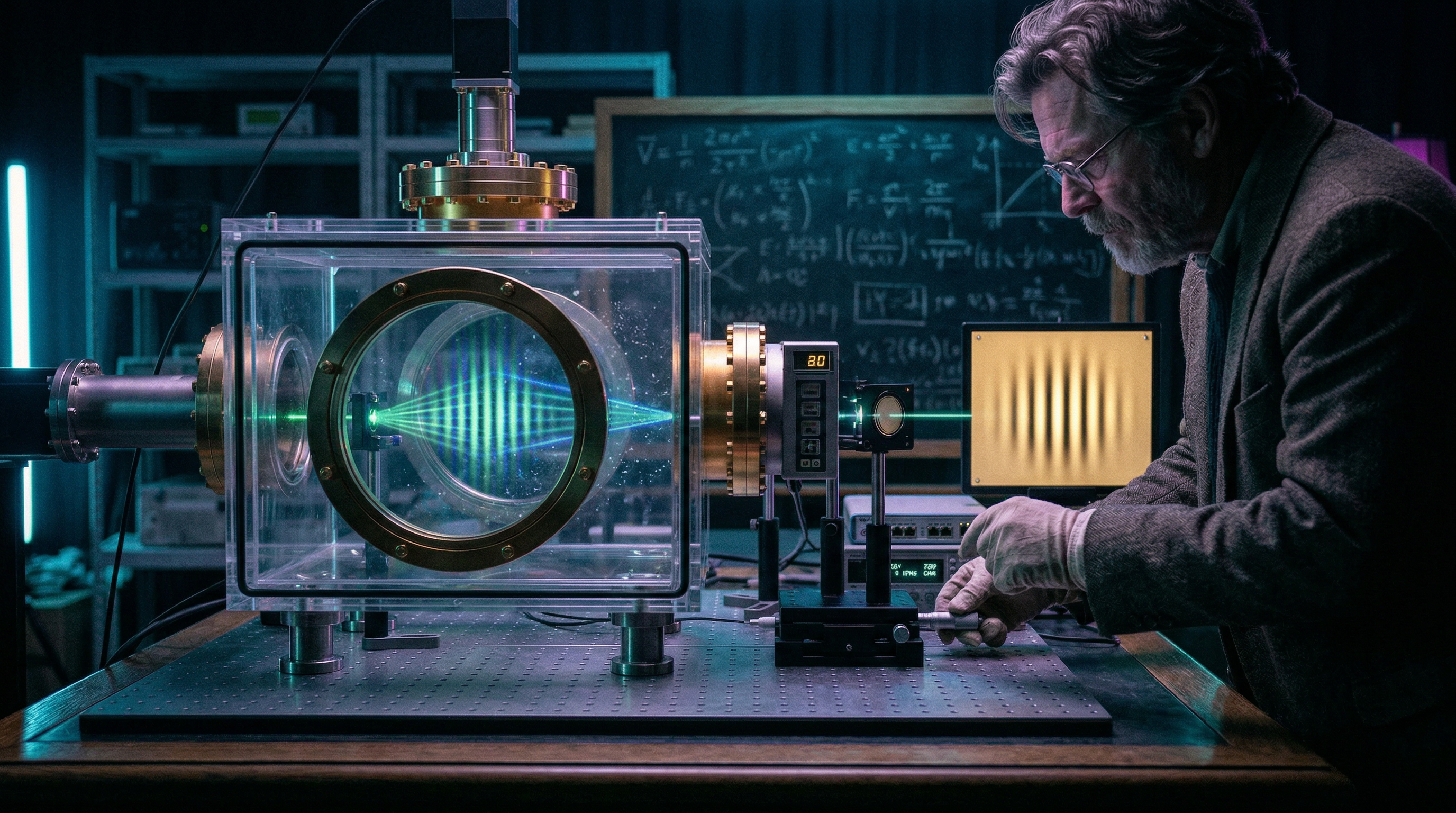
In 1996, Serge Haroche and colleagues at the École Normale Supérieure in Paris observed decoherence in real time by preparing a superposition of coherent states of the electromagnetic field in a microwave cavity and watching the interference fringes decay as the field interacted with its environment. This work contributed to Haroche's 2012 Nobel Prize in Physics.
Zurek and colleagues have demonstrated the progressive loss of coherence in ion trap experiments, confirming the predicted relationship between decoherence rate and system size. Superconducting qubit experiments at laboratories including IBM, Google, and academic institutions worldwide routinely measure decoherence times (T₁ and T₂ times) as critical performance metrics for quantum computing hardware.
Matter-wave interferometry experiments with increasingly large molecules — from fullerenes to organic molecules with thousands of atoms — have demonstrated the transition from quantum to classical behaviour as molecular complexity increases, providing direct evidence that decoherence from internal degrees of freedom (molecular vibrations, thermal radiation) becomes increasingly dominant with size.
Decoherence in Quantum Technology
Decoherence is the primary obstacle to practical quantum computing. A quantum computer requires qubits to maintain coherent superpositions long enough for computations to complete. Environmental decoherence constantly threatens to destroy these superpositions, converting delicate quantum information into classical noise.
Strategies for combating decoherence in quantum technology include physical isolation (operating at temperatures near absolute zero, in high vacuum, with electromagnetic shielding), quantum error correction (encoding logical qubits across multiple physical qubits with redundancy sufficient to detect and correct decoherence-induced errors), dynamical decoupling (applying sequences of control pulses that effectively refocus the environment's disruption), and topological approaches (encoding information in topological properties of quantum states that are inherently resistant to local environmental perturbation).
The race to build practical quantum computers is, in large part, a race against decoherence. Every improvement in qubit coherence time directly translates to longer computation windows and the ability to execute more complex quantum algorithms before environmental noise overwhelms the quantum advantage.
Broader Significance
Beyond its technical applications, decoherence has profound implications for foundational questions in physics and philosophy. It demonstrates that the boundary between the quantum and classical worlds is not a sharp divide but a gradual transition governed by the strength and nature of environmental interaction. There is no size or mass at which quantum mechanics "stops working" and classical physics "takes over." Rather, decoherence provides a smooth, quantitative account of how classical appearances emerge from quantum substrates as systems become larger and more strongly coupled to their environments.
This perspective dissolves the long-standing puzzle of why the macroscopic world appears classical despite being fundamentally quantum mechanical. The classical world is not a separate domain governed by different laws — it is the quantum world viewed through the filter of environmental decoherence, which suppresses all observable quantum signatures at everyday scales.
The question that decoherence leaves unanswered — why individual measurements produce definite outcomes — remains the deepest open question in the foundations of quantum mechanics. Whether this question will be answered by a refinement of existing theory, a new interpretation, or an entirely new framework remains to be seen.






