Praxis Dr. med. Heinz Weber
Praxis Dr. med. Heinz Weber occupied the ground floor of a respectable building in Hamburg's Eppendorf district, serving the city's international community from the mid-1950s through the early 1970s. Dr. Weber's fluent English, discretion regarding sensitive matters, and competence in obstetric care made his practice invaluable for expatriate women navigating pregnancy in a foreign country. Here Jane Lahey received confirmation of her pregnancy on 7 February 1962, the diagnosis delivered in a cream-painted examination room overlooking a winter courtyard, the word "schwanger" requiring no translation despite her limited German.
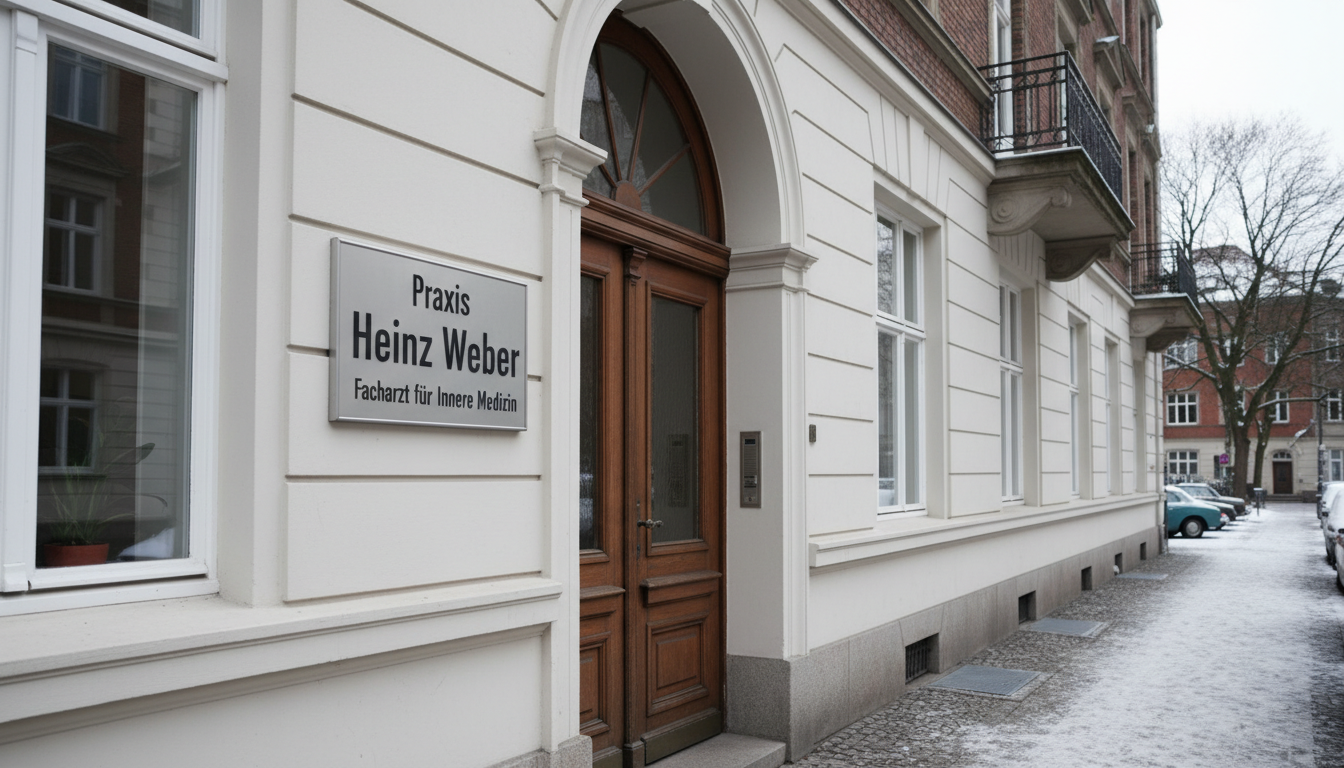
Location and Architectural Context
The building at 73 Eppendorfer Landstraße occupied a prominent position along one of Hamburg's most respectable residential and medical thoroughfares. Eppendorf, situated north of the Alster lakes and the city centre, had evolved throughout the late nineteenth and early twentieth centuries from rural village into affluent urban district, its character defined by substantial late-Victorian and Wilhelmine-era apartment buildings, tree-lined streets, and the proximity of the Universitätsklinikum Hamburg-Eppendorf, one of Germany's leading teaching hospitals.
The street itself, Eppendorfer Landstraße, formed one of the district's main arterial routes, connecting the neighbourhood's residential areas to the university hospital complex and providing access to the broader Hamburg transport network. By the early 1960s, the thoroughfare accommodated a mixture of residential properties, medical practices serving the hospital's overflow and private patients, and the occasional shop serving local needs. The address 73 sat approximately midway along the street's length, positioned to be accessible both to Eppendorf residents and to patients travelling from other Hamburg districts.
The building housing Praxis Dr. med. Heinz Weber exemplified the solid bourgeois architecture that characterised Eppendorf's development during the 1890s. Constructed in 1893 as part of Hamburg's rapid expansion following German unification, the five-storey structure featured the ornate brick façade typical of the period—decorative stonework around windows, modest balconies on upper floors, and a ground floor designed with higher ceilings to accommodate commercial or professional use. The building had survived the Second World War with minimal damage, Eppendorf's location having spared it the catastrophic destruction that Hamburg's port and industrial areas had suffered during Allied bombing campaigns.
The ground floor, where Dr. Weber's practice was located, provided the dual advantages of accessibility—no stairs for pregnant women or elderly patients to navigate—and visibility, with large windows facing Eppendorfer Landstraße allowing natural light whilst also signalling the practice's presence to potential patients. The entrance, positioned slightly recessed from the street, featured the characteristic heavy wooden door with brass fittings that German professional establishments favoured, with a discreet brass plaque reading "Praxis Dr. med. Heinz Weber – Allgemeinmedizin" mounted beside the doorbell.
Dr. Heinz Weber: Background and Practice Philosophy
Dr. Heinz Weber had established his practice at 73 Eppendorfer Landstraße in 1954, following completion of his medical training and several years working at the Universitätsklinikum Hamburg-Eppendorf in general medicine and obstetrics. Born in 1913 in Hamburg, Weber had completed his medical studies in the late 1930s, his career complicated by the war years in ways he rarely discussed but which attentive patients might infer from occasional comments and the careful way he avoided certain topics related to the period between 1939 and 1945.
His decision to establish a private practice rather than remaining in hospital medicine reflected both practical considerations—private practice offered greater autonomy and potentially higher income—and personal philosophy. Weber believed that medicine should accommodate patients' needs for privacy and dignity, that certain medical matters were best handled in settings that offered discretion rather than institutional efficiency. This philosophy made his practice particularly valuable for patients whose circumstances required confidentiality—unmarried pregnant women, married women bearing children in complicated circumstances, international patients unfamiliar with German medical systems.
Weber's fluency in English, acquired through pre-war study in London and maintained through continued practice, distinguished his practice from most Hamburg general practitioners. By the early 1960s, Hamburg's growing international business community—shipping executives, engineers contracted to German firms, diplomatic staff—created demand for medical services that could accommodate non-German speakers. Weber's practice filled this niche, his patient roster including British, American, Australian, and Scandinavian expatriates who valued his linguistic accessibility alongside his medical competence.
His approach to obstetric care combined German medical thoroughness with understanding that pregnancy often involved circumstances beyond mere biological process. Weber recognised that women seeking prenatal care might be managing complex emotional, social, or financial situations alongside their pregnancies. His consultations included not just medical examination but careful inquiry about patients' support systems, living situations, and resources for managing pregnancy and early motherhood. This holistic approach, unusual for the period's medical practice, earned him reputation amongst Hamburg's expatriate women as doctor who understood that pregnancy occurred within complicated human contexts.
The Practice: Physical Layout and Atmosphere
The entrance to Praxis Dr. med. Heinz Weber opened directly from Eppendorfer Landstraße into a small reception area that had been carefully designed to balance medical professionalism with welcoming atmosphere. The space measured approximately four metres by three metres, with the walls painted in cream that had been selected to feel clean without the institutional starkness that hospitals employed. A reception desk occupied one corner, staffed during business hours by Schwester Margarete Schmidt, the practice's nurse and administrative manager who had worked with Dr. Weber since the practice's establishment.
The waiting area contained six chairs upholstered in dark green fabric, arranged along two walls to provide seating without creating the crowded feeling that more chairs would have generated. A small table held several months' worth of German magazines—Der Spiegel, Stern, women's magazines featuring recipes and household advice—alongside a few English-language publications that Weber maintained specifically for his international patients. The walls displayed several framed botanical prints, neutral subjects that provided visual interest without risking the controversial content that political or historical imagery might have involved in 1960s Germany.
A narrow corridor led from the reception area to the examination rooms and Dr. Weber's private office. The corridor's walls were lined with glass-fronted cabinets containing medical supplies organised with the precision that German professional practice demanded—bandages, antiseptics, instruments, everything visible and accessible yet protected from contamination. The floor throughout the practice was covered in linoleum, practical for maintaining the hygiene standards that medical practice required, its pattern a neutral grey that showed dirt less readily than lighter colours would have whilst remaining appropriately clinical.
The practice contained two examination rooms, allowing Dr. Weber to see multiple patients efficiently when schedules required. The rooms were identically equipped and decorated, each measuring approximately three and a half metres by three metres. The examination tables were standard German medical equipment—adjustable height, covered in washable material, with crisp white paper changed between patients. Each room contained a sink with lever taps (foot-operated to maintain hygiene), glass cabinets storing instruments and supplies specific to examinations, and a small desk where Dr. Weber would sit to discuss findings with patients after examination was complete.
The examination room windows provided natural light and views of the building's small rear courtyard—a modest space containing a few winter-bare trees and minimal landscaping, maintained by the building's residents' association. The courtyard views offered patients something to focus on beyond the medical examination, a small psychological comfort that Weber had deliberately preserved when designing his practice's layout. During consultations, the windows could be covered with translucent curtains that maintained privacy whilst allowing natural light, the balance between openness and discretion reflecting Weber's broader practice philosophy.
Dr. Weber's private office occupied a slightly larger space at the corridor's end, measuring approximately four metres by four metres. This room served multiple functions—space for record-keeping, location for consultations that didn't require examination, and Weber's retreat for the brief periods between patients when he reviewed notes and prepared for subsequent appointments. The office contained a substantial desk, filing cabinets storing patient records organised with meticulous German attention to documentation, and bookshelves holding medical references, journals, and the accumulated professional literature that twenty years of practice had generated.
Practice Operations and Patient Demographics
Praxis Dr. med. Heinz Weber operated Monday through Friday, 8:00 AM to 6:00 PM, with Saturday morning hours (8:00 AM to noon) accommodating patients whose work schedules prevented weekday appointments. The practice accepted both appointment-based visits and walk-in patients, though Weber encouraged appointments for matters requiring extended consultation—prenatal visits, comprehensive examinations, discussions about ongoing health concerns. Schwester Margarete managed the appointment book with precision that ensured adequate time for each patient whilst minimising waiting periods that would have created the crowded, stressful atmosphere Weber wished to avoid.
The patient demographic reflected Eppendorf's affluent character and Weber's particular reputation amongst Hamburg's international community. Local German patients—primarily middle-class Eppendorf residents who valued the practice's convenient location and Weber's thorough approach—constituted perhaps sixty percent of the practice's caseload. These patients sought treatment for routine medical needs, preferring Weber's private practice to the university hospital's clinics where waiting times were longer and personal attention less consistent.
The remaining forty percent consisted of international patients who had discovered Weber through expatriate networks or through referrals from Hamburg's English-language establishments—the British Consulate, international schools, shipping companies employing foreign engineers. These patients valued Weber's English fluency and his understanding that being ill in a foreign country involved complications beyond mere symptoms—unfamiliarity with German medical systems, inability to read prescription instructions, anxiety about communicating symptoms in inadequate German.
Pregnant women represented significant portion of Weber's practice, his obstetric training and gentle manner making him popular choice for prenatal care. German women appreciated his thoroughness and willingness to spend time answering questions that hospital doctors often dismissed as unnecessary. International women valued even more highly his ability to explain German medical practices, his patience with their limited German, and particularly his discretion regarding circumstances that might have prompted judgment from less understanding practitioners.
The fee structure reflected the practice's positioning—more expensive than public clinics but less costly than Hamburg's most elite private practices. A standard consultation cost 15 Deutsche Marks in 1962, prenatal visits 20 DM, with additional charges for laboratory work or procedures requiring special equipment. These fees were affordable for the middle-class patients Weber primarily served whilst remaining beyond reach of working-class families who relied on public healthcare. The practice accepted both private payment and reimbursement through German health insurance, with Schwester Margarete managing the paperwork that such mixed payment systems required.
Medical Capabilities and Limitations
Praxis Dr. med. Heinz Weber was equipped to handle the full range of general practice medicine—routine examinations, minor procedures, prenatal care, treatment of common illnesses and injuries. The practice's equipment reflected 1960s medical standards—examination tables, basic diagnostic instruments (stethoscope, blood pressure cuff, thermometer, ophthalmoscope), a small autoclave for sterilising instruments, and refrigerated storage for medications and biological samples requiring cold preservation.
For more complex diagnostic procedures, Weber maintained relationships with several Hamburg laboratories that provided testing services. Urine and blood samples could be collected at the practice and sent for analysis, with results typically returning within 24-48 hours. Pregnancy tests, conducted via urine analysis detecting human chorionic gonadotropin, required approximately 30 minutes when performed using the practice's basic testing equipment, though more definitive laboratory confirmation could be obtained through external facilities.
The practice's limitations were clearly defined by the scope of general practice medicine. Weber did not perform surgeries beyond minor procedures (suturing wounds, removing superficial lesions, minor biopsies). Patients requiring specialist care—surgeries, complex diagnostics, emergency treatment—were referred to the Universitätsklinikum Hamburg-Eppendorf or other Hamburg hospitals. Weber maintained collegial relationships with specialists across various disciplines, facilitating referrals when patients' conditions exceeded general practice capabilities.
For obstetric care, Weber provided comprehensive prenatal monitoring but did not deliver babies himself. His patients gave birth either at the Universitätsklinikum Hamburg-Eppendorf or at one of Hamburg's private maternity clinics, with Weber coordinating care and ensuring smooth transitions between prenatal monitoring and delivery care. This division of labour was standard German practice—general practitioners managed pregnancies, specialist obstetricians handled deliveries—though Weber maintained close communication with delivery providers to ensure continuity of care.
The practice's discretion regarding sensitive matters was perhaps its most valued but least advertised capability. Weber understood that some patients' situations required more than medical care—they required confidentiality, non-judgmental support, and occasionally connections to resources that addressed social rather than strictly medical needs. His referrals might include adoption agencies, social services, financial counselling, or other supports that helped patients manage life circumstances rather than merely treating biological conditions.
Jane Lahey's Visit: 7 February 1962
Jane Lahey's visit to Praxis Dr. med. Heinz Weber on Wednesday, 7 February 1962, followed the pattern typical of international patients seeking confirmation of suspected pregnancy. She had secured the appointment through telephone call to Schwester Margarete several days earlier, her limited German sufficient for basic appointment-making though revealing her as foreign speaker. Schwester Margarete, accustomed to managing international patients, had confirmed the appointment for 10:30 AM, scheduling adequate time for consultation that might require slower communication due to language barriers.
Jane arrived precisely at 10:30, her punctuality reflecting both personal habit and anxiety about the appointment's purpose. Schwester Margarete greeted her with professional warmth, recognising immediately from Jane's accent and somewhat formal German that she was English-speaking expatriate. The intake process—recording basic information, explaining the procedure, collecting the urine sample for pregnancy testing—was conducted in mixture of German and English that accommodated Jane's linguistic limitations whilst maintaining the practice's professional atmosphere.
The examination room where Jane waited whilst the test processed exemplified the practice's careful balance between medical efficiency and human comfort. The cream walls, the view of the winter courtyard beyond the window, the clean but not sterile atmosphere—all created space that acknowledged pregnancy testing's emotional weight rather than treating it as purely mechanical process. Jane sat in the patient chair, hands folded in her lap, attempting to maintain composure whilst her mind cycled through the catastrophic implications of what she increasingly knew the test would confirm.
Dr. Weber entered at precisely 11:00, his timing suggesting the efficiency that made him valuable to patients who couldn't afford to spend entire mornings in medical waiting rooms. He was approximately fifty, grey-haired and professionally reassuring, his manner combining German formality with awareness that delivering medical news required human warmth. His English was excellent, barely accented, and he shifted immediately to English after noting Jane's struggle with the German intake forms.
The diagnosis—pregnancy, approximately ten to eleven weeks based on Jane's reported cycle dates and symptom onset—was delivered with clinical precision that nonetheless acknowledged the information's significance. Dr. Weber explained what Jane had known before arriving: the test was positive, the pregnancy appeared healthy based on symptoms and basic examination, the expected delivery date would be late August or early September. He offered congratulations with professional warmth, then paused, his expression shifting subtly as he registered Jane's response—not joy or relief but something closer to suppressed devastation.
The consultation that followed revealed Dr. Weber's particular gift for understanding that medical facts existed within complicated human contexts. His careful question—"Is this a planned pregnancy?"—opened space for Jane to indicate her distress without requiring detailed explanation. His discussion of "options"—phrased carefully, acknowledging possibilities without explicitly offering illegal services—demonstrated the discretion that made his practice valuable for patients in complicated circumstances.
The appointment concluded with Dr. Weber providing literature about prenatal care, scheduling a follow-up appointment for four weeks hence, and offering continued support regardless of what Jane decided. His final words—"Many women experience initial distress upon discovering pregnancy. Such reactions don't indicate bad mothers. Take time to process the situation before making decisions"—offered permission for the emotional complexity Jane was experiencing, acknowledging that pregnancy could be both biological fact and personal catastrophe simultaneously.
The Practice's Role in Hamburg's Expatriate Community
Throughout the 1960s, Praxis Dr. med. Heinz Weber served as unofficial medical home for significant portion of Hamburg's English-speaking expatriate community. The practice's reputation spread through the informal networks that expatriates relied upon—recommendations at international schools, references from shipping company personnel departments, word-of-mouth amongst wives attending English-language coffee mornings. For women particularly, Weber's practice offered rare combination of medical competence and understanding that pregnancy and reproductive health involved dimensions beyond mere biology.
The practice handled numerous cases similar to Jane Lahey's—women discovering pregnancies in circumstances requiring discretion, international patients navigating German medical systems whilst managing personal crises, individuals needing not just medical care but social support that German institutions weren't always equipped to provide. Weber's files, had they been preserved and later examined, would have revealed the hidden complexity of expatriate life—the affairs, the unplanned pregnancies, the marriages under strain, the isolation that prosperity and adventure couldn't eliminate.
Schwester Margarete's role in maintaining the practice's discretion was perhaps as important as Weber's medical skills. She understood that appointment scheduling sometimes required flexibility to accommodate patients' need to visit without husbands or employers knowing. She recognised that some telephone inquiries required careful responses that provided information without creating documented trails. Her files contained not just medical records but also careful notations about patients' circumstances—which could be contacted at home, which required messages left only at specific numbers, which needed reminders sent via post rather than telephone.
Closure and Legacy
Praxis Dr. med. Heinz Weber continued operating at 73 Eppendorfer Landstraße until Dr. Weber's retirement in 1974, his decision to close the practice rather than sell it reflecting his belief that medical practice was fundamentally personal relationship that couldn't be transferred like commercial property. The practice's closure marked end of particular era in Hamburg's medical landscape—the small, personal practices that had characterised German medicine were increasingly being replaced by group practices, medical centres, and institutional healthcare that prioritised efficiency over the individual attention that Weber had provided.
The building at 73 Eppendorfer Landstraße continued housing medical practices after Weber's retirement, subsequent doctors recognising the location's advantages for serving Eppendorf's population. Yet those who had been Weber's patients remembered the particular quality of care he had provided—the unhurried consultations, the careful attention to circumstances beyond symptoms, the discretion that had been invaluable when medical needs intersected with personal crises requiring confidentiality.






