Portsmouth Gaol, Hampshire
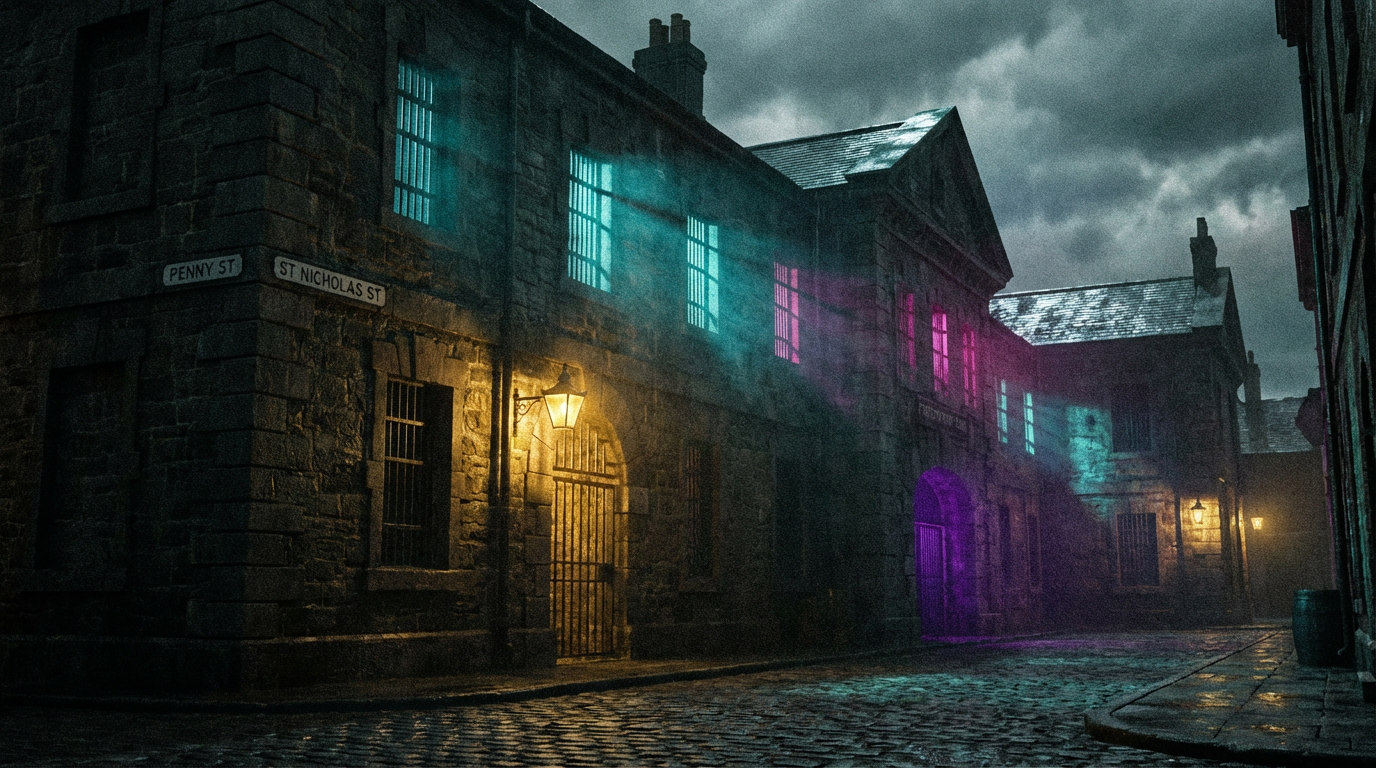
Portsmouth Gaol occupied the corner of Penny Street and St Nicholas Street from 1808 until its closure in 1878, a borough prison built to replace the notorious "White House" on High Street that had confined debtors and felons in shared squalor since at least the seventeenth century. Authorised under the royal charter of 1627 which first granted Portsmouth the right to maintain its own prison, the gaol processed thousands of prisoners across seven decades — petty thieves and prostitutes, debtors and deserters, men awaiting the hulks and women imprisoned for the twenty-second time. Its walls absorbed every shade of human misery the law could deliver, and gave back nothing.
The Charter and the White House
The right to confine was among the oldest privileges a borough could possess, and Portsmouth claimed it formally in 1627 when Charles I granted the town an expanded charter that included, among its provisions, authority to maintain a prison or gaol within the borough's limits. Whether confinement had occurred in Portsmouth before that date is beyond question — the town had held prisoners in one form or another since at least the late medieval period — but the charter gave the practice legal standing, binding the administration of local justice to the corporation and its appointed officers.
For well over a century following the charter, the borough gaol occupied premises adjoining the Crown Inn on the High Street, a building known locally as the White House. Separated from the pavement by an iron railing, the White House served the dual purpose of confining petty offenders tried before the borough magistrates and holding felons prior to their conveyance to the county gaol at Winchester for more serious proceedings. It was, by every contemporary account, a wretched place — cramped, airless, and stubbornly resistant to improvement.
A table of fees hung inside the gaol bore the signature of the town clerk, George Huish, dated 30 June 1738, though Huish noted that the fees had been paid since at least 1693 and were understood to have been "antiently paid" before that. Every commitment cost fifteen shillings and tenpence, of which three shillings and sixpence went to the town clerk. The sergeants at mace collected the remainder. Justice, in Portsmouth as elsewhere, was a transaction before it was a principle.
The White House stood barely two hundred yards from the old Town Hall on the High Street, where the borough's quarter sessions were held. Prisoners were conveyed between the two buildings through a passage beneath the street — a damp, low-ceilinged corridor of rough stone that spared the borough the spectacle of chained men being marched through the market in daylight, though whether this arrangement served the dignity of the accused or merely the sensibilities of the merchants who traded above was a question no one thought to ask.
The physical reality of the White House was catalogued with unflinching precision by John Howard, the prison reformer whose tours of English gaols in the 1770s and 1780s exposed conditions that most civic authorities preferred not to examine. Howard found the debtors' ward facing the street, with five lodging rooms upstairs containing beds. In the court behind stood a large room for felons, where he noted on one occasion that debtors had been lodged alongside them — a mingling of the merely unfortunate with the genuinely criminal that offended every principle of contemporary penology. The rooms above, designated for women, were described as "very black, having never been white-washed." There was, Howard recorded, no convenience for the separation of the sexes. The prison was, in his careful terminology, a "close prison" — meaning that its inmates could not be seen from the street and had no access to open air.
Allowances were sparse. Felons received a twopenny loaf and a penny in money. Clauses against the sale of spirituous liquors were eventually posted, and the keeper — who held no licence to sell alcohol — drew a salary of sixty pounds per annum. By the time of Howard's visit in July 1788, the gaol held three debtors and eighteen felons in a space designed for considerably fewer.
The White House persisted in this condition for decades, sustained by the same institutional inertia that kept scores of English borough gaols in operation long past the point of adequacy. The building's deficiencies were acknowledged, complained about, and ultimately tolerated, because replacing a gaol required money, and money required the borough corporation to levy rates that ratepayers would resist.
The Last Days of the White House
By the opening years of the nineteenth century, the White House had been confining men and women for the better part of two hundred years, and the weight of that history had settled into its fabric with a permanence that no amount of whitewash could have disguised, even had anyone thought to apply it. The stones were slick with centuries of damp. The air carried the sour tang of mildew and iron. The fear of those who had sat in its cells had soaked into the very mortar, each new prisoner adding another layer to a sediment of human misery that predated living memory.
It was in this condition — decrepit, condemned, and already earmarked for demolition — that the White House received William Jeffries in the spring of 1807. He was twenty-two years old, a clerk by trade, arrested on a charge of stealing a watch from a merchant named Josiah Blackwell and held on remand in the fortnight before his trial at the guildhall. The cell that contained him was everything Howard had described and worse: a narrow space with a low ceiling, limestone walls beaded with cold moisture, a straw mattress flattened to uselessness over the flagstone floor, and a narrow window slit high in the wall that admitted the barest trace of dawn. Rats scratched in the darkness. Water dripped from some unseen crack. The bells of St Thomas's Church, barely two hundred yards distant, tolled the hours with a clarity that cut through the stone like a blade.
Jeffries was convicted on 15 April 1807 and sentenced to seven years' transportation. He remained at the White House for several weeks following the verdict, enduring the gaol's daily rituals — the morning bell, the communal trough, the stone yard, the thin gruel and bread hard enough to crack teeth — before his eventual transfer to the prison hulks anchored in the harbour. His parents, Edward and Elizabeth Jeffries, visited him through iron bars in a room divided by a wall that permitted speech but not touch. The gaoler, a man named Culpepper, dispensed counsel that was gruff, practical, and entirely without sentiment.
Jeffries was far from the last prisoner the White House would hold, but the building's days were already numbered. Construction of a replacement had begun two years earlier, in 1805, on a site fronting Penny Street and extending back to St Nicholas Street. The new gaol rose slowly — stone by stone, yard by yard — within earshot of the old one, a reminder to every inmate of the White House that the borough could build a better prison but could not build it quickly enough to spare them.
The New Gaol on Penny Street
On 15 July 1808, the prisoners of the White House were marched through the streets of Old Portsmouth for the last time — not to the guildhall, but to the new Borough Gaol on Penny Street. The old building, described in official correspondence as "wretched" and "a disgrace to the Borough, in which the unfortunate shared a common fate with the infamous," was pulled down shortly afterwards. Whatever remained of its stones was absorbed into the fabric of the town, indistinguishable from the masonry of the buildings that replaced it.
The new structure represented a considerable improvement, at least in scale. It extended one hundred and sixty feet along the Penny Street frontage, with four courtyards and a day room in each. The entrance, centrally placed, opened into a hall approximately eleven feet square. To the right lay the gaoler's office; to the left, a room for the turnkey. A staircase from the hall gave access to the upper storeys and was common to all the apartments above. On either side of the hall, a narrow lobby — barely three feet wide — led to the courtyards: the men felons' yard measuring sixty feet by twenty-seven, and the yard for men debtors and those committed for slight misdemeanours measuring fifty-four feet by twenty-four.
George Luscombe served as the first gaoler, succeeded in due course by Edward Hunt, who held the concurrent title of Sergeant at Mace. The gaoler's salary stood at two hundred pounds per annum, with an additional eighty pounds for a turnkey. Fees continued much as they had at the White House: debtors paid nine shillings and sixpence upon commitment, felons fifteen shillings and tenpence, with three shillings and sixpence from each sum forwarded to the town clerk. No chaplain was appointed in the early years; a surgeon was sent from the parish when one was needed, which was often.
The daily allowance for every class of prisoner was a threepenny loaf. On Wednesdays, each prisoner received one pound of meat and vegetables, together with sevenpence in money per week — a sum referred to, with the grim humour characteristic of institutional language, as "prize money." The gaoler received sevenpence per day for the support of each prisoner, raised from the original sixpence, and from this sum was expected to furnish the prescribed rations and a fire to each day room. Whether the arithmetic left anything for the gaoler's profit was a question the corporation preferred not to examine too closely.
Inspection, Expansion, and the Persistence of Squalor
The new gaol attracted the attention of parliamentary inspectors almost from the moment it opened. The Account of Gaols published in 1818 recorded that Portsmouth Borough Gaol had committed four hundred and seventy-two prisoners in the preceding year, with a daily population peaking at sixty-four — a figure that tested the capacity of a building designed with more ambition than foresight. The inspectors' reports, submitted annually to Parliament through the 1820s and 1830s, painted a picture of incremental inadequacy: a facility that was never quite large enough, never quite clean enough, never quite disciplined enough to satisfy the evolving expectations of the age.
Among the inspectors' recurring concerns was the absence of a chapel and the lack of a dedicated chaplain. Religious instruction was regarded by early nineteenth-century reformers as essential to the moral rehabilitation of prisoners, and its absence at Portsmouth was noted with increasing firmness in successive reports. The Rules and Orders drawn up in 1821 addressed matters of daily discipline but could not conjure a chapel from empty ground.
Further recommendations included the removal of fixed canvas coverings from the men's bedsteads, which promoted the accumulation of filth; the appointment of an additional turnkey to strengthen general discipline and assist in the preservation of silence; and the construction of additional cells so that every prisoner might sleep separately at night. Re-committals were noted as "very numerous" — one woman had been imprisoned twenty-two times, one man eighteen — a statistic that spoke less to the gaol's rehabilitative capacity than to the revolving door between poverty, petty crime, and incarceration that defined the lives of Portsmouth's poorest residents.
In 1838, the borough corporation finally addressed the most pressing deficiency by enlarging the gaol. A chapel and additional yards were erected on the site of old almshouses purchased for seven hundred pounds, a transaction that converted one form of institutional charity into another. The appointment of a curate's licence to Alexander Lowry as chaplain to the Gaol and House of Correction formalised religious provision that had been absent since the facility opened. The enlargement brought the gaol closer to the standards demanded by successive Inspectors of Prisons, though their reports continued to identify shortcomings with a regularity that suggested the standards moved faster than the building could follow.
A contract for further enlargement was drawn up in 1843, and the gaol continued to evolve through the middle decades of the century — absorbing new regulations, adapting to new expectations, processing the steady flow of petty offenders, debtors, and felons that the borough's courts delivered to its door. The work was unglamorous and unending. Prisoners arrived, served their time or awaited transportation, and departed. The gaol persisted.
Closure and Afterlife
The Prison Act of 1877 nationalised the English prison system, transferring responsibility for local gaols from borough corporations and county magistrates to the newly established Prison Commission. For Portsmouth, this meant the end of two and a half centuries of borough-administered confinement. The gaol on Penny Street was closed in 1878, its remaining prisoners transferred to the new prison at Kingston in the eastern suburbs — a purpose-built facility designed by local architect George Rake on the Pentonville radial model, with an octagonal central hall and five radiating wings. What the Penny Street gaol had achieved through incremental adaptation, Kingston achieved through modern design. The age of the borough gaol was over.
The Penny Street site did not remain empty for long. The buildings were acquired by Portsmouth Grammar School, which had occupied premises further along the same street since 1750. The school expanded into the former gaol's footprint, and the rooms that had once held felons and debtors were given over to purposes their builders could not have imagined. The city's archives — charters, records of local government, the town seals and corporation money — were stored on the site for a period before their eventual transfer to the Guildhall, where they narrowly survived the bombing of 1941.
Today, nothing visible remains of the Borough Gaol on Penny Street. The grammar school buildings have long since absorbed or replaced the original structure, and the casual visitor to Old Portsmouth would find no plaque, no marker, no indication that the site once housed the borough's most desperate and dispossessed. The White House on High Street fared no better — demolished after 1808, its stones lost to the fabric of the town, its precise location a matter for local historians and the occasional archaeologist.
What survives is documentary. The fee tables signed by George Huish. The inspection reports submitted to Parliament. The rules and orders of 1821. The contract for enlargement in 1843. The calendars of prisoners, held now at the Hampshire Record Office in Winchester and the National Archives at Kew, recording in careful clerical hand the names, offences, and sentences of those who passed through the gaol's doors across seven decades. Among them, entered in the spring of 1807 under the old regime at the White House, is the name of William Thomas Jeffries — age twenty-two, occupation clerk, offence theft, sentence seven years' transportation. A single line in a ledger. A life reduced to administrative shorthand. The gaol, which had no interest in the stories of those it confined, preserved them anyway, indifferent to their significance.







