Portsmouth Constabulary
The Portsmouth Constabulary traces its origins to the parish constables first recorded in the thirteenth century, though the force as a formal institution dates from 18 March 1836, when forty officers were sworn in under the provisions of the Municipal Corporations Act. For over a century and a quarter, the constabulary policed a city shaped by the demands of the Royal Navy, the volatility of its transient populations, and the ordinary miseries of poverty, drink, and desperation that defined life on Portsea Island. It ceased to exist on 31 March 1967, absorbed into the newly formed Hampshire Constabulary — its name retired, its traditions dispersed, its century of service reduced to a line in an Act of Parliament.
Before the Badge
Policing in Portsmouth predates any formal institution by centuries. The earliest recorded appointment of a constable within the borough dates to 1241, a period when the maintenance of the King's peace fell to men chosen from the community they served — unpaid, often reluctant, and answerable to a system of local justice that relied more on obligation than organisation. These were parish constables and tythingmen, their authority derived from custom and statute rather than training or expertise, their duties encompassing everything from apprehending felons to impounding stray livestock to ensuring that the Sabbath was observed with appropriate solemnity.
The office persisted through the medieval and early modern periods with a consistency that owed more to the absence of alternatives than to any particular effectiveness. Parish constables are recorded in Portsmouth in 1435, 1531, and 1621, each entry confirming that the system endured largely unchanged across centuries. The constable served for a year, was selected by the parish vestry or appointed by the magistrates, and was expected to discharge his obligations alongside whatever trade or employment actually sustained his household. The arrangement produced men of variable quality: some diligent, some indifferent, some so manifestly unsuitable that their appointment amounted to a public inconvenience rather than a public service.
By the eighteenth century, the parish constable system had been supplemented — though never replaced — by a night watch of paid watchmen who patrolled the streets after dark. Portsmouth's status as the primary home port of the Royal Navy ensured a population that swelled and contracted with the tides of war and peace, its streets filled with sailors on shore leave, dockyard workers whose labour was as seasonal as the fleet's movements, and the innkeepers, prostitutes, and petty criminals who sustained themselves on the margins of naval commerce. By the early 1700s, the borough contained one hundred and fifty-five public houses — a figure that would only grow as the Navy's presence expanded — and the task of maintaining order among their patrons fell to men whose numbers, training, and resources were wholly inadequate to the challenge.
The Old Constabulary
It was into this imperfect system that men like Silas Ezra Greaves built careers that spanned decades. Greaves, born in 1755 to a cobbler on Oyster Street, entered constabulary service as an apprentice in 1769 under the supervision of Robert Thorne, a veteran officer whose methods favoured persuasion over force. The apprenticeship lasted six years, and Greaves emerged from it with a philosophy of enforcement that valued judgment over rigidity — the belief that the desperate father who stole bread and the habitual thief who stole for profit, though equally guilty under statute, were not equally deserving of the law's full weight.
Greaves served for over four decades, retiring in 1820 at the age of sixty-five, his career encompassing the American War, the Revolutionary and Napoleonic Wars, and the enormous social upheaval that accompanied each. The wars with France from 1793 transformed Portsmouth into a city under perpetual mobilisation, its population surging with every new campaign, its streets volatile with the tensions between permanent residents and transient military populations. Greaves and his fellow constables worked alongside naval authorities whose jurisdiction overlapped with civil policing in ways that were never entirely resolved, navigating a patchwork of competing powers that would have defeated a lesser man's patience.
Among the cases that defined Greaves's later career was the arrest of William Jeffries in the spring of 1807, a young clerk charged with the theft of a pocket watch from the merchant Josiah Blackwell. Greaves had encountered Jeffries once before — a decade earlier, when the boy was twelve years old and Greaves had shown him mercy rather than deliver him to the magistrates. The second encounter permitted no such discretion. Greaves made the arrest, gave his testimony, and watched as the court sentenced Jeffries to seven years' transportation. Whether the constable dwelt on the boy he had once spared, or whether duty had long since taught him to separate sentiment from obligation, the record does not say.
The pre-reform constabulary produced men of Greaves's calibre not because the system was designed to do so, but because the work itself — relentless, underpaid, and largely unappreciated — attracted a particular temperament and repelled most others. Those who endured did so out of conviction or stubbornness or some combination of the two, and the community they served was better for it, even if no one thought to tell them so at the time.
The Municipal Corporations Act and the New Force
The reform of English policing came not from Portsmouth but from London, where Sir Robert Peel's Metropolitan Police Act of 1829 established the first professional, uniformed police force in the country. The model spread outward through the Municipal Corporations Act of 1835, which required every borough in England and Wales to establish a watch committee and appoint a body of paid constables. The era of the parish constable and the night watchman was, at least in law, at an end.
Portsmouth's watch committee met for the first time on 25 January 1836 to determine the size and composition of the new force. An advertisement appeared in the Hampshire Telegraph inviting applications for the posts of one superintendent, three inspectors, three sub-inspectors, and twenty-four constables — forty men in total, tasked with policing a borough whose population, character, and demands would have tested a force three times that number. The first officers were sworn in on 18 March 1836, and the Portsmouth Borough Police came formally into existence.
The transition from the old system to the new was neither seamless nor immediate. The parish constables and watchmen did not simply vanish; many of the old hands applied for positions in the new force, bringing with them the local knowledge and street-level experience that no amount of formal training could replicate. Others, unsuited to the discipline and regulation that professional policing demanded, drifted back to whatever trades they had practised before. The new force inherited both the strengths and the deficiencies of its predecessors — the intimate familiarity with the borough's geography and population, but also the habits of irregular enforcement and personal discretion that reformers had sought to eliminate.
The early decades tested the force repeatedly. In August 1850, a three-day riot erupted in Portsea between soldiers of the 50th Regiment of Foot and seamen of HMS Fox, a confrontation that overwhelmed the constabulary's capacity and required military intervention to suppress. In March 1861, a massive fire broke out at a travelling circus in the early hours of the morning, and the police found themselves simultaneously rescuing animals, dousing flames, and holding back an ever-growing crowd of spectators. These incidents exposed the fundamental tension at the heart of borough policing: a force sized for routine order was perpetually vulnerable to events that exceeded routine.
Growth and the Expanding Borough
As Portsmouth grew, so the force expanded, its development traceable through the construction of new police stations across the borough. The Albert Road station opened in 1872, followed by the Guildhall station in 1890, Kingston Cross in 1895, Fratton in 1907, Eastney in 1914, and Cosham in 1924 — the last coinciding with the extension of the borough boundaries northward to Portsbridge. Each station marked the incorporation of another district into the constabulary's jurisdiction, another set of streets to patrol, another population to police.
The authorised strength of the force increased correspondingly, though never as quickly as the demands upon it. In 1874, the establishment stood at one hundred and twenty officers. By 1904 it had reached two hundred and forty-six; by 1924, two hundred and ninety; by 1939, three hundred and twenty-one. The pay of a constable from 1865 to 1900 remained fixed at twenty-three shillings per week — a sum that placed the police officer squarely within the working class he was employed to police, sharing the same streets, the same economic pressures, and often the same public houses as the people whose behaviour he was expected to regulate.
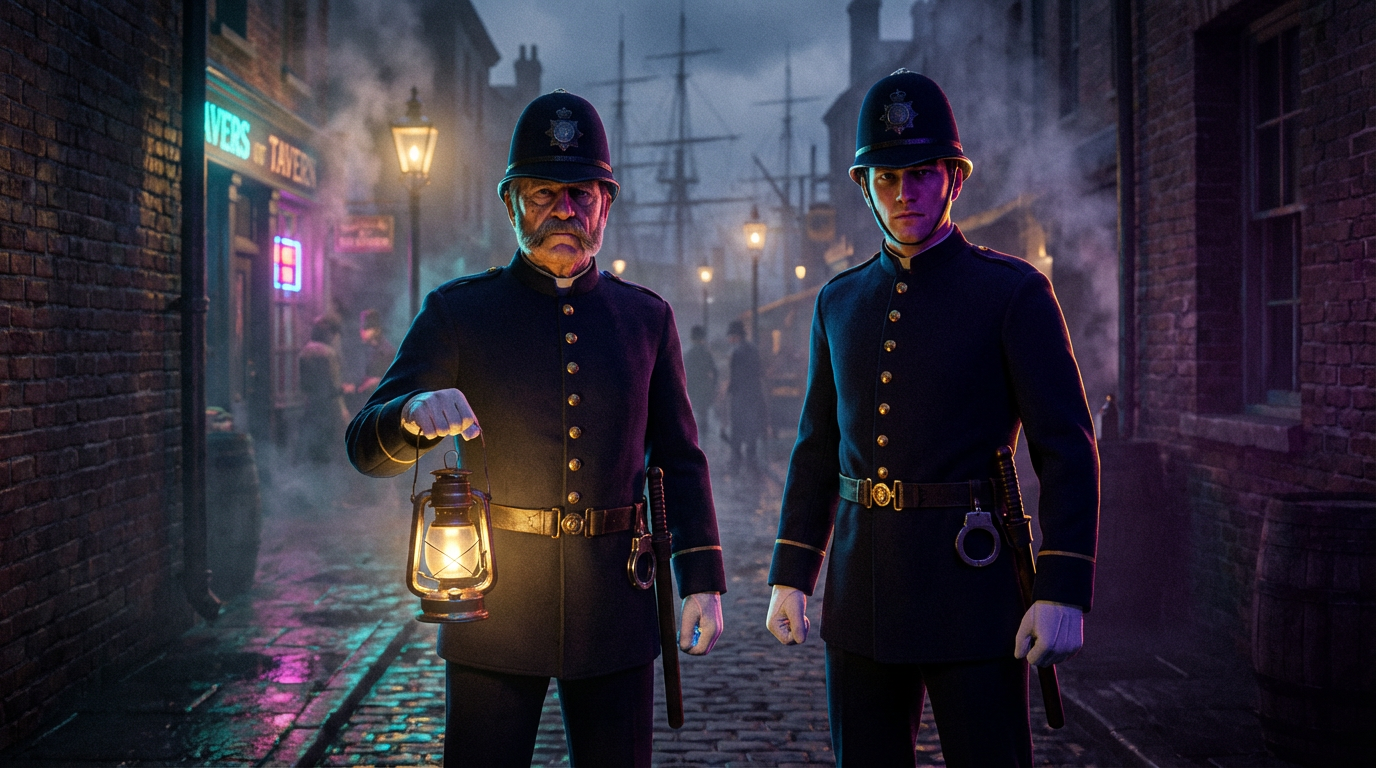
The force replaced its glazed hats with plain coxcomb helmets in 1870, though it was not until 1877 that a helmet plate — or "front ornament" — was added. These were small gestures toward the professional identity that the Metropolitan Police had cultivated from its inception, but they mattered. A uniform distinguished the officer from the civilian, conferred authority that the parish constable's plain clothes had never carried, and announced the presence of the law in streets where its writ had previously been uncertain.
Wars and the Weight of Service
The twentieth century brought demands that the force's Victorian founders could not have anticipated. The First World War drew officers into military service and brought the Special Constabulary into regular duties for the first time — volunteer citizens filling the gaps left by men who had exchanged one uniform for another. Portsmouth's strategic importance as a naval base ensured that the city operated under wartime conditions more acutely than most, its population swelling once again with servicemen, its docks and supply lines requiring protection against sabotage and espionage.
The Second World War struck Portsmouth with a ferocity that tested every institution in the city. The Blitz of 1941 devastated large areas of the borough, destroying homes, businesses, and public buildings including the Guildhall itself. The police worked through the bombing, maintaining order amidst chaos, directing survivors to shelters, recovering the dead, and ensuring that the essential functions of civil life continued even as the physical fabric of the city was torn apart. Officers who had joined the force to walk a beat found themselves performing duties closer to those of soldiers — a transformation that no training had prepared them for and no peacetime service could equal.
By 1947, the authorised strength had reached three hundred and eighty-seven, and in 1952 the force consisted of the Chief Constable, an Assistant Chief Constable, six superintendents, nineteen inspectors, fifty-two sergeants, and three hundred and eight constables, together with one police woman inspector, two police woman sergeants, and fifteen police woman constables. The inclusion of women in the establishment — belated and modest though it was — marked a recognition that policing required skills and perspectives that an exclusively male force could not provide.
Amalgamation and Afterlife
The Police Act of 1964 set in motion the reorganisation of English policing that would end Portsmouth's independent constabulary. The logic was administrative: larger forces offered economies of scale, broader resources, and greater capacity to respond to serious crime. The sentiment was less easily accommodated. A force that had policed its own city for over a century possessed an institutional identity, a local knowledge, and a relationship with the community it served that could not be transferred by statute.
On 31 March 1967, the Portsmouth City Police ceased to exist, amalgamated alongside Southampton City Police into the newly formed Hampshire Constabulary. The officers who had worn the Portsmouth badge on their helmets exchanged it for the Hampshire crest; the stations they had worked from continued to operate under new authority; the streets they had patrolled remained the same streets, policed now by an organisation whose jurisdiction extended far beyond the borough boundaries that had defined their predecessors' world.
What was lost in the amalgamation cannot be precisely quantified, because it was never precisely defined. It was the accumulation of a hundred and thirty-one years of institutional memory — the knowledge of which families caused trouble and which could be relied upon, which corners attracted crime and which were merely dark, which publicans watered their beer and which served honest measure. It was the understanding, passed from officer to officer across generations, that Portsmouth was not merely a jurisdiction but a place, and that policing it required knowing it in ways that no training manual could convey. The Hampshire Constabulary inherited the territory. The knowledge, like the name, was quietly retired.







