Plymouth, Devon, England
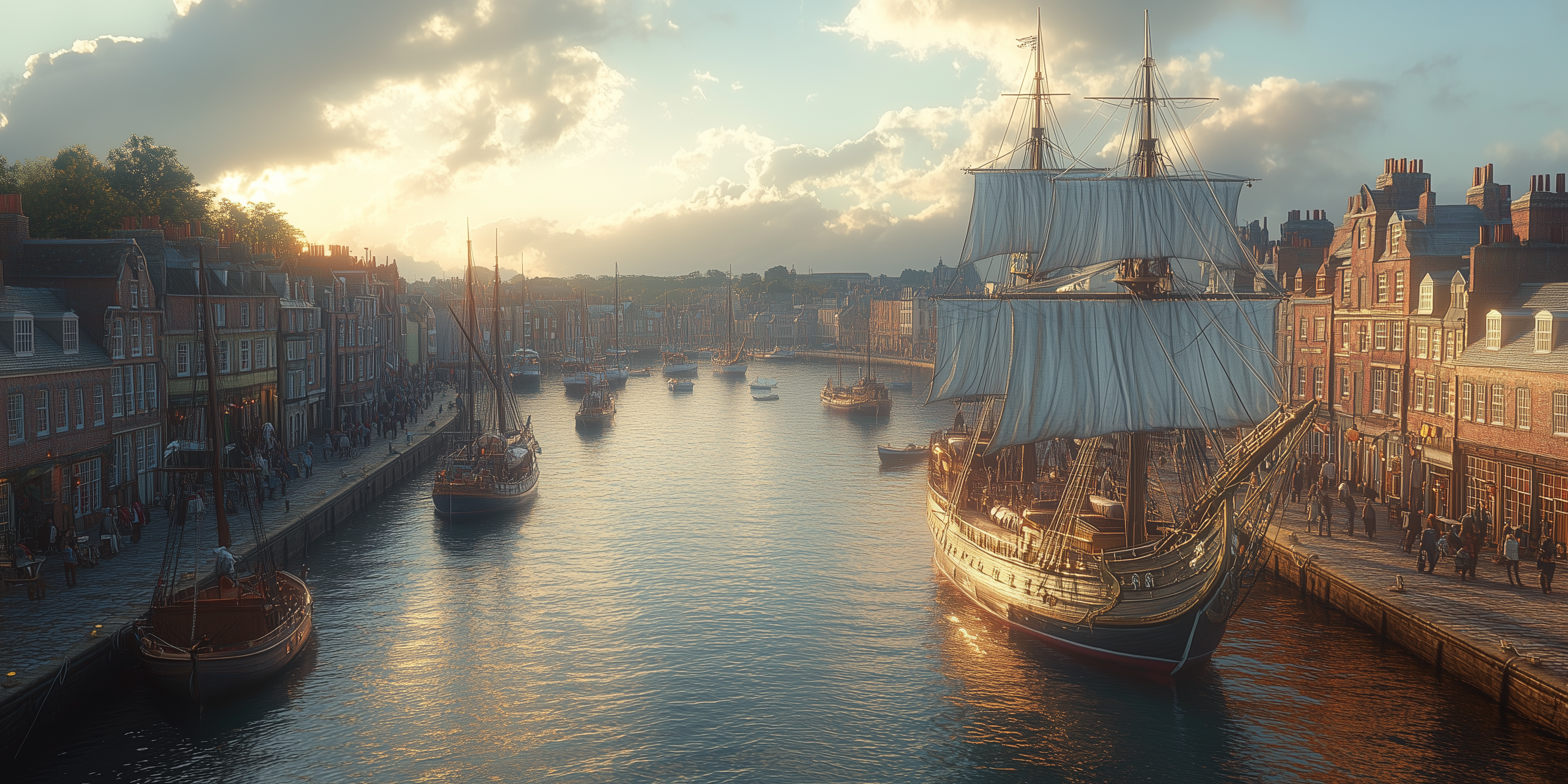
Plymouth is a port city on Devon's south coast, set between the mouths of the rivers Plym and Tamar where they meet the natural harbour of Plymouth Sound. From its origins as the Saxon fishing village of Sutton, it grew into one of England's most strategically important maritime centres — the port from which Drake sailed against the Armada, the Pilgrim Fathers departed for the New World, and the Royal Navy built and sustained a fleet that shaped the course of empire. Besieged, bombarded, and rebuilt, Plymouth endures.
Ancient Origins and Saxon Settlement
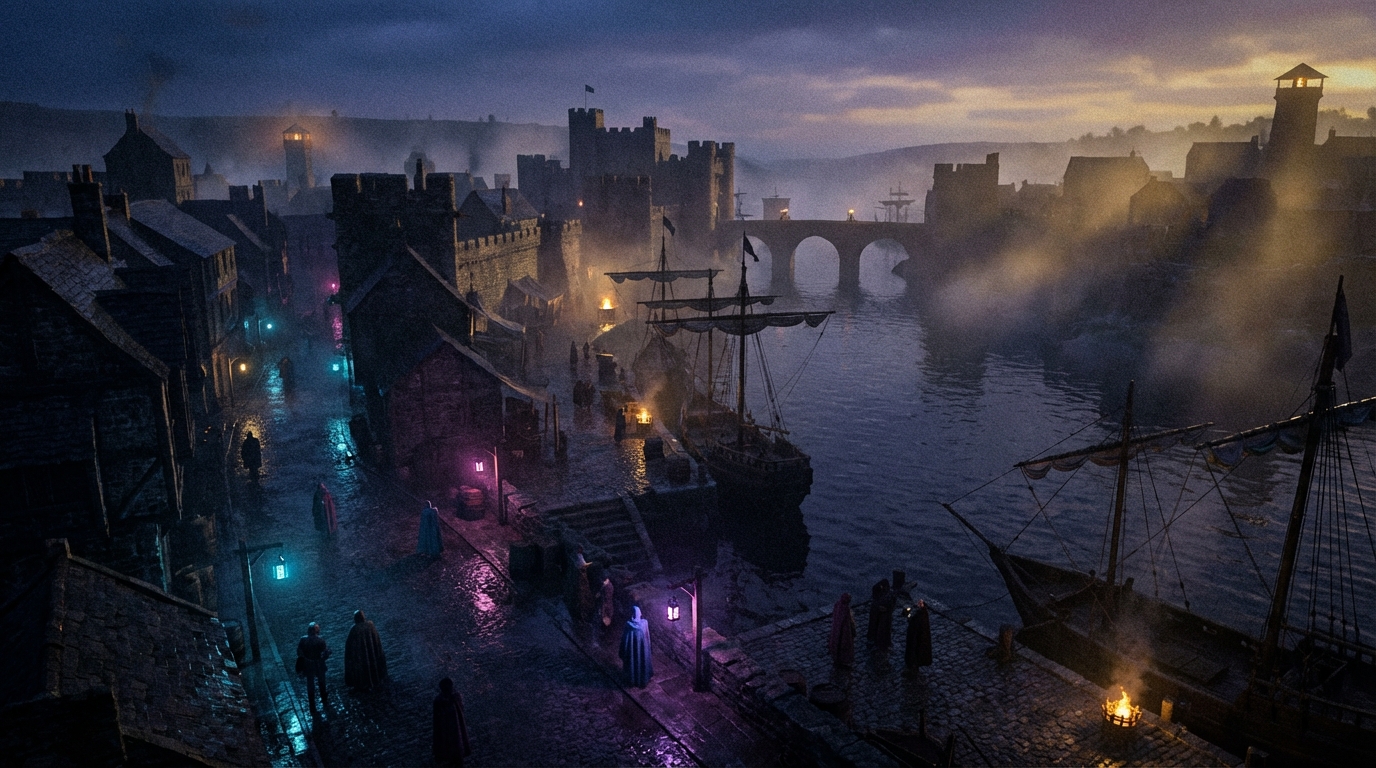
Human activity around Plymouth Sound reaches back to the Bronze Age, when a settlement at Mount Batten — a rocky peninsula jutting into the harbour — served as a trading post for tin and other commodities with the continent. This outpost continued through the Iron Age and into the Roman period, when Dartmoor tin found its way to markets across the Empire. But Plymouth's story as a town begins not at the waterfront, but on higher ground inland. The Saxon settlement of Sutton — meaning simply "south farm" — appears in the Domesday Book of 1086 as a modest agricultural holding near what is now Sutton Harbour, within the hundred of Roborough. The manor was held by the Crown, its recorded population a handful of households, its annual value a single pound.
Medieval Market Town
Plymouth's transformation from farming hamlet to trading port accelerated in the thirteenth century, as the higher reaches of the River Plym silted up and the older settlement of Plympton lost its usefulness as a harbour. Ships and merchants migrated downstream to the deeper waters around Sutton Pool, where the river met Plymouth Sound. The priory at Plympton, which held lands at Sutton, secured a charter from Henry III in 1254 granting the right to hold a weekly market and annual fair — the formal act that made Sutton a market town. Trade expanded rapidly: tin, cloth, and wool were exported to Gascony and the Low Countries; wine, salt, and manufactured goods flowed back. Fishing — particularly for pilchard and herring — sustained a large proportion of the population, while the harbour's natural depth and shelter attracted an ever-growing fleet.
In 1403, Breton raiders attacked and burned parts of the town, a reminder of Plymouth's exposed position on the Channel coast. The response was fortification. Plymouth Castle, a square-plan fortress with four round towers, was built near Sutton Pool in the late fifteenth century to protect the harbour. In 1439, Parliament granted the town its first charter of incorporation — formally renaming it Plymouth and making it the first town in England to be incorporated by act of Parliament. The charter consolidated the previously separate manors of Sutton Prior, Sutton Valletort, and Sutton Ralf into a single self-governing borough, empowered to levy taxes, regulate trade, and construct defensive walls.
The Age of Exploration
The sixteenth century made Plymouth famous. Its position at the mouth of the Channel, with open access to the Atlantic, placed it at the centre of England's emerging maritime ambitions. William Hawkins made the first English trading expeditions to West Africa from Plymouth in the 1530s. His son, Sir John Hawkins, led England's first ventures into the transatlantic slave trade from the same port. But it was Sir Francis Drake who became inseparable from the city's identity. Born in Tavistock but later mayor of Plymouth, Drake sailed from the port in 1577 aboard the Golden Hinde to complete the first English circumnavigation of the globe, returning in 1580 laden with Spanish treasure. In 1588, the English fleet assembled in Plymouth Sound to meet the Spanish Armada — and it was on Plymouth Hoe, according to enduring legend, that Drake insisted on finishing his game of bowls before setting sail to face the enemy.
Drake's contributions to the town were practical as well as legendary. In 1591, Drake's Leat was opened — a watercourse tapping the River Meavy on Dartmoor and carrying fresh water some seventeen miles to Plymouth, an engineering achievement that sustained the town for over two centuries. In 1512, an Act of Parliament authorised further fortification of the port, and a string of artillery blockhouses were built along the shoreline, including defences on St Nicholas Island (later Drake's Island) and a fort on the Hoe that would eventually become the site of the Royal Citadel.
On 6 September 1620, the Mayflower departed from Sutton Pool carrying the Pilgrim Fathers to the New World, where they established Plymouth Colony in Massachusetts — the second permanent English settlement in America. The Mayflower Steps on the Barbican, though a later commemorative addition, mark the approximate point of departure and remain one of Plymouth's most visited landmarks.
Civil War and Restoration
When the English Civil War began in August 1642, Plymouth — a town of roughly seven thousand inhabitants — declared for Parliament, placing it at odds with the largely Royalist county of Devon. What followed was one of the longest sieges of the war. From 1642 to January 1646, Royalist forces blockaded the town by land, cutting off supplies and, critically, blocking Drake's Leat to deny the population fresh water. The population swelled to perhaps ten thousand as Parliamentary supporters from outlying areas sought refuge behind the defensive walls. Disease — particularly typhus — compounded the misery. Yet Plymouth never fell. Parliamentary control of the Royal Navy ensured that the port could be resupplied by sea, and a crescent of hastily constructed forts along the high ground to the north — at Lipson, Holiwell, Maudlyn, Pennycomequick, and New Work — held against repeated assaults. The decisive moment came in December 1643, when a Royalist force that had captured the outpost at Laira Point was routed at what is now Freedom Fields Park, an action commemorated locally as the "Great Deliverance." The siege was finally lifted when Sir Thomas Fairfax marched his army into the South West in early 1646.
The Restoration brought a pointed royal rebuke. Construction of the Royal Citadel began in 1665 under Charles II — a massive star-shaped fortress on the eastern end of Plymouth Hoe, its cannon pointing not only out to sea but inward toward the town, a deliberate reminder to Plymouth's stubbornly Parliamentarian citizens not to oppose the Crown again.
The Royal Dockyard and Naval Expansion
In 1689, William III recognised the need for a major new dockyard in the West Country. Edmund Dummer, Surveyor of the Navy, was dispatched to find a suitable site and settled on the Hamoaze — a section of the River Tamar west of Plymouth, in the parish of Stoke Damerel. On 30 December 1690, a contract was let for construction, and Plymouth Dock was born. Dummer's design was revolutionary: at its heart, a stone-lined wet basin giving access to the first successful stepped stone dry dock in Europe, surrounded by logically positioned storehouses, a combined rope-house and sail loft, and, on the high ground above, a grand terrace of officers' houses — the first known palace-front terrace in the country.
The dockyard transformed the area. A new town — initially called Plymouth Dock, renamed Devonport in 1824 — grew rapidly around it, becoming a distinct community alongside Plymouth and the smaller settlement of East Stonehouse. Together, these were known as the "Three Towns." Through the eighteenth century, the dockyard expanded steadily: an ordnance yard was added in 1719, further docks and slipways in the 1760s, and the Keyham Steam Yard was completed in 1853 to accommodate the transition from sail to steam. Over nearly three centuries, more than three hundred warships were built at Devonport, the last being HMS Scylla in 1971.
The dockyard's appetite for provisions drove the construction of the Royal William Victualling Yard at Stonehouse, designed by Sir John Rennie and built between 1826 and 1835. Named after William IV, the sixteen-acre complex of neoclassical buildings — brewery, bakery, slaughterhouse, cooperage, and vast storehouses arranged around a granite-lined tidal basin — consolidated the scattered victualling operations that had sustained the fleet since the thirteenth century. It remains one of the finest collections of Grade I and II* listed military buildings in Europe.
In Plymouth Sound itself, John Rennie's mile-long Breakwater — begun in 1812 and not completed until 1841 after numerous technical difficulties and storm damage — finally provided the protected anchorage the fleet had always needed. The ring of Palmerston forts constructed around Devonport in the 1860s completed the defensive infrastructure of what had become one of the most important naval bases in the world.
Georgian and Victorian Plymouth
The eighteenth and nineteenth centuries saw Plymouth evolve from a strategic port into a substantial urban centre. The architect John Foulston, an early and important advocate of the Greek Revival, was responsible for a series of grand public buildings across the Three Towns from the 1810s onward, including the Theatre Royal, the Athenaeum, and the Royal Hotel — many of which would later be destroyed in the Blitz. In 1768, the local chemist William Cookworthy established England's first porcelain manufacture in Plymouth, exploiting deposits of china clay he had discovered in Cornwall. Though the venture lasted only two years, it launched an extractive industry that would sustain the region for generations.
The dockyard remained the economic engine, employing thousands and drawing skilled workers from across the country. Throughout the Napoleonic Wars, Plymouth served as a critical base for the Channel Fleet. By the mid-nineteenth century, the port handled substantial imports — maize, wheat, barley, sugar, guano, and nitrates from the Americas — while exporting Dartmoor minerals including tin, copper, lime, and arsenic. The arrival of the railway in 1849, when the South Devon Railway reached Plymouth, and the completion of Isambard Kingdom Brunel's Royal Albert Bridge across the Tamar in 1859, connected the city to the national network and accelerated its commercial growth.
It was into this bustling, dockyard-dominated city that Samuel John Brooks was born on 14 October 1765, the son of George Brooks, a shipwright at the dockyards, and Mary, née Wainwright. Growing up within earshot of the hammering and sawing of the yards, Brooks attended the local grammar school before following his father into maritime service. His meticulous nature and talent for navigation carried him from deckhand to quartermaster, and he would spend decades aboard the merchant vessel Persephone — including a critical voyage in 1818 carrying William Jeffries Sr. from Hobart Town to England — before retiring to Plymouth, where he died on 22 November 1840.
That same year of 1765 also saw the birth of Elias Harcourt on 16 April, another son of Plymouth's maritime world. Harcourt served first in the Royal Navy before transitioning to colonial transport routes, becoming known as a strict but fair captain who maintained order aboard convict transports while navigating the treacherous Roaring Forties. He died of fever at Port Jackson in 1823, aged fifty-eight.
Nine years later, on 23 October 1774, Elijah James Goodwin was born near Plymouth's bustling docks, where his father Thomas worked as a shipwright. The sea claimed Goodwin early — he was aboard merchant vessels by fifteen — and it was the sea that delivered him to a new life when he was shipwrecked off Van Diemen's Land in 1810. Settling in Hobart Town and bringing his family over in 1812, Goodwin took over the management of the Whale and Whistle Tavern in 1815, transforming it into one of the fledgling settlement's most beloved gathering places. He died in Hobart on 17 November 1849, aged seventy-five, having carried Plymouth's spirit of resilience and camaraderie to the other side of the world.
The Three Towns and City Status
In 1914, the county boroughs of Plymouth and Devonport and the urban district of East Stonehouse were merged to form a single county borough of Plymouth. On 18 October 1928, the enlarged borough was granted city status, and in 1935 Plymouth gained the right to appoint a Lord Mayor. One of its most notable parliamentary representatives was Nancy Astor, who in 1919 became the first woman to take her seat as a Member of Parliament, representing Plymouth Sutton.
The Plymouth Blitz
The Second World War brought devastation on a scale Plymouth had never experienced. As the home of HMNB Devonport — the largest naval base in Western Europe — the city was a prime target for the Luftwaffe's campaign against British ports. The first bombs fell on 6 July 1940 at North Prospect, killing three people. But the worst was still to come. In March and April 1941, five major raids reduced much of the city centre to rubble. Incendiary bombs started fires that consumed whole streets; high explosives brought down buildings by the hundred. On the night of 22 April 1941, a direct hit on the communal air-raid shelter at Portland Square killed seventy-six people — only three survived.
Over the course of fifty-nine bombing attacks between 1940 and 1944, 1,172 civilians were killed and 4,448 injured. More than 18,000 houses were damaged, nearly 4,000 of them destroyed. The city's two main shopping centres were obliterated, along with twenty-six schools, eight cinemas, and forty-one churches. St Andrew's Parish Church, the city's principal place of worship, was gutted. Amidst the smoking ruins, a headmistress nailed a wooden sign over the door reading simply "Resurgam" — Latin for "I shall rise again." The resident population, which had stood at 220,000 at the outbreak of war, fell to just 127,000 as thousands fled or were evacuated, many to the fringes of Dartmoor. Churchill visited the devastated city on 2 May 1941, walking through rubble-strewn streets to cheering crowds of dockyard workers.
In the autumn of 1941, even as the raids continued, the City Council appointed Professor Patrick Abercrombie to prepare a plan for reconstruction. His report, co-authored with city engineer James Paton Watson and published in 1943, proposed a radical redevelopment: the original street plan of the city centre — with the sole exception of Union Street — would be erased and replaced with a grand vista leading from the Naval Memorial on the Hoe to the railway station, intersected by new roads and lined with modern buildings. Construction began in 1947 and was largely completed by 1962. Plymouth was the only British city to retain and implement its wartime rebuilding plans. The result was a city centre of broad avenues and modernist concrete — functional and forward-looking, if lacking the character of what had been lost. The bombed-out shell of Charles Church, dedicated in 1958 as a memorial to the civilian dead, stands on its traffic roundabout as a permanent reminder of the cost.
The City Today
Modern Plymouth is the most populous city in Devon and the second-largest in the South West after Bristol, with a population of approximately 264,700 at the 2021 census. HMNB Devonport remains the largest operational naval base in Western Europe, covering over 650 acres with fourteen dry docks and four miles of waterfront, and serving as the sole nuclear submarine refit and refuelling facility in the United Kingdom. The Barbican — Plymouth's oldest quarter, with its cobbled streets, Elizabethan merchant houses, and over a hundred listed buildings — preserves the character of the port from which explorers once sailed. Plymouth Hoe, the broad limestone clifftop overlooking the Sound, remains the city's gathering place, home to Smeaton's Tower — the upper two-thirds of the 1759 Eddystone Lighthouse, dismantled and reassembled here in 1877 — and to the Naval Memorial, the Armada Memorial, and a succession of war memorials recording the city's long relationship with conflict and service.
The University of Plymouth, which received its charter in 1992 and grew from nineteenth-century foundations, serves some 25,000 students and is particularly noted for its marine and environmental research. The National Marine Aquarium on Sutton Harbour, opened in 1998, is the largest aquarium in Britain. Brittany Ferries operates international services from Millbay to Roscoff and Santander, maintaining Plymouth's centuries-old connections across the Channel and beyond. The city's economy, once overwhelmingly dependent on the dockyard, has diversified into marine science, defence technology, healthcare, and education, though the naval base and its supply chain remain central to Plymouth's identity and livelihood.







