Pavel Josef Novak
Pavel Novak, born in Ostrava in 1949, was a Vítkovice ironworks fitter and the younger brother of the surgeon Mikhail. Widowed when his wife Eva died of cancer in 1985, he emigrated with his young son Stefan to Adelaide in 1987, worked the Holden line at Elizabeth, and married Dorothy Hennessy. An undemonstrative man who loved through provision, he became the steady grandfather his son refused to be, and died in a Salisbury nursing home in 2017.
The Younger Son of Ostrava
Pavel Josef Novak was born on the 11th of February 1949 in Ostrava, the coal-and-iron city wedged into the north-east corner of what was then the new communist republic of Czechoslovakia, where the blast furnaces threw their orange light against the low cloud and the snow turned grey before it had finished falling. He was the second son of Václav Novak, a foundryman at the Vítkovice ironworks, and his wife Marie (née Kratochvílová), who kept the household and took in mending to stretch a labourer's wage. His middle name, Josef, came down from his mother's father — a Kratochvíl of the same coal-stained streets — and behind it, as behind so many names in that family, stood a saint the new republic preferred its citizens to forget.
The Novaks were an Ostrava family in the way that mattered there — bound to the works, to the shift whistle, to the particular pride of men who made the steel on which other people's ambitions were built.
He grew up in the shadow of an older brother. Mikhail, four years his senior, was the clever one almost from the cradle — the boy who read, who asked the teachers questions, who was marked early for something beyond the foundry gate.
Pavel was the other kind of son. He was good with his hands long before he was good with anything else, happiest taking apart the household's few machines and putting them back together improved, and the schoolroom held nothing for him that the workshop did not hold better. The comparison between the brothers was settled by the time Pavel was ten, and it was never afterwards unsettled. Mikhail would leave for Prague and the medical faculty; Pavel would walk through the same gate his father walked through. Neither of them, then, thought this a tragedy. It was simply the order of things.
Their father was a hard, contained man who measured his sons in the currency of usefulness, and Pavel — who could be useful — got on with him more easily than the bookish Mikhail ever did. From Václav he took his trade, his stoicism, and a way of loving people by doing things for them rather than saying anything to them. It was the only language of affection the household spoke, and Pavel learned it so thoroughly that he never learned any other.
Family Tree
The Vítkovice Fitter
He started at the Vítkovice ironworks at sixteen, in 1965, first as a labourer and then, through a tradesman's apprenticeship, as a fitter — a man of the bench and the calliper, of bearings and tolerances and the patient diagnosis of why a thing had stopped working. It suited him exactly. He was unhurried, methodical, and quietly satisfied by a problem that yielded to attention, and he would remain a fitter, in one country or another, for the whole of his working life.
He met Eva Dvořáková at a works dance in the winter of 1971 — a seamstress with a quick needle and a constitution that had never been strong, a slight, dark-eyed woman who laughed more easily than he did and drew the quiet out of him for as long as she lived. They married in the spring of 1973. Their only child, a son, was born on the 9th of May 1975, and Pavel named him Stefan Václav, the middle name his father's, a plain act of respect that pleased the old man more than he ever admitted.
There would be no more children. Eva's health, fragile since girlhood, never fully recovered from the birth, and the two-room panelák flat they shared held one child where they had once imagined a houseful. Pavel did not speak of the disappointment. He worked, and he provided, and he assumed — as his father had assumed — that this was what a man gave his family in place of words.
The family's world was small and orderly: the flat in the concrete block, the tram that rattled past the window, the long grey winters, the works that swallowed Pavel before dawn and returned him after dark. He was an undemonstrative father to the small boy, generous with provision and sparing with everything else, and he could not have told anyone, least of all himself, that the arrangement left anything wanting.
The Year of Two Departures
The winter of 1984 took Eva from him. The pain in her stomach that she had dismissed for months turned out to be a cancer the doctors had caught far too late, and she died in the spring of 1985, a few weeks short of Stefan's tenth birthday. Pavel was thirty-six. He met his widowing the way he met everything — by absorbing it and carrying on. At the funeral he wept once, briefly and almost in anger, in front of his son, and then he folded the grief away somewhere it could not be reached, and he did not take it out again.
That same year his brother left the country. Mikhail, by then a cardiothoracic surgeon of standing in Prague, had secured a post in Melbourne, and in 1985 he emigrated with his wife Natalia, a barrister, to begin the Australian life that would in time make him a man with a Toorak address and a surgeon's reputation at St Vincent's.
The two departures fused in Pavel's memory into a single year in which the shape of his life came apart: the wife gone into the ground, the brother gone to the far side of the world, and a motherless boy of ten looking up at him for a steadiness he did not feel he possessed. He went back to the bench because the bench was there, and because work was the one thing he had never not known how to do.
South, Away from His Brother
Mikhail's letters began arriving within months of his leaving, and they worked on Pavel slowly, the way water works on a stone. They described a country of light and space, of wages that did not have to be queued for, of a boy's life that could be larger than a panelák flat and a foundry gate. For a widower with a young son, a hardening country, and little left in Ostrava to hold him but a pair of ageing parents, the letters became harder to set aside with each passing season.
He made his decision in 1987. It meant leaving his mother and father behind, two old people in a flat near the works, and Pavel understood as he packed that he was unlikely ever to stand in that room again. He was right. The parting from his father was the last; the old fitter and the younger one shook hands at the door and said almost nothing to each other, which was, between them, a great deal.
What he would not do was go to Melbourne. Mikhail had offered — there was room, there were connections, there was a soft landing to be had in his brother's prosperous orbit — and Pavel declined it with a stubbornness that surprised even him. He would not arrive in the new country as the lesser brother, taken in and provided for, a poor relation in a rich man's spare room. He chose Adelaide instead, a city where he knew no one and owed no one, and in the winter of 1987 he flew south with twelve-year-old Stefan beside him, two suitcases between them and a handful of memorised English words.
The House in Elizabeth
They settled in Elizabeth, the working town on Adelaide's northern edge built around the General Motors Holden plant, and the plant took Pavel on without much ceremony. The work was not so different from Vítkovice — a line, a shift, a body of machinery that needed men who understood it — and he slotted into it gratefully. He bought, on a mortgage that frightened him, a small fibro house on a street of shift-workers, and he set about the slow business of making it a place his son could grow up in.
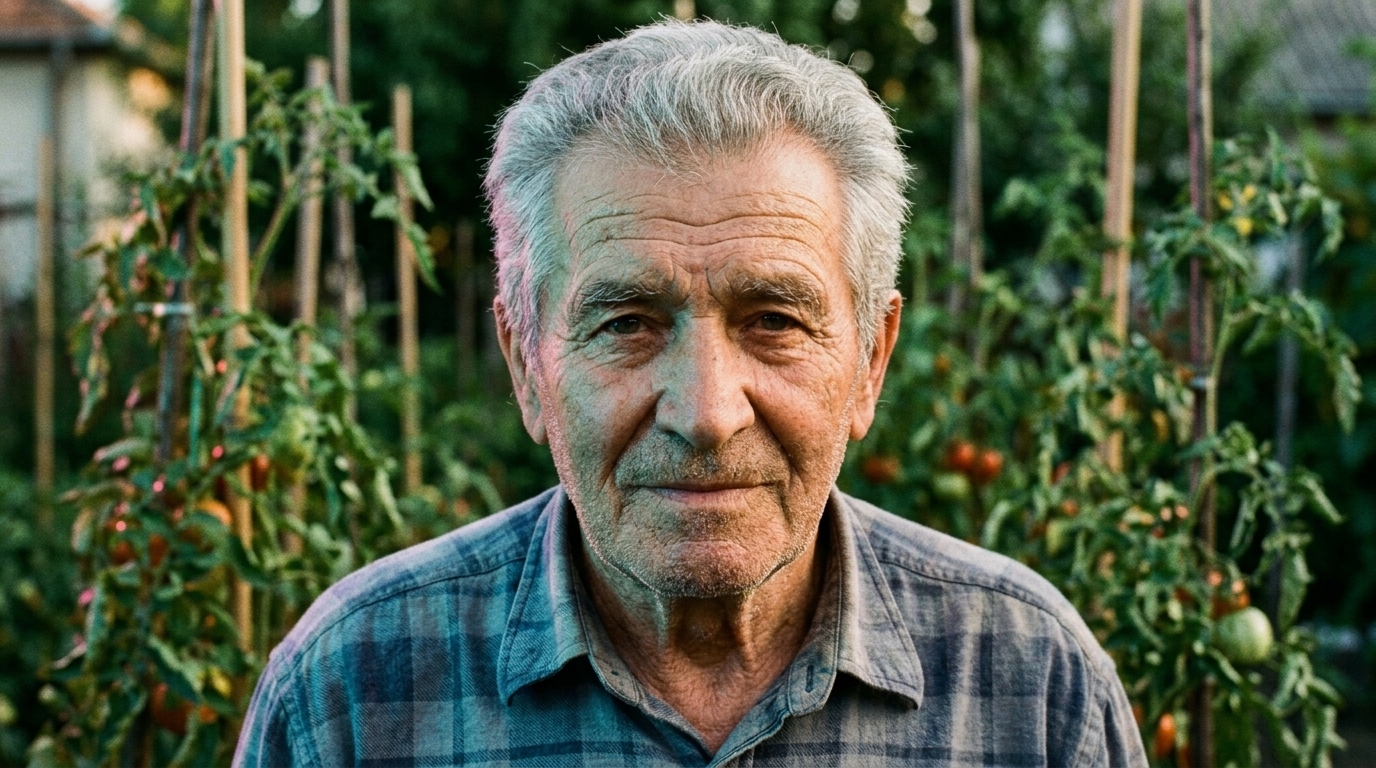
He turned the backyard into something the neighbours found curious: a dense, productive vegetable plot of the kind every Czech of his generation knew how to keep, tomatoes and cucumbers and kohlrabi staked in straight rows, far more than two people could eat. He never paid a mechanic or a tradesman in his life. He kept his fitter's tools in a chest in the shed and serviced the family's cars himself, lying under them on the concrete on his days off. These were the things he did instead of speaking, and they were also, though no one in the house would have said so, how he went on grieving.
Raising the boy alone was the hardest work he had ever taken on, and he was not, by his own private reckoning, good at it. He could provide — there was always food, the bills were paid, the boy had boots that fit — but the warmth Eva had supplied was simply gone, and Pavel had no idea how to manufacture it. He spoke to Stefan in Czech for years, then less and less as the boy's English overtook his own, until the two of them met somewhere in the middle, in a blunt domestic shorthand that carried information and almost no feeling.
The house steadied in 1989. Pavel met Dorothy Hennessy at a social club in Salisbury — a plain-spoken Australian woman who worked the canteen line at a nearby factory, had passed forty without marrying, and wanted no fuss made of anything. They married quietly that year. Dorothy had no children of her own and took the fourteen-year-old Stefan on without sentiment or complaint, packing his lunches, sitting up when he came home late, absorbing his adolescent sullenness with a flat, durable patience that asked for nothing back.
It was not a marriage of high romance, and neither of them pretended it was. It was a partnership of two undemonstrative people who had each decided, separately, that companionship and steadiness were worth more than a passion they no longer expected. Pavel was easier in Dorothy's company than he had been since Eva, and if he never quite brought himself to say that he loved her, she had married him knowing he wouldn't, and seemed to count it no great loss.
The Brother He Could Not Reach
The two brothers were citizens of the same country now, for the first time since boyhood, and it changed nothing. The seven hundred kilometres between Elizabeth and Toorak might as well have been the old distance between Ostrava and Prague, and Pavel made no move to close it. There were visits in the early years — stiff, careful afternoons in Mikhail's large bright house, Pavel in his good shirt among furniture he was half afraid to mark, Stefan watching his father grow smaller in his brother's presence.
What lay between them was not a quarrel. There had been no rupture, no offence, nothing that could be named and therefore nothing that could be forgiven. There was only the unbearable arithmetic of comparison — the surgeon and the line-worker, the barrister's wife and the canteen worker, the Toorak garden and the Elizabeth vegetable plot — and Pavel's pride, which could survive poverty but could not survive being pitied. He preferred distance to charity. He stopped accepting the invitations. The telephone calls grew shorter and then ceremonial, and the Christmas cards thinned year on year until, sometime in the late nineties, they simply stopped, and neither brother remarked on it.
He told himself, and half believed, that he did not think about Mikhail at all. It was not true. The brother was a permanent third presence in the house, an unspoken measure against which Pavel quietly found his own life wanting, and the resentment he never voiced seeped into Stefan, who grew up hating a man and a family he had barely met. It was, perhaps, the one inheritance Pavel passed down whole.
Provision, and Its Limits
When Stefan left school at the end of Year 10 to go to work, Pavel saw nothing in it to mourn. A boy going out to earn his living was a boy doing the right thing; it was what Pavel had done, and his father before him, and the long shadow of the foundry gate fell across the decision and made it seem natural. He did not see — could not have seen — that the world had shifted under him, that the trades no longer ran in the old reliable grooves, and that a clever, passive boy turned loose without a qualification would simply drift. He had given Stefan the only model of manhood he owned: work, provide, endure, say nothing. It was not enough, and it was the best he had.
At Stefan's wedding to Kylie Hammond, Pavel stood stiff at the back of the registry office in a borrowed tie, a man uneasy with ceremony and unsure of his welcome, and watched his son take on a family of his own. For a time he was cautiously hopeful. A granddaughter, Taryn Elise, arrived on the 3rd of September 1998, and a grandson, Connor, in 2003, and Pavel discovered in himself, to his own surprise, a capacity for the children he had never quite managed for their father.
With Taryn and Connor he was a different man — or rather the same man, finally handed something he knew how to do. He could not say he loved them either, but he could grow tomatoes with a small girl crouched beside him in the dirt, and he could put a spanner in a boy's hand and show him how a thing came apart and went back together, and the children understood this dialect of love perfectly, because it asked nothing of them but their presence. The grandfather they knew was patient, steady, and reliably there — the precise qualities their own father was steadily proving he lacked.
He watched, with a helplessness that curdled slowly into something like shame, as Stefan's life came apart. The drinking he recognised; the lateness and the lies and the lost jobs he recognised; he had seen weaker men go the same way at Vítkovice and at Holden. But when Stefan walked out on Kylie and the children in February 2010 — simply left, without a word, for a life an hour up the river — Pavel found he had no language for it at all. A man provided for his family. Whatever else Pavel had failed to give his son, he had given him that single iron rule, and Stefan had broken it, and the breaking shamed them both.
What Pavel did then was the truest thing he ever did, and he did it without announcement. He did not chase his son or argue with him; that was beyond him. Instead he and Dorothy quietly closed ranks around the family Stefan had abandoned. They kept up with Kylie, who was carrying two children on a checkout wage; they turned up at the school concerts and the birthdays; they slipped money where pride would let them and sometimes where it wouldn't. Pavel became, in his wordless way, the steady male fact in his grandchildren's lives that his own son had refused to be. It did not undo the damage. It was simply the most a reticent old man could offer, and he offered all of it.
The Salisbury Years
He had smoked since he was fourteen, the cheap cigarettes of the Eastern bloc giving way to Australian ones without the habit ever loosening its grip, and the decades of foundry dust, engine fumes, and tobacco came due in his sixties. His breath shortened. The garden grew smaller as the work in it grew harder, and the man who had never paid a mechanic began, grudgingly, to let the cars go.
The first stroke came in 2015 and took something from his left side, and more from his speech, which had never been generous to begin with. A second, the following year, took most of what remained. By the end of 2016 he could no longer be safely kept at home, and Dorothy, herself ageing and unable to lift him, made the decision she had dreaded and moved him into a nursing home in Salisbury, not far from the streets where they had built their life together.
He did not flourish there, and he did not complain, because complaint had never been part of his vocabulary. Dorothy came most days. The grandchildren came when they could; Taryn, by then a sharp and determined young woman, sat with him on afternoons when he no longer reliably knew who she was, and held the hand of the one Novak of his Australian line who had turned out exactly as he might have hoped, had he ever been a man able to hope out loud.
The Holden plant where he had spent his Australian working life closed its doors for the last time in October 2017, the end of an industry and of the town's reason for being, and Pavel was by then past the point of knowing it. He died in the nursing home in Salisbury the following month, in November 2017, at the age of sixty-eight, with Dorothy beside him and his brother in Melbourne, from whom he had been estranged for twenty years, unaware until afterward. He had outlived his first wife by thirty-two years, his country by a continent, and the young man at the Vítkovice bench by half a lifetime.
The funeral was a small affair in a Salisbury chapel. Dorothy sat at the front, dry-eyed and upright in the way of a woman who had done her grieving quietly and long before. Kylie came, and the grandchildren came. And Stefan came too — Dorothy had telephoned him with the news — and stood at the very back of the chapel in a borrowed grief, unable to meet the eyes of people who knew exactly what he had done, and slipped out before the wake. Father and son had never reconciled, because there had never been a quarrel to reconcile, only the long mutual silence of two men who had loved each other in a language neither could speak.
Three months later, Taryn Novak began a university degree, the first of their branch of the family ever to manage it. Pavel did not live to see it, and would not have known how to say what it meant to him if he had. But he had helped make it possible in the only way he had ever known — by turning up, by providing, by being reliably and wordlessly there — and somewhere in the steadiness of that motherless, fatherless girl was the steadiness of the old fitter who had grown tomatoes beside her, and who had given his family, to the very last, everything he had except the words.







