Papyrus Fragment III: The Field of Reeds
The third gilded papyrus fragment from the Book of the Dead of Neferhotep depicts the Field of Reeds — the Egyptian paradise where the worthy dead spent eternity in agricultural abundance. Painted by the scribe Amenemhat at Thebes in 1274 BC, the vignette shows Neferhotep ploughing, sowing, and harvesting in an idealised Nile landscape of extraordinary colour, surrounded by waterways of turquoise and fields of golden grain.
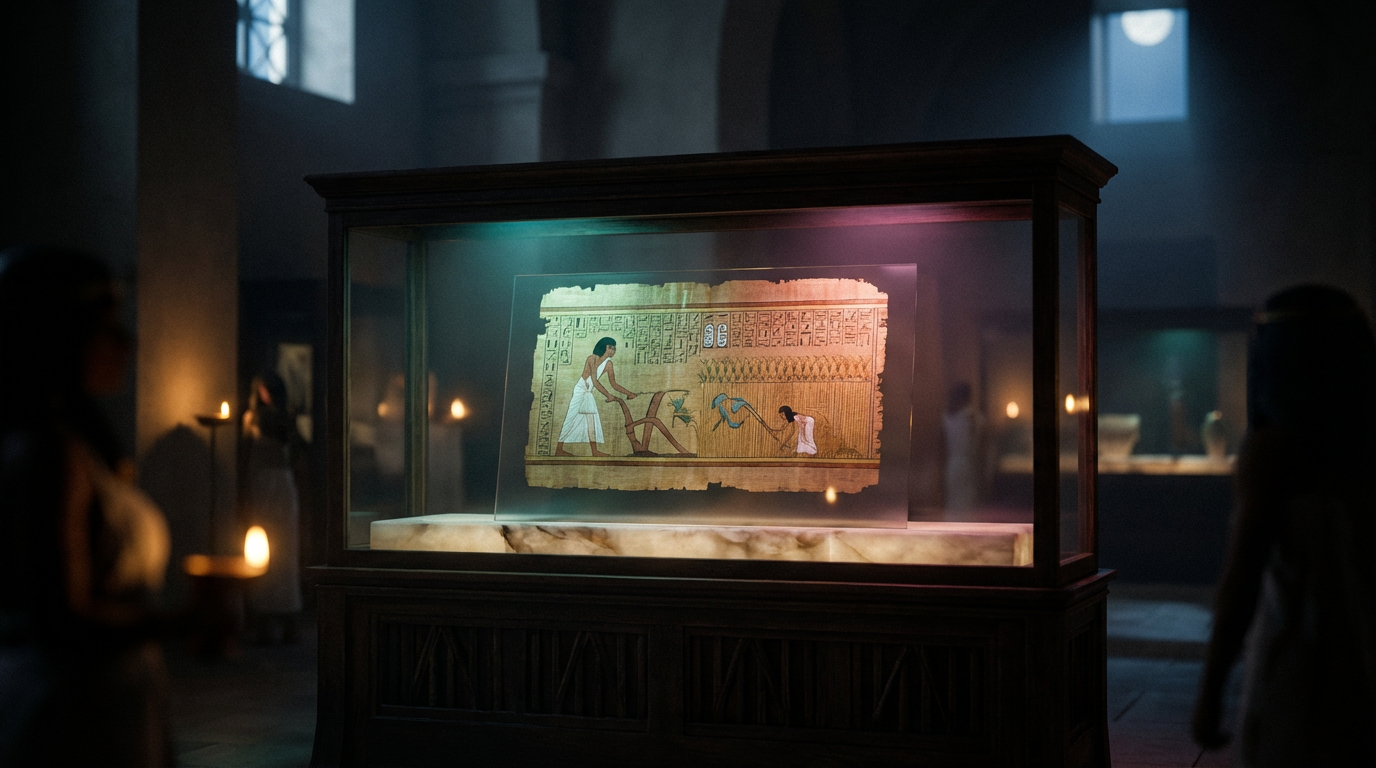
Description
The largest of the three fragments, measuring approximately fifty centimetres in width and thirty-two in height, this section depicts the Field of Reeds (Aaru) — the Egyptian afterlife paradise reserved for those who passed the Weighing of the Heart. The vignette is divided into horizontal registers showing Neferhotep engaged in idealised agricultural activities: ploughing with a team of oxen in the upper register, sowing seed in the middle, and harvesting golden grain in the lower.
The scene is set within a landscape of extraordinary colour — waterways rendered in vivid turquoise pigment, fields in warm ochre and gold, papyrus stands in deep green. The overall effect is of a paradise of perpetual abundance, an eternal Nile Valley in which the seasons cycle without drought or famine. Hieroglyphic spells from Chapter 110 of the Book of the Dead accompany the scene, describing the dimensions and features of the Field of Reeds.
The fragment is displayed in an ornate gilt frame on the eastern wall of the Blue Room, completing the triptych with Fragments I and II.
Historical Setting
Produced alongside the other two fragments at the scriptorial workshop of the Temple of Amun at Karnak, Thebes, on the 2nd of Thoth, year 5 of the reign of Ramesses II (1274 BC), by the scribe-illustrator Amenemhat, son of Nakht. This vignette occupied the final section of the complete scroll, representing the ultimate destination of the deceased following successful judgement.
The Field of Reeds imagery was among the most popular subjects in Book of the Dead illustration, as it provided a vivid and comforting vision of the afterlife that resonated with the agricultural foundations of Egyptian society. Amenemhat's version is distinguished by its exceptional use of mineral pigments — particularly the turquoise derived from copper compounds and the gold leaf applied to the grain in the harvesting register — indicating a commission of the highest quality.
Provenance
This fragment took a different route from the other two following the original scroll's dismemberment. It was acquired by a Coptic monastery in Upper Egypt during the medieval period, where it was preserved as a curiosity rather than a religious object. It left the monastery's collection during the Ottoman conquest of Egypt in 1517 and entered the Cairo antiquities market. It was documented in a French collector's inventory in Paris in 1782, and was acquired through William Jeffries Sr.'s intermediaries in 1820 — arriving at Jeffries Manor last of the three fragments, completing the triptych that reunited sections of Neferhotep's Book of the Dead for the first time in over two thousand years.






