Papyrus Fragment I: The Weighing of the Heart
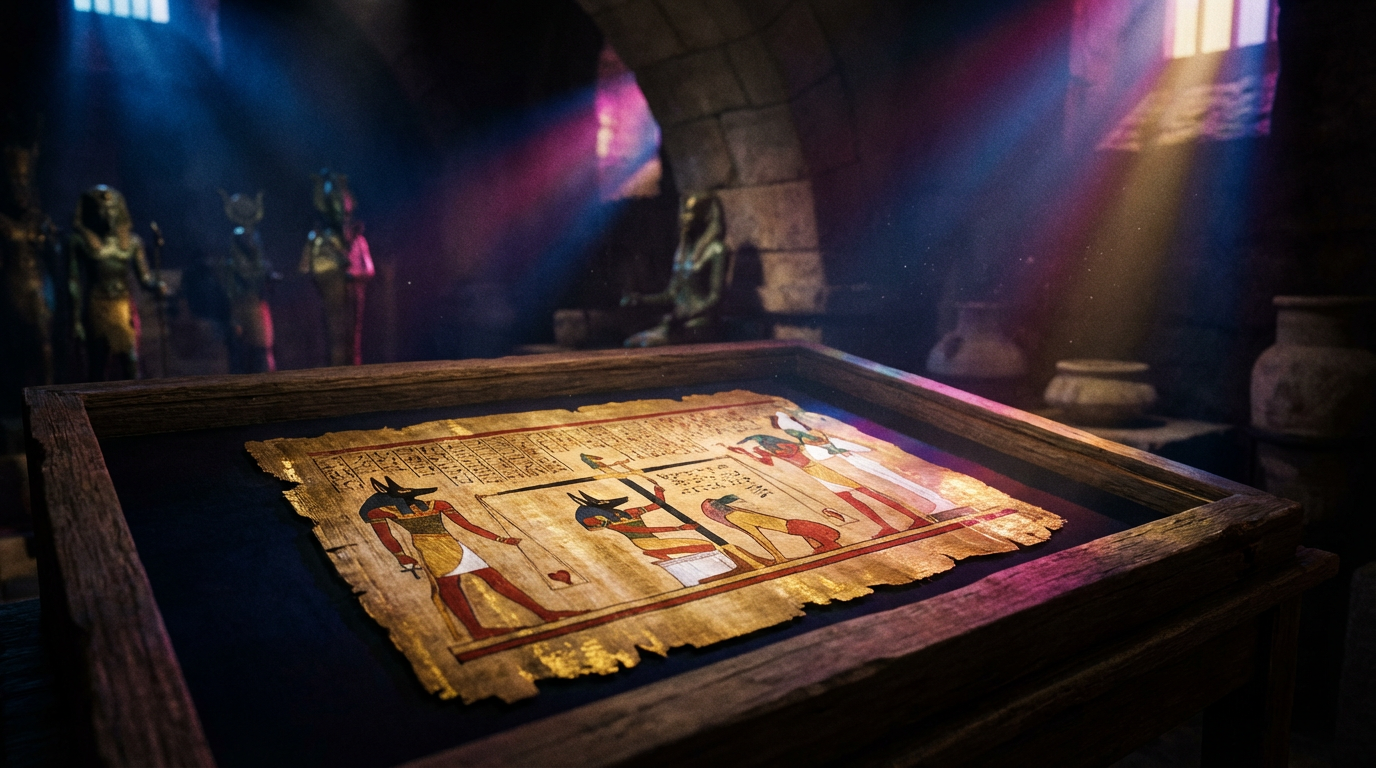
A gilded papyrus fragment depicting the Weighing of the Heart ceremony from the Book of the Dead, painted by the scribe and illustrator Amenemhat at the workshop of the Temple of Amun in Thebes on the 2nd of Thoth, year 5 of the reign of Ramesses II (1274 BC). The fragment shows Anubis guiding the deceased before the scales of Ma'at, rendered in vivid mineral pigments upon gold-washed papyrus.
Description
The fragment measures approximately forty-five centimetres in width and thirty in height, preserving a single complete vignette from a larger Book of the Dead scroll. The scene depicts the Weighing of the Heart ceremony — the central judgement of the Egyptian afterlife — in which the jackal-headed god Anubis leads the deceased to a great balance where the heart is weighed against the feather of Ma'at, goddess of truth and justice.
The figures are painted in the canonical New Kingdom style: Anubis rendered in black with gold detailing, the deceased in white linen garments, the scales picked out in red and gold. The hieroglyphic text accompanying the scene comprises spells from Chapter 125 of the Book of the Dead, written in a precise hieratic hand. The papyrus itself has been treated with a gold wash that gives the background a warm, luminous quality, indicating that the scroll was commissioned for a burial of considerable wealth and status.
The fragment is displayed in an ornate gilt frame, positioned on the eastern wall of the Blue Room at Jeffries Manor.
Historical Setting
The papyrus was produced on the 2nd of Thoth, year 5 of the reign of Ramesses II (1274 BC), at the scriptorial workshop attached to the Temple of Amun at Karnak, Thebes. The scribe-illustrator responsible was Amenemhat, son of Nakht, who held the title of Scribe of the Sacred Writings and was one of the most accomplished Book of the Dead illustrators working in the Theban workshops during the early reign of Ramesses II.
The complete scroll was commissioned for the burial of Neferhotep, a high-ranking official who served as Overseer of the Granaries of Amun — a position of considerable administrative authority within the temple economy. Neferhotep's tomb, located in the Valley of the Nobles on the west bank of the Nile at Thebes, was sealed following his death in approximately 1271 BC.
Provenance
The scroll was removed from Neferhotep's tomb during antiquity — most likely during the Third Intermediate Period (approximately 1070–664 BC), when widespread tomb robbery affected the Theban necropolis. The complete scroll was subsequently cut into sections, a common practice among antiquities dealers who could profit more from selling individual vignettes than from a single intact roll. This fragment — depicting the Weighing of the Heart, the most visually dramatic scene — was the most commercially valuable section.
The fragment surfaced in the collections of a Mamluk-era Cairo dealer in approximately 1340 and passed through various Middle Eastern and European hands over the following centuries. It was documented in a Genoese merchant's inventory in 1492 and in a private collection in Leipzig in 1756. It was acquired through William Jeffries Sr.'s intermediaries in 1819 and arrived at Jeffries Manor in that year.






