Ottoman Court Rug
A monumental silk and wool carpet woven at the imperial nakkaşhane workshops of the Topkapi Palace in Istanbul, completed on the 12th of April 1638 under the patronage of Sultan Murad IV. Its labyrinthine design of interlocking circles and squares — a geometric meditation with no discernible centre or exit — was conceived by the court artist Nakkaş Hasan and rendered in natural dyes of extraordinary depth and permanence by a team of twelve master weavers.
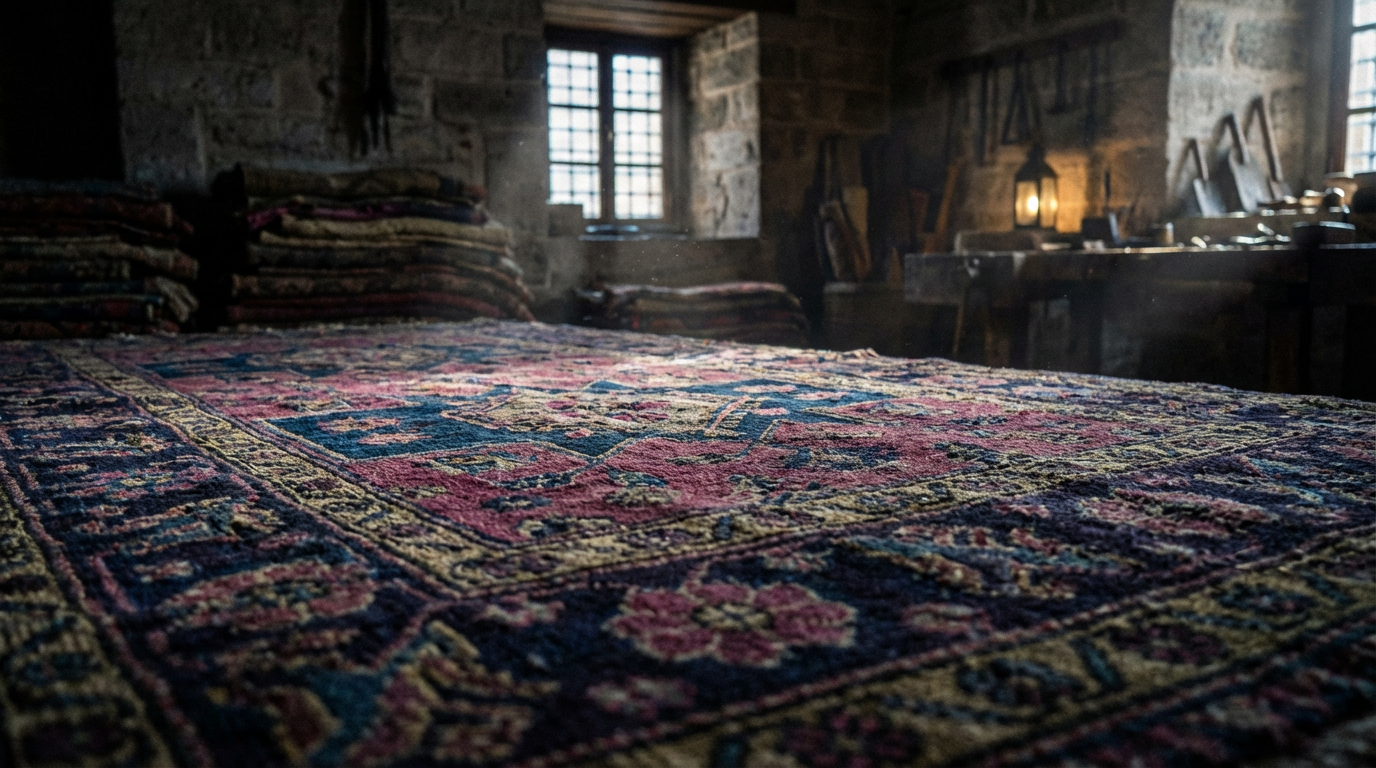
Description
The rug measures approximately three metres in length and two in width, woven from a combination of silk and the finest Anatolian wool in a knotting density that exceeds three hundred symmetrical (Turkish) knots per square centimetre — a level of refinement achieved only in pieces produced for the Ottoman imperial household. The pile is dense and close-cropped, giving the surface a velvet-like quality that absorbs and holds light rather than reflecting it.
The design is geometric rather than floral, distinguishing it from the more commonly seen Ottoman court carpets of the period. The field comprises interlocking circles and squares arranged in a pattern of extraordinary mathematical complexity — each shape containing smaller iterations of the same forms, which in turn contain yet smaller versions, creating the impression of infinite regression. The eye is drawn inward through successive layers of the design without ever arriving at a fixed centre. The border repeats a variation of the same interlocking motif, rendering the boundary between the rug's pattern and its frame ambiguous.
The palette is rich but restrained: deep indigo blue forms the primary ground, with the geometric forms picked out in madder red, saffron gold, and ivory white. The natural dyes have aged to a lustrous depth that synthetic pigments cannot replicate, with the indigo in particular developing the characteristic warmth that distinguishes Ottoman imperial dyes from provincial production. The rug's underside bears a small woven cartouche containing the tughra (calligraphic signature) of Sultan Murad IV and the date of completion in the Islamic calendar.
Historical Setting
The rug was completed on the 12th of April 1638 (the 27th of Dhul Hijjah, 1047 AH) at the imperial nakkaşhane (court design workshop) located within the Topkapi Palace complex in Istanbul. The nakkaşhane was the artistic nerve centre of the Ottoman Empire, responsible for producing designs that were executed not only in carpets but in ceramics, textiles, illuminated manuscripts, and architectural decoration. Its artists, known as nakkaş, were among the most highly trained and carefully supervised craftsmen in the empire.
The designer responsible for the rug's pattern was Nakkaş Hasan, a senior court artist who had served the nakkaşhane since 1611 and was known for his mastery of geometric composition. Unlike the more fashionable floral and saz-style designs favoured by many of his contemporaries, Nakkaş Hasan specialised in geometric patterns derived from Islamic mathematical traditions — designs that drew upon centuries of scholarship in tessellation, symmetry, and spatial recursion. The labyrinthine quality of this particular carpet was reportedly inspired by the geometric tile work of the Alhambra in Granada, examples of which had reached the Ottoman court through diplomatic channels following the fall of Moorish Spain.
The weaving was executed by a team of twelve master weavers under the supervision of a baş dokumacı (chief weaver) named Yusuf of Uşak, who had been recruited from the celebrated Uşak weaving tradition to oversee imperial carpet production. The silk warp and weft threads were sourced from the Bursa silk trade, whilst the wool pile came from flocks maintained in the highland pastures of central Anatolia — sheep whose fleece was reserved exclusively for imperial use.
Sultan Murad IV, who commissioned the piece, was a patron of the arts despite his reputation for military severity. The rug was produced during the final year of his reign (he would die in February 1640) and was intended for use in the sultan's private audience chamber at Topkapi, where it served as a meditation carpet — its infinite geometric pattern designed to occupy the contemplative mind without resolving into a fixed image.
Provenance
The rug remained in the Topkapi Palace collection throughout the seventeenth and eighteenth centuries, surviving the various upheavals of Ottoman court life. It was removed from the palace during the Russo-Turkish War of 1768–1774, when the Ottoman treasury liquidated certain assets to fund military operations. The rug entered the possession of a Greek merchant in Constantinople who traded it to a Venetian dealer in 1781.
It subsequently passed through European hands — documented in a private collection in Vienna in 1793 and offered at auction in London in 1807. The piece was acquired through intermediaries connected to William Jeffries Sr.'s trading network in 1817, arriving at Jeffries Manor during its initial furnishing and becoming one of the first objects installed in the Blue Room. Unlike the later artefacts that arrived as payment for specific services, the rug may have been acquired through more conventional — though still irregular — antiquities channels, predating the establishment of the arrangements that would bring the Egyptian, Chinese, and Mycenaean pieces to Van Diemen's Land.






