Oliver Thomas Evans
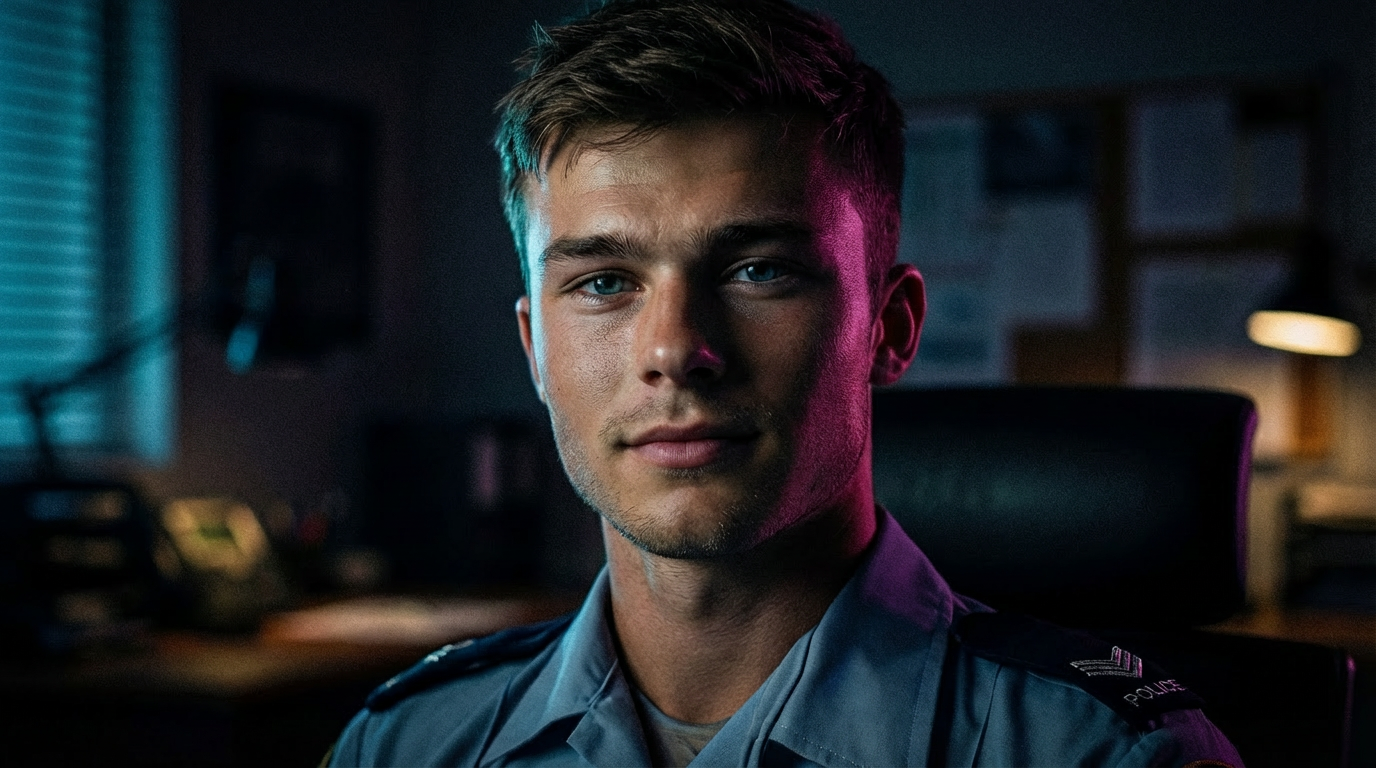
Born in Launceston in 1995, Oliver Thomas Evans drifted through odd jobs and false starts before finding his purpose in the Tasmania Police at twenty. His easy charm and instinct for reading people marked him as a natural on the front line, though his impatience with procedure tested his superiors' patience. The events of August 2018 — including his discovery of the empty kennel at Hobart Police Station — accelerated a maturation that his career had been building towards, shaping the officer and the man he became in the years that followed.
A Launceston Childhood
Oliver Thomas Evans was born on 17 August 1995 at the Launceston General Hospital, the youngest of three children born to Paul Raymond Evans, a delivery driver for a north-coast distribution company, and Margaret Anne Evans (née Taylor), a registered nurse at the same hospital where her son arrived. The family lived in a fibro-clad house on Peel Street in the suburb of Kings Meadows, at the end of a cul-de-sac that backed onto a reserve where the neighbourhood children disappeared after school and returned at dusk with scratched knees and stories that did not always survive parental scrutiny.
Oliver's older siblings — Daniel Paul Evans, born in 1988, and Rebecca Margaret Evans, born in 1991 — had established the household's rhythms well before he arrived. The seven-year gap between Daniel and Oliver created a dynamic in which the youngest was simultaneously indulged and overlooked, doted on by a mother whose nursing shifts left her wrung out but never too tired to sit with her children, and treated by his father with the gruff affection of a man who worked long hours and expressed tenderness through action rather than vocabulary. Paul Evans was dependable in the way that delivery drivers who kept the same route for twenty years were dependable — he showed up, he did the work, and he came home. His dry, understated wit surfaced in the evenings when fatigue had loosened whatever restraint the day had imposed, and Oliver inherited this quality so completely that colleagues who met him as an adult sometimes mistook the humour for flippancy without recognising the sharper observation beneath it.
Margaret worried. It was, Oliver would later joke, her secondary occupation. She worried about his tendency to climb things not designed for climbing, his cheerful indifference to consequences, and the parade of minor injuries that accompanied a childhood conducted at maximum velocity with minimum caution. He was the kind of boy who turned scrapes into stories and mistakes into lessons, to the alternating exasperation and amusement of everyone who tried to keep up with him.
Kings Meadows and the Rugby Field
Oliver attended Kings Meadow High School from 2008 to 2012, where his academic career confirmed the pattern his primary school years had established. He was an average student in the classroom — capable in subjects that rewarded practical reasoning, indifferent to those that did not, and often more absorbed by the social dynamics around him than by whatever the curriculum was attempting to deliver. His reports were variations on a theme: Oliver has ability but needs to apply himself. The refrain became so familiar that Margaret, who collected every report in a folder in the kitchen drawer, eventually stopped underlining the word "apply."
Rugby was different. On the field, the qualities that the classroom could not accommodate found their natural arena. Oliver was quick, physically committed, and possessed an instinct for reading the play that coaches valued above speed or size. He understood where the gaps would open before they appeared, anticipated the movements of opponents and teammates alike, and operated with an awareness that suggested a mind fully engaged in a way his mathematics homework never achieved. He was elected vice-captain of the school's team in his final year — not the captaincy, which went to a boy whose consistency off the field matched his performance on it, but a recognition that Oliver's influence in the group mattered enough to formalise. Rugby gave him something the classroom could not: the understanding that individual talent meant nothing without the willingness to endure for the benefit of the collective.
The Drift
Oliver graduated in 2012 and spent the following three years in the kind of aimless passage that young men without a clear direction sometimes navigated in regional Tasmania. He worked as a retail assistant at a Launceston hardware store for eight months before the monotony became intolerable. He laboured on a construction site for a summer, following his brother Daniel's footsteps towards a possible trade, and discovered that the physical demands suited him but the repetition did not. He stacked shelves, delivered furniture, worked a brief and unhappy stint in a call centre, and returned to his parents' house between each departure with the deflated good humour of someone who knew he was capable of more but had not yet identified what "more" looked like.
Paul said little during these years, trusting that the restlessness would resolve itself. Margaret said rather more. Daniel, who had completed an apprenticeship and was working as a carpenter, offered to get Oliver onto his crew. Rebecca, studying accounting and living in Melbourne, sent encouraging texts that Oliver appreciated without acting upon. The family watched and waited for the boy who had always been in motion to find something worth running towards.
The something arrived in 2015, at a police recruitment event that a rugby mate dragged him to on a Saturday afternoon. Oliver had gone reluctantly, expecting the kind of institutional sales pitch that had never appealed to him. What he found instead was a description of work that combined everything he was good at — physical engagement, reading people, thinking under pressure, operating in unpredictable environments — with a sense of purpose that his string of odd jobs had conspicuously lacked. He filled out the application form that afternoon.
The Academy and Early Career
Oliver entered the Tasmania Police Academy at Rokeby in late 2015. The academic components tested him in familiar ways — he struggled with written assessments, found the legal frameworks dense and unforgiving, and produced coursework that his instructors marked with restrained encouragement. But in the scenario-based exercises — the simulated incidents, the role-played confrontations, the situations where composure and quick thinking mattered more than memorised statute references — Oliver excelled. He had a talent for de-escalation that his instructors identified immediately: the ability to talk to people in crisis without condescension, to find the register that connected with someone whose emotional state had overwhelmed their capacity for rational response. His rugby instincts translated directly — reading the room the way he had read the field, anticipating where the trouble would come from.
He graduated in 2016 and was posted to Launceston Police Station, where he spent a year on general duties — patrols, community liaison, the unglamorous foundation that every new constable laid down. In late 2017, his supervisors encouraged his transfer to Hobart's Southern Division, where the scale and variety of the work would stretch his developing capabilities.
At Hobart Police Station, Oliver adapted quickly. He settled in a share house in Moonah with two other junior constables and proved equally comfortable navigating the city's rougher neighbourhoods on foot patrol and conducting community liaison in the suburban divisions. His natural ability to build rapport made him a valued presence, though his reliance on gut instinct occasionally outran his willingness to verify what his instincts were telling him, and his paperwork remained a source of mild exasperation for administrative staff who processed his consistently late reports.
In late 2017, Oliver responded to a domestic disturbance in Glenorchy that escalated into a standoff when the suspect, a man in his forties experiencing a severe mental health crisis, barricaded himself in a bathroom with a knife. The specialist negotiator was forty minutes away. Oliver talked to the man through the door for twenty-seven minutes — quietly, without ultimatums, without institutional language. When the door opened and the knife was placed on the floor, the tactical team found an outcome that training manuals described as optimal and experience taught officers to consider improbable. Oliver filed the report two days late. Nobody mentioned it.
6 August 2018
On the morning of Monday 6 August 2018, Oliver began his basement rotation at Hobart Police Station with the routine efficiency of someone performing a task so familiar it had become almost automatic. He rounded the corner into the K9 facility and found Kennel Four empty. Jargus, the German Shepherd assigned to missing Detective Karl Jenkins and housed at the station since his recovery two days earlier, was gone. The kennel was locked. The facility log recorded nothing overnight.
Oliver contacted Sergeant Gareth Briscoe, and within the hour, Briscoe had the surveillance footage playing on six screens in a sealed room and the investigation had moved inside the building's own walls. The footage revealed an unidentified silver-haired woman accessing the facility using Jenkins' own security card — through locks that showed no record of a breach. For Oliver, who had looked up to Karl Jenkins since his arrival at Hobart, the discovery converted the general unease of the preceding days into something more personal and more unsettling: the recognition that whatever was happening exceeded the boundaries of any case he had been trained to understand.
Sophie, and the Years After
Oliver met Sophie Catherine Brennan in March 2019, at a fundraiser for the Hobart City Mission that he had attended as a police representative and she had attended as a volunteer coordinator. Sophie was twenty-five, a social worker employed by Colony 47 in Hobart's community support division, dark-haired and direct in a way that Oliver found simultaneously attractive and slightly intimidating. She was not impressed by the uniform — she dealt with the consequences of policing's failures every working day and had developed opinions about institutional authority that she did not soften for the benefit of individual officers. Oliver, accustomed to the easy charm that had carried him through most social encounters, found himself working harder than usual and enjoying the effort.
Their relationship developed through the negotiation of two demanding careers whose schedules overlapped badly and whose professional perspectives occasionally collided. Sophie's work placed her alongside people who experienced the justice system as a source of harm; Oliver's placed him inside it as an instrument of enforcement. The tension was not irreconcilable, but it required a willingness on both sides to listen without defending, to acknowledge complexity without retreating into institutional loyalty or institutional critique. They managed it — not always gracefully, not without arguments that left both of them silent for a day or two, but with a persistent commitment that surprised Oliver more than it surprised Sophie, who had recognised in him from the beginning something more considered than the easygoing surface suggested.
They moved in together in late 2019, renting a ground-floor flat in New Town with a small courtyard and a view of the rooftops towards the river. Oliver proposed in January 2021, during a weekend trip to Freycinet that had been planned as a holiday and that Sophie, who read situations professionally, had suspected might contain an additional agenda. They married in November 2021 at a small ceremony in the gardens of the Woolmers Estate in Longford, attended by both families and a handful of close friends. Daniel was best man. Rebecca flew from Melbourne. Margaret cried. Paul shook Oliver's hand with a grip that communicated everything the Evans family preferred to leave unsaid.
Their daughter, Isla Margaret Evans, was born in September 2023 at the Royal Hobart Hospital. Oliver, who had spent his career managing other people's crises with studied composure, discovered that the arrival of his own child dismantled that composure entirely and replaced it with something he had no vocabulary for. He held his daughter in the delivery room and understood, with the visceral certainty that new parenthood imposed, that the stakes of everything — his work, his safety, his choices — had changed in ways that no amount of prior warning could have made real.
Career Progression and the Shift Towards Investigation
The years following 2018 saw Oliver's career develop with a steadiness that his earlier restlessness had not predicted. The events of that August — the empty kennel, the surveillance footage, the institutional tremor that ran through the station in the months that followed — left him with a sharpened awareness of how quickly the ordinary could become something else, and a corresponding commitment to the kind of thorough, attentive policing that might detect the warning signs before they escalated.
His promotion to Senior Constable came in 2020, reflecting consistent operational performance and the gradual improvement of his administrative habits that experience and Sophie's influence had encouraged. He began expressing interest in investigative work — the sustained analytical engagement that detective pathways offered — and his supervisors supported him in completing additional training modules in evidence management, witness interviewing, and crime scene assessment. The Glenorchy standoff and his broader record of effective de-escalation made him a strong candidate for roles that required interpersonal skill alongside investigative capability.
In 2022, Oliver was seconded to a joint task force targeting a series of aggravated burglaries across Hobart's eastern suburbs. The six-month operation, which involved surveillance, witness development, and coordinated arrests, gave him his first sustained exposure to the investigative process from initiation to prosecution. He acquitted himself well — his instinct for reading behaviour proved as effective in an investigative context as it had been on the street, and the task force's senior detective noted in his assessment that Oliver combined natural ability with a growing willingness to do the less visible work that successful investigations demanded.
By 2024, Oliver had commenced the formal detective training pathway, balancing the coursework with his operational duties and the demands of a household that now included a toddler whose energy levels matched, and frequently exceeded, his own. The trajectory was clear: the aimless boy who had drifted through odd jobs and share houses was building a career whose shape and direction he had chosen deliberately, informed by the experiences that had shown him what policing could accomplish and what it could cost.
Personal Life and Character
Oliver and Sophie settled into the New Town flat with the practical contentment of a couple whose expectations of domestic life were shaped more by realism than by romance. The courtyard acquired a sandpit after Isla's arrival, and the bookshelves — Sophie's, primarily — expanded to occupy surfaces that Oliver would have left bare. He remained involved with the youth rugby team in Hobart's northern suburbs on Saturday mornings, though Isla's arrival rearranged the logistics, and Sophie, who had no interest in rugby whatsoever, occasionally attended with the tolerant bemusement of a partner who had accepted this particular enthusiasm as a permanent feature of the landscape.
Oliver visited Launceston regularly, bringing Isla to see her grandparents with a frequency that Margaret approved of and that Paul, now retired, received with the quiet pleasure of a man who had not anticipated how much a granddaughter would alter the texture of his days. Daniel's children — two boys, aged eight and six — treated their younger cousin with the protective fascination that older children brought to babies, and the Evans family gatherings grew noisier and more crowded with each passing year.
He continued volunteering with community outreach programmes, mentoring young people who expressed interest in policing, approaching the work with the conviction that the force needed officers whose backgrounds reflected the communities they served. The mentoring connected to something personal — Oliver remembered the drift, the odd jobs, the years of not knowing what he was for, and he recognised in some of the young people he worked with the same restlessness that had preceded his own decision. He did not romanticise his path. He simply made himself available as evidence that finding your direction late did not mean finding it wrong.
Those who worked alongside Oliver Evans described a man who had grown into his potential without losing the qualities that had made him worth investing in from the start. The charm remained, but it was tempered now by the responsibilities that marriage, parenthood, and professional development had imposed. The instincts were still sharp, but they operated within a framework of experience and discipline that his younger self would not have tolerated. He was still the officer who noticed things that others missed, who connected with people that others could not reach, and who filed his reports later than the administrative ideal suggested. But he was also the father who drove home after a night shift thinking about the world his daughter would inherit, the husband who listened when his wife described the failures of the systems he worked within, and the constable who had once found an empty kennel on a Monday morning and carried the unease of that discovery into every room he entered afterwards — not as fear, but as the understanding that the ordinary was never quite as reliable as it appeared.







