Oliver Brett Smith
Oliver Brett Smith, born on 3 December 2010, was the twin brother of Grace Elizabeth Smith, the children of Brett Smith, a council parks and gardens worker, and Megan Smith, a childcare educator. Raised primarily by his father in Ferny Grove, Brisbane, after his parents' separation, Oliver was energetic, outdoorsy, and defined by his bond with Grace, who lived with their mother in Toowoomba. He was seven when the school bus passed through a Portal into Clivilius on 5 August 2018, separating him from his twin. He became a survey and trail specialist at Bixbus.
Two of Everything
Oliver Brett Smith was born on 3 December 2010 at the Royal Brisbane and Women's Hospital, seven minutes before his twin sister, Grace Elizabeth Smith. Their parents were Brett David Smith, a council parks and gardens worker, and Megan Louise Smith (née Taylor), a childcare educator at a centre in Keperra. The family lived in a rented weatherboard cottage in Ferny Grove, in Brisbane's north-western suburbs, where the back fence bordered council bushland and the sound of king parrots in the Moreton Bay figs carried through the windows on summer mornings.
Brett was a lean, sunburnt man who had grown up in Samford and left school at sixteen to work for the Brisbane City Council, maintaining parks and reserves across the north-western suburbs. He mowed, he planted, he cleared fallen branches after storms, and he came home each evening smelling of cut grass and two-stroke fuel. He had married Megan in 2009, at a ceremony in the Samford Valley that his mother organised and his father attended with the resigned courtesy of a man who had divorced Brett's mother fifteen years earlier and had not been consulted about anything since. Brett's father, Kevin Wayne Smith, lived alone in a flat in Strathpine and worked as a storeman at a plumbing supplies warehouse. His mother, Denise Anne Smith (née Kerr), had remarried in 2002 and lived in Dayboro with her second husband, a retired electrician named Graham.
Megan was from Ipswich, the middle of three sisters born to Gareth and Wendy Taylor — Gareth a bus driver, Wendy a school tuckshop manager. Megan had completed a Certificate III in childcare at TAFE and worked at the same centre in Keperra since she was twenty. She was organised, affectionate, and possessed of a cheerfulness that functioned at a consistent frequency regardless of circumstance, which Brett had found comforting during their courtship and suffocating by the third year of their marriage. The separation, when it came in early 2015, was prompted by no single event and a hundred small ones — the accumulation of silences at the dinner table, the retreats to separate rooms after the twins were in bed, the growing awareness that the best parts of their relationship had been the parts that predated the children.
Megan moved to Toowoomba in mid-2015, taking a position at a childcare centre near her eldest sister, and the custody arrangement that followed was functional but imperfect.
The twins alternated fortnights — two weeks with Brett in Ferny Grove, two weeks with Megan in Toowoomba — until the logistics of schooling made the split unworkable. By 2017, Oliver lived primarily with Brett and attended school in Brisbane, while Grace lived primarily with Megan and attended school in Toowoomba. They traded during school holidays and long weekends, and the swaps were conducted at a service station in Gatton, roughly halfway between the two cities, where the twins would see each other across a car park and run.
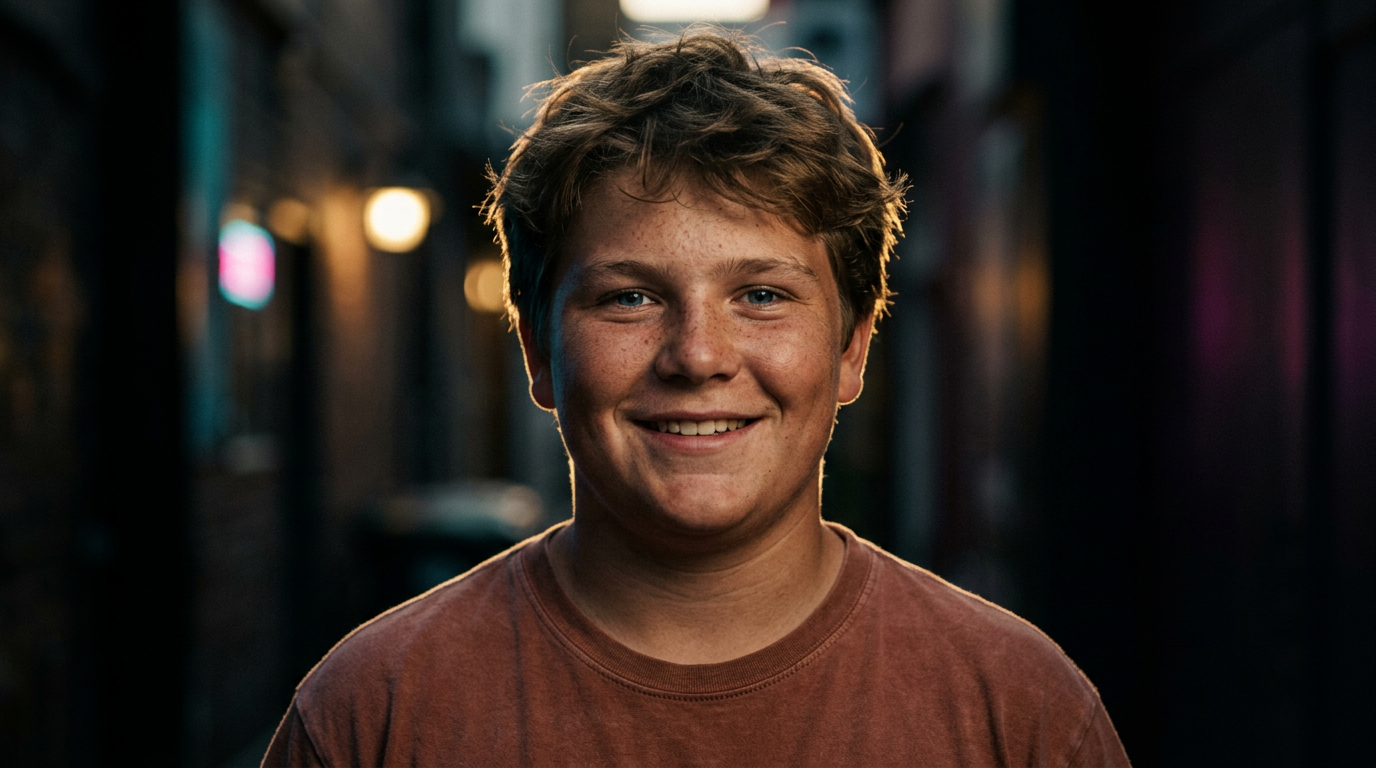
Being a twin was the most important fact about Oliver's life, and it was the fact most easily overlooked by people who had never been one. He and Grace were fraternal — he was sandy-haired and blue-eyed where she was dark-haired and brown-eyed, he was stocky where she was lean — but the connection between them was not physical resemblance. It was something more fundamental: a shared rhythm, a mutual awareness, the sense of having entered the world alongside another person and having that other person as the baseline against which all subsequent relationships were measured. Oliver at seven could not have articulated this. He did not need to. Grace was simply there, the way breathing was there — essential, automatic, and noticed only in its absence.
Oliver was, even by the standards of seven-year-old boys, conspicuously energetic. He climbed fences. He chased skinks through the garden. He once pursued a brush turkey into the council bushland behind the house and was gone for forty minutes before Brett found him sitting cross-legged beside a mound, watching the male bird tend its nest with the absorbed fascination of a nature documentary presenter who had somehow been shrunk to child size. He came home every afternoon with scratches on his shins and stories about what he had seen, and Brett — who spent his working days in the same bushland reserves his son explored after school — listened with the quiet satisfaction of a man whose child had inherited the one thing he had worth passing on.
He entered Brisbane Grammar School in Year 2, in 2018. Brett had heard about the school's outdoor education programme from a colleague at the council depot, and the bursary scheme brought the fees within reach of a single father's wages. The enrolment was not discussed with Megan in advance, a decision that produced an argument conducted over the phone in the kitchen while Oliver sat on the back step and pretended not to listen. Megan thought Grammar was pretentious. Brett thought the bush programme was exactly what Oliver needed. The argument ended the way their arguments always ended — in a silence that was not agreement but exhaustion — and Oliver started at Grammar the following term.
He was not an academic child. His reading was adequate. His writing was enthusiastic and misspelled. His mathematics was unremarkable. He was, however, the kind of student that teachers remembered — not for his grades but for his presence, which was large and warm and relentless. He volunteered for everything. He befriended everyone. He treated the school grounds as an extension of the bushland behind his house, conducting investigations into the wildlife that lived in the school's garden beds with a thoroughness that his science teacher found impressive and the groundskeeper found inconvenient.
Running Without His Shadow
The overnight field trip to D'Aguilar National Park departed from Brisbane Grammar School on the morning of Saturday, 4 August 2018. Grace was in Toowoomba that weekend. It was Megan's fortnight, and the trip fell on the wrong Saturday, and Oliver had asked — twice, with increasing urgency — whether Grace could swap weekends and come to Brisbane so she could see the park. She could not. Megan had plans that weekend that could not be rearranged, and Oliver accepted this with the frustrated resignation of a child who understood, at seven, that his parents' inability to coordinate was a permanent feature of his life and not a problem he could solve.
He sat near the back of the bus, talking to anyone who would listen, which was most people. At D'Aguilar, he was in constant motion — scrambling up rocks, wading into the creek, crouching beside logs to inspect what lived underneath. He collected a handful of smooth creek stones and put them in his pocket, not because he collected rocks but because he wanted to give them to Grace. He always brought her something from the places she had not been. It was their arrangement, unspoken and inviolable: Oliver brought her a stone, a leaf, a feather, and she brought him a drawing of something she had seen in Toowoomba. The exchange was the currency of a twin relationship conducted across a hundred and thirty kilometres of highway, and Oliver honoured it with the seriousness of a treaty obligation.
The bus departed D'Aguilar on the morning of 5 August for the return to Brisbane. Oliver was in the middle section, the creek stones in his pocket, his legs swinging because they did not reach the floor.
The bus passed through a Portal opened across a road in the Brisbane suburbs and collided with vehicles on the far side, in the landscape of Clivilius. The impact threw Oliver across the aisle. His left knee struck the metal seat base at an angle that wrenched the joint sideways, tearing the lateral ligament and producing a pain that was sharp, specific, and immediately disabling. Heavy bruising spread across his ribs and shoulder where he landed. He did not lose consciousness, but the pain in his knee was so acute and so focused that for several seconds it occupied the entirety of his awareness, and when it receded enough to let him see the world around him, the world had changed.
David Nguyen examined the knee on the bus floor and immobilised it with a splint improvised from a broken seat rail and torn fabric. The ligament damage was significant but not surgical — the knee would heal, given time and immobilisation, though the recovery would be slow and the joint would carry the memory of the injury in ways that would not become apparent for years. Oliver did not cry during the treatment. He pressed his hand into his pocket and gripped the creek stones and stared at the ceiling of the wrecked bus and said nothing, which was so unlike him that Nguyen checked him for head injury before concluding that the silence was psychological rather than neurological.
The first thing Oliver thought, after the pain, after the confusion, after the sky that was wrong and the landscape that was alien and the sound of children screaming around him, was that Grace did not know where he was. The thought was precise and devastating. He was not thinking about his father or his mother or his house in Ferny Grove. He was thinking about his twin, who was in Toowoomba eating breakfast or watching television or drawing something for him, and who did not know that the other half of her had fallen through a hole in the world and was not coming back.
Half of a Whole
The knee healed in eight weeks, faster than the adults had expected. Oliver was young enough that the ligament regenerated with reasonable integrity, though the joint remained prone to swelling after sustained activity, and a sharp lateral movement on uneven ground could produce a flare of pain that reminded him, with unpleasant precision, of the metal seat base in the bus aisle. The creek stones from D'Aguilar stayed in his pocket. He transferred them to each new set of clothing as the settlement's supplies were established, and when the pockets wore through he kept them in a small fabric pouch beside his bed. They were for Grace. He had not delivered them, and until he did they remained her property, held in trust.
He attended the Learning Grove from its opening weeks, limping on a splinted knee, talking with the relentless energy of a child who processed the world through speech and who would, if left in silence, be forced to confront things he was not ready to confront. Jenny Triffett placed him with the youngest group, alongside Mason Clarke and other children of similar age, and Oliver threw himself into every activity the school offered with an enthusiasm that the staff recognised as partly genuine and partly defensive. He volunteered first. He talked most. He befriended children who did not want friends and persisted until they accepted his company, because Oliver had never met a person who was not improved by his presence and did not intend to start questioning the assumption now.
The afternoon practical sessions at partner sites revealed what would become his defining orientation in Bixbus. At the Haven of Wilds, where Lucas White had gravitated toward the livestock pens, Oliver was drawn to the boundary — the edge where the settlement met the landscape, the transition zone between what had been built and what was wild. He wanted to know what was out there. He asked questions that the adults could not always answer: what was beyond the next ridge, what animals lived in the scrubland to the east, whether the creek that ran past the settlement came from somewhere specific or just appeared. He was seven, and his questions were not sophisticated, but they were persistent, and they pointed in a direction that the settlement's leadership would eventually recognise as useful.
The transition to Bixbus School in late 2019 gave Oliver's restlessness a formal channel. His morning academic work remained his weakest area — his literacy was below average, his numeracy struggled with abstraction, and his handwriting was a source of ongoing despair to the teachers who attempted to decode it. But the afternoon mentorship programme, which placed students with community teams, gave him access to the surveying and exploration groups that were beginning to map the landscape beyond Bixbus's immediate perimeter. Oliver, at nine, was too young for the longer-range expeditions, but he joined the teams that maintained trails, assessed terrain, and documented the flora and fauna of the areas closest to the settlement.
He was good at it. His father had taught him to read landscapes — where water pooled, where ground was unstable, where a path could be cut without disturbing drainage — and the knowledge transferred to Clivilius with surprising fidelity. Different trees, different soil, different sky, but the principles of terrain were the same. Oliver could walk a ridge and predict where the easiest descent lay. He could assess a creek crossing and judge whether it would hold after rain. He moved through the landscape with a physical confidence that his academic teachers would not have recognised, because the boy who fidgeted through reading comprehension was a different creature entirely from the boy who scrambled up a rock face and stood at the top surveying the horizon with the practiced eye of someone whose father had spent twenty years maintaining the ground beneath other people's feet.
His social life was broad and shallow in a way that he believed was wide and deep. He knew everyone. He talked to everyone. He was the boy in the shared quarters who organised evening games, who mediated disputes between younger children, who could make anyone laugh with a physical gag or a perfectly timed absurdity. He was generous with his energy and his company, and people gravitated toward him because his warmth was genuine and his enthusiasm was infectious and it was very difficult to feel alone when Oliver Smith was in the room.
What nobody saw — because Oliver was very good at making sure nobody saw — was that the warmth was also a wall. He talked so that he would not have to think. He surrounded himself with people so that he would not have to be alone with the absence that sat at the centre of his life like a missing tooth. Grace. He did not talk about Grace. He mentioned her occasionally, lightly, in the way that a person might mention a place they once visited — enough to acknowledge that she existed, not enough to reveal what her absence cost him.
The other children who had lost families had lost parents, siblings, homes. Oliver had lost his twin, and the loss was a category that nobody else on the bus shared and that he could not explain without sounding as though he were claiming a grief more special than theirs. It was not more. It was different. He had spent seven years sharing a heartbeat with another person and was now expected to function with only one.
He was fifteen, and he lived in the shared quarters at Bixbus with the noisy, sociable ease of a boy who had never met a stranger. His mornings were spent at Bixbus School, where his teachers had made peace with his academic limitations and his practical instructors relied on his terrain knowledge. His afternoons were spent with the survey and trail teams, mapping the landscape beyond the settlement's boundaries with the physical competence of someone whose body knew what to do even when his mind could not settle. His knee ached on cold mornings and after long descents, a dull reminder that the bus had taken something from him that would not fully return.
The creek stones from D'Aguilar sat in their fabric pouch beside his bed. He checked them sometimes, turning each one in his palm, smooth and round, river-polished, still carrying the dust of a park fifteen minutes from his father's house. They were for Grace. They had always been for Grace. He would give them to her when he saw her, and if he did not see her then they would remain where they were — a delivery unfinished, a twin's promise kept in the only way available to him, which was to keep it until keeping it was no longer necessary.







