Noah Alexander Jones
Noah Alexander Jones, born on 18 June 2008 in Brisbane, was the youngest of three sons of Mark Jones, a geologist, and Sarah Jones, an English teacher. He grew up in Kenmore with his older brothers Callum and Ethan. After the Brisbane school bus passed through a Portal into Clivilius on 5 August 2018, Noah applied his inherited geological instincts to mapping and analysing the unfamiliar landscape, producing systematic surveys that informed the expansion of Bixbus from settlement to city.
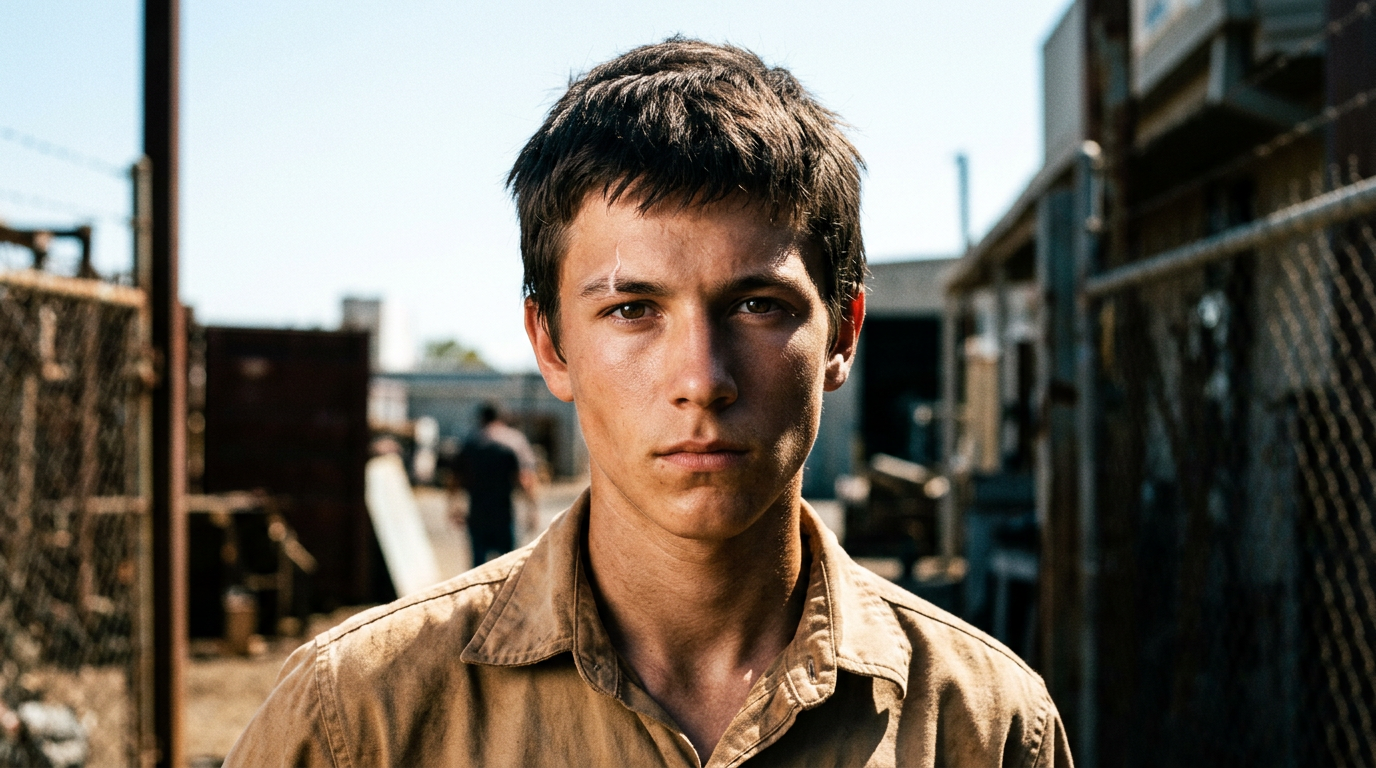
The Youngest Jones Boy
Noah Alexander Jones was born on 18 June 2008 at the Royal Brisbane and Women's Hospital, the third son of Mark Andrew Jones, a geologist, and Sarah Emily Jones (née Whitaker), a secondary school English teacher. The family lived in a brick house on a quiet cul-de-sac in Kenmore, in Brisbane's western suburbs, where the backyards backed onto bushland and the creek at the bottom of the street ran brown after rain. Noah arrived four years after his eldest brother, Callum Robert Jones, born on 2 January 2004, and two years after the middle child, Ethan James Jones, born on 14 March 2006.
Mark had grown up in Townsville, the son of Robert Jones, a cane farmer in the Burdekin district, and Helen Jones (née Pratt), a primary school teacher. He was the elder of two — his sister, Karen, three years younger, married an electrician and stayed in Townsville. Mark had studied geology at James Cook University and then completed a Master's at the University of Queensland, where he met Sarah during a faculty mixer in their final year. He worked for a mid-sized mining consultancy that contracted to operations across central and western Queensland, which meant he was away two or three weeks in every eight, driving red dirt roads between drill sites and sending Sarah photographs of core samples that she pretended to find interesting.
Sarah was from Toowoomba, the daughter of Geoffrey Whitaker, a pharmacist, and Margaret Whitaker (née Doyle), who had managed the accounts for a stock and station agent. Sarah was the middle child of three — an older sister, Catherine, who taught at a primary school in Ipswich, and a younger brother, Andrew, who had joined the Army and was posted to Townsville, which was how Mark had met him and, through him, Sarah. She had studied English and education at the University of Southern Queensland and taught at a state high school in Indooroopilly, where she ran the debating programme and the school magazine with the particular energy of a woman who believed that clear writing was a civic virtue.
The Jones household was loud in the way that households with three boys are loud — not chaotic but dense, the air always occupied by someone's voice or someone's feet or the sound of something being dropped. Callum, the eldest, was a swimmer — early mornings, chlorine in his hair, a directness that came from years of racing in lanes and knowing exactly where he stood in every field. Ethan was musical, teaching himself guitar from YouTube videos with the dogged persistence of a middle child determined to occupy territory his brothers had not claimed. Noah was the quiet one. Not shy — he spoke when he had something to say — but quiet in the way of a child who preferred to examine things before responding to them.
The quietness concerned Sarah mildly and Mark not at all. Mark recognised it, because he had been the same as a boy — the kind of child who turned things over in his hands and in his mind before committing to a position. He took Noah on field trips from the age of five — not the consultancy work, which involved fly-in sites and accommodation that was no place for a child, but weekend drives to road cuttings and creek beds where the geology was exposed and readable. Mark would crouch beside a sandstone outcrop and explain what the layers meant — time, pressure, the slow accumulation of sediment into stone — and Noah would listen with an attention that neither Callum nor Ethan had ever produced for the same subject.
For his seventh birthday, Mark gave Noah a piece of petrified wood from a site near Chinchilla. It was palm-sized, heavy for its dimensions, the grain of the original timber still visible in the mineralised surface. Noah carried it in his schoolbag every day for the next year, and then in his pocket, and then in whatever container was nearest to his bed. The object was not a toy. It was evidence — proof that the world was older and stranger than it appeared, that wood could become stone if you gave it enough time, and Noah found the idea not frightening but reassuring, as though the planet's patience with its own transformation was a quality he could borrow.
Rocks and Road Cuttings
Noah entered Brisbane Grammar School in Year 3 in 2016. The bursary scheme was not a factor — Mark's consultancy salary and Sarah's teaching income covered the fees, though Sarah described the arrangement as "manageable if nobody gets sick." Callum was already in Year 8 and Ethan in Year 6 when Noah arrived, which gave him the particular invisibility of the youngest sibling at a school where his surname was already known.
His academic work was steady and unspectacular in the way that masked genuine ability. His reading was strong — Sarah's household had books in every room and arguments about grammar at the dinner table. His writing was clear, organised, and completely lacking in flair, which Sarah found privately amusing and did not attempt to change. His numeracy was good. His science was excellent, though the excellence was narrow — he was engaged when the subject involved earth sciences or physical systems, and merely competent when it involved biology or chemistry.
He had begun collecting rocks systematically by the time he was eight, using a classification method he had adapted from a Geological Survey pamphlet Mark had brought home from work. The collection lived in a series of egg cartons on shelves in his bedroom, each specimen labelled with a small card noting the rock type, location of collection, date, and any identifying features. By Year 5, the collection contained over a hundred specimens, and Noah could identify most common igneous, sedimentary, and metamorphic rocks by sight. His teacher, after Noah had corrected a textbook's identification of a rock sample during a science lesson, noted in his report that Noah's knowledge of geology was "well beyond what the curriculum requires and occasionally beyond what the teacher possesses."
He was not popular in the way that Callum was popular — Callum's swimming had given him a physical confidence that translated into social ease. Noah's friendships were few and specific. He sat with the same three boys at lunch, spoke to them about things that interested him, and did not seek wider approval. He was not bullied, not excluded, simply peripheral in the way that quiet children are peripheral in large schools where volume and visibility determine the social order.
The Outcrop at D'Aguilar
The field trip to D'Aguilar National Park was announced for the weekend of 4–5 August 2018. Noah, by then in Year 5, received the news with the contained enthusiasm that Sarah had learned to read as excitement — a slight straightening of posture, a series of questions about the park's geology that she could not answer and that Mark, over the phone from a site near Emerald, answered in detail that exceeded what a ten-year-old had asked for but not what this particular ten-year-old wanted.
He packed the petrified wood in his bag, along with a hand lens Mark had given him the previous Christmas. He also packed a small hammer that Sarah removed from his bag and replaced with a stern note about not damaging national park property. Noah accepted the confiscation without argument, though he considered the restriction unreasonable.
At D'Aguilar, Noah was attentive in a way that the guided walk's emphasis on flora and fauna did not entirely reward. He listened to Susan Clarke's explanations of the forest ecology, but his eyes kept drifting to the exposed rock in the road cuttings and the creek beds — the sandstone, the metamorphic outcrops, the way the landscape told a story that the trees and birds were merely the latest chapter of. During a rest stop, he examined a creek-bed exposure and explained to Isabella Taylor, who was sitting nearby, that the layering suggested the area had once been a shallow marine environment. Isabella, whose interests lay in living systems rather than ancient ones, listened with the polite tolerance of a friend who had heard Noah talk about rocks before.
The bus departed D'Aguilar on the morning of 5 August for the return journey to Brisbane. Noah had the petrified wood in his pocket and the hand lens in his bag and a head full of observations he intended to discuss with his father when he got home.
The bus passed through a Portal that opened across a road in the Brisbane suburbs and collided with vehicles on the far side, in the landscape of Clivilius. The impact threw Noah forward into the seat ahead. His forehead struck the metal frame of the headrest and split the skin above his left eyebrow — a short, deep cut that bled freely and immediately, the blood running into his eye and down the side of his face with a warmth that he registered before the pain arrived. His ribs on the left side hit the armrest, bruising two of them and producing a grinding ache that worsened every time he breathed.
He sat in the seat, bleeding, and did not move for several minutes. The hand lens had shattered in his bag. The petrified wood was still in his pocket, its weight against his thigh the one familiar thing in a bus that had become, in the space of a few seconds, a place he did not recognise. When an adult reached him and pressed a folded cloth against the cut on his forehead, Noah said, "The rocks outside are wrong." It was the first thing he had noticed about Clivilius, and it was, in its way, the most accurate assessment anyone on the bus had made — the geology visible through the cracked window was not Earth geology, and Noah, at ten, had seen it before the bleeding had stopped.
Reading a New World
The cut healed into a thin white scar above his left eyebrow. The bruised ribs took longer — weeks of careful breathing and a tenderness when he rolled onto his left side at night. The hand lens was gone. The petrified wood remained, and Noah kept it in whatever passed for a pocket in the settlement's improvised clothing, touching it with the absent regularity of a habit that had become superstition.
In the first weeks at the Bixbus settlement, Noah was quieter than he had been at home, which was saying something. He ate, he slept, he moved through the camp with the mechanical compliance of a child whose processing was happening internally and whose external behaviour gave no indication of its progress. He missed his brothers with a specificity that surprised him — not their company in the abstract but the exact sound of Callum's voice calling him from the bottom of the stairs, the exact pattern of Ethan's guitar practice through the bedroom wall, the exact weight of the house when all five of them were in it.
He entered the Learning Grove in September 2018 and Jenny Triffett placed him in an ability group that reflected his strong reading, good numeracy, and excellent science comprehension. His academic work was reliable — consistently good, never brilliant in the way that catches a teacher's eye, but solid in a way that freed Triffett to focus her attention on children who needed more. What she noticed about Noah was not his performance but his preoccupation. He drew geological cross-sections in the margins of his exercise books. He collected rock samples from around the settlement and arranged them on the floor beside his sleeping space. He asked questions about the landscape — its composition, its age, its formation — that the adults could not answer because nobody had studied it.
The afternoon practical sessions produced an immediate vocation. Noah gravitated to the construction and survey teams, where Mason Clarke had already established himself as the child who understood stone as a building material — which deposits suited foundations, which clay held moisture, which gravel compacted well under weight. Noah's interest was adjacent but different. He did not want to build with the rock. He wanted to read it.
The distinction mattered. Mason assessed a stone outcrop and thought about what it could support. Noah assessed the same outcrop and thought about what it revealed — the mineralogy, the formation history, what the layering and composition told you about the water table beneath it, the soil quality around it, the likelihood of useful mineral deposits nearby. Mason's geology was practical and immediate, oriented toward the next building. Noah's was analytical and systemic, oriented toward understanding the land itself.
The two boys worked well together, and the adults who supervised the construction teams recognised that the combination was more useful than either child alone. Mason could tell you which stone to use for a wall. Noah could tell you where to find more of it and why it was there.
By the time Noah was twelve, he was producing hand-drawn geological maps of the area around Bixbus — not the sketched, specimen-focused maps that Mason had been making, but systematic surveys that attempted to record the underlying structure of the landscape, its rock types, its fault lines, its drainage patterns.
The Methodical Boy
The transition to Bixbus School in late 2019 formalised what the Learning Grove had already established: Noah was a student whose academic competence was broad and whose practical expertise was deep and specific. His mornings at the school were unremarkable — solid work across all subjects, with science consistently the strongest and English a quiet second, the legacy of a mother who had insisted that clear expression was not optional. His afternoons were spent with the survey and construction teams, where his geological mapping had become a recognised part of the settlement's planning process.
He grew into his teens with the same quiet steadiness that had characterised his childhood. He did not have many friends, but the ones he had were close — Isabella Taylor, whose ecological thinking complemented his geological analysis in ways that produced conversations neither of them could have had with anyone else; a handful of others who shared his temperament or his interests or both.
He was dry in his humour, deadpan in delivery, and capable of the kind of understated observation that made people laugh several seconds after he had said it. He did not seek attention. He did not avoid it. He simply operated at a frequency that required a certain kind of listening to detect.
He missed his family, but the missing had changed shape as the years passed. At ten, it had been raw — a specific, physical absence, the house in Kenmore with its creek and its bookshelves and its three bedrooms that he could still map in his mind room by room. At fourteen, it was quieter, woven into the texture of who he was rather than sitting on the surface of every day. He thought about his father when he examined rock formations. He thought about his mother when he wrote reports. He thought about Callum and Ethan at odd moments — a gesture, a phrase, the particular quality of evening light that looked like Brisbane in winter. The petrified wood stayed in his pocket, worn smooth by years of handling, and he no longer needed to touch it deliberately. His hand found it on its own.
Bixbus transformed around him. The settlement he had arrived at — dust, containers, the desperate improvisation of people building shelter from nothing — became a city. The Arlington's towers rose. The railroad connected Bixbus to Brierly. The geological maps he had drawn as a twelve-year-old were superseded by professional surveys conducted with proper equipment, but the observations in his early notebooks — the clay deposits he had mapped west of the settlement, the aquifer indicators he had noted from surface drainage patterns — had informed the city's expansion in ways that the planners acknowledged even as they replaced his hand-drawn charts with digital models.
The Resources Beneath the City
By the time Noah was sixteen, his understanding of Bixbus geology had moved well beyond what a student at Bixbus School could reasonably be taught. His teachers recognised it. The adults who managed the city's resource planning recognised it. The Clivilius National University, whose campus had grown along the south-eastern banks of the Bixbus River into a sprawling complex of faculty buildings and research laboratories, offered the obvious path forward.
Noah enrolled in the Bachelor of Environmental Resource Engineering programme at seventeen, one of the youngest students in his cohort but not conspicuously so — the ability-based system that had shaped his schooling at Bixbus had produced a generation of students whose capabilities did not always align with their ages. The programme, administered by the Faculty of Environmental Sciences, combined geological analysis with engineering applications — water systems, soil remediation, mineral extraction, the practical challenge of building a sustainable civilisation on a planet whose resources were still being discovered and catalogued.
He approached the coursework with the same methodical attention he had applied to everything since childhood. The introductory units — earth systems, environmental engineering principles, Clivilius geology — covered ground he already knew, but the research methods and data analysis components gave him tools his self-taught approach had lacked. He was learning, for the first time, to formalise the intuitions he had developed over seven years of watching the landscape and recording what he saw.







