4344.40 · February 9, 2024 AD
Nihavend Makamı
The suitcase is carry-on sized — equipment first, life fitted around it. By the time the camera, the notebooks, and the photographs are packed, there's room for two changes of clothes and a pair of flat shoes a man in Cairo told her to bring. Then music seeps through the ceiling — a ney flute, a voice from 1962, and the particular volume of someone who turns the dial higher than his ears require.
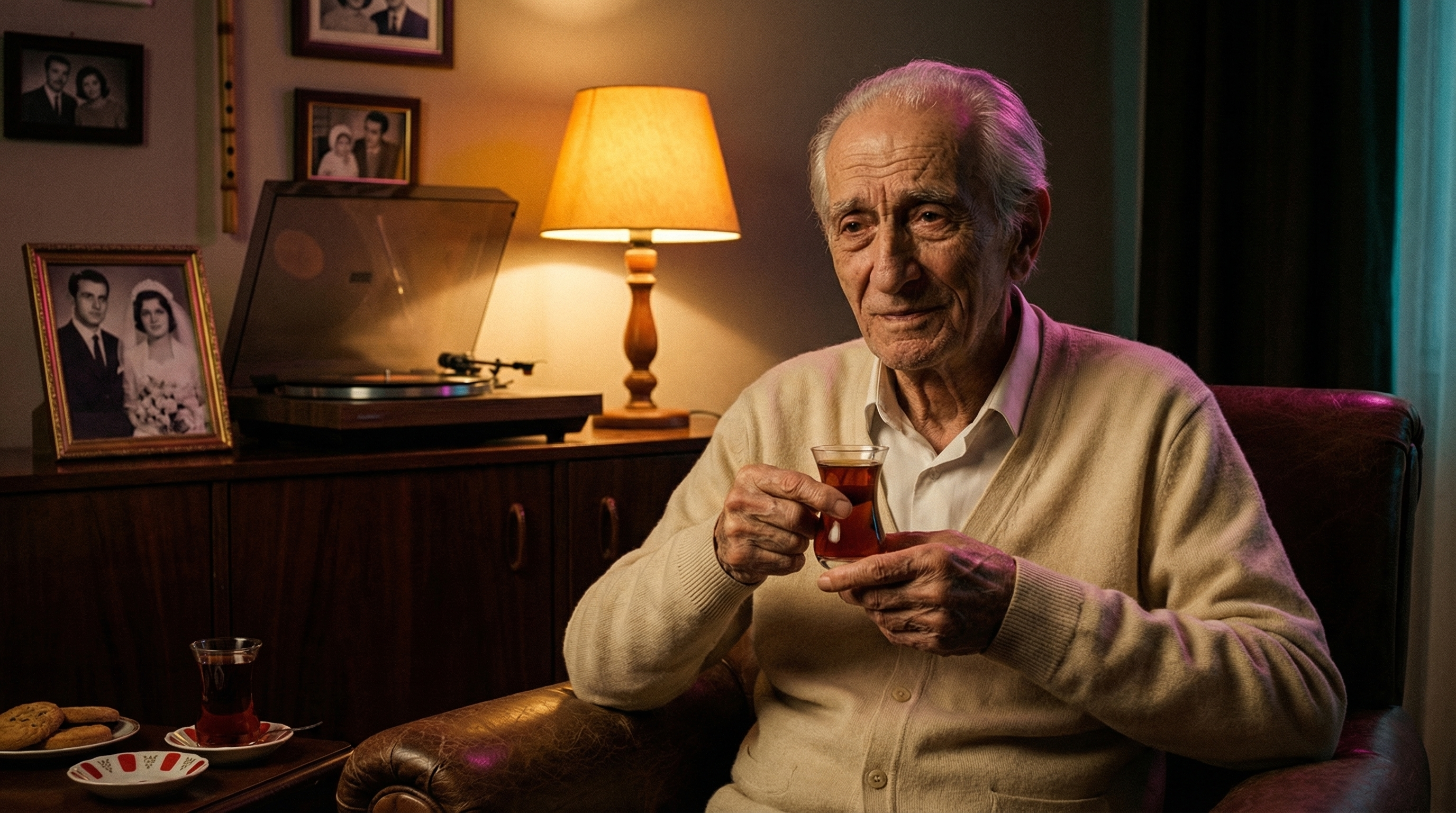
"Silence in a flat that used to hold two people is a different kind of silence than silence in a flat that has always held one."
The building's front door stuck in cold weather. It always had — something about the frame expanding or contracting, I'd never been sure which, only that every winter I had to lean my shoulder into the wood and shove whilst simultaneously turning the key, a manoeuvre that required either practice or a second pair of hands and which I'd mastered through four years of stubborn repetition.
The entrance hall smelled the way it always smelled — old stone and damp and the faint sweetness of the jasmine plant that Halil Bey on the third floor kept in a ceramic pot at the base of the stairs, despite the fact that it received almost no sunlight and had been in a state of gentle decline for as long as I'd lived here. He watered it every morning. I'd seen him, moving slowly down from the third floor in his slippers, a glass of water in one hand and the other on the banister, tending to a plant that was clearly dying with the same steady devotion some people brought to prayer.
The stairs were marble — worn smooth in the centre of each step by a century and a half of feet. The building was 1890s, built during the last flush of Ottoman-era construction in Cihangir, when the neighbourhood had housed foreign diplomats and wealthy Greek and Armenian families. The ceilings were high, the metalwork on the banisters ornate, the plaster mouldings on the stairwell walls cracked but still beautiful in the way that old things were beautiful — not despite the damage but because of it. Because the cracks told you something had lasted.
I climbed to the second floor. My flat was at the front of the building — two rooms, a kitchen barely large enough to turn around in, a bathroom with temperamental plumbing and a window that didn't close properly, and a balcony overlooking the street that was just wide enough for one chair and a pot of herbs I kept meaning to replace because the basil had died in November and the rosemary wasn't far behind.
I unlocked the door and stepped inside.
The flat was exactly as I'd left it that morning — which was to say, it was a disaster. The dining table was still buried under notebooks, printouts, and the Kisura contract photographs I'd been rearranging for three weeks. My laptop sat on top of a stack of books about Bronze Age Mesopotamia. Three glasses of abandoned tea marked a trail from the table to the kitchen counter to the windowsill, each one a small monument to a moment when I'd intended to drink properly and then forgotten. A cardigan hung over the back of a chair. A pair of boots I'd kicked off two days ago sat in the middle of the hallway where I'd left them, a tripping hazard I navigated around with the unconscious precision of someone who'd memorised her own mess.
The walls were mostly bare. I'd hung one thing — a framed photograph of my grandmother that I'd taken at the iftar dinner three years ago. Ayşe was laughing in it, caught mid-sentence, one hand raised in the gesture she always made when she was about to say something she thought was very clever. It was the only decoration in the flat that wasn't accidental.
The kitchen told the story of someone who knew how to cook but rarely bothered. A good knife, a decent pan, spices that had been brought from Ankara and replenished on each visit home. A jar of Ayşe's homemade pepper paste that I'd found in the back of her fridge after the funeral and brought here and couldn't bring myself to open or throw away. In the fridge: half a lemon, some white cheese wrapped in paper, olives, three eggs, and a bottle of ayran that was probably past its best.
I dropped my bag on the hallway floor, stepped over the boots, and went to the bedroom.
The bedroom was the smaller of the two rooms but it had the better view — a narrow slice of the Bosphorus visible between the neighbouring buildings, the water darkening now as the February evening settled in. Cargo ships moved through the strait with their lights on, slow and patient, and the Asian shore was a line of amber pinpricks in the dusk.
I pulled my suitcase from the top of the wardrobe. It was small — carry-on sized, the kind of bag that said I'm not staying long even when the trip was open-ended. I set it on the bed and unzipped it.
Packing for archive work was different from packing for anything else. Other people packed clothes first and then added whatever else they needed. I packed the equipment first and then fitted my life around it.
The camera went in first. A Canon EOS R5 with a macro lens — not mine, technically, but the facility's, though I'd been the only person to use it for two years and it had become mine in the way that tools became yours when you were the one who cleaned them and charged the batteries and knew exactly which angle produced the best raking light on cuneiform impressions. I wrapped it in a soft cloth and nested it in the corner of the suitcase.
The laptop and its charger. My main notebook — a Moleskine, almost full, containing three weeks of analysis on the Kisura contract: transcriptions, sign-by-sign comparisons, notes on stylus angle and pressure depth, the particular characteristics of Azariel's hand that I'd memorised to the point where I could probably identify it in my sleep. A second notebook, empty, for Cairo. Two mechanical pencils. A USB drive containing high-resolution copies of every photograph I'd taken of the contract.
The folder of printed photographs — the Kisura contract from every angle, plus the six images Tariq had sent that morning of Fragment 847-C. I'd printed them at the facility before leaving, on the high-quality photo printer that Deniz usually used for conservation documentation. I'd print more in Cairo if needed, but I wanted these with me. Physical copies. Something I could hold, spread across a table, compare side by side without switching between screens.
That was the work. Now the life.
I looked at the suitcase. The equipment took up roughly half the space. Into the remaining half I put: two changes of clothes, underwear, a spare headscarf for archive work where dust was an issue, toiletries in a zippered bag, my phone charger, a universal power adaptor, and a pair of flat shoes that Tariq had essentially told me to bring.
I paused. Looked at the suitcase again. Realised I'd packed for three days but had no idea how long I'd actually be in Cairo. Tariq had said four thousand catalogued items and an unknown quantity of uncatalogued materials. That wasn't three days of work. That was weeks. Months, potentially.
But the flight was for tomorrow and the suitcase was carry-on and I could buy whatever I needed in Cairo if the trip extended. I was good at travelling light. Had been good at it since my SOAS years in London, when I'd learned to fit a semester's worth of essentials into a bag small enough for the overhead compartment of a budget airline, because checking luggage cost money and money was something I'd never had enough of.
I zipped the suitcase. Set it by the bedroom door.
Then I heard the music.
It came through the ceiling the way it always came — not as a wall of sound but as a presence, a slow infusion, the way warmth from a radiator fills a room. The melody was unmistakable even through the plaster and the hundred-year-old joists: a ney flute, breathy and aching, playing the opening taksim of something I almost recognised. Then a voice joined it — male, rich, precise, riding the melody with the controlled passion of someone who understood that restraint was not the opposite of feeling but its highest expression.
Münir Nurettin Selçuk. I was almost certain. One of the great voices of twentieth-century Turkish art music, the man who'd made makam-based composition feel as intimate as conversation. My father had a boxed set of his recordings that he'd played on Sunday mornings throughout my childhood, the music filling the Ankara flat like incense, my mother complaining gently that it was too early for that much emotion.
Tonight it was too loud. Not aggressive — Halil Bey was never aggressive about anything — but loud in the way that indicated he'd adjusted the volume for ears that no longer registered the lower registers without assistance. The ney was delicate through the ceiling but the vocal line was clear enough that I could almost make out the words, which meant it was significantly above the level that allowed for concentration, let alone sleep.
I stood in my bedroom for a moment, listening. Part of me didn't want to interrupt. The music was beautiful — genuinely beautiful, the kind of performance that reminded you why human beings had been making music for millennia, the same impulse that had driven someone in ancient Mesopotamia to carve a bone flute and breathe into it and discover that air could carry grief. I could appreciate that. Could feel the pull of it even through plaster and old wood.
But my alarm was set for 4:30 AM and the flight was at 6:40 and I needed to sleep.
I put on my shoes. Left the flat. Climbed the stairs to the third floor.
Halil Bey's door was the one on the left — dark wood, a brass number 5 that had oxidised to green, and a small ceramic evil eye hanging from the peephole that I suspected had been placed there by his late wife and which he'd never removed. I knocked.
The music continued. I knocked again, harder.
A shuffling sound. The scrape of a chain being undone. The door opened and Halil Bey looked out at me with the expression of someone who had not been expecting visitors and was trying to determine whether this was a pleasant surprise or an inconvenience.
He was slight — he'd always been slight, as far as I could tell, though the framed photographs visible on the shelf behind him suggested a younger man who'd been lean rather than thin, dark-haired, straight-backed, the kind of handsomeness that came from proportion rather than feature. Now he was eighty-one, white-haired, and dressed in a cardigan over a pressed shirt and trousers that still carried a crease, because Halil Bey was a man who dressed properly even when nobody was coming.
"Mira Hanım." His face shifted — not quite a smile, but the softening that came before one. "Hoş geldiniz."
"Hoş bulduk, Halil Bey. Rahatsız ettiğim için özür dilerim." I gestured upward, towards his flat, towards the music. "Müzik biraz yüksek."
He cupped a hand to his ear. "Efendim?"
I raised my voice slightly. "Müzik. Biraz yüksek."
"Ah." He looked genuinely surprised, as though it hadn't occurred to him that the volume might carry. "Çok mu yüksek? Ben pek fark etmiyorum artık." He tapped his ear with a rueful expression. "Kulaklar eskisi gibi değil."
He stepped back from the door and gestured me inside with the automatic hospitality of a generation that didn't conduct conversations in doorways. I hesitated — I should go back downstairs, finish preparing, try to sleep — but the gesture was so natural, so unhesitating, that refusing it felt like a small cruelty.
I stepped in.
Halil Bey's flat was the mirror image of my own, one floor up, but it felt like a different building entirely. Where my walls were bare, his were covered — photographs in frames of every size and era, from formal black-and-white studio portraits to faded colour snapshots to a single large canvas print of the Bosphorus at sunset that dominated the wall above a dark wood sideboard. Where my furniture was minimal and largely accidental — things I'd bought cheaply or inherited from the flat's previous tenant — Halil Bey's had the weight and character of pieces that had been chosen once, decades ago, and kept because replacing them would mean admitting that the life they'd been chosen for had changed.
The music was coming from a sound system that looked older than me — a wooden-cased amplifier and a pair of speakers that were probably worth nothing financially and everything emotionally, positioned on either side of the sideboard with the particular care of someone who understood that speaker placement mattered. A turntable sat on top of the amplifier, a record spinning slowly, the needle tracking through grooves that contained a voice recorded sixty years ago.
Halil Bey was already in the kitchen. I could hear the click of the gas stove, the rattle of the çaydanlık being positioned, the small sounds of tea preparation that were identical in every Turkish home regardless of the age, wealth, or temperament of the person making it. Tea was not optional. Tea was the medium through which Turkish hospitality flowed, and declining it was theoretically possible but practically unthinkable.
I looked at the photographs while I waited. A wedding portrait — Halil Bey, impossibly young, standing beside a woman with dark eyes and a smile that suggested she was trying very hard not to laugh during a formal occasion. The same woman, older, sitting at a table covered in sheet music, a pen in her hand. A group photograph — a dozen people in formal attire, standing on the steps of a building I didn't recognise, holding instruments. Halil Bey in the back row with a ney in his hands.
A ney player. He'd been a ney player.
I looked at the sound system again. The record sleeve was propped against the amplifier — Münir Nurettin Selçuk, I'd been right, a recording from 1962. The cover art was a simple portrait, the lettering in the old Turkish style.
"Buyrun." Halil Bey appeared beside me with two tulip glasses of tea on a small tray, a sugar bowl, and a plate of biscuits that looked like they'd been purchased from the bakkal on the corner and arranged with more care than their packaging suggested they deserved. He set the tray on the low table between two armchairs and gestured for me to sit.
I sat. He sat across from me. The music played between us — Münir Nurettin Selçuk's voice rising and falling through the makam, the ney weaving underneath it like breath.
"Münir Nurettin?" I asked, nodding towards the turntable.
His face lit up. "Evet, evet. Nihavend makamı. Bunu hanımla her akşam dinlerdik." He paused. Looked at the wedding portrait on the wall. "Şimdi ben tek başıma dinliyorum."
He picked up his tea glass. Held it between both hands the way elderly people often did, not for warmth but for steadiness. The record turned. The voice sang. The ney followed.
I sipped my tea. It was strong, brewed properly — not the hurried version I made for myself with a teabag and a kettle, but the real thing, steeped in the çaydanlık, the colour of dark amber. The biscuit was dry and slightly stale and I ate it anyway because Halil Bey was watching with the particular attentiveness of a host who measured the success of his hospitality by whether his guest ate.
"Siz de müzikle ilgilenirsiniz, değil mi?" he asked. "Babanız öğretmendi, sanırım?"
I shook my head. "Babam tarih profesörü. Ama müziği çok sever. Özellikle sanat müziği."
"Ah, tarih." He nodded slowly, as though this explained something. "Tarih ve müzik, ikisi de aynı şeyi yapar. Geçmişi yaşatır."
He rose from his chair — slowly, one hand on the armrest — and crossed to the sideboard. From a drawer he took a framed photograph that was smaller than the others, older, the image faded to sepia tones. He brought it to me and held it out.
A young man — very young, perhaps eighteen — standing in front of a building I now recognised from the group photograph. He was holding a ney, the instrument resting against his shoulder as though it were an extension of his arm. Behind him, partially visible through an arched doorway, was a long room filled with music stands and wooden chairs.
"İstanbul Belediye Konservatuvarı," Halil Bey said. "Bin dokuz yüz altmış bir." He touched the photograph gently. "Kırk üç yıl orada ney öğrettim. Emekli olana kadar."
Forty-three years. Teaching ney at the Istanbul Conservatory from 1961 until retirement. A lifetime spent in the service of a single instrument, a single tradition, the unbroken chain of teacher and student that stretched back through centuries of Ottoman court music to the Sufi lodges where the ney was considered the closest human-made sound to the divine breath.
I looked at the photograph, then at Halil Bey, then at the record turning slowly on the turntable.
"Çok güzel bir hayat," I said. A beautiful life.
He took the photograph back. Held it for a moment. Then returned it to the drawer with the care of someone handling something infinitely valuable.
"Güzel, evet. Ama sessiz." He looked around the flat. The music filled the space the way it filled his evenings — not as entertainment but as company. "Karım öldükten sonra, müzik ve ben başbaşa kaldık. O yüzden belki biraz yüksek açıyorum." A small smile. "Kulaklar bahane. Aslında sessizlik korkutuyor."
He was afraid of the silence. That was why the music was loud. Not because he couldn't hear it — though that was true too — but because silence in a flat that used to hold two people was a different kind of silence than silence in a flat that had always held one. It was an absence. A presence that had been subtracted. And music, turned up high enough, could almost fill the shape of what was missing.
I understood this. Understood it in a way I couldn't have articulated and didn't try to. I finished my tea. Set the glass on the tray.
"Halil Bey, çok teşekkür ederim. Çayınız harikaydı." I stood. "Ama yarın çok erken kalkmam gerekiyor. Uçağım var."
"Seyahat mi ediyorsunuz?" His eyebrows rose — curious, not prying. "Nereye?"
"Kahire."
"Kahire!" He clasped his hands together. "Güzel şehir. Karımla bin dokuz yüz yetmiş yedide gittik. Müze'deki ney koleksiyonunu görmelisiniz. Olağanüstü."
I smiled. "Bakacağım."
He walked me to the door. In the hallway, he paused with his hand on the frame.
"Müziği kısayım mı?"
"Biraz, lütfen. Sadece biraz."
He nodded. "Biraz." He said it like a concession he was willing to make but wanted noted as generous. "İyi geceler, Mira Hanım. İyi yolculuklar."
"İyi geceler, Halil Bey."
I stepped into the stairwell. Behind me, the door closed softly. A moment later, the music dropped — not to silence, but to something gentler. Münir Nurettin Selçuk's voice receded from the walls and became what it should have been all along: a private conversation between an old man and his memories, conducted at a volume the neighbours could sleep through.
I stood on the landing between the third floor and the second. The stairwell was dim — the timed light had clicked off and I hadn't pressed the switch again. The marble steps glowed faintly in the light filtering up from the entrance hall below. The building settled around me, the way old buildings did at night, creaking and ticking as the temperature dropped and the stone contracted.
Then I heard a door open. Not below me — above.







