4127.105 · April 15, 1807 AD
Night Terrors
The gaol does not sleep. As darkness fills the cell and the corridor lamp gutters low, William's first night as a convicted man strips away every defence he has built through the long, wretched day. The sounds beyond his door speak of men already broken, and the vermin that stir in the dark corners care nothing for dignity. When the body fails and the mind follows, only the ghost of a mother's voice stands between a man and the abyss.
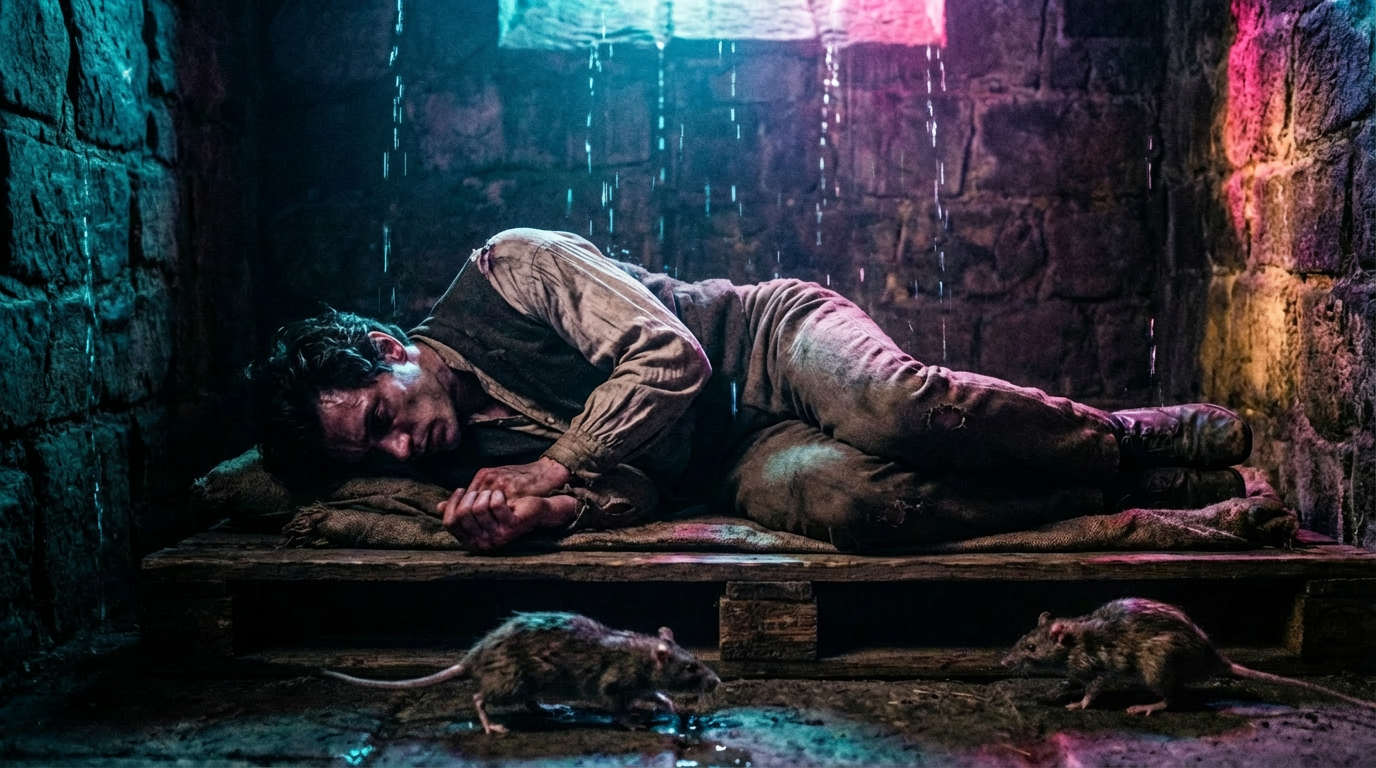
"A man may hold himself together through a trial, a verdict, and a sentencing. It is the first night that undoes him."
The corridor lamp had been turned down to a miserly stub, its flame no larger than a thumbnail, casting a weak and trembling light that barely reached the grate of my door. Beyond it, the passage lay in near-total darkness, a throat of stone swallowing what little remained of the day. Through the narrow slit of window above my head, the sky had passed from violet to black, and the moon — half-veiled by the storm's last trailing remnants — offered only a thin, intermittent glow that fell across the flagstones in pale, broken bars. The shadows of the real bars lay within them, sharp as knife-edges, and when the clouds shifted the two sets of lines moved against one another like the teeth of a trap slowly closing.
I lay on the pallet with the blanket pulled to my chin. They had given it to me with the tray — a coarse, stiff rectangle of wool that smelled of other men's bodies and the particular sour mustiness of cloth that has been damp too often and dried too seldom. It scratched at the skin of my neck and hands like horsehair, and offered about as much warmth. The cold rose through the iron frame beneath me, up through the thin straw, and into my bones with the slow, patient certainty of water finding its level. I curled onto my side, drawing my knees towards my chest, and felt the frame's edge press a dull ache into my hip. I shifted. The straw rustled and resettled, forming new ridges that dug into my ribs. I shifted again. The ache moved but did not leave.
There was no position that did not hurt. I understood, with the grim clarity of a man who has exhausted his options, that this was not a bed designed for rest. It was a surface upon which a body might be placed — horizontally, for a number of hours, in approximate imitation of sleep — and that was the full extent of its ambition. Comfort was not a consideration. Comfort was not a right. I was no longer a man to whom such things were owed; I was a unit of the Crown's inventory, stored until required, and the Crown's storage did not concern itself with the tenderness of hips or the aching of spines.
I closed my eyes. Behind them, the courtroom waited — the judge's mouth shaping words I had already memorised, the foreman rising with his dreadful steadiness, Mother's cry splitting the air like a blade through silk. I wrenched my thoughts away, but they circled back, persistent as flies returning to a wound, and each time they returned they brought more with them: Hawley's shrug, Ashford's satisfied smile, the door closing behind me with its coffin-lid finality.
I opened my eyes. The ceiling stared back, close and featureless, its stones weeping slow moisture in the dark.
The gaol did not sleep.
I had imagined — foolishly, in the way of a man who has never known true confinement — that night would bring silence. That the great stone building would settle into quiet as the lamps were lowered and the turnkeys withdrew, and that in that quiet I might find, if not peace, then at least the temporary mercy of oblivion. I was wrong. The gaol's daytime sounds merely changed their clothes and came back wearing darker garments.
It began with the coughing. Not the polite, stifled cough of a man clearing his throat in company, but the deep, wet, racking convulsions of lungs fighting a battle they were slowly losing. It came from somewhere to my left, muffled by stone but carrying with a dreadful clarity that made each spasm feel as though it erupted from the wall itself. The sound was thick, liquid, heavy with the unmistakable gurgle of phlegm and worse. Consumption, most likely — the gaol cough, Culpepper might have called it — that slow, patient killer that thrived in damp and close quarters and took its time about its work. The man hacked and retched, hacked and retched, the rhythm broken by long, agonising pauses during which I could hear him fighting to draw breath, his lungs rattling like a bellows with a torn seam. Then the fit would seize him again, and the sound would fill the corridor like something alive, something feeding.
I pressed the blanket against my ear. It made no difference.
Beneath the coughing, other sounds asserted themselves. A young man — a boy, perhaps — was weeping in the cell to my left. Not loudly, not with the abandon of a child, but with the choked, shuddering restraint of someone who knows he is heard and is ashamed of it. Each sob was bitten back almost before it escaped, swallowed hard, only to be followed by another that could not be contained. The sound was pitiful, piercing, unbearable — the raw grief of a soul that had not yet learned to armour itself against the dark.
"Shut your gob!" The command came from further down the passage, a man's voice roughened to a snarl by years of breathing gaol air. "Some of us are trying to bloody sleep!"
The sobbing faltered, caught in the boy's throat like a bone lodged sideways. For a moment there was silence — true silence, sudden and complete — and in that silence I heard the boy's breathing, fast and shallow, the ragged intake of a creature trying to make itself small. Then the weeping returned, quieter now, driven underground, muffled by what I imagined was a fist pressed hard against the mouth or a face buried in straw. It did not matter. The sound found me anyway, threading through stone and iron and the thin fabric of my blanket to settle in my chest like a stone I could not cough up.
I knew that weeping. I had heard its twin in my own throat all afternoon, held back by nothing more than the terrified conviction that if I once let it loose I would never gather myself again. The boy had less practice at containment than I, or less reason to try. I wondered how old he was. I wondered what he had done, or what had been done to him, to land him here. I wondered if anyone had told him to keep his head high.
I did not wonder for long. The gaol had other lessons to deliver.
The smell, which I had noticed upon first entering and which the distraction of Culpepper's conversation and Carver's counsel had pushed to the margins of my attention, now reasserted itself with the full, undeniable authority of the dark. It was not a single smell but a layered architecture of stenches, each one distinct, each one vile, and together they composed a reek so thick and so comprehensive that breathing through the mouth offered no relief — the air itself was tainted, and the tongue tasted what the nose could not escape.
The bucket in the corner was the nearest and most insistent source. I had used it once already — an act of such wretched necessity that I will not dwell upon it here, save to say that the first time a man must relieve himself into an iron pail in a stone cell with no door but a grate through which any passing eye might observe him, something is taken from him that can never quite be returned. The bucket had not been emptied. It would not be emptied, I suspected, until morning, and by then its contents would have had the full benefit of the night's cold to thicken and settle. The smell rose from it in slow, patient waves, sweet and sharp and foul, filling the lower reaches of the cell with an invisible fog that no amount of shallow breathing could avoid.
But the bucket was merely the nearest voice in a chorus. Beyond it lay the deeper, older reek of the gaol itself — the accumulated residue of decades of confinement, of bodies packed too tightly and washed too rarely, of straw that had absorbed the sweat and sickness of a hundred men before me and been changed too seldom. There was the sharp ammonia bite of urine soaked into stone that no scrubbing would ever fully cleanse. There was the damp — not clean damp, not the fresh wet of rain, but the stale, fungal damp of water that had crept through cracks and sat in darkness until it turned to something living. And beneath it all, threading through every other scent like a bass note beneath a melody, there was the particular odour of unwashed human bodies confined in close quarters — a thick, sweetish, animal smell that clung to the blanket, the straw, the walls, and now, already, to my own skin.
I breathed it. I had no choice. It entered me with every inhalation, coating the inside of my nose and throat, and I understood that by morning I would have ceased to notice it — not because it would lessen, but because my senses would surrender, defeated by the sheer relentless constancy of the assault. This, too, was part of the gaol's design: to strip away, layer by layer, the small dignities that distinguish a man from the beasts he shares his quarters with, until the distinction itself seems a luxury too fine for his station.
The rats came with the dark's full settling.
I had heard their scratching earlier — a faint, exploratory sound from the far corner, easily dismissed as the building's own restless creaking. But now, as the corridor lamp guttered lower and the cell sank into its deepest gloom, the sound grew bolder, more purposeful. Not one set of claws but several, moving with the quick, confident industry of creatures that knew this territory far better than I did. They had been here long before me, and they would remain long after I was gone. I was the intruder. They were the permanent residents.
I heard the first one before I saw it — a rapid, pattering scurry across the flagstones near the foot of the pallet, so close that the sound seemed to pass directly beneath me. My body reacted before my mind could intervene: I jerked upright, my heart slamming against my ribs, my legs drawing up beneath me with an instinct born not of thought but of pure, animal revulsion. The blanket tangled about my knees. My breath came fast and ragged, and I peered into the darkness with eyes that strained to find shapes in the formless black.
There — a movement. Low to the ground, quick and fluid, a darker shadow sliding along the base of the wall. It paused near the bucket, and I caught the faintest gleam of eyes — two wet, black points of reflected moonlight, utterly without expression, regarding me with the blank appraisal of a creature that has learned to fear nothing smaller than a boot.
My gorge rose. I could feel the gruel and bread from the evening's meal churning in my stomach, threatening rebellion, and I swallowed hard against the bile that climbed my throat. The rat — it was large, larger than my fist, its body a matted, hunched shape that moved with an oily, boneless fluidity — turned from me without haste and continued along the wall, its claws ticking against the stone. A second followed, smaller, quicker, darting in nervous zigzags. A third emerged from the darkness near the door, drawn by whatever scent the bucket offered.
I slammed my boot against the frame. The crack rang through the cell, sharp and violent, and the rats scattered — a brief, frantic eruption of movement that sent them streaming into cracks and crevices I had not known existed. For a moment, the corner was still.
Then the scratching resumed. Fainter, more cautious, but unmistakably present. They had retreated, not fled. The distinction, I understood, was important. These creatures could not be vanquished; they could only be temporarily discouraged. They would return. They would always return. And on the nights when sleep took me — if sleep ever came in this place — they would grow bold enough to cross the pallet itself, to nose at my hands, to investigate the warmth of my neck and the moisture of my lips.
The thought sent a shudder through me so violent that my teeth struck together. I pulled the blanket over my head and lay rigid, my fists clenched against my chest, my breath hot and damp against my own face. The wool's rough weave pressed against my mouth and nose, filling my lungs with the smell of other men's sweat and the gaol's ancient, patient decay. I could feel my composure — that brittle shell I had carried through the trial and the sentencing and the walk back and the count and the meal — beginning to fracture. Hairline cracks, spreading outward from a centre that could not hold.
My jaw tightened. My eyes burned. The pressure built behind them, swelling in waves, and I fought it with the same desperate, clenched fury with which I had fought everything this day had thrown at me. I would not weep. I would not add my voice to the boy's sobs or the consumptive's hacking or the chorus of groans and curses that filled this corridor like the sounds of purgatory itself. I would not give this place that satisfaction.
But the body does not negotiate. It does not respect the terms a man sets with his pride. The first sob took me by ambush — a single, wrenching convulsion that tore loose from somewhere beneath my ribs and forced itself up through my throat before I could clamp my mouth against it. It came out as a sound I did not recognise: not a cry, not a moan, but something raw and formless, an animal noise that belonged to the darkest, most undefended part of me.
I pressed my fist against my mouth, hard, the knuckles grinding against my teeth. The second sob came anyway, and the third, and then they would not stop. They poured out of me in great, heaving waves, shaking my shoulders, bowing my spine, stripping away every pretence of control I had constructed across the long, terrible hours of this day. I wept as I had not wept since childhood — without restraint, without dignity, without the faintest hope that the weeping might accomplish anything at all. I wept for the life I had lost and the years that stretched before me. I wept for Mother's face and Father's voice and the house on Butcher Street that I would not see again for seven years. I wept for the boy I could hear through the wall, who was weeping too, and for the old man down the corridor whose lungs were slowly filling with the fluid that would kill him, and for every poor wretch in this building who lay awake in the dark and wondered how his life had come to this.
I wept until there was nothing left — until my chest ached and my throat was raw and the blanket beneath my face was soaked through with the salt of it. And when at last the sobs subsided, leaving me hollowed out and trembling, I lay still and listened to my own breathing and felt, beneath the devastation, the faintest stirring of something I had not expected.
Relief.
Not happiness. Not hope. Certainly not peace. But a kind of emptiness that was, for the first time since the foreman had spoken, bearable. The pressure that had been building all day — in my chest, behind my eyes, in the rigid muscles of my jaw and shoulders — had found its release, and though the release had been ugly and graceless, it had done its work. The wound had been lanced. The poison had run.
I lowered the blanket from my face and drew a long, shuddering breath. The air tasted of damp and iron and the contents of the bucket, but I breathed it fully, filling my lungs, letting it settle. The rats were scratching again in their corner. The boy to my left had fallen silent at last, his grief exhausted or his body claimed by sleep. The consumptive coughed — once, twice — then was still. From somewhere further away, a man muttered to himself in a low, ceaseless monologue that might have been prayer or madness or some territory between the two that the gaol had carved out for its own.
The moonlight had shifted while I was lost inside myself. It fell now across the wall beside my head, illuminating a section of stone I had not examined before. There, scratched into the surface with what must have been a nail or a shard of broken iron, were marks. Not tallies, as I had first assumed, but letters — crude, uneven, carved with the slow determination of a hand that was perhaps unaccustomed to writing but would not be denied its say.
I traced them with my fingertip. The grooves were shallow, worn smooth by time, but still legible in the pale light.
T.M. 1793. God forgive.
Three words and a date. Fourteen years ago, a man had lain where I lay now, and had taken the trouble — at what cost of effort, with what improvised tool, across how many sleepless nights — to leave this record of his existence. God forgive. Not God save, not God help, but forgive. A man who believed himself guilty, then, or who feared he was. A man who had wanted the wall to know his name and his contrition, even if no living soul would ever read it.
I wondered what had become of him. Whether he had served his sentence and returned, or whether the colony or the voyage or the gaol itself had claimed him. Whether his plea had been answered. Whether forgiveness, in whatever form it took, had found him before the end.
The thought carried me, against my will, to a place I had been circling all evening — the memory I had held at arm's length since the cell door closed.
It was not the courtroom. It was not the verdict. It was earlier, much earlier — years before, a lifetime before — and it arrived not through the mind but through the body, summoned by the particular quality of the cold that pressed against my skin, by the smell of damp wool, by the sound of rain still dripping from the eaves beyond the window.
I was seven years old, crouched beneath the kitchen table on Butcher Street, and the storm outside was the worst I had ever known. Thunder cracked so close that the plates rattled on the shelf, and lightning bleached the room white, and the rain drove against the window with a fury that made the glass bow inward. I had my blanket — the same threadbare thing I slept with every night, its edges frayed to softness — pulled over my head, and I was shaking so badly that my teeth chattered, and the table legs around me looked like the bars of a cage, and I was certain, with the absolute conviction of a terrified child, that the house was going to come apart around me and the storm would take me away.
Then her hands. Her hands finding me beneath the table, warm and sure, smelling of the lavender soap she kept for Sundays and the flour that never quite left her knuckles. She did not pull me out. She did not scold me for hiding. She simply knelt, her skirts pooling on the cold floor, and gathered me against her, blanket and all, and held me there while the thunder rolled and the lightning flashed and the rain beat its fists against the world.
"You're safe, William," she said, and her voice was the calmest thing I had ever heard, calmer than the silence between thunderclaps, calmer than the still water in the harbour on a windless morning. "There's no storm strong enough to bring this house down. Not while I'm in it."
And I had believed her. Of course I had. She was my mother, and her arms were the boundaries of the world, and nothing beyond them could touch me. I had pressed my face into her shoulder and breathed the smell of lavender and flour and the faint, warm scent that was simply her, and the shaking had stopped, and the thunder had faded to a distant grumble, and I had fallen asleep right there, beneath the kitchen table, held fast in the one place where the storm could not reach.
I could feel her arms now. That was the cruelty of it — not the memory itself, but its vividness, the way it pressed itself upon my senses with such force that for a single, perfect, agonising moment I could feel the warmth of her, could smell the lavender, could hear her voice saying the words that had once made everything right. The sensation was so complete, so achingly real, that my hands reached out in the darkness — actually reached, fingers extended, grasping — before the stone wall met my palms and the truth crashed back with a violence worse than any thunder.
She was not here. She could not reach me. No one could. The table was a pallet and the blanket was a stranger's rag and the storm was not outside but within, and no voice, however calm, however loving, could tell me I was safe, because I was not. I was twenty-two years old and I was lying in a gaol cell in the dark with rats at my feet and another man's filth in a bucket at my side and seven years of exile stretching before me like an ocean with no further shore in sight.
My hands fell back to my chest. I pressed them there, one over the other, and felt my heart beating beneath them — fast, unsteady, but beating.
The moonlight moved on, carrying its cold illumination across the wall, past the scratched initials, past the sweating mortar, into the corner where the rats continued their patient industry. The consumptive's coughing had subsided to an intermittent, rattling wheeze. The dripping from the ceiling had slowed to a single drop at long, irregular intervals, each one striking the puddle on the flagstones with a sound like a fingertip tapping bone.
I lay still. The blanket was damp against my face. The iron frame pressed its cold line into my hip. Somewhere in the passage, the man who might have been praying continued his low, unbroken murmur, the words shapeless and unceasing, a sound that belonged neither to wakefulness nor sleep but to some grey country between the two where the gaol kept its truest inhabitants.
The night did not end. It simply went on, and on, and on.







