4308.263 · September 19, 1988 AD
Newsprint and Wind
A gust of spring wind delivers a torn page of the Silver City Sentinel into Violet Dallow's path as she and Jasmine walk to school along the eucalyptus-lined streets of Broken Hill. The headline concerns a missing explorer named Sally Harlow — a woman who vanished near Silverton whilst researching the same disappearances that haunt Violet's own notebooks. The name settles into her like a splinter she cannot locate but cannot ignore.
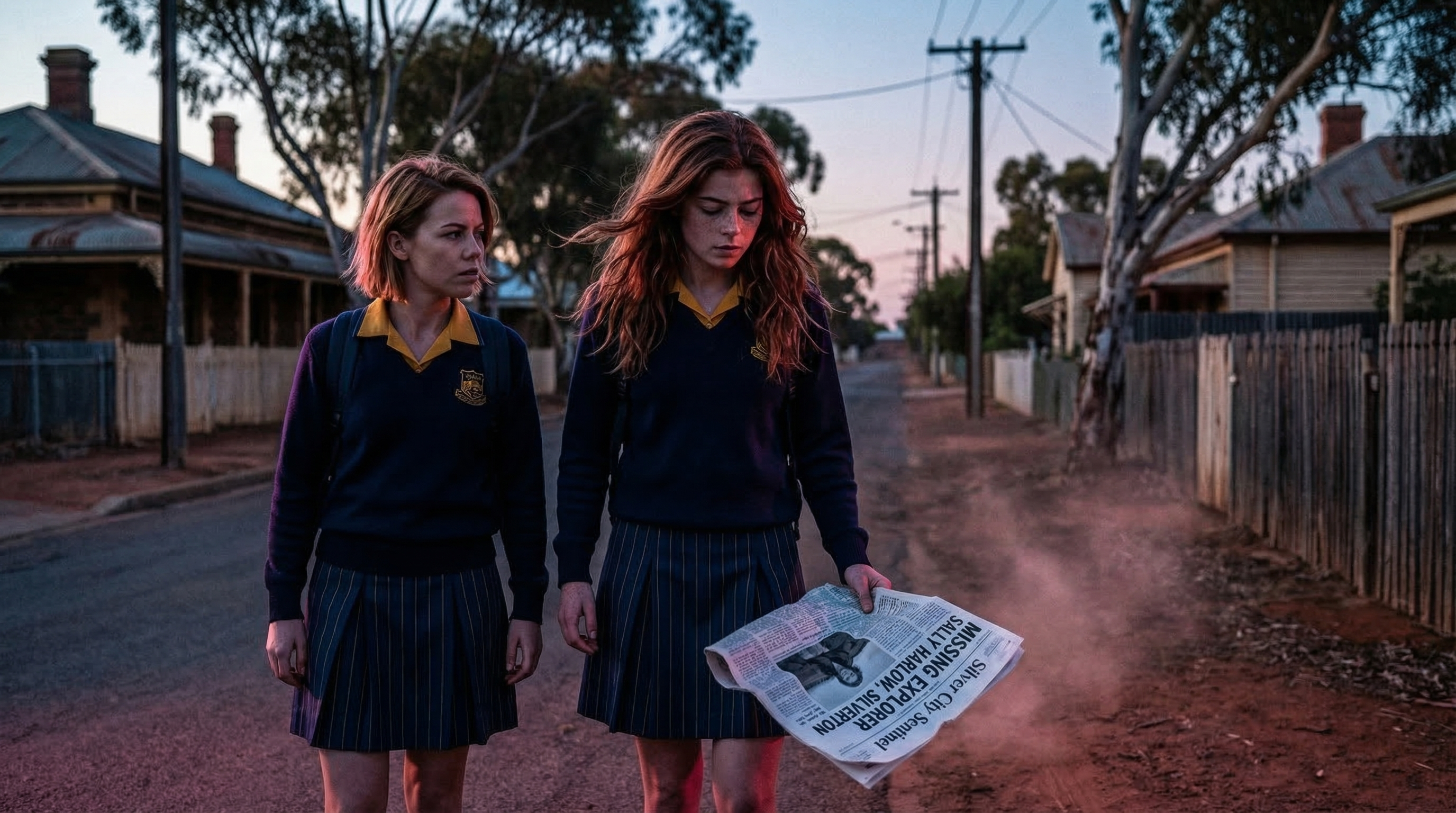
The walk to Broken Hill High School followed the same route it had followed for four years, and Violet's feet knew it well enough that her mind was free to wander whilst her body navigated the cracked bitumen and gravel shoulders of the streets that connected Chloride Street to the school gates. The eucalyptus trees that lined the road stood in their habitual postures — pale trunks scarred and shedding bark in long curls, their canopies filtering the strengthening light into patterns that shifted with each breath of breeze. The scent of gum leaves hung sharp in the air, braided with the dry iron tang of soil that stained everything in this town the colour of rust.
Jasmine walked beside her, content in the way she often was during these morning passages — pointing out a cloud shaped like a turtle, tracking the trajectory of rosellas as they darted between branches in streaks of crimson and blue. A magpie warbled from the telephone wire above them, its song carrying that particular quality of liquid melancholy that belonged to no other bird. Further along the fence line, a willy wagtail worked its nervous choreography, tail flicking like a conductor's baton keeping time with music only it could hear.
The sisters moved at different speeds, though neither acknowledged it. Violet's stride was longer, her pace unconsciously calibrated to the restlessness that drove her forward even when there was nowhere particular to go. Jasmine's steps were shorter, more deliberate, her attention distributed evenly between the path ahead and the small details that populated its margins — a beetle navigating a crack in the footpath, a tuft of spinifex leaning into the breeze as though reaching for something just beyond its grasp. Their shoulders bumped occasionally, the casual contact of bodies that had walked together so many times the proximity had become its own form of punctuation.
The town unfolded around them in its morning rhythms. Broken Hill in early spring carried a quality of provisional gentleness — the worst of the summer heat still weeks away, the winter cold retreating, the days occupying a temperate middle ground that would not last but was pleasant whilst it held. Sprinklers arced across front lawns that fought a losing battle against the red earth's tendency to reclaim everything that grew from it. Screen doors banged as children emerged for their own walks to school, their voices carrying across the flat terrain in fragments — laughter, complaint, the universal protests of the young against the tyranny of routine.
Along the commercial stretch where the residential streets gave way to shopfronts and awnings, the town's daily commerce was stirring into operation. Leonard Pascoe — Len to everyone who had bought so much as a tin of condensed milk from him in the past thirty years — was already at work outside the Red Dust Emporium, his squat brick premises with its faded green awning that still bore the ghost of a Bushells Tea advertisement rubbed nearly invisible by decades of sun and wind. He moved amongst his crates of apples and tinned milk with the unhurried authority of a man whose relationship with this particular patch of footpath predated the birth of every student who passed it on the way to school.
Len Pascoe was sixty-three years old and had occupied the same shop since 1962, when he purchased it from the widow of a miner who had gone underground one morning and never come back up. He had watched Broken Hill contract and persist, had seen families arrive with optimism and depart with dust in their luggage, had served three generations of the same households and could recite their preferences from memory — who took their tea with sugar, who needed their flour in bulk, which children were sent with coins counted into their palms and which arrived with accounts their parents would settle on payday. His skin had been tanned to the colour and texture of old saddle leather by years of hauling stock in the open air, and his arms moved with the mechanical efficiency of someone whose body had memorised every task his trade required.
He looked up as the Dallow girls approached, his face creasing into the broad, automatic warmth he offered every familiar face that passed his shop. His hand rose in greeting, his voice carrying across the quiet street with the volume of a man accustomed to being heard over the clatter of delivery trucks and the complaints of reluctant refrigeration units. Violet returned the wave but her hand was slow, her attention somewhere else, and Len's experienced eye — trained by three decades of reading the moods of a small town's inhabitants — noted the distraction without remarking on it. He offered his weather warning instead, the information passed along with the practised casualness of someone who understood that in the Outback, weather was never merely weather. A storm system building to the north-west, he said. Coming in strong. The girls should take care.
Jasmine received the warning with the polite gravity she brought to all interactions with adults, her nod conveying both acknowledgement and the particular respect that Broken Hill's children were raised to offer the town's elders. Violet heard the words but processed them at a delay, her thoughts snagged on something she could not yet identify — a quality in the morning air, a tension beneath the birdsong and the eucalyptus scent, as though the day itself were holding something back.
They moved on. The school was visible now, its angular silhouette rising above the roofline ahead, grey and institutional against the sharpening blue of the sky. Other students appeared on converging paths, their bags slung low, their postures communicating the reluctant momentum of youth funnelled toward obligation. The sound of the approaching school day — voices, footsteps, the distant percussion of a ball bouncing in the yard — began to assert itself over the quieter morning sounds that had accompanied the sisters' walk.
It was then that the wind shifted.
The gust came from the north-west — the same direction Len Pascoe had indicated when he spoke of the approaching storm — and it arrived with a sharpness that surprised the morning's gentler currents. It stirred the fine red dust from the footpath edges, sent a scatter of leaves tumbling across the bitumen, and lifted a loose page of newspaper from wherever it had been discarded, sending it into a spinning arc through the air. The page wheeled and pirouetted as though caught in some private performance, pale against the blue sky, before the wind released it and it descended in a slow flutter directly into Violet's path.
The paper struck her shin with a soft collision that pulled her attention downward. She stooped to catch it before it could escape, her fingers closing on edges that were browned and softened by exposure to the elements. The print was faintly smudged in places, the ink having surrendered some of its definition to sun and moisture, but the headline remained legible — stark black type across the top of the page, the kind of bold lettering that newspapers reserved for stories they wanted no reader to overlook.
EXPLORER SALLY HARLOW MYSTERIOUSLY VANISHES DURING OUTBACK EXPEDITION.
The words struck something in Violet's chest that she could not immediately name. She straightened, holding the page before her, and read the subheading: Belongings Found Near Abandoned Mine as Search Intensifies. Below the text, a photograph occupied a column's width — a woman captured mid-smile, her face creased by sun and years of outdoor living, her hair windblown beneath a hat tilted back at an angle that suggested habitual carelessness about appearance and absolute seriousness about everything else. The image was grainy, reproduced on newsprint that degraded the original's resolution, but the woman's expression burned through the limitations of the medium. She looked like someone who had spent her life asking questions that other people preferred to leave unasked.
Violet's eyes moved through the article with the particular velocity she reserved for information that mattered. Sally Louise Harlow, thirty-one years old, originally from Newcastle. A historian and explorer — the word explorer landed with weight, as though it had been chosen specifically to speak to Violet across the distance between the printed page and her own aspirations. Miss Harlow had been conducting research into historical disappearances in the Silverton region. She had been last seen on the evening of the thirteenth of September, leaving the Silverton Hotel. Her belongings had been found near an abandoned mining shack. There was no sign of Miss Harlow herself.
The article quoted a Sergeant Barry Glasson of Broken Hill Police — a name Violet knew, though in a different context entirely, as Mandy's father — describing the discovery of belongings as deeply concerning. It quoted the publican of the Silverton Hotel recalling Miss Harlow's excitement in the days before her disappearance, her conviction that she had uncovered something significant about the patterns of vanishings in the region. It quoted her mother, a woman named Brenda Harlow, who had travelled from Newcastle and who stated with the certainty of someone who knew her daughter's habits that Sally would not simply wander off.
Historical disappearances. Silverton. Patterns nobody had noticed.
The words assembled themselves in Violet's mind with the precision of tumblers falling into alignment inside a lock. She had spent months in the Broken Hill library, poring over the same territory — the same town, the same questions, the same stubborn conviction that something connected the vanishings that peppered the region's history. The prospector who vanished near Silverton in 1921, whose clipping hung on Violet's bedroom wall at that very moment. And now this woman — this Sally Harlow, with her sun-lined face and her canvas backpack and her research notes found abandoned near a mine — had been pursuing the same thread, and the thread had swallowed her.
A strange tightness coiled beneath Violet's ribs. Not fear, precisely — or not only fear. Recognition. The sensation of encountering someone whose trajectory so closely mirrored her own that the parallel felt less like coincidence and more like correspondence, as though the same current that pulled Violet toward Silverton's mysteries had pulled Sally Harlow before her, and the current did not care about the difference between curiosity and danger.
She folded the page with deliberate care, pressing the creases flat with her thumbnail, and tucked it beneath her arm the way one might carry something that had not yet revealed whether it was precious or perilous. The photograph remained vivid in her mind — those eyes, steady and alive, belonging to a woman who was at that moment somewhere in the vast country surrounding Silverton, either surviving or not surviving, either findable or already lost to the same silence that had consumed everyone else who had vanished from that stretch of earth.
Jasmine had noticed. She had drifted ahead during the seconds Violet spent reading, her half-sung tune carrying on the breeze, but the change in her sister's rhythm — the sudden stop, the prolonged stillness, the quality of attention that indicated Violet had encountered something that demanded engagement — brought her back. Her eyes found the newspaper, then found Violet's face, and read both with the fluency of long practice.
Violet told her. An explorer, she said. Sally Harlow. Disappeared out in the bush near Silverton. Gone without a trace. The words emerged coloured with something Jasmine could hear but Violet could not yet name — a blend of fascination and unease, the two states so thoroughly intertwined that separating them would have required tools neither sister possessed.
Jasmine's response carried the honest weight of someone too young to have learned that certain questions are better left decorative. She wanted to know what Violet thought had happened. The question was genuine — not morbid curiosity but the authentic wondering of a fourteen-year-old confronting the reality that adults could vanish from the world as completely as stones dropped into deep water.
Violet looked at the folded newspaper, then at the stretch of bushland visible beyond the rooftops at the town's edge — the same country that had absorbed Sally Harlow and returned only her belongings. She did not have an answer. The absence of an answer was itself the thing that would not release her, the gap in the narrative where explanation should have been, pulling at her attention the way the Outback pulled at the roots of every tree that tried to grow from its reluctant soil.
They walked the remaining distance to the school gates in a silence that had changed its composition. The easy companionship of the morning's earlier stretch had acquired a new element — not tension, exactly, but awareness. The awareness that somewhere beyond the familiar geometry of Broken Hill's streets and fences and corrugated rooftops, the country held a woman's absence the way it held everything else: without comment, without apology, without any indication of whether it intended to give back what it had taken.
Violet's bag hung heavier on her shoulder. Inside it, amongst the textbooks and the half-eaten remnants of yesterday's provisions, the folded newspaper page lay against the fabric lining — a new addition to the collection of unexplained things she carried, this one still warm with the urgency of the present tense.
The school gates stood open ahead of them, their chipped paint and familiar hinges offering the ordinary refuge of routine. Students filtered through in the slow current of morning arrivals, and the sounds of the schoolyard — voices, laughter, the administrative bell preparing to assert its authority over the day — rose to meet the sisters as they approached.
Jasmine glanced at Violet once more, checking for something she could not have articulated — reassurance, perhaps, or simply confirmation that her sister was still present, still walking beside her, still anchored to the morning despite the obvious pull of wherever her thoughts had gone. Violet met the glance and offered what she could, which was proximity and the particular set of her jaw that indicated she was processing rather than withdrawing.
They passed through the gates together, two figures absorbed into the larger pattern of a school day beginning, and behind them the wind that had delivered the newspaper page continued its passage through the streets of Broken Hill, stirring dust and leaves and the edges of things that had not yet been secured against its attention.







