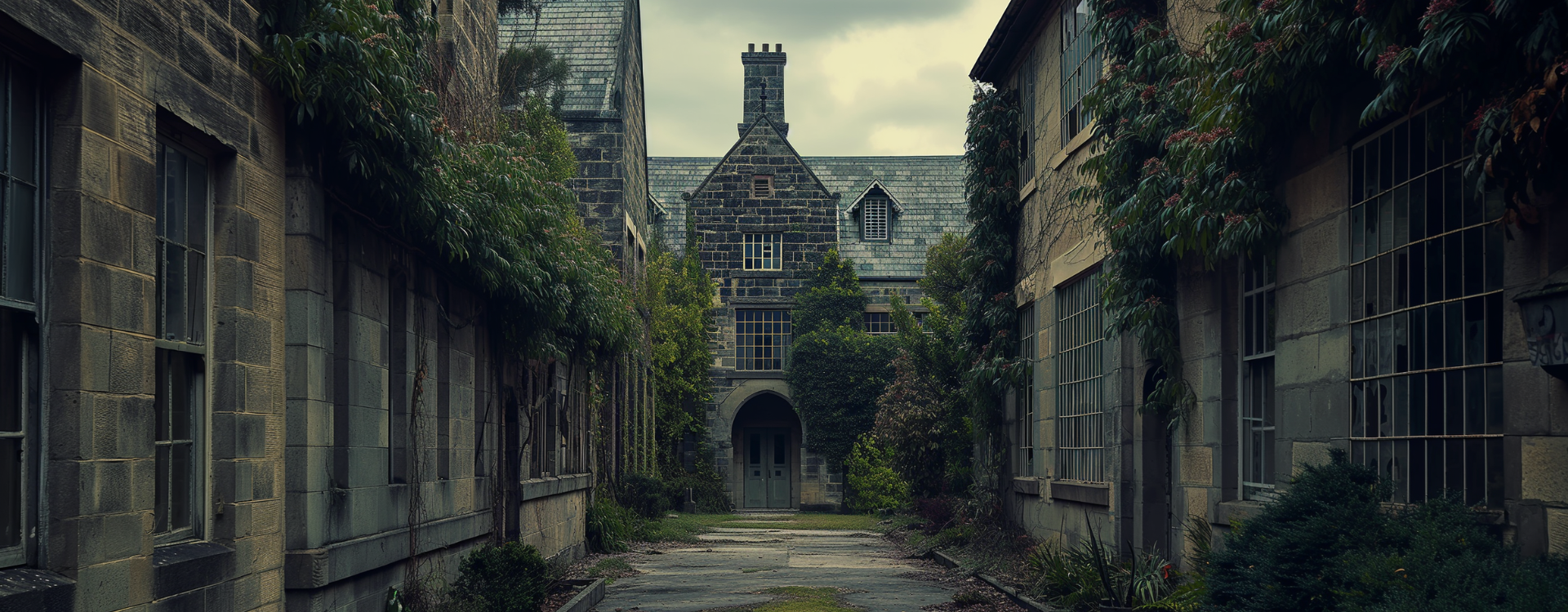
New Norfolk Asylum, New Norfolk
New Norfolk Asylum, established in 1827 on the banks of Tasmania's Derwent River, served as the colony's principal mental health institution for over a century. Built initially as a modest sandstone facility under Governor George Arthur's directive, the asylum evolved through periods of harsh Victorian treatment, progressive reform, and eventual transformation into modern psychiatric care. Its most notorious chapter involved Rita Larkin's 1842 commitment and mysterious 1844 disappearance from a locked room, adding supernatural mystery to its already troubled legacy.
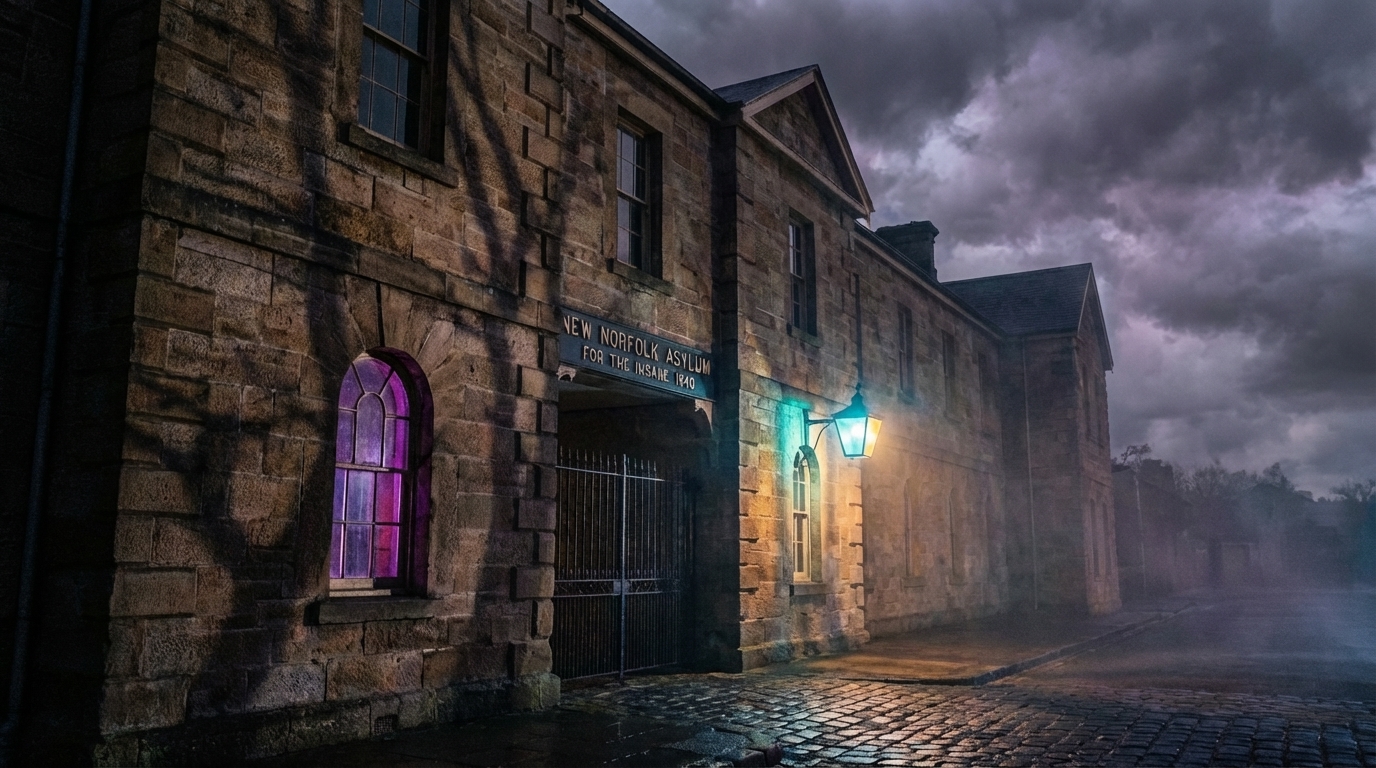
Colonial Necessity and Foundation
In the winter of 1827, as Van Diemen's Land struggled to manage its growing population of convicts, settlers, and the inevitable casualties of colonial hardship, Governor George Arthur authorised construction of a dedicated institution for the mentally afflicted. The site selected lay on the outskirts of New Norfolk, the colony's third-oldest settlement, positioned some thirty-two kilometres northwest of Hobart Town along the Derwent River. The location offered practical advantages—sufficient distance from the capital to isolate disturbing influences whilst remaining accessible for supply transport and official inspections.
The first building, christened Arthur House in honour of the governor who ordered its construction, rose from locally quarried sandstone cut by convict labour under the supervision of colonial architect John Lee Archer. The structure embodied the austere philosophy that governed early nineteenth-century attitudes towards mental illness: a two-storey rectangular edifice with narrow, heavily barred windows, thick walls designed to muffle sound, and internal arrangements that prioritised containment over comfort. The initial capacity accommodated twenty patients—or "inmates," as contemporary documentation invariably designated them—in wards that featured bare stone floors, simple wooden cots, and virtually no decoration beyond what functional necessity demanded.
The asylum's first superintendent, Dr Thomas Abernathy, arrived from Edinburgh in 1826, bringing with him the medical orthodoxies of Scottish institutional psychiatry. A man approaching his fortieth year when he assumed his posting, Abernathy possessed a stern countenance and rigid bearing that patients and staff alike found intimidating, yet those who worked closely with him recognised genuine dedication beneath his severe exterior. He believed absolutely in the therapeutic value of routine, discipline, and what he termed "moral regulation"—a philosophy that justified strict schedules, limited stimulation, and frequent use of physical restraints to prevent patients from acting upon dangerous impulses or disturbing the institution's order.
Under Abernathy's fifteen-year superintendency, the asylum established patterns that would persist for decades. Patients rose at dawn, attended to ablutions under supervision, consumed simple meals at precise hours, engaged in assigned tasks when their conditions permitted, and retired to locked wards at dusk. Those deemed manageable worked in gardens, laundries, or workshops; those considered dangerous remained in isolation cells whose dimensions barely permitted standing with outstretched arms. Abernathy maintained meticulous records, his neat handwriting filling ledgers with observations about individual patients' behaviours, treatments administered, and outcomes—death being recorded with the same clinical detachment as recovery or transfer.
Expansion and the Gardens
By the mid-1830s, Van Diemen's Land's mental health demands had exceeded Arthur House's capacity several times over. Additional wings extended from the original structure in 1834 and 1838, creating a sprawling complex that could accommodate nearly eighty patients whilst maintaining the rigid separation between male and female wards that Victorian propriety demanded. The expansion brought new treatment rooms, additional isolation cells, and expanded workshops where patients deemed suitable manufactured simple goods—brooms, baskets, rope—under staff supervision.
Yet perhaps the asylum's most significant development came in 1836 with the establishment of extensive therapeutic gardens under the direction of Samuel Whittaker, a horticulturalist who had arrived in the colony five years earlier with impeccable references from estates in Devon. Whittaker understood that working with soil and growing things offered psychological benefits that confinement in stone wards could never provide, and he convinced Dr Abernathy—then in his final years of service—that supervised garden work might reduce the violent episodes and melancholic deterioration that plagued so many long-term patients.
The gardens eventually covered nearly three acres, arranged in formal beds that displayed both ornamental flowers and practical vegetables. Patients selected for garden duty worked under Whittaker's watchful supervision, their activities closely monitored to prevent escape attempts or self-harm with the implements necessary for cultivation. The work proved remarkably therapeutic for many, providing purpose, routine, and tangible evidence of accomplishment as seeds became plants, plants bore flowers or food, and the landscape itself transformed through their efforts. Whittaker maintained the gardens until his death in 1867, after which a succession of less talented head gardeners struggled to sustain his vision.
Reform and the Braithwaite Era
The appointment of Dr Eleanor Braithwaite as superintendent in 1863 marked a watershed moment in the asylum's history, though not all the changes she instituted proved immediately successful or universally welcomed. At thirty-seven years old, she became one of the first female physicians to hold such a position anywhere in the British Empire, having trained in Edinburgh and London before emigrating to Tasmania with her sister in 1861. Her selection provoked considerable controversy—colonial newspapers questioned whether a woman possessed sufficient authority to manage violent male patients, whilst some staff members resented answering to female leadership.
Yet Braithwaite arrived with progressive ideas influenced by European reforms that were gradually transforming mental health treatment. She had studied the work of Philippe Pinel in France and William Tuke in England, both advocates of "moral treatment" that emphasised kindness, occupation, and minimal restraint over harsh punishment. During her nine-year tenure, she introduced numerous innovations: a small library stocked with appropriate reading matter, art materials for patients showing creative inclinations, occasional musical evenings where those capable could perform or listen, and most controversially, a dramatic reduction in the use of chains, straitjackets, and isolation cells.
The reforms met resistance from staff accustomed to older methods and from some patients' families who believed that leniency encouraged dangerous behaviours rather than suppressing them. A vocal faction of Hobart Town physicians publicly questioned Braithwaite's competence, suggesting that her gender made her too sympathetic towards patients whose conditions required firm masculine authority. The controversy reached its peak in 1868 when a male patient briefly escaped during an unsupervised garden period, though he was recovered within hours having done no harm. The incident provided ammunition for Braithwaite's critics, and despite her achievements in reducing mortality rates and improving overall conditions, she resigned under pressure in 1872, returning to England where she continued medical practice until her death in 1891.
The Hawthorne Darkness
Dr Charles Hawthorne's appointment as superintendent in 1873 represented a stark reversal of Braithwaite's progressive philosophy. A physician in his early fifties who had previously managed an institution in Yorkshire notorious for its severe disciplinary regime, Hawthorne believed that mental illness stemmed from moral weakness and lack of will, conditions best addressed through rigorous routine, strict obedience, and, when necessary, physical interventions that discouraged inappropriate behaviours through discomfort or incapacitation.
Under his twenty-three-year administration, the asylum reverted to Victorian grimness. Restraints returned to common use, isolation cells filled once more, and treatments emphasised control over comfort. Hawthorne embraced emerging theories about hereditary mental deficiency that were gaining traction in psychiatric circles, theories that would eventually contribute to the eugenics movements of the early twentieth century. He became particularly interested in surgical interventions, and whilst the lobotomy procedures that would later become infamous were not yet developed during his tenure, he experimented with other physical treatments whose efficacy remained unproven and whose effects on patients were frequently devastating.
The asylum's atmosphere during these years grew fearful and oppressive. Staff members who questioned Hawthorne's methods found themselves dismissed, patients who complained faced punitive measures, and families who expressed concerns about treatment received assurances that their relatives' conditions necessitated approaches that outsiders might misunderstand as harsh. The mortality rate climbed, though official records attributed deaths to natural progression of mental diseases rather than to treatment complications or neglect.
It was during Hawthorne's superintendency that the asylum's most enduring mystery unfolded. Rita Mabel Larkin, committed in 1842 during the previous superintendent's tenure, had remained a patient for twenty-three months when, on 10 November 1844, she vanished from a locked and barred room on the second floor of the women's ward. Staff discovered her absence during morning rounds, finding the door still locked from the outside, window bars intact, and no evidence suggesting how a sixty-five-year-old woman had escaped what should have been an inescapable chamber.
The investigation that followed proved perfunctory. Hawthorne's official report concluded that Rita must have somehow secured assistance from sympathetic staff members who helped her escape, though no evidence supported this theory and interrogations of all personnel yielded nothing. Searches of the surrounding countryside found no trace, and after several weeks, authorities concluded she had likely perished in the wilderness. Yet the incident added a layer of supernatural speculation to the asylum's already troubling reputation, with staff and patients alike whispering that the building itself harboured mysteries beyond medical explanation.
Twentieth-Century Transformation
The dawn of the new century brought gradual shifts in psychiatric understanding that eventually filtered through to even conservative institutions like New Norfolk Asylum. Hawthorne's death in 1896 removed the primary obstacle to reform, and his successor, Dr Harold Pennington, arrived in 1907 with commitments to newer treatment philosophies emerging from continental Europe.
Pennington had studied with early psychoanalytic practitioners in Vienna and returned to Britain convinced that mental illness originated not from moral failing but from psychological conflicts requiring patient exploration and resolution rather than forcible suppression. His appointment raised eyebrows amongst Tasmania's medical establishment, yet by 1907 the asylum's reputation had deteriorated sufficiently that authorities welcomed anyone willing to attempt improvements.
His reforms proceeded cautiously but steadily. Physical restraints diminished once more, though never entirely disappearing. Therapy sessions replaced punitive isolation. The gardens, which had fallen into neglect, received renewed attention as therapeutic spaces. Pennington established regular staff training programmes, emphasising observation and patience over immediate disciplinary responses. Mortality rates declined, instances of violent episodes decreased, and families began reporting that their institutionalised relatives seemed less traumatised by confinement.
Yet perhaps the most significant transformation came not from administrative policy but from medical innovation. The introduction of the first effective psychotropic medications in the 1950s revolutionised treatment possibilities. Patients whose conditions had previously required permanent institutionalisation could now manage symptoms sufficiently to contemplate eventual release. By the early 1960s, the facility had officially redesignated itself as New Norfolk Mental Health Hospital, reflecting the philosophical shift from custodial containment towards active treatment and rehabilitation.
The Garden's Dark Revelation
In April 1923, during routine spring planting in the therapeutic gardens, several patients working under staff supervision unearthed human bones buried approximately two feet beneath the soil in what had been one of Samuel Whittaker's original formal flowerbeds. The discovery prompted an immediate investigation that eventually located remains from at least seven individuals, all buried without markers or official documentation.
The subsequent inquiry revealed uncomfortable truths about the asylum's past. The remains dated primarily to the 1870s and 1880s—the Hawthorne era—and appeared to be patients who had died under circumstances that officials had deemed insufficiently significant to warrant proper burial in the asylum's small cemetery. Whether the burials represented deliberate concealment of treatment-related deaths or simply callous disposal of bodies deemed unworthy of formal interment remained unclear, though the investigation uncovered documentation suggesting both factors contributed to different cases.
The scandal briefly made national news, prompting questions in Tasmania's parliament about asylum oversight and historical accountability. Yet by 1923, all individuals directly responsible had been dead for years, and authorities settled on enhancing oversight for current operations rather than pursuing retrospective justice for victims whose identities, in most cases, could no longer be definitively established. The bones received proper burial in the asylum cemetery with a memorial stone acknowledging "unknown patients interred without ceremony, remembered in death if not honoured during life."
Decline, Closure, and Preservation
The deinstitutionalisation movement that swept through Western mental health systems during the 1970s and 1980s gradually reduced New Norfolk's patient population. New medications allowed many individuals to manage conditions in community settings with outpatient support. Changing philosophies emphasised the least restrictive treatment environments, favouring small group homes and community programmes over large institutional complexes.
By 1990, the facility housed fewer than fifty patients, most requiring intensive care that community resources could not adequately provide. Yet the aging buildings, many dating to the mid-nineteenth century, required extensive renovations to meet modern standards. After considerable debate, authorities decided that constructing a new, purpose-built facility elsewhere made more sense than attempting to modernise the historic but problematic New Norfolk complex.
The asylum officially closed as an active medical facility in 2001, with remaining patients transferred to newly constructed facilities near Hobart. The fate of the empty buildings sparked considerable discussion. Some advocated demolition, viewing the structures as monuments to outdated and often cruel treatment philosophies. Others argued for preservation as historically significant architecture documenting Tasmania's social history, however uncomfortable that history might be.
Preservation advocates ultimately prevailed. In 2005, after extensive renovations addressing safety concerns whilst maintaining historical integrity, the site reopened as a museum and cultural centre. The restored wards, gardens, and administrative buildings now welcome visitors interested in understanding the evolution of mental health treatment, the institution's role in colonial and modern Tasmania, and the countless individuals whose lives intersected with the asylum across nearly two centuries.
Legacy and Remembrance
New Norfolk Asylum stands as a testament to humanity's evolving understanding of mental illness and appropriate responses to psychological suffering. Its sandstone walls witnessed both cruelty and compassion, rigorous punishment and genuine attempts at healing, neglect and dedicated care. The institution embodied the attitudes of successive eras: Victorian certainty about moral discipline, progressive reformers' hopes for humane treatment, mid-century optimism about medical solutions, and contemporary recognition that mental health care requires ongoing vigilance against both institutional indifference and well-intentioned but misguided interventions.
Visitors exploring the preserved wards encounter stories of individuals like Rita Larkin, whose mysterious disappearance reminds us that some questions about the asylum's history resist definitive answers. The restored gardens, where bones once surfaced to reveal uncomfortable truths, now offer peaceful spaces for reflection on how societies treat their most vulnerable members. The administrative records, archived and accessible to researchers, document both progress and failure across generations of superintendents, staff, and patients.







