Neptune (Transport Ship)
The Neptune was a government-contracted transport ship that carried convicts and free settlers from England to the Australian colonies during the early nineteenth century. Built in the Blackwall shipyards on the Thames around 1802, she was a substantial three-masted vessel of approximately 520 tons, larger than many of her contemporaries in the transportation trade. In January 1811, the Neptune departed London carrying convicts bound for New South Wales and a small number of free passengers destined for Van Diemen's Land—among them Martha Taylor, a recently widowed London woman seeking a new life in the colonies. The voyage marked the beginning of Martha's transformation from grieving clerk's wife to one of colonial Tasmania's most capable business administrators.
Construction and Design
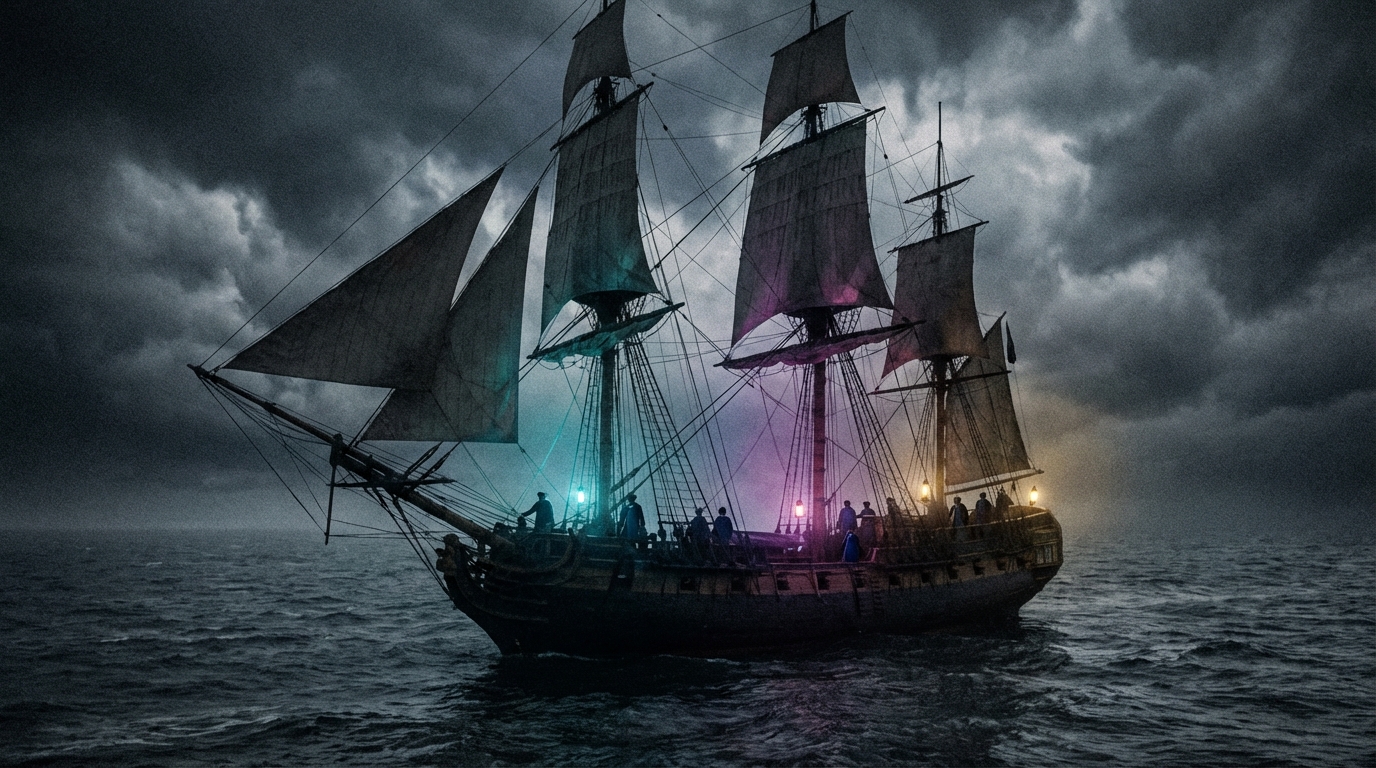
The Neptune was constructed in the Blackwall shipyards on the Thames in 1802, built to a design that prioritised cargo capacity and seaworthiness over speed or elegance. Her hull was broader than most vessels of her class, giving her stability in heavy seas at the cost of manoeuvrability; her three masts carried a full complement of square-rigged sails that could drive her through all but the most contrary winds. At approximately 520 tons burden, she was among the larger vessels employed in the transportation trade, capable of carrying upward of 250 convicts alongside the crew, soldiers, and free passengers that completed her typical complement.
Her holds had been configured specifically for the convict trade—divided into sections by iron gratings, fitted with sleeping platforms that allowed bodies to be stacked in tiers, ventilated by wind sails that provided inadequate circulation in the sweltering tropics. The conditions were brutal by any civilised measure, but they were also typical of the era; the Neptune was neither better nor worse than most transport ships, merely one of many vessels that carried the human cargo upon which colonial labour depended.
The free passenger accommodations occupied the stern section of the ship, separated from the convict decks by multiple barriers both physical and social. These cabins were small but private, offering bunks, basic furnishings, and access to the quarterdeck where passengers could take fresh air and exercise. The passengers shared a common mess, ate food prepared in the ship's galley, and existed in a strange limbo—neither crew nor cargo, suspended between the world they had left and the world that awaited them.
The 1811 Voyage
The Neptune departed London on 8th January 1811 under the command of Captain Robert Sinclair, a Scottish mariner who had spent fifteen years in the colonial shipping trade. Her manifest listed 234 convicts (189 male, 45 female), 38 soldiers of the New South Wales Corps, and 19 free passengers bound for Sydney and Hobart Town. Among the latter was Martha Taylor, a thirty-two-year-old widow who had buried her husband eighteen months earlier and exhausted her options for respectable employment in London.
Martha had secured her passage through the assisted emigration scheme that sought to populate the colonies with skilled and respectable settlers. Her references—from the parish of St Mary-le-Bow, from former employers, from the widow of her husband's superior at the Boulton and Watt works—testified to her character and capabilities. The scheme paid her passage in exchange for a commitment to remain in the colony for at least five years, a condition that troubled her not at all; she had no intention of returning to England and the memories it held.
The voyage tested Martha in ways she had not anticipated. Confined to small quarters with strangers, subject to the ship's routine and the captain's authority, she found herself adapting to circumstances that would have been unimaginable in her London life. She volunteered to assist the ship's purser with passenger records, demonstrating an aptitude for administration that caught Captain Sinclair's attention. She also helped nurse fellow passengers through bouts of seasickness and fever, earning gratitude and connections that would prove valuable upon arrival.
The Neptune made steady progress through the Atlantic, rounding the Cape of Good Hope in early April without encountering the savage storms that plagued many vessels on that passage. The crossing of the Indian Ocean brought oppressive heat and the threat of scurvy, but Captain Sinclair maintained strict adherence to the dietary provisions that prevented the disease's worst ravages. By late May, the coast of New South Wales had risen on the horizon, and the Neptune was threading her way toward Sydney Heads.
Arrival and Aftermath
The Neptune reached Sydney Cove on 2nd June 1811, her convicts disembarking to begin their sentences while the free passengers made arrangements for their onward journeys. Martha remained in Sydney for three weeks, securing passage to Hobart Town aboard a coastal vessel and gathering what intelligence she could about conditions in Van Diemen's Land.
She arrived in Hobart Town in late June 1811, stepping onto the wharf at Sullivan's Cove with a single trunk of possessions, a handful of letters of introduction, and a determination to build a life that did not depend on the charity of relatives or the precarious position of a widow without means. Within weeks, she had secured employment in the household of Samuel Hartley, a merchant whose trading house offered the combination of respectability and opportunity she sought.
The Neptune herself continued in colonial service, completing three more voyages to New South Wales before being transferred to the India trade in 1816. Her later career took her to Calcutta, Madras, and the ports of the East Indies, carrying goods rather than convicts, her holds reconfigured for cargo that did not require chains or guards. She was lost in a typhoon off the coast of Java in 1823, going down with all hands in circumstances that were never fully explained.






