4075.104 · April 14, 1755 AD
Needle and Nerve
Elspeth Stewart arrives at Edinburgh's most prestigious fashion house to begin an apprenticeship that could save her struggling family from ruin. But as she crosses the threshold of Moira MacKenzie's Emporium, she quickly realises that silk and secrets are woven together in equal measure—and discretion may prove as vital a skill as any stitch.
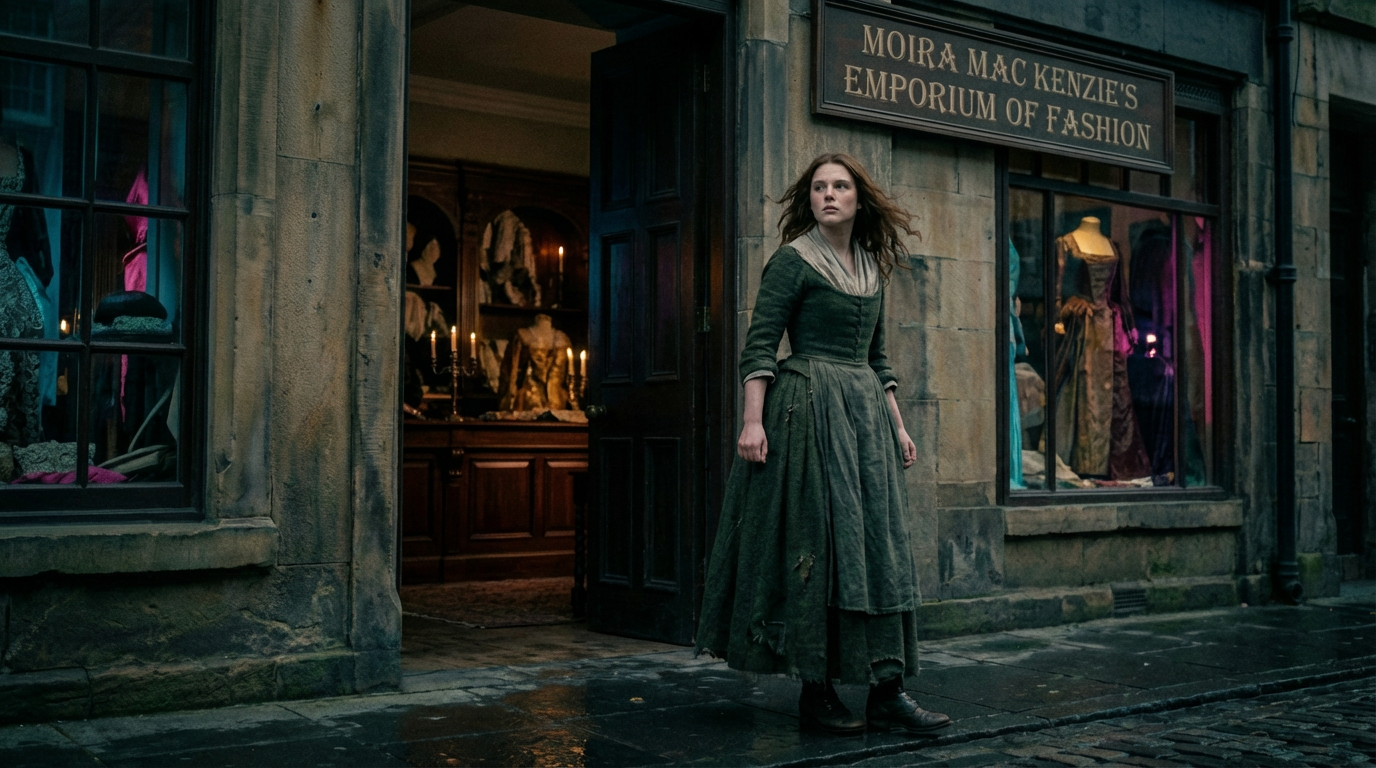
"My father taught me that a Stewart faces what lies ahead with shoulders square and chin raised. He neglected to mention that sometimes what lies ahead has storm-grey eyes and knows rather too much about everyone."
The day dawned grey and blustery, a chill wind sweeping through the cobbled streets of Edinburgh with an insistence that spoke of winter's lingering grip. It was the sort of morning that seemed to whisper of secrets and hidden dangers—a fitting backdrop, I thought, for a city steeped in centuries of intrigue. Above me, the Old Town rose in its familiar labyrinth of narrow wynds and towering tenements, standing sentinel over the awakening city, its weathered stones holding fast against the relentless passage of time.
For me—Elspeth Stewart, a lass of merely seventeen summers—this day was unlike any I had known before. As I made my way through the winding streets, my heart thudded with a potent mixture of anticipation and trepidation. The rough cobblestones beneath my feet were slick with the previous night's rain, forcing me to tread carefully lest I slip and soil my best dress—a modest affair of dark green wool that had seen better days but was the finest I owned. With each step, the worn soles of my boots caught against the uneven stones, as if the very city conspired to hold me back from my destination.
The weight of responsibility pressed heavily upon my young shoulders. It had been less than a year since my father, Angus Stewart, had been taken from us—a cruel twist of fate that had left our family reeling. I could still recall the day with painful clarity: the urgent knock at the door, the grim-faced men bearing news of an accident at the smithy. The memory came unbidden even now—the acrid scent of smoke that had clung to the messengers' clothes, the hollow sound of my mother's keening that had echoed through our modest home for days afterwards. In an instant, our world had shattered, leaving my mother, Morag, a widow with four daughters to feed and clothe.
As the eldest, I had shouldered much of the burden. I had watched my mother's face grow gaunt with worry, the once-vibrant woman seeming to fade like a watercolour left too long in the sun. I had heard her muffled sobs late at night when she thought her children were asleep, the sound piercing my heart more keenly than any blade. Our household, once filled with laughter and the warmth of familial love, now seemed to echo with the ghosts of happier times—my father's booming laugh now just a phantom in the corridors of my memory.
My thoughts turned to my sisters as I walked. Effie, thirteen and already showing signs of the beauty she would become, her golden hair and bright eyes drawing attention that would soon turn from innocent to something else entirely. Katrina, eleven and full of a quiet determination that sometimes reminded me painfully of our father—the set of her jaw when faced with adversity so like his that it made my breath catch. And little Violet, just nine, with her perpetual questions and flower-like fragility, still too young to fully comprehend the gravity of our situation. They were the reason I pushed forward, the reason I had swallowed my pride and sought out this opportunity at Moira MacKenzie's Emporium of Fashion.
As I rounded a corner, the wind caught my shawl, nearly tearing it from my shoulders with spectral fingers. I clutched it tighter, my knuckles white with cold and determination. The streets were beginning to fill with the early morning bustle—bakers carrying steaming loaves that sent tendrils of yeasty warmth into the bitter air, fishwives with their baskets of herring calling out their wares in voices roughened by years of similar cries, and gentlemen hurrying to their businesses, coat collars turned up against the chill, pocket watches clutched in gloved hands as if they could command time itself.
I could not help but notice the sidelong glances some cast my way, their eyes taking in my threadbare cloak and patched shoes with a mixture of pity and disdain. I lifted my chin, refusing to be cowed by their scrutiny. Let them look, I thought defiantly, my spine straightening despite the cold that seemed to seep into my very marrow. They knew nothing of my struggles, nor of the steel that had been forged in the crucible of my grief.
My destination loomed before me: the Emporium, a name that carried weight in the circles of Edinburgh's elite. The reputation of the establishment had reached my ears long before I had ever laid eyes upon it, whispered about in hushed tones by ladies of quality and servants alike. It was said to be a place where dreams were woven into reality, where the finest fabrics from across the Empire—silks from Cathay, cotton from India, wool from the Highlands—were transformed into garments of such beauty that they could make a plain woman shine like a diamond and a handsome man appear positively regal.
But it was not merely the Emporium's creations that had captured the imagination of Edinburgh society. At the heart of every rumour, every whispered conversation, was the enigmatic figure of Moira MacKenzie herself. A woman of striking beauty and razor-sharp intellect, Moira was said to command attention without uttering a single word, her very presence casting a spell over those around her. Her reputation preceded her: a discerning eye that could spot the smallest flaw in a piece of fabric from across a crowded room, a memory that never failed to recall a customer's preferences down to the shade of ribbon they had admired three seasons past, and a talent for discretion that made her the keeper of Edinburgh's most closely guarded secrets.
Some said she knew which wealthy merchant was on the verge of ruin before even he did, which lady of society was carrying a child that could not be her husband's, which politician was accepting bribes from foreign powers. Such knowledge, whispered the gossips, was power—and Moira MacKenzie, for all her smiles and courtesies, was not a woman to be trifled with.
As I approached the shop, I paused to take in the sight before me. The Emporium was a grand structure, its façade an impressive blend of Georgian elegance and subtle opulence that set it apart from the surrounding buildings. Tall windows, framed by intricately carved stone, offered tantalising glimpses of the finery within. Dresses of silk and lace were artfully displayed on mannequins that seemed to regard the outside world with an air of aloof indifference, as if they knew the secrets that lay hidden behind the Emporium's walls. Their painted faces, though inanimate, appeared to follow my movements with knowing eyes, silently judging whether I was worthy to cross the threshold.
Above the door, a carved sign hung proudly, its gilded letters proclaiming "Moira MacKenzie's Emporium of Fashion" to all who passed by. The gold leaf caught what little sunlight managed to break through the overcast sky, winking at me as if sharing in some private jest. I wondered briefly how many others had stood where I now stood, hearts racing with similar hopes and fears, before entering a place that might change the course of their lives.
I hesitated at the entrance, my fingers brushing the cold, wrought-iron handle. The metal was worked into an intricate pattern of thistles and roses, beautiful yet thorned—much like the opportunity that awaited me within. The wind tugged at my shawl, threatening to unravel the careful arrangement of my hair—a style I had practised for hours the night before, my arms aching from being held above my head as I twisted and pinned until every strand was in place, wanting desperately to make the best impression possible.
For a brief moment, I considered turning back, retreating to the safety of the familiar. The thought of returning home, of spending another day in the quiet emptiness that had filled our household since my father's passing, sent a shiver down my spine that had nothing to do with the chill in the air. I could almost see the disappointment in my mother's eyes, the questions in my sisters' faces. "Did you not even try?" they would ask, though perhaps not aloud.
No. I could not afford to let fear hold me back now. Not when this apprenticeship could be the key to my family's future, a chance to lift myself, my mother, and my sisters out of the genteel poverty that had become our lot since my father's debts had come to light. With a deep breath that did little to calm my nerves, I squared my shoulders and pushed open the door. The threshold before me seemed more than mere wood and stone—it was the boundary between the life I had known and the secrets that awaited within Moira MacKenzie's domain.
The bell above the door chimed softly as I stepped inside, its delicate tinkle immediately swallowed by the rich silence that pervaded the Emporium. It was as if I had crossed a threshold into another world entirely, one far removed from the bustling streets and harsh realities of life in Edinburgh's Old Town. The door closed behind me with a gentle thud that seemed to seal my fate.
The air within was warm and heavy with the scent of lavender and beeswax, mingled with the faint aroma of freshly pressed linen. These familiar scents, reminiscent of laundry day in my own home, provided a small measure of comfort amidst my growing nervousness. But there was something else beneath those homely smells—a hint of exotic spices and foreign lands that spoke of the far-flung origins of the fabrics lining the shelves. Cinnamon, perhaps, and something else I could not quite place—a mysterious fragrance that seemed to whisper of distant shores and untold stories.
My eyes widened as I took in the sheer splendour of the place. Garments hung from polished wooden racks, each piece a masterpiece of craftsmanship that put my own carefully mended dress to shame. Silk in shades of emerald, sapphire, and ruby shimmered in the soft light filtering through the windows, their colours so vivid that they seemed almost alive, as if they might ripple and flow like water at the slightest touch. Lace veils, delicate as spiderwebs after a morning dew, lay draped over mannequins' shoulders, their intricate patterns telling stories of patience and skill passed down through generations of nimble fingers. Bonnets adorned with feathers and ribbons were displayed on shelves as if they were the crowns of royalty, each one a work of art in its own right, testament to the imagination and artistry that dwelt within these walls.
The floorboards creaked slightly underfoot, a subtle reminder of the building's age and the countless footsteps that had passed through these halls over the years. Each board seemed to speak of secrets long held—whispers trapped in the grain of the wood, waiting to be released. I wondered briefly about the stories these old boards could tell—of ladies trying on gowns for grand balls where political alliances were formed and broken over champagne and candlelight; of gentlemen selecting waistcoats for duels at dawn, perhaps their final adornment before meeting their maker; of whispered conversations and clandestine meetings hidden behind the rustle of fine fabrics, where fortunes were won and lost on the turn of a card or the promise in a glance.
For a moment, I felt overwhelmed by it all, a sensation not unlike standing at the edge of a precipice, looking down into depths I could not fathom. How could I, a simple girl from a modest background, ever hope to belong in such a place? The fine clothes and elegant surroundings seemed to mock my very presence, whispering that I was an interloper, a pretender reaching above my station. The mannequins appeared to stare with their painted eyes, as if they could see through my pretence to the uncertainty that lay beneath.
I thought of my sisters. Effie, who dreamt of fine dresses and balls, whose eyes would sparkle at the sight of such finery. Katrina, who preferred books to baubles, who would likely be searching for the stories behind each garment rather than admiring their beauty. And little Violet, who still played with rag dolls, who would probably be more enchanted by the ribbons and buttons than the finished creations they adorned. What would they think of this place, so far removed from our humble home with its darned linens and chipped crockery?
But before doubt could take root like a weed in fertile soil, a voice called out to me from the back of the shop, clear and commanding, cutting through my thoughts like a blade through silk.
"Miss Stewart, I presume?"
I turned, my heart leaping into my throat, to see Moira MacKenzie emerging from a doorway behind the counter. The woman before me was every bit as striking as the rumours had suggested—tall and poised, with a regal bearing that belied her relatively young age. She moved with the grace of a cat, each step deliberate and assured, as if the very ground should be honoured to bear her weight. Her dark hair, glossy as a raven's wing, was swept up into a neat chignon, not a strand out of place despite the blustery day beyond the shop's walls. She wore a gown of deep blue silk that seemed to shimmer like the sea at twilight, its cut both fashionable and flattering without being ostentatious. The fabric whispered with each movement, a secret language of luxury that I had never before heard so clearly.
But it was Moira's eyes that captured my attention and held it fast, like a butterfly pinned to a collector's board. They were grey, the colour of storm clouds gathering on the horizon, and just as full of portent. Those eyes missed nothing, I realised, feeling as if every secret I had ever held was being laid bare under that penetrating gaze. There was something almost unnatural about their clarity, about the way they seemed to pierce through flesh and bone to see the soul beneath. In that moment, I understood why so many of Edinburgh's elite both sought Moira's services and feared her judgement.
"Yes, madam," I replied, dipping into a polite curtsey that I hoped appeared more graceful than it felt. My knees trembled slightly, betraying my nervousness, though whether from the intensity of Moira's scrutiny or the enormity of what this opportunity represented, I could not say. My voice sounded small and uncertain in the hushed atmosphere of the shop, and I silently cursed myself for it. Clearing my throat, I added with more conviction, "Thank you for the opportunity. I am eager to begin."
Moira nodded, her expression unreadable as she assessed me. A slight tilt of her head, a narrowing of those remarkable eyes—these were the only indications that she was forming judgements, cataloguing impressions that would determine my fate within the Emporium's hallowed walls.
"You are punctual, at least," she said, a hint of approval in her tone that warmed me like a sip of hot tea on a cold morning. "That is a quality I value highly in my employees. It speaks to a sense of responsibility and respect for others' time."
I felt a small surge of pride at the words. It was not effusive praise by any means, but from what I had heard of Moira MacKenzie, even this small acknowledgement was significant, like a rare bloom in a winter garden. I thought of my father, who had always stressed the importance of timeliness and hard work. "A Stewart is never late," he used to say, his eyes twinkling with good humour as he fastened his pocket watch to his waistcoat each morning. The memory brought a lump to my throat, thick and painful, but I forced it down. Now was not the time for sentiment; now was the time for strength.
"Come with me," Moira continued, turning on her heel in a swirl of blue silk. "I shall show you to your station and explain your duties."
I followed her through the shop, my heart still pounding as we passed by rows of exquisite garments. Each step felt like a journey deeper into a world I had only dreamt of, a world of beauty and refinement that had always seemed just out of reach, like stars glimpsed through a city's haze. I could not help but imagine how my sisters would react to such finery—Effie would be in raptures, no doubt, her hands itching to touch every fabric, to hold each trinket to the light; whilst Katrina might scoff at the extravagance, though even she would be hard-pressed to deny the craftsmanship evident in every stitch. Violet, bless her innocent heart, would probably be more interested in playing hide-and-seek amongst the dress racks, her giggles echoing through the solemn quiet of the shop.
As we walked, I noticed something odd, a discordant note in the perfect harmony of the Emporium. There was a tension in the air, a sense of watchfulness that seemed at odds with the serene atmosphere of the shop. I caught glimpses of other employees—a young man with nimble fingers arranging cravats with mathematical precision, an older woman measuring fabric with eyes that seemed to count each thread—all of whom appeared to be paying just a little too much attention to Moira's progress through the shop. Their eyes flicked towards us, then away just as quickly, as if afraid of being caught staring. It reminded me of the way prey animals in the fields beyond the city would freeze at the shadow of a hawk passing overhead—a stillness born not of peace but of wariness.
We made our way to a small workroom at the back of the shop, tucked away behind a heavy velvet curtain the colour of dried blood that muffled the already quiet sounds from the front. The curtain parted at Moira's touch, revealing a space both more intimate and more industrious than the showroom we had left behind. The room was dominated by a large table, its surface scarred and stained from years of use, bearing the marks of countless projects—rings left by cups of tea, small burns from irons heated too high, ink spots from pattern-making. Around it stood several chairs, each one occupied by a woman bent intently over her work, as if the very act of creation required not just their hands but their entire beings.
The quiet click of needles and the soft rustle of fabric filled the air, punctuated occasionally by murmured conversations too low for me to make out—words exchanged like secrets, half-heard and quickly forgotten. The light streaming through a high window cast patterns across the scene, illuminating particles of dust that danced in the air like tiny stars in a secret constellation.
The walls were lined with shelves, each one laden with bolts of fabric in every colour imaginable, from the palest cream to the deepest midnight blue, arranged with a precision that spoke of a mind valuing order above all else. Ribbons and lace were neatly arranged in drawers, their labels written in a flowing script that I recognised as the same hand that had penned my letter of acceptance—elegant yet authoritative, much like the woman herself. Scissors, pins, and other tools of the trade were meticulously organised, everything in its proper place, as if the very idea of chaos was anathema in this temple of creation.
The room smelt faintly of soap and starch, with undertones of wool and silk. It was a comforting scent, reminiscent of long afternoons spent helping my mother with the mending, of stories told over the rhythm of needle and thread. But there was an energy here that I had never experienced before—a sense of purpose and creativity that seemed to hum in the very air, an almost palpable current of possibility that made my fingertips tingle with anticipation.
"This is where you shall spend most of your time," Moira said, gesturing to an empty chair at the far end of the table. The seat seemed both a promise and a challenge, a place to be earned rather than merely occupied. "You will begin by assisting my seamstresses. Your tasks will be menial at first—pressing fabrics, threading needles, and ensuring that everything is kept in order. But if you prove yourself capable and trustworthy, you may earn the privilege of working on more important projects."
I nodded, feeling both relieved and determined. I had expected no less, and was prepared to work my fingers to the bone if that was what it took to prove my worth. This was not merely employment; it was the beginning of my journey, a chance to learn a trade that could support my family for years to come, a skill that could not be taken from me as so many of our possessions had been when my father's debts were called in. I thought of my mother, worn down by grief and worry, the lines around her eyes deepening with each passing month; and my sisters, growing up too quickly in the shadow of our father's death, their childhood games giving way to practical concerns far too soon. This was for them, as much as for myself—a lifeline thrown into the turbulent waters of our circumstances.
"Yes, madam," I replied, my voice steadier now, drawing strength from the thought of those I loved. "I understand, and I am prepared to work hard and learn all that I can."
Moira's expression softened almost imperceptibly, a flicker of something—approval? amusement? recognition of a kindred spirit?—passing through her eyes like lightning through storm clouds. "That is a commendable attitude, Miss Stewart. But remember, in this business, hard work is only part of the equation. You must also cultivate discretion and a keen eye for detail. Our clients trust us not only with their appearances but often with their secrets as well."
There was something in Moira's tone, a hint of something unspoken, that made my skin prickle with awareness, tiny hairs standing on end as if before a lightning strike. I sensed that there was more to this warning than mere business practice, that the secrets held within these walls went beyond the usual gossip and scandal of high society. For a moment, I wondered if I was stepping into something far more complex—and potentially dangerous—than I had anticipated, like a swimmer who realises too late that what appeared to be a gentle current is in fact a riptide, pulling her towards depths unknown.
"I understand, madam," I said carefully, meeting Moira's gaze with a steadiness that surprised even myself. "You can trust in my discretion. I know the value of keeping one's own counsel." I thought of the secrets I already kept—the true extent of my family's financial troubles, which even my mother did not fully comprehend; the nights I had gone to bed hungry so that my sisters might have a little more on their plates; the tears I had shed in private, where no one could see my momentary weakness. Yes, I understood the importance of discretion all too well. Secrets were like stitches—they held the fabric of life together, and if one came undone, the whole garment might unravel.
Moira held my gaze for a long moment, as if searching for something in my eyes—doubt, perhaps, or fear, or deception. Whatever she saw there—or did not see—seemed to satisfy her, for she nodded once, decisively, like a queen bestowing a royal decree.
"Very well, Miss Stewart. Welcome to the Emporium. Agnes here will show you where to store your things and get you started on your first tasks." She gestured to a middle-aged woman with kind eyes the colour of honey and work-roughened hands that spoke of years of dedication to her craft. "I trust you will make the most of this opportunity."
With that, Moira turned and left the workroom, the velvet curtain swishing closed behind her with a finality that felt somehow significant, as if one chapter had ended and another begun. The other women in the room, who had fallen silent upon their employer's entrance, frozen in place like figures in a tableau, slowly resumed their work, though I could feel curious glances being cast my way, some welcoming, others more guarded.
Agnes approached with a warm smile that crinkled the corners of her eyes, her manner putting me slightly more at ease. There was something motherly about her, a sense of practical kindness that reminded me of my own mother before grief had etched its permanent mark upon her.
"Well then, lass, let's get you settled. There's a peg for your shawl just there, and you can keep your personal items in this drawer here." She indicated a small drawer built into the underside of the worktable, its brass handle worn smooth by countless hands before mine. "Now, don't be bringing anything valuable, mind. We're all honest folk here, but it's best not to tempt fate."
As Agnes showed me around the workroom, explaining the organisation system with patient thoroughness and introducing me to the other seamstresses—Martha with her spectacles perched on the end of her nose; Jane, whose fingers were stained with indigo; Elizabeth, who hummed quietly as she worked; and several others whose names blurred together in my overwhelmed mind—my thoughts kept returning to my sisters, to my mother, to the small house in Canongate where they waited for news of my first day.
I took my seat at the worktable and picked up my first task—sorting a tangled mass of silk threads into their proper colours, a rainbow in disarray. The threads were finer than any I had worked with before, slipping through my fingers like whispered promises. Scarlet, gold, cerulean, violet—each one catching the light from the high window, each one worth more than I cared to calculate.
My hands, I noticed, had stopped trembling.
The work was simple enough, requiring patience rather than skill, and as I separated strand from strand, I allowed myself to breathe. I was here. I had crossed the threshold. Whatever mysteries this place might hold, whatever secrets lurked behind Moira MacKenzie's storm-grey eyes, they could wait. For now, there was only this: the soft whisper of silk between my fingers, the quiet industry of the women around me, and the faint, impossible hope that I might actually belong here.
Somewhere in the shop, the bell above the door chimed as a customer entered. The sound seemed to come from very far away, from another world entirely—the world I had left behind when I stepped through that door this morning.
I bent my head over my work and continued sorting threads, one colour at a time.







