Natalia Novak (née Blackstone)
Natalia Novak, born Blackstone in Melbourne in 1955, was a leading commercial Queen's Counsel and the third generation of a Victorian legal dynasty. She married the Czech surgeon Mikhail Novak in Prague, brought him home to Melbourne in 1985, and built a formidable practice at the Owen Dixon chambers. Mother of the art collector Julia, she was a brilliant, glacial cross-examiner who tried to argue her daughter out of art, and ended estranged from both the child and the mother whose verdicts she could never appeal.
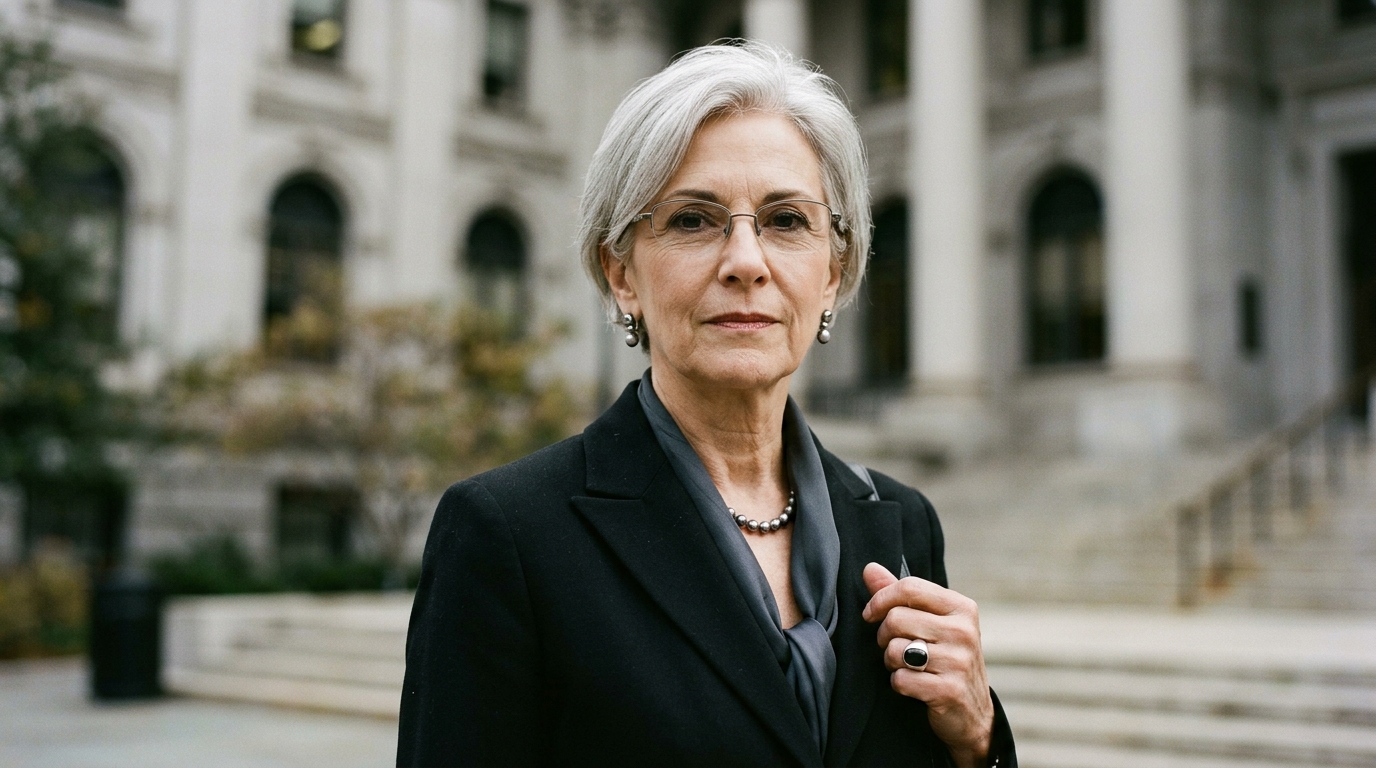
The Third Generation
Natalia Blackstone was born on the 22nd of March 1955 in Melbourne, into a family that had practised the law for as long as anyone in it could remember. Her grandfather, Edmund Blackstone, had been among the first of the name to sign the Victorian bar roll; her father, Hugh Blackstone, took silk before he was fifty and went onto the Supreme Court bench while Natalia was still a schoolgirl, so that she grew up understanding the law not as a career a person might choose but as the weather the Blackstones simply lived inside.
The house in South Yarra ran on the rhythms of the courts — the terms and the long vacations, the briefs spread across the dining table on a Sunday, the particular hush that descended when her father was writing a judgment and the whole household arranged itself around his concentration. To be a Blackstone was to be told, gently and constantly and without anyone ever quite saying it aloud, that one's opinions had better be reasoned and one's reasoning had better hold.
Her father, knighted in the early 1970s, became Sir Hugh, and her mother became Lady Blackstone, and somewhere inside that elevation a person disappeared. Elena, Lady Blackstone — born Elena Hartley — had come to the marriage a painter of real promise, a young woman who had shown at a respectable gallery or two before the wedding and then, by a logic nobody in that world thought to question, had folded her gift away into the duties of a judge's wife. The brushes went into a drawer. What was left was a clever, restless, faintly disappointed woman who arranged the flowers and chaired the auxiliary and watched her own daughter with an attention Natalia would not understand for another sixty years.
There was an elder brother, Lawrence, born in 1951, on whom the dynasty's expectations had naturally first settled, and who turned out to possess no forensic instinct whatever — a genial, easy, unbookish boy who drifted comfortably into stockbroking and a life at Portsea and was a mild, lifelong disappointment to his father without ever being troubled by the fact. The law, when it came to be carried at all, would be carried by the daughter, and nobody had planned for that, least of all the daughter.
Family Tree
The Daughter With the Forensic Mind
She was schooled at Merton Hall, among the daughters of the establishment she had been born into, and she was from the beginning the kind of pupil who unsettled her teachers a little — not because she was difficult but because she was right, and knew it, and could say precisely why. She had her father's gift exactly: the ability to find the load-bearing point of any argument and put her whole weight on it. What in a son would have been received as the family birthright was, in a daughter of the 1960s, regarded as a faintly alarming surplus, a brilliance for which the world had not yet decided there was a use.
She read law at the University of Melbourne and took it the way other people took a vocation, which is to say without visible doubt. By the time she signed the bar roll at the end of the 1970s she had already settled on the harder road — not the solicitor's office but the bar itself, the cab-rank and the brief and the exposure of standing on her feet before a hostile bench with nowhere to hide.
The bar she entered was very nearly a closed shop of men, and it received her with the elaborate, smiling discouragement of an institution that had no rule against women and no intention of making them welcome. She read with a senior silk who took her on partly, she always suspected, for the pleasure of her father's gratitude, and she learned in those first years to be twice as prepared as the men around her and half as easy to rattle. The Blackstone name opened the door of her chambers; everything past the door she did herself.
She built her practice in the unglamorous, lucrative country of commercial and corporate litigation — contracts and companies, shareholders at each other's throats, the long grinding disputes where fortunes turned on a clause and a witness's nerve. It suited her precisely. There was no sentiment in it, only structure, and she was better at structure than almost anyone. Solicitors learned that a brief to Blackstone came back annotated to the margins, every weakness in their own case flagged before the other side could find it, and that the politeness with which she demolished an opponent's expert in cross-examination was somehow more frightening than another barrister's anger would have been.
Prague
In the early months of 1983 she took a season in Europe — the kind of restorative interval an ascending junior could still permit herself before the practice closed over her entirely — and somewhere in the middle of it she came to Prague. She was twenty-seven, certain of herself, travelling alone and enjoying it, and at a dinner arranged by an acquaintance she was seated across from a Czech cardiothoracic surgeon some sixteen years her senior, a contained, exact, faintly forbidding man named Mikhail Novak.
What happened between them was not, on either side, the ordinary business of falling in love. It was recognition. Each had spent a lifetime being the most formidable person in most rooms, and each saw at once that the other was the rare exception, and the relief of it — the relief of not having to make oneself smaller, or warmer, or more easily understood — was, for two people built as they were built, very nearly the most romantic thing that could happen to them.
The courtship ran across the Iron Curtain, by letter and by the occasional fraught and monitored telephone call, a correspondence between two people almost alarmingly alike. Her mother watched it with a wariness Natalia took at the time for ordinary maternal caution and understood much later to have been something nearer to recognition — Elena, who had married into a great cold house and lost herself in it, looking at the cold, brilliant man her daughter had chosen and seeing a pattern she had no power to interrupt. Natalia married Mikhail in 1984, and the following year she brought him home to Melbourne, where she meant to take silk and build the practice that was always going to be the centre of her life, and where he would have to begin his own again from nothing. That he was willing to was, to her, the proof of him.
Silk
The marriage was a true one and it was never, by any conventional measure, a warm one, and that was not its failure but very nearly its design. Natalia had grown up watching her mother dissolve a real and particular gift into the role of a suitable wife, diminished by increments inside a respectable marriage until almost nothing of the original woman remained. She had resolved, without ever putting it into words, that this would not be done to her — and so she had chosen, with a clear eye, a husband who would never once ask her to be less than she was, who had no warmth to demand of her in return, and who left her wholly free to be the formidable thing she had always intended to become. It was, on its own terms, a kind of love, and it held for forty years.
Through the late 1980s and the 1990s she rose steadily at the Victorian bar from a respected junior to a leader of the commercial list, briefed in the largest corporate disputes the state could produce, the kind that ran for months and turned on her capacity to hold an entire architecture of fact in her head and never once let a thread go slack. She took silk in 2001, Natalia Novak QC, one of the relatively few women of her vintage to do so, and from her chambers at Owen Dixon she became, over the following decade, one of the names solicitors reached for when the sum in dispute had too many zeros to risk on anyone less certain.
She wore her success the way she did everything, without display and without apology. She was tall, composed, and immaculate, and she had cultivated a courtroom manner of such glacial precision that opposing counsel learned to dread the moment she rose slowly to her feet and said, in a tone of almost tender reasonableness, that she had just a few questions. Outside the law she collected — Australian contemporary painting, chosen with the same discernment she brought to a brief — and it was over acquisitions that she and Mikhail conducted what passed, in that household, for passion, the two of them arguing the merits of a canvas with a heat they brought to almost nothing else.
The Mother Who Argued
Children had been deferred, sensibly, until the practice stood on bedrock, and so it was not until the 15th of August 1993, when Natalia was thirty-eight, that her only child was born at the Epworth — a daughter, Julia Anastasia. Natalia approached motherhood as she approached everything, as a thing to be done thoroughly and well, and for some years she was in fact the warmer of the two parents, the one who negotiated and bargained and found the workable compromise where Mikhail simply withdrew into silence.
When the small Julia announced that she would paint rather than practise the violin, it was Natalia who brokered the truce — lessons permitted, so long as the marks stayed exceptional — and Natalia who, for a while, seemed to her daughter the more reachable of the two.
But the reachability had a floor under it, and the floor was the assumption, never seriously examined, that the painting was a phase and the real life would be medicine or the law. As Julia grew and the phase stubbornly refused to end, Natalia did the one thing she knew how to do supremely well: she argued. The family dinners curdled, by degrees, into hearings. She cross-examined her daughter's choices with the forensic skill that had unmade better-defended witnesses than a teenage girl — found the soft places in Julia's reasoning, pressed them, demanded that she justify a life in art against a standard of seriousness Natalia had spent her whole career defining.
She believed, entirely sincerely, that she was saving her daughter from a small and precarious future. It never once occurred to her that there is no cross-examination that ends with the witness loving you, and that a child argued with is a child who learns, in the end, only how to leave.
Her Mother's Brief
Sir Hugh died in 2003, and Elena, widowed at last and released from the role that had swallowed her, did a thing in her long final years that Natalia knew nothing about until it was too late to answer. The old woman — the painter who had given it all up — quietly took the side of the granddaughter who had not. Elena went to Julia's small exhibitions under names that were not her own, followed the girl's progress with a fierce secret pride, and decided, somewhere in that watching, that her own surrendered life was to be redeemed in this one.
When Elena died on the 4th of March 2018, the will revealed what the living woman had concealed. She had left her entire estate — a substantial portfolio and the Armadale house — not to her daughter the QC but directly to her granddaughter the collector, untouchable and unconditional, with a letter telling Julia to live the artistic life she herself had not.
For Natalia it was the one verdict in her life she had not seen coming and could not contest. The cross-examiner had been handed, from beyond reach of any reply, her own mother's secret brief — the finding that Natalia had become precisely the kind of person for whose comfort Elena had sacrificed her art, and that the wild, impractical girl was the redemption and the formidable daughter the cautionary tale. There was no appeal from it and no one left to argue with. She absorbed it the way she absorbed everything, behind a composure that gave nothing away, and she did not speak of it, and the rupture it opened with Julia never afterwards closed.
The Name on the Door
By the early 2020s the wheel had come, it seemed, very nearly full circle. After four decades at the bar Natalia's name had begun to be spoken — discreetly, in the careful way these things are spoken — in connection with an appointment to the Supreme Court of Victoria, the very court on which her father had sat, the completion of a dynasty that had waited three generations for its judge. She had wanted the bench more than she had let anyone see. It would have been the last argument won.
It did not survive her daughter. In the early months of 2023 the Novak name broke into the Melbourne papers in connection with a death in the far outback — a remote gallery, a vanished sculpture, a murder investigation, and Julia among those under suspicion — and the discreet conversations about the bench simply stopped, as Natalia had known they would the moment she saw the first headline. A judicial appointment cannot survive that kind of proximity to scandal, and she did not waste energy pretending otherwise.
What she did instead was protect the one thing she had built entirely herself. Quietly, without announcement, the name Novak came off her professional listings and her door, and she practised again as Blackstone, the name reverting across a single weekend to the dynasty it had always belonged to, the marriage and the daughter sealed off from the chambers as cleanly as a redaction. It was, in its way, the exact counterpart of her husband's statement through his hospital — two formidable people, faced with the wreck of their child, each instinctively saving the institution that had defined them, neither able to do the one thing the child might have needed, which was simply to be stood beside.
The Verdicts She Could Not Appeal
And so she came into her seventies as one of the most accomplished women her profession had produced, and as a woman holding the two judgements of her life that had gone against her, both delivered by people who had loved her and neither of them open to reply. Her mother had found her wanting; her daughter had fled her; the bench she had earned across forty years had evaporated in a single news cycle on account of a child she could no longer reach.
The dynasty that had carried the law for three generations ended, in effect, with her — the brother's line scattered into comfortable irrelevance, her own line narrowed to a single estranged daughter facing trial with no intention of carrying anything Blackstone into the future at all.
She remained in the glass house on Albany Road with Mikhail, the two of them growing old together among his Czech modernists and her Australian canvases, two people who had built an immaculate life with no soft place anywhere in it and had produced, between them, the one wild and unmanageable thing that immaculate life could not survive. Natalia had spent her whole career proving that a sufficiently rigorous argument could carry any room. She had been right about that for forty years, in every room but the two that mattered, and she lived out her days in the cool, ordered, beautifully reasoned silence of a woman who had finally met the cases she could not win.







