Mycenaean Funerary Mask
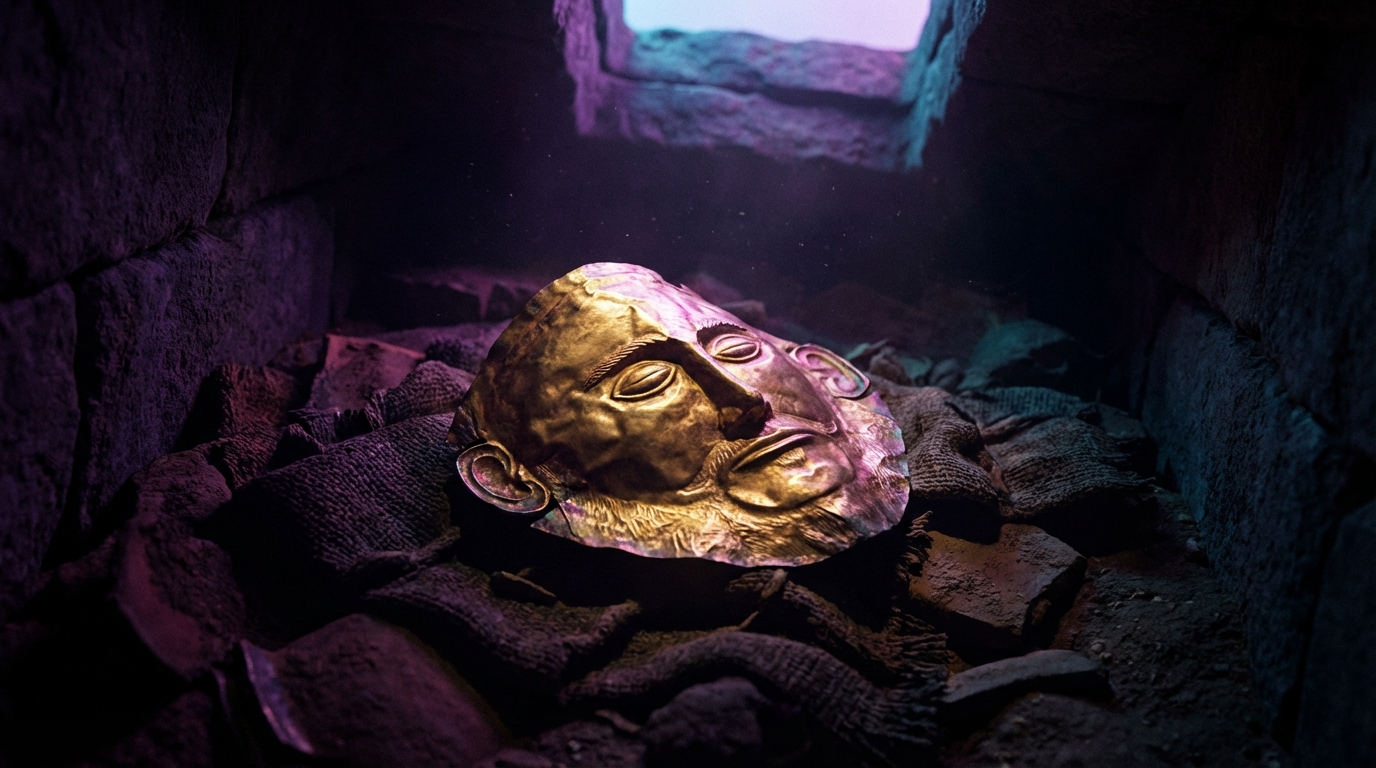
A gold death mask hammered from a single sheet of high-purity gold, this funerary piece was crafted for the burial of a Mycenaean nobleman interred in a shaft grave near the citadel of Mycenae in 1497 BC. Depicting the idealised features of the deceased with open eyelids and a close-trimmed beard, the mask predates the wider world's knowledge of Mycenaean civilisation by decades — Schliemann's famous excavations did not begin until 1876.
Description
The mask is formed from a single sheet of gold, hammered over a wooden form to produce a three-dimensional representation of a human face. It measures approximately thirty-two centimetres in height and twenty-four in width, with a weight that suggests gold of exceptional purity — consistent with alluvial deposits from the rivers of the Peloponnese. The features are rendered with restrained naturalism: a straight nose extending from a smooth brow, closed eyelids incised with fine lines suggesting lashes, a firmly set mouth, and a short, squared beard worked in low relief.
Small perforations near the ears indicate that the mask was originally secured to the face of the deceased with cord or fine wire, following the Mycenaean funerary convention for high-status burials. The gold retains a warm lustre that appears to shift in quality depending on the angle of light — an effect produced by the hammering technique, which leaves microscopic variations in the metal's surface.
The mask's craftsmanship is of the highest order, displaying the refined metalworking skills that characterised the late shaft grave period at Mycenae. It belongs to the same tradition as the funerary masks later discovered by Heinrich Schliemann at Grave Circle A in 1876, though it originates from an unrecorded grave site and was never subjected to archaeological documentation.
Historical Setting
The mask was created on or around the 7th day of the third month of the harvest season, 1497 BC, at the citadel of Mycenae in the Argolid region of the Peloponnese, by a master goldsmith serving the ruling warrior aristocracy. The deceased — a nobleman of the Mycenaean elite whose name is not preserved — was interred in a shaft grave approximately three hundred metres south of what would later be designated Grave Circle A by modern archaeologists. The grave site, never formally excavated, was disturbed by agricultural activity in the early medieval period, dispersing its contents into local circulation.
The goldsmith who produced the mask worked within the palatial workshop system that supported Mycenaean elite burial practices during the Late Helladic I period (approximately 1550–1500 BC). These artisans were among the most skilled metalworkers in the Bronze Age Aegean, employing techniques of repoussé (hammering from the reverse), chasing (working the front surface), and incision to produce portrait masks of remarkable individuality. The tradition of gold funerary masks appears to have been unique to Mycenae, with no comparable practice documented elsewhere in the Bronze Age Mediterranean.
Provenance
The mask's history between its creation in 1497 BC and its arrival at Jeffries Manor in 1820 is necessarily fragmentary. Following the disturbance of its original grave site during the early medieval period, the mask entered a succession of private collections across the eastern Mediterranean. It was recorded in the possession of a Byzantine merchant family in Corinth in approximately 1185, passed through the hands of Venetian traders following the Fourth Crusade, and was documented in a Florentine private collection in 1507. It subsequently moved through the European antiquities market — appearing in inventories in Vienna (1689) and Paris (1774) — before being acquired by intermediaries in London connected to William Jeffries Sr.'s trading network. It arrived at Jeffries Manor in the spring of 1820, approximately one year before William Jeffries's disappearance, as compensation for services whose nature remains officially unrecorded.
The mask's significance was entirely unrecognised in 1821. The Mycenaean civilisation would not enter Western scholarly awareness until Heinrich Schliemann's excavations at Mycenae in 1876, fifty-five years after the mask was already hanging in a guest chamber at the edge of the known world. To any observer in 1821 — including Constable Broadmoor, who would later examine the Blue Room's contents — the mask would have appeared as an object of wholly unknown origin, its culture, period, and purpose entirely beyond identification.






