Morningside, Midlothian, Scotland
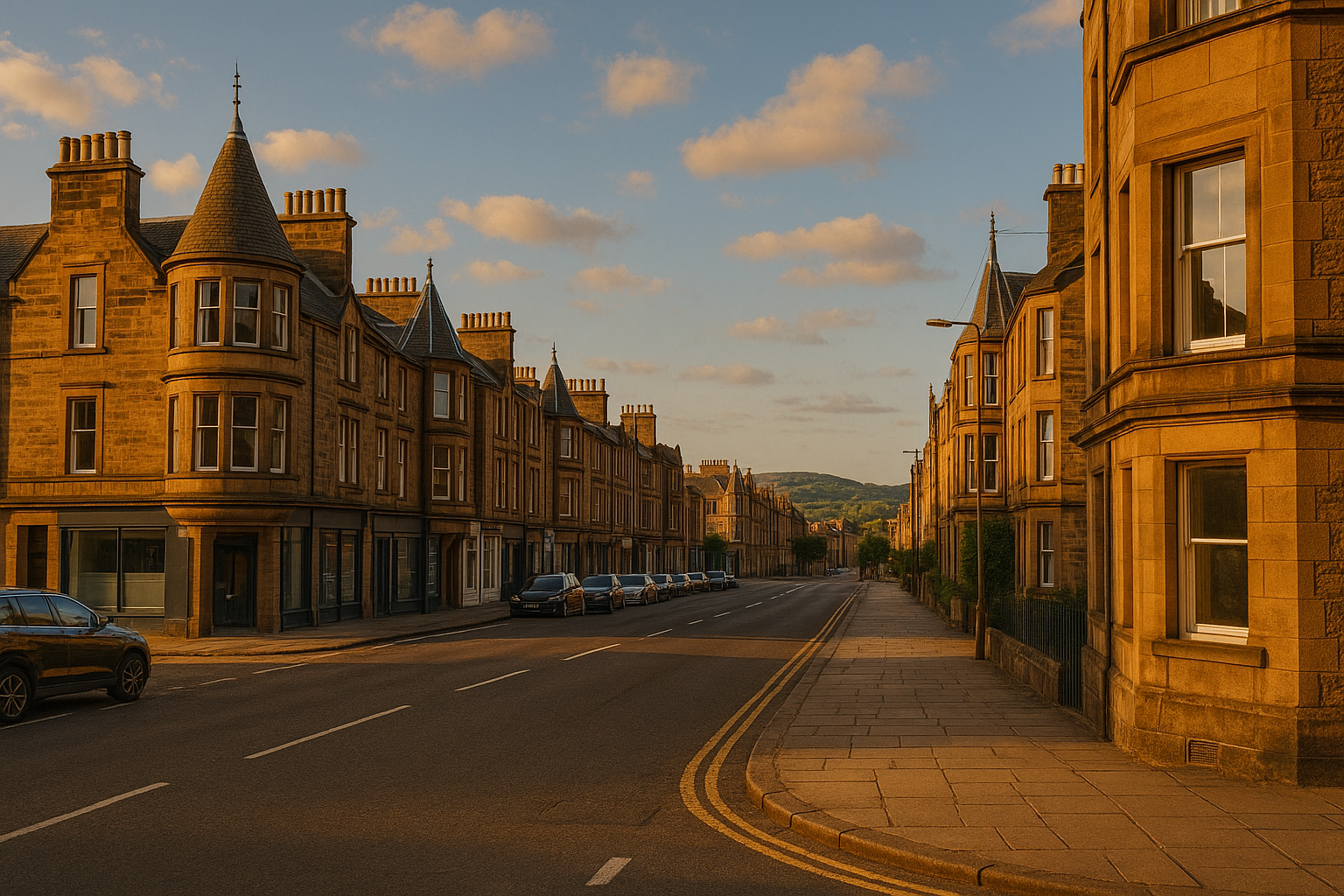
South of Edinburgh's Old Town, where Victorian terraces yield to the slopes of the Braid Hills, Morningside maintains the measured character of a village absorbed but never quite consumed by the city around it. Its tree-lined streets and sandstone façades shelter independent shops, quiet cafés, and the kind of community memory that accumulates across generations. Some families have called these streets home for longer than records easily trace.
Geography and Position
Morningside occupies Edinburgh's southern reaches, a suburb positioned where the city's dense urban fabric begins to loosen against the rising ground of the Braid Hills and Blackford Hill. The district extends roughly from the junction of Morningside Road and Colinton Road in the north to the edges of the Hermitage of Braid nature reserve in the south, bounded to the east by the playing fields of George Watson's College and to the west by the residential streets climbing towards Craiglockhart. This geography—approximately two square miles of mixed residential and commercial development—creates a self-contained community that functions as urban village despite formal incorporation into Edinburgh's administrative structure.
The terrain rises steadily from north to south, a gradual ascent that becomes more pronounced as streets approach the Braid Hills. This elevation provides many properties with views across Edinburgh towards the Firth of Forth, whilst the hills themselves offer accessible green space within walking distance of even the densest residential areas. The Hermitage of Braid, a wooded valley following the course of the Braid Burn, penetrates deep into the district's southern reaches, creating a ribbon of quasi-rural landscape that residents have protected across generations of development pressure.
The geological foundation beneath Morningside consists primarily of sedimentary rocks laid down during the Carboniferous period, with occasional volcanic intrusions from Edinburgh's dramatic geological past. Natural springs emerge at various points where water percolating through porous layers encounters impermeable strata, their reliable flow historically supporting both domestic use and commercial enterprise. The soil, derived from glacial deposits overlaying this bedrock, supports the mature gardens that characterise the district's residential areas—adequate for ornamental purposes without particular distinction, though certain properties have developed growing conditions exceeding what geology alone might predict.
Historical Development
Morningside's origins predate its absorption into Edinburgh, the name deriving from the Scots word for a slope facing the morning sun—an apt description of the district's eastern-facing hillside position. Documentary records from the fifteenth century mention the lands of Morningside as agricultural holdings supporting the Abbey of Holyrood, though settlement remained sparse until improved roads and Edinburgh's expansion created conditions for suburban development.
The transformation from rural backwater to desirable suburb accelerated during the eighteenth century as Edinburgh's professional classes sought residences combining rural character with reasonable proximity to the city's commercial and intellectual centres. The earliest substantial houses date from this period—Georgian villas set within generous grounds, their restrained classical proportions reflecting the era's architectural sensibilities whilst their thick stone walls acknowledged Scottish climatic realities. Several of these properties survive, though most have been subdivided or adapted to contemporary purposes that their original builders could not have anticipated.
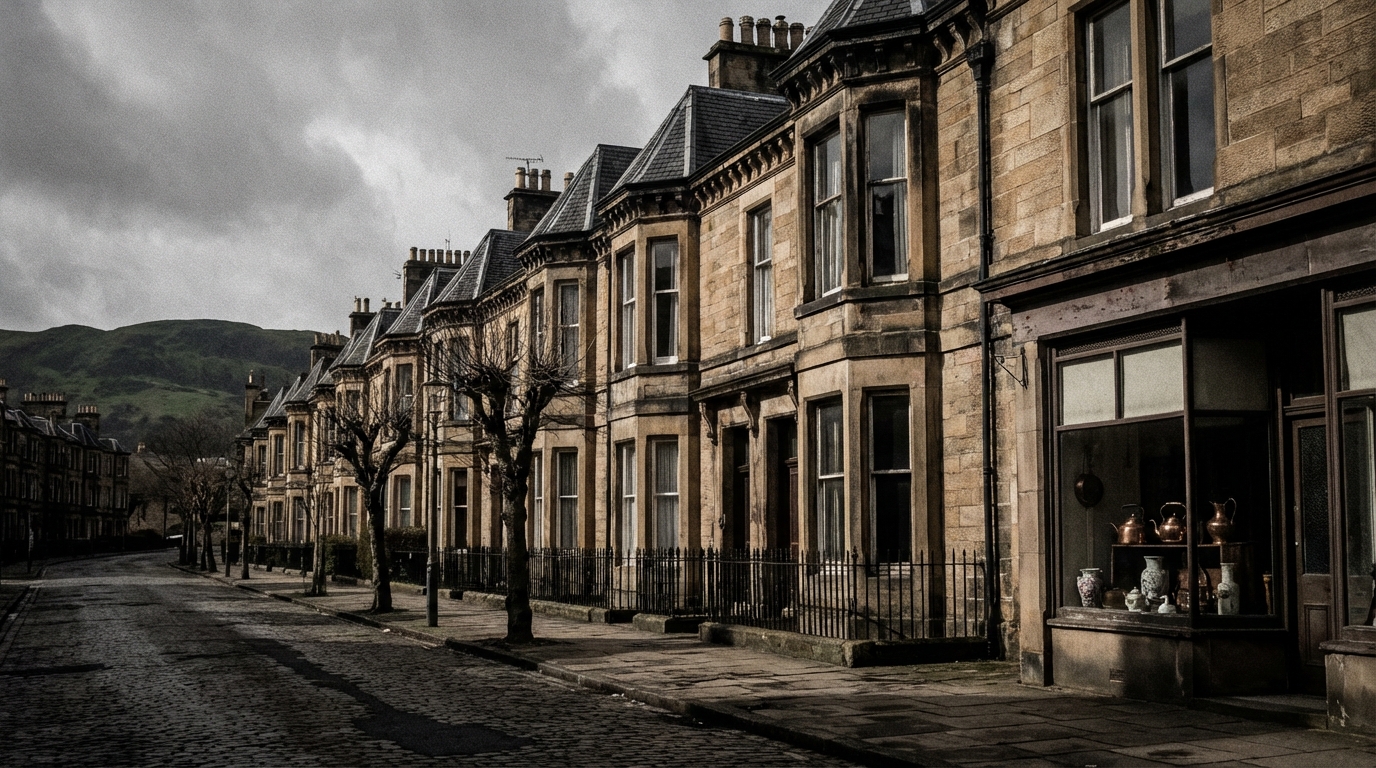
Victorian expansion reshaped Morningside more dramatically than any previous era. The arrival of horse-drawn tramways along Morningside Road in 1871, electrified in 1910, connected the district to Edinburgh's centre with unprecedented convenience, triggering rapid residential development. Speculators and builders transformed agricultural land into the terraced streets and villa plots that define Morningside's contemporary character. The architecture of this period—sandstone façades, bay windows, ornamental ironwork, slate roofs—established the visual vocabulary that subsequent development has generally respected.
Commercial premises clustered along Morningside Road itself, creating a linear high street serving the burgeoning residential population. Butchers, bakers, greengrocers, stationers, and the various other trades supporting Victorian domestic life established premises in purpose-built shop units with residential accommodation above. Some of these businesses have operated continuously across multiple generations, their survival reflecting both commercial acumen and the community loyalty that independent traders can cultivate in stable neighbourhoods.
The twentieth century brought consolidation rather than transformation. Morningside's desirability as a residential location ensured property values that discouraged demolition and redevelopment, preserving the Victorian and Edwardian streetscape whilst individual buildings underwent internal modernisation. The district acquired its contemporary reputation during this period—respectable, comfortable, perhaps slightly conservative, attractive to professionals and retirees seeking quality housing without ostentation.
Architectural Character
The built environment of Morningside demonstrates remarkable coherence despite construction spanning more than two centuries. Sandstone predominates, quarried historically from sites across central Scotland and selected for durability in Edinburgh's demanding climate. The stone weathers to varying shades of grey, cream, and occasionally pink depending on mineral composition, creating subtle variation within overall unity. Slate roofs, now often replaced with modern alternatives that approximate the original appearance, complete the traditional palette.
Along Morningside Road, commercial premises occupy ground floors beneath residential accommodation, their shopfronts reflecting successive eras of retail fashion whilst maintaining appropriate scale and proportion. The best examples preserve original features—carved stonework, decorative tiles, timber and brass fittings—that connect contemporary commerce to Victorian precedent. Even modern interventions generally respect established patterns, planning authorities and community pressure combining to discourage inappropriate development.
The residential streets branching from the main road display the hierarchy typical of Victorian suburban development. Larger detached villas occupy corner plots and elevated positions, their generous gardens and distinctive architectural details signalling the prosperity of original occupants. Terraced housing, built to more modest specifications but still constructed with care, accommodates the clerks, teachers, and tradespeople whose labour supported professional households. The boundaries between these categories blur in Morningside's gentle topography, creating mixed streetscapes where substantial properties neighbour more humble dwellings without obvious social demarcation.
Several properties merit particular attention for their departure from residential norms. Georgian manor houses, predating the Victorian expansion, occupy grounds that once extended across acres now subdivided into multiple plots. Their survival required adaptation—conversion to flats, institutional use, or the kind of careful family stewardship that preserves character whilst accommodating contemporary needs. The grounds of these older properties often contain outbuildings, greenhouses, and garden features reflecting centuries of accumulated development, their purposes evolving as successive generations found new uses for inherited infrastructure.
Churches punctuate the streetscape at intervals reflecting Victorian denominational diversity—Church of Scotland, Free Church, Episcopal, Catholic—their spires and towers creating vertical accents in the predominantly horizontal residential fabric. Several have found secular afterlives as the congregations that built them dwindled, their ecclesiastical architecture repurposed for community halls, residential conversion, or commercial use that preserves external appearance whilst transforming interior function.
The High Street
Morningside Road functions as the district's commercial spine, a continuous ribbon of shops and services extending roughly a mile from the junction with Colinton Road southward to the edge of more purely residential territory. The character shifts subtly along this length—denser commercial activity in the north where footfall benefits from proximity to bus routes and the broader city, transitioning to quieter stretches where residential use predominates over retail.
The composition of businesses reflects both Morningside's demographic character and broader trends in British retail. Traditional traders persist in surprising numbers—butchers who remember customers' preferences across decades, greengrocers maintaining relationships with local suppliers, pharmacies that function as informal community health resources. These survivors coexist with newer arrivals serving contemporary tastes—specialty coffee shops, organic grocers, yoga studios, and the various enterprises that cluster in affluent neighbourhoods.
Charity shops occupy multiple premises, their presence reflecting both the district's elderly demographic and the recycling economy that such populations support. The quality of donations in Morningside's charity shops exceeds average, a reflection of households clearing possessions accumulated across comfortable lifetimes. Browsers seeking vintage clothing, quality homewares, or simply good books at modest prices know to check Morningside's offerings regularly.
The café culture that has transformed British high streets finds particular expression in Morningside, where multiple establishments compete for customers seeking quality coffee, comfortable seating, and the indefinable atmosphere that transforms beverage service into social experience. Some occupy premises purpose-built for hospitality, whilst others have adapted spaces originally serving different functions—a former bank, a converted church hall, the ground floor of a Victorian villa. Each cultivates distinctive character whilst serving the common purpose of providing what sociologists term "third places"—locations neither home nor workplace where community forms through repeated casual encounter.
One establishment on a quieter stretch of Morningside Road warrants particular attention, though its significance extends beyond what casual observation might suggest. The Leaf & Bean Café occupies a ground-floor premises in a late-Victorian terrace, its large windows and warm interior creating the welcoming atmosphere that successful cafés require. The building housing it dates from the 1890s, part of the commercial-residential construction that lined Morningside Road during the district's rapid expansion. Yet the site's history extends further back—the premises previously housed an apothecary whose proprietor served the community from the 1930s until the mid-1950s, her expertise in traditional remedies and botanical preparations establishing a legacy that subsequent occupants have maintained in forms adapted to contemporary expectations.
Residential Character
The people who call Morningside home reflect patterns established across generations of selective migration. The district has long attracted those seeking residential stability—professionals establishing households, families requiring good schools and safe streets, retirees downsizing from larger properties elsewhere. Property values, consistently among Edinburgh's highest, ensure that residents possess either substantial income or the accumulated wealth that permits comfortable living without current earnings.
The demographic skews older than Edinburgh's average, a reflection of housing stock dominated by family-sized properties that empty nesters often retain rather than vacating for younger households. Long-term residence creates the kind of accumulated community knowledge that newcomers find simultaneously welcoming and impenetrable—neighbours who remember children grown and departed, shopkeepers who recall deceased spouses, the layered history that stable populations carry within living memory.
Professional occupations predominate among working-age residents—lawyers, doctors, academics, senior managers—though the shift towards remote work has diversified the district's daytime population beyond those whose employment requires physical presence elsewhere. Home offices occupy spare bedrooms and converted attics, their occupants emerging at intervals for coffee and the casual social contact that domestic isolation otherwise precludes.
Families with school-age children cluster around the district's educational institutions, proximity to George Watson's College and various primary schools influencing residential choices. The morning and afternoon school runs create predictable patterns of vehicular and pedestrian traffic, parents navigating the tension between educational aspiration and practical logistics. The schools themselves—private, state, and denominational—contribute to Morningside's character as a place where education matters, where children's futures warrant investment of time, money, and residential compromise.
The elderly population, substantial in absolute numbers and proportionally significant, maintains visible presence through patterns that younger residents might overlook. Morning walks follow habitual routes at predictable times, the same faces appearing at the same locations with regularity that creates informal surveillance—neighbours notice when expected appearances fail to materialise. Cafés and tearooms serve as informal social centres where those whose working lives have concluded find company, conversation, and the structured outings that combat domestic isolation.
Community Life
Morningside sustains community organisations reflecting both historical inheritance and contemporary initiative. The Morningside Heritage Association documents and advocates for the district's architectural and historical character, its membership drawn from residents who value preservation over development. The various churches maintain congregational life alongside broader community programming—coffee mornings, lunch clubs, youth activities—that serves residents regardless of religious affiliation.
The community council provides formal democratic representation within Edinburgh's governance structures, its meetings addressing planning applications, traffic management, and the various local concerns that engage civic-minded residents. Attendance fluctuates according to the controversies of the moment, but a core of committed participants ensures continuous attention to neighbourhood affairs.
Informal networks supplement these formal structures. Dog walkers know each other through repeated encounters in the Hermitage of Braid, their conversations creating community across boundaries that other social categories might enforce. Parents connect through schools and the activities that children's lives require—football clubs, music lessons, birthday parties—these connections sometimes outlasting the childhood relationships that initially prompted them.
The district's commercial establishments function as community infrastructure beyond their primary commercial purposes. Butchers who remember customers' preferences across decades become repositories of neighbourhood knowledge. Café proprietors observe patterns of presence and absence that might signal trouble requiring gentle intervention. The various relationships that repeated transaction cultivates create safety nets invisible to official structures but effective in their quiet operation.
Seasonal events punctuate the annual calendar with opportunities for broader community gathering. Christmas lights along Morningside Road, organised through commercial association and community council collaboration, create festive atmosphere whilst providing occasion for evening promenading. Summer fêtes in church grounds or the Hermitage of Braid attract families seeking entertainment that reinforces local identity. These events matter less for their specific content than for the community affirmation their repetition provides—Morningside marking time together, year after year, the participants changing gradually whilst the occasions persist.
Hidden Currents
Beneath Morningside's respectable surface flow currents that casual observation might miss entirely. The district's stability creates conditions where certain activities can persist across generations, shielded by the very respectability that makes them unlikely. Long-term residence creates accumulated knowledge that includes awareness of which questions not to ask, which peculiarities to overlook, which neighbours maintain practices best left unremarked.
The older properties scattered throughout the district—Georgian manors, substantial Victorian villas—often contain features invisible from the street. Cellars extend beyond what above-ground footprints might suggest. Outbuildings serve purposes their external appearance does not advertise. Gardens shelter greenhouses whose contents exceed ordinary horticultural interest. These properties have sheltered their secrets across multiple generations, their current occupants inheriting obligations alongside architecture.
The apothecary tradition that once flourished along Morningside Road has not entirely vanished, though its contemporary expressions differ from historical precedent. Certain establishments maintain expertise in botanical preparations that conventional pharmacology does not encompass, their knowledge passed through informal channels rather than academic credentials. Customers seeking such services know how to enquire without stating needs explicitly, the transactions conducted within relationships of trust that outsiders cannot easily penetrate.
The district's position on Edinburgh's southern edge creates proximity to the Braid Hills and the open country beyond—terrain where activities requiring privacy can occur without observation. Paths through the Hermitage of Braid connect to routes extending into the hills, their course known to those who have walked them across generations. What happens in those hills, what purposes those walks serve, remains knowledge shared among those with reason to know.
Certain families have called Morningside home for longer than easily traced, their presence woven into the district's fabric across centuries rather than merely generations. These families know each other, maintain connections that formal social categories might not predict, share understanding of histories that official records do not capture. Their children attend the same schools, their elders frequent the same establishments, their lives intersecting repeatedly in ways that appear coincidental but follow patterns too consistent for chance alone to explain.
The Present Moment
Morningside in the third decade of the twenty-first century displays the tensions characterising prosperous British suburbs throughout. Property values have escalated beyond what young families can readily afford, creating demographic pressures that threaten the generational continuity the district has historically sustained. The independent shops that define its character face competition from online retail and out-of-town supermarkets, their survival depending on community loyalty that cannot be assumed indefinitely.
Climate concerns have begun reshaping domestic and commercial practice—solar panels appearing on slate roofs, electric vehicles replacing petrol cars in driveways, gardens increasingly managed for biodiversity rather than purely ornamental effect. These changes accumulate gradually, individual decisions creating collective transformation that preserves Morningside's character whilst adapting it to circumstances its Victorian builders could not have imagined.
The events of April 2025 touched Morningside in ways that most residents perceived only as disruption without understanding cause. Emergency services responding to an incident on Braid Hills Drive, smoke visible from multiple locations throughout the district, subsequent investigations that seemed disproportionate to what neighbours understood had occurred. The official explanation satisfied those without reason to question it, whilst those who knew more maintained the discretion that has always characterised certain Morningside residents.
What was lost in that fire, what purposes the destroyed property had served, remains knowledge confined to circles whose membership does not advertise itself. The cottage that survived maintains minimal occupation, its caretakers neither inviting nor entirely discouraging neighbourly curiosity. The ruins themselves, screened by boundary walls and surviving woodland, gradually settle into the landscape as Edinburgh's weather works its patient transformation.
Life in Morningside continues much as it has for generations—shops opening, cafés serving, residents walking familiar routes through streets whose every detail they know without conscious attention. The district absorbs change as it always has, adapting whilst preserving the character that makes it distinctively itself. Whatever secrets it shelters remain sheltered, the respectability that makes them possible also making enquiry seem inappropriate.
The families who have always lived here continue living here, their children growing into the responsibilities their parents carried. New residents arrive, attracted by the same qualities that attracted their predecessors, gradually learning what Morningside offers and what it expects in return. The community persists, its continuity requiring nothing more dramatic than the accumulated decisions of individuals choosing, day after day, to make their lives in this particular place.







