Morag Stewart (née MacKenzie)
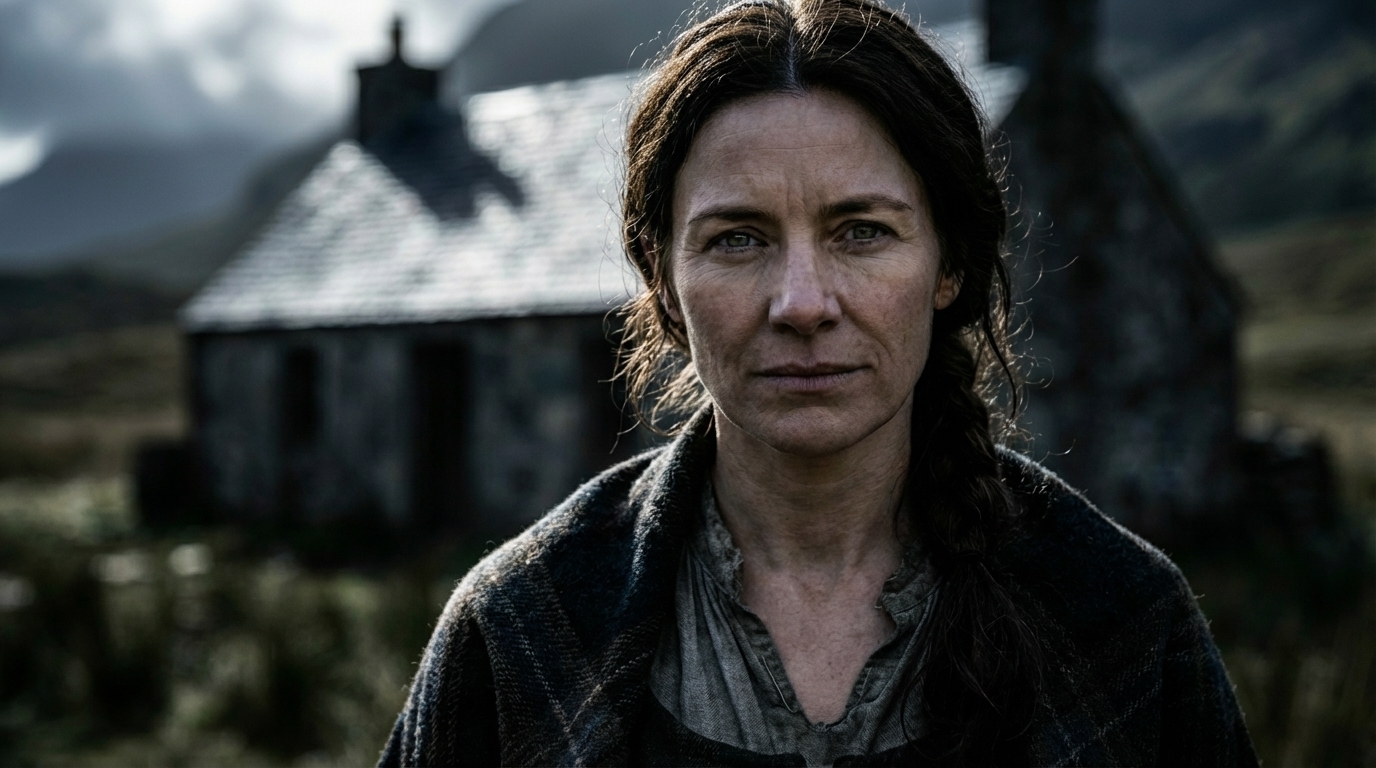
Born in Glenfinnan in 1716, Morag MacKenzie learned weaving from her father and compassion from her midwife mother before meeting a young blacksmith named Angus Stewart at a cattle fair in 1735. Their marriage produced four daughters who would become the founding Guardians of New Edinburgh—a destiny Morag never fully understood but supported with the quiet strength that defined her life. She survived her husband by thirty-six years, watching her girls transform from Edinburgh seamstresses into figures of legend, never knowing that Angus had fathered another child during their marriage. She died in 1790, her legacy woven into daughters who changed two worlds.
A Highland Daughter
Morag MacKenzie came into the world on 19 April 1716 in Glenfinnan, a small village at the head of Loch Shiel in the western Highlands. She was born just five months after the failure of the 1715 Jacobite Rising, into a Scotland still reeling from rebellion and its aftermath. The village where she drew her first breath would, three decades later, witness another Stuart prince raise his standard—but in 1716, Glenfinnan was simply home: a cluster of cottages nestled among some of the most dramatic scenery in Britain, where the rhythms of life followed the seasons and the traditions of generations.
Her father, Hamish MacKenzie, was a weaver whose skill with the loom had earned him respect throughout the region. The tartans he produced were known for their quality—tight weaves in colours drawn from the lichens and plants of the surrounding hills, patterns that carried the identity of clans and families in their very threads. His workshop, attached to their modest cottage, was filled with the clack of the shuttle and the earthy smell of wool, sounds and scents that would remain with Morag throughout her life.
Her mother, Fiona, was a midwife whose reputation extended across the glens. Women sent for her when their time came, trusting her steady hands and calm demeanour to bring their children safely into the world. Fiona had learned her craft from her own mother, and she brought to it not only practical skill but a gentleness that put labouring women at ease. From her, Morag inherited an instinct for nurturing—an ability to sense what others needed and provide it without being asked.
Morag was the third of five children, positioned in the middle of a household that was neither wealthy nor poor by Highland standards. Her elder brothers would eventually take over their father's trade; her younger sisters would marry into other families in the region. But Morag, from early childhood, seemed marked for something different—not extraordinary, perhaps, but distinct. She had her father's eye for pattern and colour, her mother's gift for patience and care. She moved through the world with a quiet competence that made others trust her.
The Weaver's Apprentice
By the time she was eight years old, Morag had begun learning the loom. Her father recognised her aptitude and took care to teach her properly, not merely the mechanics of weaving but the art that transformed wool and dye into something meaningful. She learned to read patterns, to understand how colours interacted, to feel when the tension was right and when it needed adjustment. The work was physical and demanding, but Morag found satisfaction in it—the way raw materials became finished cloth under her hands, the visible progress of each piece as it grew on the loom.
She also learned from her mother, accompanying Fiona on visits to expectant women in the surrounding villages. Morag was too young to assist with births directly, but she observed everything—the way her mother spoke to women in labour, the herbs she used to ease pain and prevent complications, the quiet confidence that seemed to flow from her presence. These lessons in care and compassion would shape Morag as profoundly as her father's instruction in craft.
The MacKenzies of Glenfinnan were part of a larger network of kinship that extended throughout the western Highlands. Morag grew up knowing her cousins, attending gatherings where families shared news and celebrated occasions together. Among these relations was another MacKenzie girl, Moira, born just seven months before Morag in the same village. The two were close in childhood—playing together among the heather, learning the same skills from their respective fathers, sharing the experiences that bound Highland children to their landscape and traditions.
When Moira's parents died of smallpox in 1731, and the orphaned girl made her way to Edinburgh to seek her fortune, Morag felt the loss keenly. The cousin who had been her companion through childhood was gone, swallowed by a city that seemed impossibly distant from Glenfinnan's quiet glens. They would meet again, years later, but by then both had been transformed by the lives they had lived apart.
The Cattle Fair
In the autumn of 1735, when Morag was nineteen years old, her father took her to a cattle fair near Fort William. Such fairs were important events in Highland life—opportunities for trade, certainly, but also for socialising, for meeting people from other villages, for young men and women to encounter potential spouses beyond their immediate communities. Hamish MacKenzie had business to conduct, but he also had a daughter of marriageable age, and he was not unaware of what the fair might offer.
It was there that Morag first saw Angus Stewart.
He was working at a temporary forge set up at the edge of the fair, repairing tools and shoeing horses for the farmers who had brought their cattle to market. He was twenty-one years old, tall and dark-haired, with the quiet intensity of someone who took his work seriously. Morag watched him from a distance at first, noting the economy of his movements, the care he took with each piece of metal that passed through his hands. When their eyes met across the crowded fairground, she felt something shift in her chest—recognition, perhaps, of a kindred spirit who understood the satisfaction of skilled work.
Their courtship was slow by necessity. Angus lived in Glen Nevis with his father, tending sheep and learning the blacksmith's trade. Morag remained in Glenfinnan with her family. The distance between them was not great by modern standards, but in the Highlands of the 1730s, where travel meant walking or riding over rough terrain, it was significant. They saw each other when they could—at fairs, at gatherings, during the occasional visit that family business justified—and they wrote letters when they could not meet.
Over two years, their connection deepened into something both of them recognised as lasting. Angus was not a man of many words, but when he spoke, he meant what he said. Morag appreciated his steadiness, his integrity, the way he treated her as an equal rather than a prize to be won. She saw in him the qualities she valued most: honesty, dedication, a capacity for love that did not need constant expression to be real.
Marriage
On 27 June 1737, Morag MacKenzie and Angus Stewart were married in a simple ceremony in Glenfinnan, surrounded by family and friends from both their communities. She was twenty-one; he was twenty-two. The celebration was modest but joyful, filled with music and dancing that continued long after the summer sun had set. Morag wore a dress she had helped weave herself, the fabric carrying patterns her father had taught her to read. It was, everyone agreed, a good match—two young people of similar backgrounds and values, beginning a life together with reasonable prospects and genuine affection.
The newlyweds did not remain in the Highlands. Angus had ambitions that Glen Nevis could not accommodate, dreams of establishing himself as a craftsman in his own right rather than working in his father's shadow. Edinburgh offered opportunities that no Highland village could match—a larger market for skilled metalwork, connections to merchants and tradesmen who could help build a reputation. Within months of their wedding, Angus and Morag had made their way to the capital, ready to begin their new life in a city neither of them truly knew.
The transition was not easy. Edinburgh was overwhelming for two young people raised among the glens and lochs of the western Highlands. The noise, the crowds, the unfamiliar customs and accents—all of it took time to absorb. They found lodgings in the Grassmarket, the lower part of the Old Town where craftsmen and tradespeople congregated, and Angus began seeking work with established blacksmiths who might take on a journeyman.
Morag, meanwhile, discovered that her weaving skills translated well into the seamstress work that Edinburgh's households required. She found commissions among the merchants' wives and minor gentry of the city, her reputation growing as word spread of the Highland woman whose needlework combined precision with artistry. The income was irregular at first, but it helped sustain them through the lean months when Angus was still establishing himself.
Motherhood
On 17 May 1738, less than a year after their arrival in Edinburgh, Morag gave birth to their first child. The labour was difficult—Morag had suffered two miscarriages in the months since their marriage, and the fear that she might lose this child too hung over the final weeks of pregnancy. But at 11:11 in the evening, by candlelight in the small room above the Grassmarket, a daughter emerged healthy and crying, her small body bearing a circular birthmark on her shoulder that the midwife remarked upon as unusual.
They named her Elspeth.
In the years that followed, three more daughters arrived: Effie on 3 November 1742, Katrina on 12 February 1744, and Violet on 8 August 1746. Each pregnancy carried its own anxieties—Morag never forgot the children she had lost—but each birth brought a healthy girl into the world. The Stewart household grew crowded with daughters, their modest rooms filled with the noise and energy of children learning to navigate the world.
Morag devoted herself to their upbringing with the same dedication she brought to her craft. She taught them to sew, passing down the skills her father had given her, watching their small fingers learn to hold needles and guide thread. She taught them the values her mother had instilled—kindness, patience, the importance of caring for others. She raised them to be capable and self-reliant, knowing that life offered no guarantees and that the skills they developed would be their greatest security.
Through it all, Angus worked at the forge he had eventually established in the Grassmarket. His reputation grew as Edinburgh's merchants and craftsmen discovered the quality of his metalwork. The family was never wealthy, but they were stable—a household built on mutual respect and shared purpose, where both parents contributed their skills to creating a life for their children.
The Years of the Affair
Between 1740 and 1742, something changed in Angus that Morag could not quite identify.
He was still the same man she had married—steady, hardworking, devoted to his family. But there were moments when he seemed distracted, times when his attention drifted somewhere she could not follow. He began working longer hours at the forge, returning home later than he once had. When she asked if something troubled him, he assured her that all was well, that he was simply busy with commissions. She believed him because she had no reason not to, because the foundation of their marriage was trust, because it did not occur to her that Angus Stewart might be capable of deception.
She never learned the truth.
Angus's affair with Helen Montgomery—the healer and scholar who had sought metalwork for a book-binding project—remained hidden from Morag throughout their marriage. The relationship that developed between her husband and the Guardian's daughter, the son born of that union just six weeks before Effie's arrival, the guilt Angus carried for the rest of his life—none of this ever reached Morag's awareness. She raised her daughters in ignorance of the half-brother who shared their father's blood, never knowing that another woman had touched the man she loved.
Whether this ignorance was mercy or cruelty is impossible to say. Morag had built her life on the assumption that her marriage was what it appeared to be—a partnership of mutual devotion, tested by hardship but fundamentally sound. The discovery that Angus had betrayed that trust would have shattered something essential in her understanding of the world. Perhaps it was better that she never knew. Perhaps the truth would only have added pain to a life that would soon contain more than enough.
What Morag did notice, in the years after 1742, was that Angus seemed somehow diminished. The guilt he carried—hidden but heavy—affected him in ways she could not diagnose. He was gentler with her than he had ever been, more attentive to their daughters, as if trying to compensate for something she could not see. She attributed his changed demeanour to the stresses of providing for a growing family, to the natural evolution of a marriage settling into middle age. She loved him no less for the changes, and he loved her no less for not knowing their cause.
Loss
On 18 June 1754, a forge accident left Angus critically injured—red-hot metal searing through his chest in a moment of catastrophic failure. Morag was summoned from her needlework to find her husband being carried home, his body broken by the tools of his trade. For three days she sat vigil at his bedside, applying what remedies she knew, praying for recovery that would not come. Healers came and went, but none could save him. On 21 June 1754, Angus Callum Stewart died in the room where they had built their life together, thirty-nine years old, leaving behind a widow with four daughters to raise alone.
The grief that followed was profound and lasting. Morag had loved Angus with the steady devotion that defined her character, and his loss tore something essential from her world. In the weeks after his death, she moved through her days mechanically, managing the practical necessities of survival while something inside her withered. Her daughters, watching their mother fade, took on responsibilities beyond their years. Elspeth, sixteen and already showing the leadership that would define her life, shouldered much of the burden of keeping the household functioning.
But Morag did not break. Whatever pain she carried, whatever part of her had died with Angus, she found within herself the strength to continue. Her daughters needed her, and need was a powerful force. Over time, the acute grief softened into something more bearable—not healed, exactly, but integrated, woven into the fabric of who she had become. She was a widow now, a woman who had loved and lost, and she would carry that identity for the remaining thirty-six years of her life.
The discovery that Angus had died in debt added practical crisis to emotional devastation. Creditors emerged with claims Morag had not known existed, demanding payment for obligations Angus had concealed from his family. The modest security they had built evaporated, replaced by the spectre of genteel poverty that would haunt the Stewart household for years. Morag took on more seamstress work, stretching her skills and her hours to keep her daughters clothed and fed. She accepted help from unexpected quarters—including quiet support from sources she did not fully understand, channelled through intermediaries who asked no questions and provided no explanations.
The Emporium
In April 1755, less than a year after Angus's death, Morag's eldest daughter Elspeth secured an apprenticeship at Moira MacKenzie's Emporium of Fashion. The connection carried echoes of Morag's own past—Moira was the cousin she had known in childhood, now transformed into one of Edinburgh's most successful businesswomen. The girl who had fled Glenfinnan as an orphan had become a figure of elegance and influence, and she had not forgotten the family ties that bound her to the MacKenzies of her youth.
Whether Moira's offer to take Elspeth on was charity, clan loyalty, or recognition of genuine talent, Morag never asked. What mattered was that her daughter had an opportunity—a chance to learn a trade that could support the family, to develop skills that might lift them from the poverty into which Angus's death had plunged them. She watched Elspeth leave each morning for the Emporium with a mixture of pride and anxiety, knowing that her eldest was stepping into a world more complex than any of them fully understood.
Over the following years, Moira became something like a second mother to Elspeth, providing guidance that extended beyond needlework and fashion into realms Morag could not comprehend. There were aspects of Elspeth's training at the Emporium that remained opaque to her—conversations her daughter did not share, lessons whose nature Elspeth could not explain. Morag sensed that something significant was developing, that her daughter was being prepared for more than simple seamstress work, but she did not press. She had raised Elspeth to be capable and discerning; she trusted her daughter to navigate whatever complexities she encountered.
Watching and Waiting
The years between Angus's death and her daughters' departure were ones of quiet endurance for Morag. She continued her seamstress work, maintaining the household as best she could while watching her girls grow into young women. Each daughter developed in her own direction: Elspeth into leadership and quiet authority; Effie into diplomatic charm and practical wisdom; Katrina into contemplative depth and intellectual curiosity; Violet into artistic sensitivity and gentle strength. Morag nurtured each according to her nature, providing the foundation from which they would eventually launch themselves into destinies she could not imagine.
She also observed, with growing awareness, the presence of Lizbeth Wilson in her family's life.
The elderly woman had appeared occasionally over the years—at Elspeth's birth, at the Grassmarket incident when twelve-year-old Elspeth had defended a hungry boy, at various moments that seemed significant only in retrospect. Morag did not know who Lizbeth was or why she took such interest in the Stewart family, but she recognised that the woman's attention was not casual. There was purpose behind those piercing blue eyes, intention in the way she positioned herself at the margins of their lives.
Morag never confronted Lizbeth directly, never demanded explanations for her presence. Highland upbringing had taught her that some things were meant to remain mysterious, that the world contained forces and patterns beyond ordinary understanding. She sensed that Lizbeth meant no harm to her daughters—indeed, that she intended something like the opposite—and that was enough. Whatever was coming, whatever destiny Lizbeth Wilson was helping to shape, Morag trusted that her girls were being prepared for it.
The Departure
In April 1762, the preparation reached its culmination. One by one, Morag's daughters came to her with news she could barely comprehend—news of Portal Keys and Guardian Orders, of a realm called Clivilius, of a settlement called New Edinburgh that they were destined to establish and lead. They spoke of responsibilities that transcended ordinary life, of purposes that would take them beyond the world Morag had always known.
She listened, and though she did not fully understand, she did not dismiss. Her daughters were not given to fantasy or exaggeration; if they said they had been called to something extraordinary, she believed them. The evidence was before her eyes—the changes in how they carried themselves, the new confidence that seemed to emanate from each of them, the sense that they had stepped into roles that fit them perfectly.
What eased her heart was the promise they made: they would return. The Portal that connected Earth to Clivilius was not a door that closed behind them forever—at least, not for Guardians. Elspeth, Effie, Katrina, and Violet could come and go between the realms, maintaining the connection with their mother that Morag had feared losing entirely. The separation would be different from ordinary departures, yes, but it would not be absolute. She would see her daughters again.
She embraced each one in turn as they prepared to leave—Elspeth, the eldest and leader; Effie, the diplomat; Katrina, the thinker; Violet, the artist—and let them go with love rather than tears, with encouragement rather than grief. They were stepping into their purpose, and she had raised them to do exactly that.
Between Two Worlds
The years that followed were unlike anything Morag had anticipated. Her daughters did return—not constantly, for the demands of establishing New Edinburgh were immense, but regularly enough that the thread connecting mother to children remained unbroken. They appeared at her door in the Grassmarket, sometimes singly and sometimes together, bringing news of a settlement she could scarcely imagine and gifts gathered from corners of Earth she had only heard of in travellers' tales.
Through their visits, Morag pieced together a fragmentary understanding of what her daughters had become. Elspeth led the settlement with the same quiet authority she had displayed since childhood, making decisions that affected hundreds of lives. Effie negotiated with other communities in Clivilius, building alliances that ensured New Edinburgh's survival. Katrina had transformed the settlement's approach to agriculture, cultivating plants from every continent to create abundance in their new home. Violet designed buildings that carried Scottish hearts into Clivilius, structures that felt like home whilst incorporating techniques learned from distant lands.
They brought her fabrics she had never seen before—silks from the Orient in colours more vivid than any Scottish dye could produce, cottons from India soft as cloud, wools from breeds of sheep that grazed on continents she would never visit. They brought her spices that made her kitchen smell of places she could not name, teas that tasted of journeys she could only imagine. They brought her drawings of New Edinburgh—sketches that showed streets and buildings, marketplaces and gardens, a community growing under her daughters' guidance, its architecture blending Scottish tradition with influences gathered from across the globe.
Morag kept these treasures in a chest beside her bed, taking them out on nights when loneliness pressed too heavily. The fabrics she could not use in her seamstress work—their origin would raise questions she could not answer—but she held them sometimes, feeling the smoothness of silk spun on the other side of the world. The drawings she studied until she could close her eyes and walk New Edinburgh's streets in her imagination.
The visits were never long enough. Her daughters had responsibilities that could not be neglected, a settlement that depended on their presence and leadership. But they came as often as they could—for birthdays and holidays, for moments when Morag's letters suggested she needed them, for no reason at all except the desire to see their mother's face. Each arrival was a joy; each departure, a small grief she learned to carry.
The Invitation
In the spring of 1788, when Morag was seventy-one years old and feeling every year of it, Elspeth came to her with a proposal.
New Edinburgh had grown into something remarkable, she explained. What had begun as a handful of settlers carving out space in an unfamiliar realm had become a thriving community—hundreds of people building lives in a world apart from Earth yet connected to it. The settlement was stable now, prosperous even, with the systems and structures needed to sustain itself for generations. And in this community her daughters had built, there was a place for Morag.
The offer was simple: come to Clivilius. Come to New Edinburgh. Come and spend her remaining years surrounded by the daughters she had raised, in the settlement that carried her own values woven into its very foundations. She would have a home there, a room in Elspeth's own household, a place of honour as the mother of the founders.
But there was a condition Elspeth explained with careful honesty. For those who were not Guardians—who did not carry the bloodline that allowed passage in both directions—the journey through the Portal was permanent. Morag could travel to Clivilius, but she could never return to Earth. She would leave behind Edinburgh, Scotland, everything she had known for seven decades. She would die in another realm entirely, far from the kirkyard where Angus lay buried, far from the Highlands where she had been born.
Morag asked for time to consider.
The Choice
The weeks that followed were ones of quiet contemplation. Morag walked the streets of Edinburgh that she had known for more than fifty years, saying goodbye to places without acknowledging that was what she was doing. She visited Angus's grave in Greyfriars Kirkyard, sitting beside the modest stone that bore his name and wondering what he would counsel if he could speak. She looked at the rooms above the Grassmarket where she had raised four daughters, where she had loved and grieved and endured, and asked herself whether she could leave it all behind.
What kept her in Edinburgh? Memories, certainly—decades of them, layered over every street and building. But memories could be carried. The people she had known were mostly gone now, claimed by the years that had spared her. Her daughters were in Clivilius, building something extraordinary, and she was here alone with her needlework and her recollections.
What called her to New Edinburgh? Her children. The chance to see what they had built, to understand at last what their destiny had required of them. The opportunity to be grandmother to children she had only glimpsed during brief visits, to know the families her daughters had created. The possibility of spending her final years surrounded by love rather than solitude.
When she examined her heart honestly, the answer was clear. She had raised her daughters to pursue their purpose without fear. Now it was her turn to do the same.
She sent word to Elspeth: she would come.
The Crossing
On a grey morning in September 1788, Morag Stewart stepped through the Portal into Clivilius.
The sensation was unlike anything she had experienced or could have prepared for—a moment of dissolution and reconstitution, of being nowhere and everywhere simultaneously, of hearing a voice she did not recognise speak her name with intimate familiarity. Then she was standing in another realm entirely, her daughters gathered around her, the quality of the light subtly different from any Scottish morning she had known.
"Welcome to Clivilius, Morag Stewart."
The voice spoke with a warmth that seemed impossibly personal. She felt known in a way that should have been unsettling but was instead strangely comforting, as if the very consciousness of this realm had been waiting for her arrival.
Her daughters surrounded her with embraces and tears, leading her through streets she recognised from Violet's drawings into a reality that exceeded any sketch's capacity to convey. New Edinburgh spread before her—a settlement that had grown from nothing into a community of remarkable beauty and purpose. The buildings carried Scottish lines, their proportions familiar yet enhanced by techniques her daughters had gathered from their travels. Gardens flourished with plants she recognised from her Edinburgh years alongside others she had only seen in botanical illustrations—vegetables from the Americas, flowers from the Orient, herbs from the Mediterranean, all thriving together in carefully tended beds. People moved through the streets with the purposeful energy of a community that had found its footing, nodding respectfully to the elderly woman the Stewart sisters guided among them.
They brought her to Elspeth's home—a comfortable dwelling that would be hers for whatever time remained. Her room looked out over a garden Katrina had planted, and from the window she could see the heart of the settlement her daughters had built. For a long moment, Morag simply stood and looked, tears streaming down her weathered face, understanding at last what her children had become.
Final Years
The two years Morag spent in New Edinburgh were the most peaceful of her long life. Freed from the necessity of earning her keep, surrounded by family who cherished her presence, she settled into a rhythm of gentle days that asked nothing more of her than she wished to give.
She learned the patterns of life in New Edinburgh—the community's daily rhythms, the way the settlement had adapted Scottish traditions to their new circumstances, the remarkable variety of goods and knowledge the Guardians had gathered from every corner of Earth. She marvelled at fabrics she had never touched before, at foods she had never tasted, at techniques of craft and cultivation that her daughters had learned from distant lands and brought together in this one place. For a woman who had never travelled more than fifty miles from where she was born until her move to Edinburgh, New Edinburgh was a window onto a world far larger than she had ever imagined.
She met her grandchildren properly, spending hours with the young people her daughters had raised in this realm between worlds. She told them stories of Scotland, of Edinburgh, of a grandfather they would never meet and a way of life that seemed almost as distant to them as the Orient or the Americas. These children had grown up with access to knowledge and goods from across the globe; the narrow world of an eighteenth-century Highland village was as exotic to them as Chinese silk had once been to her.
Her seamstress skills, though diminished by age, found new application with the variety of fabrics available in New Edinburgh. She taught young women the techniques her father had passed to her, adapting Highland methods to silks and cottons that had never been seen in Glenfinnan. The patterns she wove carried memories of Scotland into a realm where such traditions might otherwise have been forgotten, preserving something essential even as the settlement embraced influences from every culture the Guardians had encountered.
She came to understand, at least partially, what her daughters truly were. The Guardian Order, the Portal Keys, the great work of preservation and protection that Elspeth and her sisters had undertaken—these were no longer abstract concepts but visible realities she could witness daily. She watched Elspeth make decisions that shaped the settlement's future, saw Effie return from negotiations with other communities bearing news of alliances secured, observed Katrina's agricultural innovations feeding a growing population, admired Violet's latest architectural creation rising against the sky. She had raised them for this, she realised, even without knowing what "this" would be. Everything she had taught them had prepared them for exactly what they had become.
She thought of Angus often in those final years. He would have loved to see this, she knew—would have marvelled at the settlement his daughters had built, at the tools and techniques they had developed, at the community that had welcomed them. She wished he could have lived to see what their children had become. She wished many things, but wishes were for the young. She was content with what was.
Death
On 12 November 1790, Morag Stewart died peacefully in New Edinburgh, surrounded by all four of her daughters. She was seventy-four years old, and she had lived long enough to see her children build something that would endure for centuries.
Her final days were gentle ones. She had felt herself weakening through the autumn, the energy that had sustained her for seven decades finally beginning to fade. Her daughters took turns sitting with her, holding her hand, sharing memories of Edinburgh and Glenfinnan and all the years between. She told them she was proud of them—words she had spoken before but that bore repeating. She told them she loved them, which they had never doubted but needed to hear. She told them to care for each other, as if they needed reminding.
In her last hours, she spoke of Angus—of meeting him at the cattle fair, of their wedding in Glenfinnan, of the life they had built together before it was cut short. She did not know about Helen Montgomery or Robert Angus Stewart; that secret had been kept from her perfectly. What she knew was that she had loved a good man and been loved in return, that together they had created something remarkable, that their daughters had exceeded any destiny either of them could have imagined.
She died as the light through her window shifted toward evening, her breathing simply stopping between one moment and the next. Elspeth was holding one hand; Violet, the other. Effie and Katrina stood nearby, their presence a comfort even as words became unnecessary. Morag Stewart slipped away from the world—from both worlds—with her children beside her, in the settlement that bore the name of the city where she had raised them.
Legacy
They buried her in New Edinburgh, in a garden Katrina had created specifically for the purpose—a place where those who had helped build the settlement could rest beneath soil they had cultivated. Morag's grave became the first in what would eventually be called the Founders' Garden, a place of remembrance that would grow to hold many of the settlement's pioneers.
The stone they placed above her bore simple words: "Morag Stewart, née MacKenzie. 1716-1790. Mother of Guardians. The strength from which we grew."
In the years that followed, the Stewart sisters spoke of their mother often, keeping her memory alive for generations who would never meet her. Morag became something like a patron ancestor of New Edinburgh—not a Guardian herself, but the source from which Guardians had sprung. Her story was told and retold: the weaver's daughter from Glenfinnan who had raised four extraordinary women, who had trusted them to follow their purpose even when she could not understand it, who had chosen in her final years to join them in a realm she had never expected to see.
Her influence lived on in the values that shaped the settlement—the compassion she had modelled, the resilience she had demonstrated, the dedication to others that she had instilled in her daughters. When difficult decisions needed making, the sisters sometimes asked themselves what their mother would counsel. When kindness was required, they remembered her example. When strength was needed, they drew on reserves she had helped them build.
The Highland girl who had learned weaving at her father's loom and compassion at her mother's side had become, in ways she could not have imagined, one of the most significant figures in the history of two realms. She had made the journey that ordinary people could only make once, choosing to leave everything familiar behind in order to be with her children. She had seen what they had built, had understood at last what their destiny required, and had given them her blessing with her final breaths.
Her legacy was woven into the very fabric of New Edinburgh—invisible perhaps but present in every thread.







