Moira MacKenzie's Emporium of Fashion
Edinburgh's most prestigious fashion establishment occupied 17 George Street from 1740 until well into the nineteenth century. Founded when Moira MacKenzie inherited her mentor's dressmaking workshop and renamed it, the Emporium became synonymous with elegance, discretion, and the seamless blending of Highland textile traditions with Continental sophistication. Behind its elegant Georgian façade lay not merely a dressmaker's shop but a hub of covert Jacobite activity during the '45 Rising and, later, the training ground where Elspeth Stewart first developed the skills that would serve her as a Guardian. The Emporium shaped Scottish fashion and, unknowingly, the destiny of worlds beyond its walls.
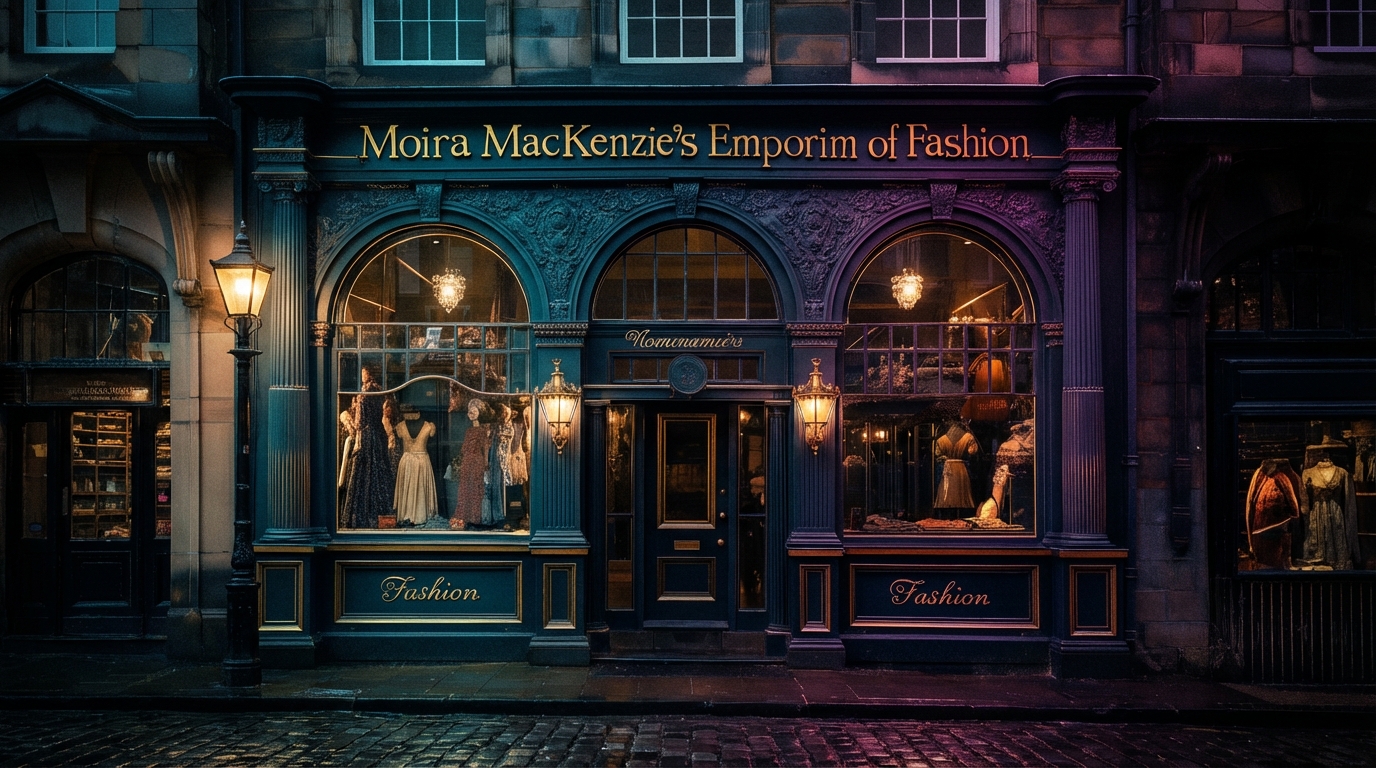
The Premises
The Emporium occupied a grand structure at 17 George Street in Edinburgh's fashionable New Town, its façade an impressive blend of Georgian elegance and subtle opulence that set it apart from surrounding buildings. Tall windows framed by intricately carved stone offered tantalising glimpses of the finery within, where dresses of silk and lace were artfully displayed on mannequins that seemed to regard the outside world with an air of aloof indifference. Above the door, a carved sign hung proudly, its gilded letters proclaiming the establishment's name to all who passed by. The gold leaf caught the Scottish sunlight when it deigned to appear, lending the entrance an air of quiet prosperity.
The door itself featured a wrought-iron handle worked into an intricate pattern of thistles and roses—beautiful yet thorned, much like the opportunities that awaited within. This detail, combining Scotland's national emblem with England's, spoke to the establishment's ambition: to serve clients from across Britain whilst remaining unmistakably Scottish in character.
Inside, the air was warm and heavy with the scent of lavender and beeswax, mingled with the faint aroma of freshly pressed linen. Beneath these familiar domestic scents lay something more exotic—hints of cinnamon and other spices that whispered of the far-flung origins of the fabrics lining the shelves. Garments hung from polished wooden racks, each piece a masterpiece of craftsmanship. Silk in shades of emerald, sapphire, and ruby shimmered in the soft light filtering through the windows, their colours so vivid they seemed almost alive. Lace veils as delicate as spiderwebs lay draped over mannequins' shoulders, whilst bonnets adorned with feathers and ribbons were displayed on shelves as if they were the crowns of royalty.
The showroom gave way to a workroom at the back, concealed behind a heavy velvet curtain. Here, the atmosphere shifted from elegant display to industrious creation. A large table dominated the space, its surface scarred and stained from years of use—rings left by cups of tea, small burns from irons heated too high, ink spots from pattern-making. Around it sat the seamstresses who brought the Emporium's creations to life, their needles clicking in quiet rhythm. The walls were lined with shelves laden with bolts of fabric in every colour imaginable, arranged with a precision that spoke of a mind valuing order above all else. Ribbons and lace were neatly organised in drawers, their labels written in flowing script. Light streamed through a high window, illuminating particles of dust that danced in the air.
Origins
The establishment that would become Moira MacKenzie's Emporium of Fashion began as the workshop of Madame Élisabeth Rochefort, a French modiste who had established herself in Edinburgh's New Town during the 1720s. Madame Rochefort built a reputation for Continental elegance adapted to Scottish tastes, serving Edinburgh's elite with gowns that combined Parisian sophistication with practical durability suited to the Scottish climate.
In 1732, a sixteen-year-old Highland girl named Moira MacKenzie arrived at Madame Rochefort's door seeking employment. Recently orphaned by smallpox, she had walked from Glenfinnan with nothing but the weaving skills her father had taught her and a determination to forge her own path. Madame Rochefort recognised talent when she saw it and took the girl on as an apprentice.
Over the following eight years, Moira transformed from promising apprentice to indispensable collaborator. Her innovative designs blended Highland textile traditions—the bold patterns and robust weaves of her heritage—with the refined techniques she learned under French tutelage. When Madame Rochefort announced her retirement in 1740 and named Moira as her successor, the twenty-five-year-old seamstress seized the opportunity to make her mark.
The workshop's renaming as "Moira MacKenzie's Emporium of Fashion" signalled more than a change of ownership. It announced a new vision: an establishment that would celebrate Scottish craftsmanship whilst embracing the finest innovations from London and Paris. The gamble paid off. Within a few years, the Emporium had become Edinburgh's most sought-after fashion destination.
The Partnership
From its earliest days under Moira's leadership, the Emporium's success rested on a partnership that balanced vision with practicality. Agnes Fraser, who had joined Madame Rochefort's workshop as a fourteen-year-old apprentice in 1734, became Moira's indispensable collaborator. Where Moira dreamed bold designs and cultivated influential clients, Agnes managed the daily operations that transformed ambition into reality.
Their complementary talents created an establishment greater than either could have built alone. Moira's creative vision and social acumen brought commissions from Edinburgh's most prestigious families. Agnes's methodical approach ensured those commissions were completed to the highest standards, on schedule, and within budget. Moira charmed clients in the showroom whilst Agnes supervised seamstresses in the workroom, their partnership invisible to those who saw only the elegant façade.
This division of labour proved especially valuable during times of political upheaval. When the Emporium became entangled in dangerous activities during the Jacobite Rising, Agnes's deliberate distance from the political dimensions provided essential cover. Her focus on the practical aspects of the business—the ordering of supplies, the training of apprentices, the maintenance of quality—helped preserve the establishment's legitimate reputation whilst Moira pursued riskier endeavours.
The '45
The Jacobite Rising of 1745 transformed the Emporium from a fashion establishment into something far more dangerous. When Prince Charles Edward Stuart raised his standard and the Highland clans rallied to his cause, Moira MacKenzie's sympathies were never in doubt. Her Highland heritage, her memories of the world the Union had changed, her connections to families who supported the Stuart claim—all drew her toward the Jacobite cause.
The Emporium became a node in a covert support network. Messages were concealed in garment linings, passed between seamstress and client during fittings that served dual purposes. The private fitting rooms, designed to protect the modesty of aristocratic ladies, proved equally useful for conversations that could not risk being overheard. Deliveries of fabric sometimes contained more than silk and wool.
The establishment's position in fashionable society provided perfect cover. Government officials' wives patronised the same establishment as Jacobite sympathisers, their appointments carefully scheduled to prevent awkward encounters. Moira's reputation for discretion—essential in any business that served women whose measurements and preferences were private matters—extended naturally to political secrets. She knew which families supported which cause, which husbands suspected their wives' sympathies, which servants might be trusted and which might not.
The most celebrated commission of this period was a gown created for Flora MacDonald, who had helped Prince Charles escape to France following the Battle of Culloden. The masterpiece of tartan silk and delicate lace cemented Moira's reputation whilst serving as a quiet statement of allegiance that those who understood such things could read clearly.
After Culloden
The Jacobite defeat at Culloden in April 1746 brought a reckoning that threatened everything Moira had built. The government's retribution swept through Scotland seeking those who had supported the rebellion. The Dress Act banned Highland dress, making the very fabrics that had been Moira's signature politically dangerous. Friends and associates were arrested, exiled, or executed.
The Emporium survived through the discretion that had always been its hallmark. Moira had been careful never to commit her political activities to paper, never to speak openly of matters that could be reported. Agnes Fraser's apparent ignorance of anything beyond the practical business of dressmaking provided additional protection—investigators found a senior seamstress concerned only with thread counts and delivery schedules, not a conspirator in rebellion.
The post-Culloden years required adaptation. The Emporium's signature Highland influences were muted, its designs shifting toward styles less likely to attract official scrutiny. The Jacobite networks dispersed, their members scattered or silenced. What remained was the core of what Moira had always been building: an establishment of excellence, a place where Edinburgh's elite could trust their appearances and their secrets to skilled and discreet hands.
The knowledge Moira had accumulated—which families were in financial difficulty, which marriages were troubled, which political allegiances had shifted—became a different kind of power. She never used it crudely, never resorted to blackmail or overt manipulation. Instead, she cultivated relationships, offered assistance when it might prove useful, remembered kindnesses and slights alike. The Emporium's influence extended far beyond fashion.
Elspeth Stewart
On 14 April 1755, a seventeen-year-old girl arrived at the Emporium seeking an apprenticeship. Elspeth Stewart came with little to recommend her beyond raw talent and desperate need—a blacksmith's daughter in a threadbare cloak, hoping to learn a trade that might support her widowed mother and younger sisters.
What Elspeth did not know was that Moira MacKenzie had been expecting her. The proprietress had maintained correspondence with her cousin Morag over the years, following the arc of her life from a distance: her marriage to the blacksmith Angus Stewart, the birth of four daughters, and now the tragedy of Angus's death and the debts that had surfaced in its aftermath. When Morag's eldest daughter appeared at the Emporium's door, Moira saw not merely a promising apprentice but family—however unacknowledged that relationship would remain.
The Emporium became Elspeth's education in ways that extended far beyond dressmaking. Under Agnes Fraser's patient instruction, she learned the practical skills of the trade: how to thread a needle efficiently, how to maintain even tension in her stitches, how to press fabric without scorching. Under Moira's more demanding tutelage, she absorbed lessons in observation, discretion, and the subtle arts of navigating Edinburgh society.
The workroom where Elspeth spent her days—sorting tangled masses of silk thread, pressing fabrics, ensuring everything remained in perfect order—became the foundation of capabilities that would serve her in ways neither mentor nor apprentice could have imagined. The discipline of the Emporium, the attention to detail, the cultivation of patience and precision: these were skills that translated across domains, preparing Elspeth for responsibilities that transcended anything her teachers understood.
A World of Secrets
The Emporium was never merely a dressmaker's shop. From its earliest days under Moira's leadership, it operated as a repository of secrets—a place where the intimacies of fitting rooms invited confidences, where the long hours of creating garments fostered relationships that transcended commerce.
The nature of the business guaranteed access to information. Women revealed themselves during fittings in ways they might not elsewhere: the lady whose measurements had changed in ways that suggested pregnancy, the widow whose mourning seemed suspiciously brief, the wife whose requests for new gowns coincided with her husband's extended absences. Seamstresses who visited clients' homes for alterations observed household dynamics invisible to casual visitors. The network of suppliers and delivery arrangements provided knowledge of financial circumstances—which families paid promptly, which sought extended credit, which had quietly reduced their orders.
Moira cultivated this information with the same care she applied to her designs. She never gossiped, never traded secrets for social advantage, never betrayed a confidence carelessly. Instead, she accumulated knowledge like a miser accumulating gold, understanding that information was its own form of currency. When she needed a favour, she knew whom to ask. When clients needed assistance, she knew whom to approach on their behalf. The Emporium's influence depended not on what Moira said but on what everyone knew she could say if she chose.
This atmosphere of watchfulness permeated the establishment. New employees quickly learned that the Emporium's walls seemed to have ears, that Moira's storm-grey eyes missed nothing, that discretion was valued above almost every other quality. Those who could not maintain appropriate silence did not last long. Those who proved trustworthy found themselves brought gradually into circles of greater confidence.
The Succession
When Moira MacKenzie died on 17 August 1780, the question of the Emporium's future was already settled. The legal arrangements she had made were complex, designed to protect her illegitimate daughter Janet's interests whilst ensuring the business continued under capable management. Agnes Fraser, who had been Moira's partner in all but name for over four decades, assumed responsibility for daily operations.
The transition was seamless. Clients who had grown accustomed to Moira's presence found Agnes equally capable of meeting their needs, if different in manner. Where Moira had commanded attention with her striking presence and penetrating gaze, Agnes offered steady competence and unfailing courtesy. The Emporium's reputation for quality and discretion remained unchanged.
Janet Sinclair MacKenzie, Moira's daughter, continued working within the establishment she had known since childhood. Her relationship to the founder remained publicly unacknowledged, but those within the Emporium understood her position. When she married the physician Malcolm Kerr, her connection to the business continued, and her children would inherit whatever claims Moira's complex legal arrangements had preserved.
Agnes managed the Emporium until her own death on 12 September 1790, having spent fifty-six years within its walls. Under her stewardship, the establishment maintained its position as Edinburgh's premier fashion destination, weathering the changing tastes of the late eighteenth century whilst preserving the standards Moira had established.
Legacy
The Emporium's influence extended far beyond the garments it produced. The seamstresses trained within its workroom carried techniques and standards into their own work, spreading Moira MacKenzie's methods throughout Scottish dressmaking. The blend of Highland tradition and Continental elegance that had been her signature influenced fashion across Britain.
More significant than its impact on clothing was the Emporium's role in shaping lives. The young women who apprenticed within its walls learned more than how to cut and stitch fabric. They absorbed lessons in observation, discretion, and the navigation of complex social environments. They developed the patience and precision that excellence demands. They discovered what women working together could accomplish.
Elspeth Stewart emerged from the Emporium prepared for a destiny that no one—not Moira, not Agnes, not Elspeth herself—could have anticipated. The skills she developed sorting silk threads and pressing fabrics, the lessons she absorbed about secrets and their keeping, the discipline she acquired through years of demanding work: all of these would serve her when she stepped through a Portal into a world beyond Edinburgh's cobbled streets.
The Emporium itself continued operating into the nineteenth century, though diminished from its peak. Eventually, the building at 17 George Street passed to other uses, the gilded sign was taken down, and the workroom where so much had been created fell silent. But the threads Moira MacKenzie had woven—into fabric, into lives, into the destiny of worlds she never knew existed—continued their patterns long after the establishment itself had faded into memory.







