Moira Jane Campbell (née Fraser)
Born in Morningside on 6 October 1950, Moira Jane Fraser inherited botanical wisdom that stretched back through generations of Edinburgh's apothecary tradition. Her grandmother Isobel Campbell had operated the Morningside Apothecary until 1956, maintaining knowledge that transcended ordinary herbalism, and Moira would spend her life cultivating that legacy through scientific rigour and patient stewardship. Her marriage to historian Alasdair William Campbell united two complementary forms of preservation, together raising four children whilst tending secrets that grew in greenhouse soil. When crisis came in April 2025, Moira's whereabouts became as mysterious as the hybrid plants she had cultivated for decades.
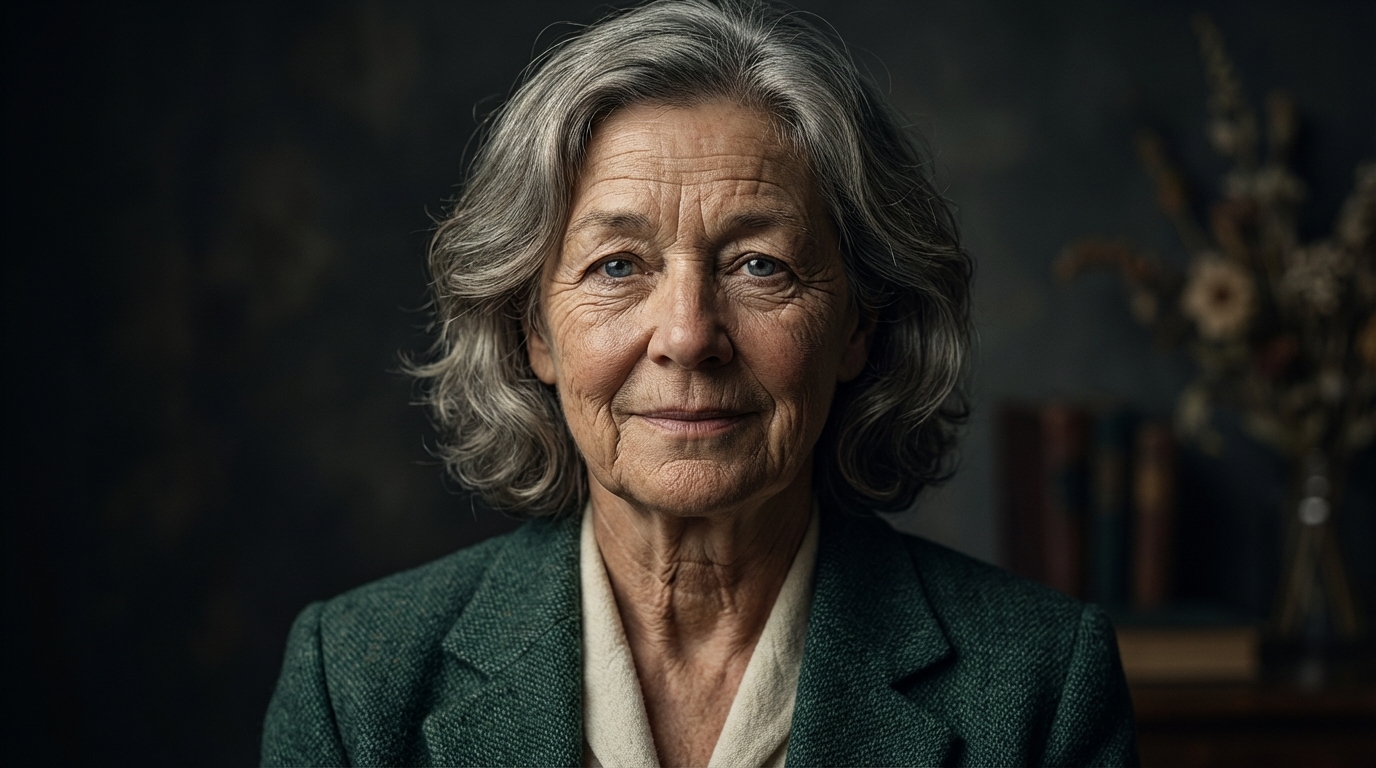
Birth and Apothecary Lineage
Moira Jane Fraser was born on 6 October 1950 in Morningside, Edinburgh, the third of six children to Dr Malcolm Fraser and Eilidh Isobel Fraser née Campbell. She arrived in the early years of the post-war period, into a household where medical knowledge and botanical wisdom intertwined naturally—her father a general practitioner serving the Morningside community, her mother a midwife whose herbal expertise extended well beyond conventional training.
The family lived in a modest but book-filled townhouse within walking distance of the former apothecary shop once run by Eilidh's mother, Isobel Margaret Campbell. That proximity to her grandmother's legacy would shape Moira's life in ways she could not have fully understood as a child. The apothecary had closed in 1956, when Moira was six years old, but its influence persisted through the cuttings her grandmother had preserved, the knowledge her mother maintained, and the stories that wove through family gatherings like threads connecting generations.
The name Jane connected her to simpler traditions—a good Scottish name without pretension—whilst Fraser carried the weight of a lineage that traced back through Edinburgh's quiet but historically significant families. Through her mother's Campbell line, Moira was distantly connected to the Campbells of Inveraray, descended from a cadet branch that had settled in Edinburgh in the mid-nineteenth century. These genealogical threads, largely forgotten by the wider family, would prove significant only when later discoveries revealed connections to histories far older than anyone had suspected.
The Grandmother's Legacy
Isobel Margaret Campbell had operated the Morningside Apothecary from 1932 until 1956, a period spanning economic depression, world war, and the early years of the National Health Service that would eventually render such establishments largely obsolete. The shop had served not merely as a dispensary for herbal remedies and traditional preparations but as something more—a quiet outpost for shared knowledge amongst those aware of connections that conventional herbalism could not explain.
Moira's earliest memories included visits to the apothecary before its closure, the scent of dried herbs and mysterious preparations filling rooms lined with dark wooden cabinets and labelled drawers. Her grandmother's hands, capable and certain despite advancing age, had demonstrated the proper handling of delicate specimens, the correct techniques for preservation, the patience required when working with materials that demanded respect rather than haste.
After Isobel's death in 1974 and the property's subsequent sale, the apothecary passed out of family hands for a generation. The building served various commercial purposes, each successive owner unaware of what the space had once meant to those who understood its true significance. Moira often thought of that building during her years away, feeling a resonance she could not fully articulate—a sense that something waited there, suspended in time, for the family to return and reclaim what had been temporarily surrendered.
Siblings and Family Position
As the third of six children, Moira occupied a middle position that afforded her both connection and independence. Her siblings arrived across twelve years, creating a household animated by the constant presence of children at various developmental stages.
Dr Fiona Louise Fraser, born in 1946, was the eldest—a folklorist who would become a university lecturer in Celtic Studies, her academic work exploring the oral traditions and cultural practices that conventional history often overlooked. Kenneth Malcolm Fraser followed in 1948, destined for a career as a chartered surveyor and land consultant, his practical expertise complementing the more esoteric interests of his sisters. After Moira came Andrew Fraser in 1952, who would become an estate agent and local councillor in East Lothian, his political involvement reflecting the family's sense of civic responsibility. Isla Margaret Fraser arrived in 1955, drawn to nursing and hospice care, her deeply spiritual nature finding expression through service to those approaching life's end. The youngest, Eilidh Ruth Fraser, born in 1958, would become an organic gardener and author of plant-based cookbooks, her work representing perhaps the most direct inheritance of their grandmother's botanical interests.
Each sibling absorbed different aspects of the family's accumulated knowledge and values. Moira found particular kinship with her eldest sister Fiona, whose scholarly attention to Celtic traditions complemented Moira's growing fascination with botanical heritage. Their conversations, extending across decades of correspondence and visits, explored the intersections between documented history and the living knowledge preserved through practice rather than text.
Education and Scientific Formation
Moira attended George Watson's College, where her academic abilities found institutional support and direction. She excelled in the sciences, demonstrating particular aptitude for biology and chemistry—subjects that provided theoretical frameworks for understanding the plant knowledge her family had transmitted through generations of practice. Teachers recognised in her a combination of intellectual rigour and intuitive understanding that suggested genuine scientific vocation rather than merely competent performance.
In 1968, she enrolled at the University of Edinburgh to pursue Botany, entering an academic environment that would expand her understanding whilst also challenging assumptions inherited from her grandmother's more traditional approach. The university's scientific methodology demanded evidence, reproducibility, and scepticism toward claims that could not be experimentally verified. Moira learned to navigate between her family's experiential knowledge and the academy's empirical requirements, developing the capacity to honour both without allowing either to entirely subsume the other.
Her undergraduate work demonstrated excellence sufficient to earn First-Class Honours in 1972, opening doors to postgraduate opportunities. Her doctoral research focused on pharmacognosy—the study of medicines derived from natural sources—with particular attention to native and invasive species in Scotland's evolving botanical landscape. This specialisation allowed her to pursue scientific questions whilst maintaining connection to the herbalist traditions her grandmother had embodied.
The Royal Botanic Garden Edinburgh provided institutional home for her early research career, where she published technical papers on plant resilience and genetic drift in island populations. Her work earned respect within the scientific community whilst also bringing her into contact with collectors, preservationists, and others whose interests in botanical heritage extended beyond purely academic concerns.
Meeting Alasdair Campbell
The meeting that would define the rest of Moira's life occurred through the intersection of her research and his archival expertise. Alasdair William Campbell, a historian at the National Library of Scotland specialising in hidden Scottish histories, was consulting records that touched upon her pharmacognosy research when their paths first crossed in 1973.
What began as professional consultation developed into something deeper. Moira found in Alasdair a complementary intelligence whose approach to preservation paralleled her own whilst operating through entirely different materials. Where she saved seeds and cultivated living specimens, he preserved documents and traced forgotten lineages. Where she maintained botanical heritage through careful propagation, he protected historical knowledge through meticulous archival work. Their conversations revealed shared values beneath different methodologies—the conviction that what was precious must be protected, that stewardship was a calling rather than merely a profession.
The discovery that they shared a surname through different branches of the Campbell clan added a dimension of coincidence that felt significant, though neither could have articulated precisely why. Her maternal grandmother had been Isobel Campbell; his family had maintained the Campbell name for generations. The convergence suggested patterns larger than individual choice, connections that extended back through centuries of Scottish history.
They married in 1975, the union grounded in mutual intellectual passion and a shared understanding that their respective work served larger purposes than personal advancement or professional recognition. Moira scaled back her institutional research to focus on private work as a genetic preservationist, quietly cultivating rare and heirloom seeds—many passed down through her maternal line—whilst Alasdair continued his archival career at the National Library.
Campbell Estate and Family Life
The couple established their home at Campbell Estate in Midlothian, property that had belonged to Alasdair's family for generations. The estate provided space for both their endeavours: archives and study for his historical work, greenhouses and gardens for her botanical preservation. The land itself seemed to welcome Moira's cultivation, responding to her care with growth that sometimes exceeded what soil quality and climate should have permitted.
Their first child, Daniel Alistair Campbell, arrived on 3 September 1976. His birth at Simpson Memorial Maternity Pavilion marked the beginning of a new generation, one that would inherit both greenhouse and archive, both living plants and documented histories. Moira held her newborn son with awareness that he represented continuation—not merely of bloodlines but of responsibilities she was only beginning to understand fully.
Fiona Alexandra followed on 12 May 1979, her arrival coinciding with a period when Moira was already nurturing both ancient seedlings and the dreams of returning to her grandmother's apothecary space. Something in Fiona's early curiosity suggested the linguistic gifts that would later draw her to ancient manuscripts and extinct dialects, continuing the family's quiet stewardship of forgotten knowledge through different means.
Ewan James came on 4 November 1982, born as autumn deepened into winter's quiet preparation. From his earliest years, he showed affinity for the natural world that would eventually lead him to conservation work and Highland rewilding projects. In Ewan, Moira recognised the most kindred expression of her own values—not merely preserving plants in gardens but restoring entire landscapes to their ancestral abundance.
Colin Fraser Campbell, the youngest, arrived on 29 June 1985, carrying Moira's maiden name as his middle name in acknowledgement of the Fraser lineage that had first brought botanical wisdom to Edinburgh. Born in midsummer when gardens reached their fullest expression, Colin would grow to bridge his mother's reverence for ancestral spaces with modern engineering, applying sustainable principles to heritage buildings.
Each child absorbed something of their parents' dedication to stewardship whilst finding individual expression for inherited values. The estate household was simultaneously warm and intellectually demanding, filled with books and plants, animated by discussions that ranged from historical minutiae to botanical technique. Moira encouraged her children to pursue their own interests whilst modelling a life devoted to careful preservation of what mattered.
Return to Morningside
In 2004, when the old apothecary building in Morningside came up for sale—then functioning as a defunct boutique—Moira experienced the moment as something approaching destiny. The property that had passed out of family hands nearly five decades earlier was suddenly available, waiting to be reclaimed by someone who understood what it had once meant.
She and Alasdair acquired the building and undertook its conversion into the Leaf & Bean Café. The project was both practical and symbolic: a modern business venture with deep roots in ancestral history, a commercial operation that could sustain itself whilst also serving purposes that went far beyond selling coffee and pastries.
Moira restored the greenhouse behind the shop, replanting species from cuttings her grandmother had preserved—specimens that had survived across generations through careful propagation and patient tending. Some of those plants possessed properties that conventional botany could not fully explain: resilience exceeding normal parameters, characteristics that seemed to respond to conditions her family's knowledge described but that scientific instruments could not detect.
The café's "seasonal blends" were based on botanical pairings with subtle properties, their formulations drawing upon the pharmacognosy research Moira had pursued academically and the traditional knowledge her grandmother had transmitted through practice. Several of the establishment's houseplants grew from Clivilius-linked soil, though this fact remained unknown to most who encountered them.
The upstairs flat became a rotating residence for the Campbell children and their friends, many of whom would go on to form key parts of the unfolding events that the family's legacy had long anticipated. The building served as meeting place, sanctuary, and connection point—fulfilling purposes that extended far beyond what its commercial function suggested to casual observers.
The Greenhouses and Deeper Knowledge
At Campbell Estate, Moira's botanical work grew increasingly focused on certain sections of the greenhouses that served purposes beyond ordinary horticulture. The hybrid plants she cultivated there—specimens descended from stock her grandmother had maintained and, before that, from sources whose origins stretched back centuries—possessed properties that defied standard classification.
These plants responded to conditions that conventional instruments could not measure, their growth patterns suggesting awareness of rhythms larger than seasonal cycles. Some bloomed at times that seemed to presage significant events; others demonstrated resilience that exceeded any normal botanical parameters. Moira documented her observations meticulously, maintaining records that combined scientific methodology with notations that would have seemed mystical to colleagues unfamiliar with what she was actually studying.
Her understanding deepened gradually across decades of cultivation and observation. The plants were not merely unusual specimens but connections—living links to something that Alasdair's archival research was simultaneously uncovering through documentary evidence. The Stewart Sisters whose Portal Keys would eventually pass to her granddaughters, the Guardian preservation efforts that his thesis had touched upon, the networks of knowledge that extended far beyond Scotland's borders—all these threads wove through the estate's greenhouses, manifest in chlorophyll and root systems rather than ink and parchment.
Moira approached this expanding understanding with characteristic patience. She documented what she learned whilst respecting boundaries that existed for reasons her research gradually revealed. The botanist who had earned academic credentials through rigorous scientific work found herself custodian of knowledge that transcended what her training had prepared her to address—yet she remained the same person, applying the same careful observation and systematic documentation to materials that conventional science could not encompass.
Grandchildren and the Warning Signs
The arrival of grandchildren transformed Moira's relationship with legacy from long-term stewardship to immediate responsibility. Isla Margaret Campbell was born on 17 December 2006, followed by Maeve Jane on 9 March 2008, and Rowan Eloise on 27 October 2010. These three granddaughters would grow to inherit far more than family property or botanical knowledge.
The death of their mother Eloise on 19 November 2016 thrust Moira into a more active grandparental role. Daniel, devastated by loss, needed support to maintain household function and continue raising three young daughters. Moira's quiet strength became the anchor that guided the family through the storm, her presence providing stability whilst grief worked its slow transformations.
At Eloise's funeral in November 2016, standing at Morningside Cemetery whilst her granddaughters faced an unimaginable loss, Moira was already sensing what the family would need—preparation for changes that her botanical observations had begun to suggest were approaching. The plants in her greenhouses had begun displaying behaviours she had documented only in historical records, patterns last observed in 1939 on the eve of global catastrophe.
The family's relocation to Campbell Estate in early 2017 brought all generations under closer proximity. The cottage that Alasdair arranged to have constructed in 2018–2019 provided Moira continued access to her greenhouses whilst maintaining the independence that decades of marriage had established as necessary for both partners' wellbeing.
She watched her granddaughters grow with awareness that patterns were accelerating toward conclusions she had long anticipated whilst hoping to avoid. Isla's analytical precision, Maeve's artistic sensitivity, Rowan's practical resourcefulness—each granddaughter embodied aspects of the family heritage that would prove essential for whatever challenges lay ahead.
March 2025 and Premature Blooms
The events of late March 2025 confirmed what Moira's plants had been signalling for months. The Skye variation's premature bloom—a botanical phenomenon she recognised immediately—indicated disturbance of a magnitude that her historical records documented in coded references stretching back generations.
These hybrid plants maintained connections to cycles larger than individual human lifetimes, responding to conditions that conventional science could not detect. Their warning had proved accurate before; Moira had no reason to doubt its reliability now. The family faced threats that required preparation beyond what ordinary precaution could address.
She participated in the family gatherings during early April 2025, offering counsel whilst maintaining the quiet observation that had characterised her approach throughout decades of cultivation and preservation. Her hands still bore soil from the greenhouse where she had spent that morning examining specimens whose behaviours continued to indicate approaching crisis. She watched her granddaughters with awareness that their lives were about to change irrevocably, feeling the weight of knowledge she could not yet fully share.
Absence and Silence
When the attack on Campbell Estate came on 7 April 2025, Moira was not in Scotland. She and Alasdair had departed several days earlier, having told Daniel they would be attending a botanical conference in Aberdeen focused on sustainable coffee cultivation. Alasdair had described presenting research findings there—a forty-five-minute talk that had supposedly drawn experts from across Europe. The explanation had seemed entirely plausible, bridging both their professional interests in ways that would satisfy any casual enquiry.
The conference did not exist. No such gathering had been scheduled in Aberdeen for that week. Douglas Thomson's discreet enquiries after the fire revealed nothing—no registration records, no programme listings, no evidence that any such event had ever been planned.
What Remains
The aftermath of April 2025 left Moira's position within the family altered in ways not yet fully understood. The greenhouses she had tended for decades were destroyed, their contents—some representing generations of careful preservation—reduced to ash. The botanical knowledge she had maintained existed now only in her memory and whatever documentation had survived the fire or been stored elsewhere.
Her granddaughters faced challenges without the grandmother who should have been present to guide them. The plants that might have helped them, the knowledge that could have prepared them, the presence that had anchored the family through previous crises—all these were absent when they were most needed. Whether Moira's absence served protective purposes that would eventually become clear, or whether it represented something more troubling, remained impossible to determine from Edinburgh.







