Moira Anne MacKenzie
Born in Glenfinnan seven months before her cousin Morag, Moira Anne MacKenzie was orphaned at sixteen when smallpox claimed both parents. She transformed tragedy into triumph, rising from apprentice seamstress to founder of Edinburgh's most prestigious fashion establishment—and its most dangerous. Behind the Emporium's elegant façade, Moira built a network of Jacobite sympathisers, using her position as keeper of society's secrets to shelter those the Crown would have destroyed. Her mentorship of Elspeth Stewart unknowingly prepared a future Guardian for her destiny, whilst her illegitimate daughter Janet ensured the MacKenzie bloodline would continue for generations. She died in 1780, her legacy woven into the fabric of Scottish history.
Glenfinnan
Moira Anne MacKenzie was born on 24 September 1715 in Glenfinnan, a small village at the head of Loch Shiel in the western Highlands. She arrived in the world just two months after the failure of the 1715 Jacobite Rising—an event that would shape not only Scottish history but the trajectory of her own life in ways no one could have foreseen. Her father, Angus MacKenzie, was a weaver whose skill with the loom had earned him respect throughout the region. Her mother, Fiona, kept their household with the quiet competence common to Highland women of her generation.
Seven months after Moira's birth, another girl was born to the MacKenzie family in Glenfinnan—her cousin Morag, daughter of Angus's brother Hamish and his wife, also named Fiona. The two girls grew up together, as close as sisters despite the slight difference in their ages. They played among the heather-covered hills, learned the rhythms of village life, and absorbed the weaving traditions that had sustained their families for generations. In those early years, their paths seemed destined to run parallel—two Highland girls learning the same skills, sharing the same expectations, bound by the same ties of blood and place.
From her father, Moira learned the art of weaving. She spent countless hours at his loom, watching the shuttle fly back and forth, learning to read patterns in the threads, developing an eye for colour and texture that would serve her throughout her life. She learned that fabric was more than mere cloth—it was identity woven into physical form, clan and family and tradition made tangible. The tartans her father produced carried meanings deeper than their colours, stories encoded in their patterns, histories preserved in their very weave.
But where Morag was steady and content, Moira was restless. She looked beyond Glenfinnan's boundaries with hungry eyes, wondering what lay in the wider world. She listened to travellers' tales of Edinburgh and London, of Paris and Rome, of cities where fashion was an art form and skilled craftspeople could build empires from needle and thread. Even as a child, she sensed that her future lay somewhere beyond the familiar hills of her birthplace.
Orphaned
In the spring of 1731, smallpox swept through Glenfinnan with devastating efficiency. The disease showed no respect for skill or reputation, for love or need. Within weeks, both Angus and Fiona MacKenzie were dead, leaving their sixteen-year-old daughter alone in the world.
The loss was shattering. In the space of days, Moira went from beloved daughter to orphan, from a girl with a secure place in the world to one with nothing but the skills her parents had taught her and the determination that had always burned within her. She watched her mother and father buried in the kirkyard above the village, their graves marked with simple stones that gave no hint of the lives they had lived or the daughter they had left behind.
Her cousin Morag, just fifteen at the time, offered what comfort she could. The two girls clung to each other through those terrible weeks, bound more closely than ever by shared grief and the knowledge that the world had become a more precarious place. But Moira knew she could not remain in Glenfinnan. The village held too many memories, too much pain. More practically, it offered no prospects for an orphaned girl with ambitions that exceeded anything the Highlands could provide.
She made her decision with the same clear-eyed pragmatism that would characterise her entire life. Edinburgh was where she would go—Edinburgh, where skilled seamstresses could find work, where talent and determination might overcome the disadvantages of humble birth and tragic circumstance. She said goodbye to Morag, promising to write, not knowing that decades would pass before they would meet again. Then she gathered what little she owned and set out on the road that would take her from the Highlands to the capital.
Edinburgh
Moira arrived in Edinburgh in 1732, a seventeen-year-old girl with nothing but a small bundle of possessions and an unshakeable conviction that she was meant for something more than the life fate had dealt her. The city was overwhelming—crowded, noisy, filled with people speaking in accents she could barely understand. The contrast with Glenfinnan could not have been more stark. Where the village had been intimate and familiar, Edinburgh was vast and anonymous. Where Highland life moved to the rhythms of season and tradition, the capital pulsed with commerce and ambition.
She found work as an apprentice in the workshop of Madame Élisabeth Rochefort, a French modiste who had established herself in Edinburgh's fashionable New Town. The position was humble—sweeping floors, running errands, threading needles for the established seamstresses—but it was a foothold in the world she wanted to enter. Moira threw herself into the work with a ferocity that quickly drew attention. She arrived before anyone else and left after everyone had gone. She watched every technique, absorbed every lesson, practised every stitch until her fingers could execute them perfectly.
Madame Rochefort recognised quality when she saw it. The Highland orphan might lack polish and connections, but she possessed something more valuable: genuine talent combined with relentless drive. Within months, Moira had progressed from general assistant to apprentice seamstress. Within years, she had become one of Madame Rochefort's most trusted employees, handling commissions for Edinburgh's most demanding clients.
Under Madame Rochefort's tutelage, Moira refined her natural abilities into professional expertise. She learned the techniques of French dressmaking—the precise cutting, the elegant lines, the subtle details that distinguished true artistry from mere competence. But she also brought something of her own to the work: an instinct for incorporating Scottish traditions into Continental styles, for blending Highland wool and tartan with Parisian silk and lace. The fusion was unusual and striking, and it began to attract attention from clients who wanted something distinctively Scottish yet undeniably fashionable.
Agnes
In 1734, a fourteen-year-old girl named Agnes Fraser arrived at the workshop seeking an apprenticeship. Born to a master carpenter and a skilled weaver in Edinburgh's Old Town, Agnes possessed the steady hands and patient temperament that seamstress work required. Moira, now nineteen and increasingly responsible for training new workers, recognised something in the younger girl—not the burning ambition that drove her own work, but a complementary quality of practical reliability that would prove equally valuable.
The partnership that developed between them would last for the rest of their lives. Where Moira was visionary and daring, Agnes was methodical and grounded. Where Moira saw possibilities, Agnes saw practicalities. The combination proved extraordinarily effective. As Moira's influence grew within the workshop, Agnes became her most trusted collaborator—someone who could translate ambitious designs into finished garments, who could manage the daily operations that Moira found tedious, who could be relied upon absolutely when discretion was required.
Their friendship deepened over years of shared work and mutual respect. Agnes was five years younger, but she understood Moira in ways that others did not. She saw past the formidable exterior to the orphaned girl who still carried grief alongside ambition, who drove herself relentlessly because stopping meant remembering what she had lost. In return, Moira provided Agnes with opportunities she could never have found elsewhere—training, advancement, and eventually a partnership in all but name.
The Emporium
In 1740, Madame Rochefort announced her intention to retire and return to France. The workshop she had built over decades—its reputation, its clientele, its carefully cultivated relationships with Edinburgh's elite—all of it was available to whoever could take it on. To the surprise of many, she named Moira MacKenzie as her successor.
Moira was twenty-five years old. She had no family connections, no inherited wealth, no social standing beyond what her own work had earned her. What she had was talent that Madame Rochefort herself acknowledged as exceptional, a reputation for delivering exactly what clients wanted, and a vision for what the workshop could become under different leadership.
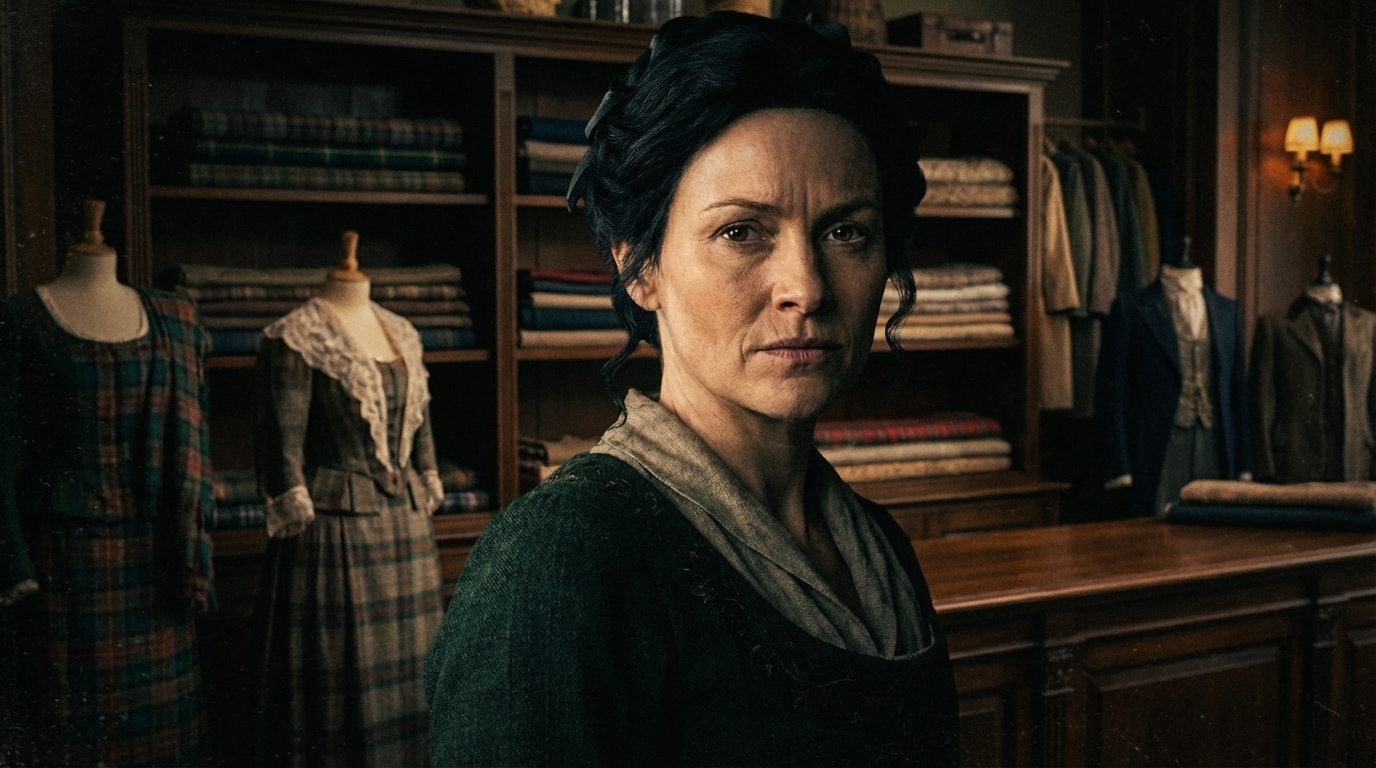
She renamed it "Moira MacKenzie's Emporium of Fashion" and set about transforming it into something unprecedented in Edinburgh. The Emporium would not merely produce fashionable garments—it would become a destination, an experience, a place where Scotland's elite came not just for clothes but for the sense of entering a world apart from ordinary life. She invested in the premises at 17 George Street, creating an environment of careful opulence: tall windows displaying the finest creations, polished wood and velvet curtains, the scent of lavender and beeswax perfuming the air. Every detail was calculated to convey quality, discretion, and the promise of transformation.
Her signature style—blending French elegance with Scottish textile traditions—found an eager market among clients who wanted to be fashionable without abandoning their heritage. Tartans appeared in unexpected contexts: linings for silk cloaks, trim on evening gowns, subtle patterns woven into fabrics that spoke of clan identity without sacrificing Continental sophistication. The wealthy women of Edinburgh discovered they could be both Scottish and stylish, and they came to Moira MacKenzie to achieve that balance.
Within a few years, the Emporium's clientele included the Duchess of Hamilton, the Countess of Eglinton, and numerous other figures from Scotland's aristocracy. Moira had achieved what she had dreamed of in Glenfinnan—a place among the elite, earned through skill and determination rather than inherited through birth.
Thomas
Sometime in the late 1730s, Moira entered into a relationship with Thomas Sinclair, a merchant whose business interests extended across Scotland and into the Continent. Thomas was older than Moira by some years, well-established in Edinburgh's commercial circles, and possessed of political sympathies that aligned with her own. He was also married, though his wife lived mostly at their country estate, their union having produced no children and little apparent affection.
The relationship was discreet, as it had to be. Edinburgh society tolerated much, but it demanded the preservation of appearances. Moira and Thomas met in private, conducted their affair away from observing eyes, maintained the pretence that their connection was purely commercial—he a supplier of fabrics, she a purchaser for her establishment. Those who suspected the truth kept their suspicions to themselves. Moira MacKenzie was not a woman whose secrets one aired carelessly.
What drew her to Thomas, beyond whatever physical attraction existed between them, was their shared commitment to the Stuart cause. Thomas had Jacobite connections that ran deep—family ties to the exiled court, business relationships that served as covers for political communication, a quiet network of sympathisers who awaited the day when a Stuart king might return to claim the throne his ancestors had lost. In Moira, he found not merely a lover but an ally, someone whose position at the centre of Edinburgh society provided access to information and influence that his commercial activities could not match.
On 15 July 1742, Moira gave birth to a daughter. The child was named Janet Sinclair MacKenzie—the middle name acknowledging her father, though officially she was recorded simply as the daughter of Moira MacKenzie, father unknown. Janet's existence was kept as quiet as possible. Moira arranged for her to be raised discreetly, acknowledging her privately whilst maintaining the public fiction of childlessness that her position required. The child would grow up knowing her mother, trained in the textile arts that were the family legacy, but always at a careful distance from the public face of the Emporium.
The '45
In August 1745, Prince Charles Edward Stuart raised his standard at Glenfinnan—the very village where Moira had been born, where her parents lay buried, where her cousin Morag still lived. The coincidence felt like fate. When news reached Edinburgh that the Young Pretender had landed and that Highland clans were rallying to his cause, Moira felt something shift within her. The political sympathies she had cultivated quietly for years suddenly demanded action.
The Emporium became something more than a dressmaking establishment. Behind its elegant façade, Moira built a network of support for the Jacobite cause. The wealthy women who came for fittings sometimes carried messages in the linings of their garments. The fabric deliveries that arrived at the back entrance occasionally concealed correspondence meant for eyes other than her own. The private rooms where clients were measured and fitted became spaces where whispered conversations could take place without fear of observation.
She was careful—she had not survived this long by being reckless. The Emporium maintained its reputation for political neutrality, serving clients of all persuasions without apparent discrimination. Government loyalists received the same impeccable service as Jacobite sympathisers. Moira's genius lay in making her establishment indispensable to both sides, creating a space where secrets could be exchanged precisely because everyone assumed everyone else was watching.
When the Jacobite army occupied Edinburgh in September 1745, Moira found herself in a position of unprecedented influence. The Prince's supporters needed channels of communication, places where plans could be discussed without attracting attention, ways to move information and resources through a city suddenly transformed by war. The Emporium provided all of these things, its proprietress moving through the chaos with the same composed authority she brought to everything.
Her most notable commission from this period was a gown designed for Flora MacDonald, the young woman who had helped the Prince escape after the disaster at Culloden. The dress—a masterpiece of tartan silk and delicate lace—became legendary, a symbol of Scottish resistance crafted by hands that understood exactly what such symbols meant. Moira never spoke publicly about the commission, but those who knew understood what it represented: a statement of allegiance made in thread and fabric, more eloquent than any words.
The Secrets She Kept
The aftermath of Culloden brought danger to everyone who had supported the Stuart cause. The British government's retribution was swift and brutal, reaching into every corner of Scottish society to punish those who had dared to dream of a different future. Many of Moira's contacts disappeared—executed, imprisoned, or fled into exile. Thomas Sinclair was among those who slipped away to the Continent, his Jacobite connections too well-known to survive investigation. Moira never saw him again.
She survived through the same combination of skill and discretion that had served her throughout her life. The Emporium had always maintained a careful neutrality in its public dealings, and she had been careful to leave no evidence of her deeper involvements. The government's investigators found nothing to connect the fashionable modiste of George Street to the networks that had supported rebellion. She was questioned, observed, but ultimately left alone—a businesswoman whose only crime, as far as anyone could prove, was making beautiful clothes for whoever could pay.
But the experience changed her. The reckless courage of the '45 gave way to a more calculated approach. She continued to shelter those who needed shelter, to pass information when information needed passing, but she did so with greater care, building networks that were harder to trace, compartmentalising knowledge so that no single person's capture could bring down the whole structure. The Emporium remained what it had always appeared to be—a place of fashion and elegance—whilst serving purposes that would have horrified its more respectable clients.
The secrets she accumulated became a form of power. In a society where reputation was everything, knowledge of hidden truths was currency more valuable than gold. Moira knew which merchants were on the verge of ruin, which ladies carried children who could not be their husbands', which politicians accepted bribes from interests they publicly opposed. She never used this knowledge crudely—blackmail was too obvious, too dangerous—but its presence in her possession shaped how Edinburgh's elite related to her. They came to the Emporium knowing that Moira MacKenzie saw everything, forgot nothing, and could be trusted absolutely to keep what she knew to herself.
Elspeth
In April 1755, a seventeen-year-old girl arrived at the Emporium seeking work. Her name was Elspeth Stewart, and she came with little to recommend her beyond raw talent and desperate need—at least, that was what anyone watching would have assumed. But Moira knew exactly who stood before her.
She had maintained correspondence with Morag over the years, irregular letters that crossed the distance between Edinburgh's New Town and the Grassmarket where her cousin had settled with her blacksmith husband. Through those letters, Moira had followed the arc of Morag's life: her marriage to Angus Stewart, the birth of four daughters, the modest prosperity they had built together. She had learned of Angus's death the previous year, of the debts that had surfaced in its aftermath, of the genteel poverty into which her cousin's family had fallen. And now here stood the eldest of those daughters, threadbare cloak pulled tight against the April chill, seeking the employment that might save her family from destitution.
This was Morag's daughter. This was the child of the girl who had been closer to her than a sister, the companion of her Glenfinnan years, the cousin she had embraced before setting out on the road that would transform her life. Twenty-four years had passed since that farewell, but blood remained blood, and Moira had not forgotten.
She had already decided to take the girl on before Elspeth had spoken a single word. How could she do otherwise? This was family, however unacknowledged. This was a debt owed to the cousin who had comforted her through the worst days of her life, who had stood beside her at her parents' graves, who had been the last piece of Glenfinnan she had touched before leaving it forever. Morag had never asked for anything in all the years of their correspondence—had never presumed upon their connection or sought favours from her successful cousin. But need had driven her daughter to the Emporium's door, and Moira would not turn her away.
What she would not do was reveal the connection. The reasons were complex, rooted in the habits of discretion that governed her entire life. To acknowledge Elspeth as family would invite questions about her own past, about Glenfinnan, about the life she had left behind. It would change the dynamic between employer and apprentice in ways that might not serve either of them. And there was something else: a sense that this girl was destined for something that required her to find her own way, to prove herself on her own merits rather than riding on the coat-tails of family connection.
So she treated Elspeth as she would any promising apprentice—with firm expectations and careful instruction, assigning her initially to Agnes Fraser's supervision. But she watched from a distance with an attention she gave to no one else, recognising in her cousin's daughter echoes of both Morag's steadiness and her own hunger. The mentorship that developed between them went beyond professional instruction, though Elspeth never knew why. Moira taught the girl everything she knew about fabric and fashion, about clients and their secrets, about the subtle arts of observation and discretion. Whatever destiny awaited Elspeth—and Moira sensed, without understanding why, that it would be an extraordinary one—she would be prepared for it.
Balcarres House
In March 1758, Moira secured an invitation for Elspeth to attend a grand soirée at Balcarres House, one of Edinburgh's most prestigious social gatherings. The invitation was a calculated gift—an opportunity for her protégée to move in circles that would otherwise have been closed to a blacksmith's daughter, to observe the society whose members the Emporium served, to begin building connections that might prove useful in ways neither of them could predict.
What Moira did not anticipate was that the evening would change Elspeth's life entirely. Among the guests was William Brodie, and the encounter between her apprentice and the enigmatic figure set in motion events that extended far beyond anything Moira understood. She had arranged the introduction thinking only of professional advancement for a talented young woman. The consequences exceeded anything so mundane.
In the years that followed, Moira watched Elspeth change. The girl who had arrived at the Emporium desperate and determined remained dedicated to her work, but there was something else now—a quality of purpose that went beyond professional ambition. Moira did not ask questions. She had learned long ago that some secrets were better left unprobed. Whatever Elspeth was becoming, Moira trusted that the foundations she had helped build would serve the girl well.
Final Years
By the 1770s, Moira MacKenzie had become an institution. The Emporium she had built from nothing was Edinburgh's most prestigious fashion establishment, its reputation extending far beyond Scotland. She had trained generations of seamstresses, shaped the tastes of Scottish society, created a legacy that would outlast her own life. Her hair, once dark as a raven's wing, had begun to grey, and the storm-cloud eyes that had always seen so much showed signs of the weariness that comes with decades of vigilance.
Her daughter Janet, now in her thirties, had become a skilled seamstress in her own right, working quietly within the Emporium's structure without publicly acknowledging her relationship to its founder. Janet would marry eventually—a physician named Malcolm Kerr—and produce children who would carry the MacKenzie bloodline forward through generations.
Agnes Fraser remained at Moira's side, their partnership unbroken after more than four decades. When Moira's health began to decline in the late 1770s, it was Agnes who took on more of the daily management, ensuring that the Emporium's standards remained as high as ever.
Elspeth had long since moved beyond the Emporium, drawn into the extraordinary destiny that the evening at Balcarres House had initiated. But she returned when she could, visiting the woman who had given her more than employment. The relationship between mentor and protégée had evolved into something like family—which, of course, it had always been, though only one of them knew it. Whether Moira ever revealed the truth of their connection to Elspeth before her death remains unknown.
Death
On 17 August 1780, Moira Anne MacKenzie died peacefully in her rooms above the Emporium she had created. She was sixty-four years old. The establishment she had built would continue under Agnes Fraser's management, maintaining its reputation for decades after its founder's passing.
She was buried in Edinburgh, in a grave that gave no hint of the extraordinary life she had lived. No inscription recorded her Jacobite activities, her network of secrets, or the role she had played in shaping Scottish society from behind a façade of silk and elegance. She would have wanted it that way. Discretion had been her greatest tool, and she carried it with her to the end.
What survived was the Emporium and everyone whose lives it had touched. The seamstresses she had trained carried her techniques into their own work. The clients she had served remembered a woman who had made them beautiful and kept their confidences. Her daughter Janet continued the family tradition in her own quiet way. And Elspeth Stewart—her cousin's daughter, her secret family, now pursuing a destiny that transcended ordinary understanding—carried forward lessons learned in workrooms scented with lavender and beeswax.







