Mikhail Antonín Novak
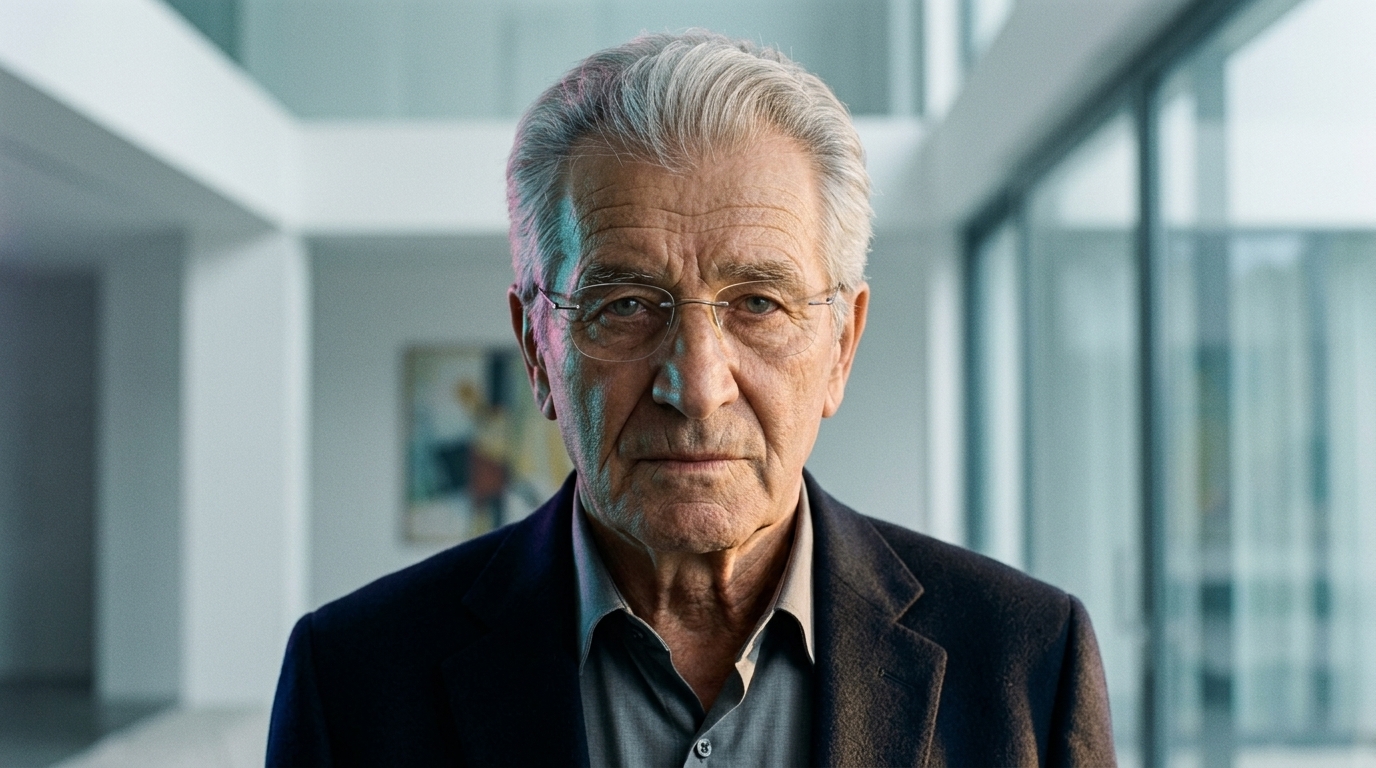
Mikhail Novak, born in Ostrava in 1945, was the clever elder son who escaped the Vítkovice foundry for the Prague medical faculty and became a cardiothoracic surgeon of standing. In 1985 he emigrated with his Australian barrister wife Natalia to Melbourne, requalified, and rose to eminence at St Vincent's, settling in a Toorak house hung with Czech modernist art. Disciplined, remote, and incapable of speaking affection, he was absent from his father's grave, estranged from his brother, and at last from his only daughter, Julia.
The Autumn After the Red Army
Mikhail Antonín Novak was born on the 8th of October 1945 in Ostrava, in the first hopeful autumn of the recovered peace, a few months after the Red Army had fought its way through the coal-and-iron city and the war that had governed his parents' young lives had at last come to an end. He was the first child of Václav Novak, a foundryman at the Vítkovice ironworks, and his wife Marie, née Kratochvílová, a miner's daughter who kept the household and kept, more quietly, the Catholic faith that the country's new masters would shortly make unfashionable.
The boy was named for the archangel Michael, a saint of his mother's devotion, and behind it sat Antonín, his father's father — a moulder on the Vítkovice casting floor — a plain assertion of the line he was born into and the works he was expected to serve. But the spelling that settled on him carried an Eastern cast, the mark of the season and of the soldiers who had just passed through, and Mikhail he remained for the whole of his life — in Ostrava, in Prague, and at last on the far side of the world.
He came into a household organised entirely around the works: the shift whistle that governed the day, the perpetual orange glow on the underside of the clouds, the smooth pale burn-scars his father wore on his forearms like a trade qualification. In such families it was understood without discussion that a son would give himself to the foundry as his father and his grandfather had before him. Mikhail would be the one who did not.
Family Tree
The Boy Marked for Prague
He was clever almost from the cradle, in the precise way the schools rewarded — a reader, a questioner, the boy who put his hand up to ask the question that lay behind the teacher's answer, and who was marked early for something the casting floor could never contain. Four years later a second son arrived, Pavel, clever in the hands instead, happiest taking a thing to pieces to see how it worked; and the comparison between the brothers was settled by the time Mikhail was a boy of ten and never afterwards unsettled. One of them would leave for Prague; the other would walk through the same gate their father walked through. Neither, then, thought it a tragedy. It was simply the order of things.
Their father was a hard, contained man who measured his sons in the single currency of usefulness, and with the practical, biddable Pavel he was at ease in a way he could never quite manage with the bookish elder boy. Václav was proud of Mikhail — fiercely, helplessly proud, in a manner he let slip to the men at the works far more often than he knew — but pride was one of the many things he had no language to say aloud, and so it reached his elder son only as expectation, and as the cool, exacting silence that the boy learned to read as the nearest thing to love the house contained.
Mikhail wanted out, and the only road out ran through the schoolroom. He gave himself to it with a discipline that frightened his teachers a little, and he won his way — by examination and by sheer relentless ability, against the quiet headwind a foundryman's son could expect under a regime that distrusted ambition it had not assigned — to the medical faculty in Prague. He left Ostrava in the early 1960s, a boy of the casting-floor streets stepping onto a train for the capital, and in every way that mattered he did not come back.
The Surgeon of the Capital
Prague made him. The faculty's rigour suited a temperament that had always preferred a hard problem to a soft conversation, and he moved through his training with the unhurried, exact concentration that would later make his name. He chose the most demanding ground he could find — the surgery of the heart and the great vessels, the chest opened and the failing pump laid bare — a discipline in which there was no room for sentiment and every room for precision, and which rewarded exactly the things he had: steady hands, an unsentimental nerve, and a refusal to be hurried by anything, including fear.
By his late thirties he was a cardiothoracic surgeon of genuine standing in the city, trusted with cases other men declined. He carried, when it became prudent to carry one, a Party card he regarded with the same flat practicality his father brought to a works pass — a thing a sensible man held because holding it cost less than not holding it did. He had inherited the old foundryman's instinct for survival under a regime one had not chosen, and he had refined it into something sleeker: he kept his counsel, did superb work, and let the system find him too useful to trouble.
What he had not inherited was any way of being warm. The cleverness had lifted him clean out of Ostrava, and each year polished him further — the manners, the languages, the cosmopolitan ease of a capital — until, on the rare occasions he came home, he stood in his father's kitchen articulate and faintly foreign and could find almost nothing whatever to say to the man who had raised him. The silence between Václav and his surgeon son was not the comfortable kind the old man kept with Pavel; it was a chasm, and neither of them ever learned how to cross it. Mikhail told himself the fault lay with the narrowness of the place he had escaped. It did not occur to him for a long time that he had carried its central defect out with him intact.
Natalia
In the spring of 1983 a young Australian barrister came to Prague. Natalia Blackstone was the daughter of an established Victorian legal dynasty — three unbroken generations of Melbourne barristers — and she was spending a season in Europe between the early triumphs of her career, clever, exacting, and entirely certain of her own worth in a way Mikhail recognised at once because it mirrored his own. They met across a dinner table arranged by mutual acquaintance, two formidable people taking the measure of one another, and what passed between them was less a romance in the ordinary sense than a kind of mutual recognition: each had found, in the other, the first person in years who did not need anything explained twice.
The courtship was conducted in large part across the Iron Curtain, by letter and by the few expensive, monitored telephone calls a Czech surgeon could contrive — a correspondence between two people who were, in temperament, almost alarmingly alike. Her mother, Elena Blackstone, a frustrated painter who had folded her own artistic life away into a suitable marriage, watched the foreign suitor with a wariness that never entirely lifted. Natalia married him regardless, and made the decision that fixed the rest of his life: she was going home to Melbourne to take silk in time and build her practice, and Mikhail, if he wanted her, would have to come.
Starting Again at Forty
He wanted her, and so in 1985, at the age of thirty-nine, Mikhail Novak left Czechoslovakia. It was, in those last years before the wall came down, a one-way departure in everything but name — a man who surrendered his homeland, his standing, and the recognition he had spent twenty years accumulating, and who understood as the aircraft lifted that he would not, for the foreseeable future, be permitted to return. The Melbourne newspapers, years afterward, would fix on the romantic word and call him a refugee; the truth was both plainer and harder. He had simply chosen a woman and a future over a country, and he had paid the country's full price for the choice.
A foothold had been arranged — a connection, a hospital willing to consider him — but his Prague seniority counted for nothing on arrival, and the Australian college required a foreign-trained surgeon to prove himself again from very near the bottom. So he proved himself again.
He sat the examinations, submitted to the supervision, swallowed the indignity of being assessed by men his junior, and over the better part of a decade he clawed his way back, fellow by fellow and case by case, to the top of his profession in a second country. By the middle of the 1990s the émigré who had landed with nothing recognisable but his hands was a cardiothoracic surgeon of formidable reputation at St Vincent's Hospital, his operating list sought after and his theatre run with a discipline that registrars remembered for the rest of their careers.
His suite became, in time, a kind of legend — for the technical brilliance that produced outcomes other surgeons could not match, and equally for the arctic exactitude with which he ran it. He did not raise his voice, because he did not need to; a single flat sentence from Mr Novak could empty the warmth out of a room. He repaired hearts with a tenderness he could find for no living person, and the patients who owed him their lives found him courteous, remote, and impossible to thank.
The success bought the life Natalia had promised them both. They settled at last in a modernist house on Albany Road in Toorak, all glass and clean planes above the brown curve of the Yarra, and there Mikhail assembled the one indulgence that ever betrayed what he carried unspoken: a collection of Czech modernist painting — Kupka, Filla, Josef Čapek — the art of the country he would not go back to, hung on the walls of the country he had chosen instead. He had left Bohemia entirely, and he kept it, every day, in oil and canvas, where he could look at it and never have to speak of it.
The Wreath He Sent
The family he had left behind grew, across the years, into the great unexamined silence of his Australian life. Before 1989 he could not safely return, and he told himself the wall was the reason. When the regime simply dissolved that November and the reason fell away, he discovered that the not-returning had hardened, somewhere along the line, from circumstance into character, and he still did not go.
His mother, Marie, died in Ostrava in the winter of 1991, of a failure of the heart that her surgeon son could perhaps have understood better than the doctors who attended her, and he grieved her at the safe distance he had spent his life cultivating. His father followed in the autumn of 1994, the foundry come due at last in the old man's lungs. Mikhail could, by then, easily have come; the country was open and the fare was nothing to a man in his position. He sent instead a handsome wreath from Melbourne and his formal regrets, and he did not come, and so the patriarch of the Novaks was put into the ground without either of his sons beside him.
With Pavel it was, if anything, sadder, because there had been no quarrel to excuse it. Mikhail had written to his widowed younger brother for two years after his own departure — warm, expansive letters describing a country of light and space and room for a boy to grow — and when Pavel finally emigrated in 1987 it was south to Adelaide, deliberately, refusing the soft landing in Melbourne that Mikhail had pressed on him. Mikhail never grasped that the offer itself had been the wound; that a proud man would not arrive in a new country as the lesser brother, taken in and provided for.
There were a few stiff visits in the early years, Pavel small and careful among furniture he was half afraid to mark, and then the invitations stopped, and the cards thinned, and somewhere in the late nineties the two of them let the thing lapse entirely. They were citizens of the same country at last, for the first time since boyhood, and seven hundred kilometres of road might as well have been the old Iron Curtain. When Pavel died in a Salisbury nursing home in 2017, estranged for twenty years, Mikhail did not hear of it until afterward.
The Daughter He Could Not Say He Loved
He and Natalia had delayed children until their careers stood on bedrock, and approached the matter, when at last they turned to it, much as they approached everything — as a thing to be planned, resourced, and brought to a successful conclusion. Their only child, a daughter, was born at Epworth Hospital on the 15th of August 1993, when Mikhail was forty-seven. They named her Julia Anastasia, and he loved her with the whole of the deep, inarticulate, undemonstrated capacity that was the only kind of love the Novak men had ever possessed — and, exactly like his father before him, he could not for the life of him say so.
What he could do was provide, and arrange, and improve. Julia's childhood ran on a schedule of his and Natalia's devising — the piano, the languages, the tennis, the tutors summoned the moment a mark slipped — and he mistook the machinery of all this provision for the thing itself, as his father had mistaken the paid bills and the boots that fit. The trouble announced itself early and never resolved: the girl was an artist to the marrow, and Mikhail, a man who had escaped a foundry by sheer rational discipline, could see in an artistic vocation only a weakness to be corrected before it cost her a serious life.
So the household settled into a long, quiet war of attrition. He hired tutors against her inclinations; he dismissed the prizes she won as encouragement handed to wealthy children; he made it understood that medicine or the law would be waiting when she had finished with painting.
When she defied them all and read art history regardless, his disappointment took the only form he had ever learned to give it — the arctic silence, the speaking-only-when-necessary, the cool withdrawal that had once been the climate of his own boyhood and was now, faithfully, the climate of hers. He had crossed the world to escape his father's wordlessness, and he had reproduced it in a glass house above the Yarra without ever once recognising his own hand in the work.
The Statement Through the Hospital
He gave up the operating table in his late sixties, the long lists and the small hours finally beyond even his discipline, and he kept on for some years afterward in the bloodless emeritus roles a great reputation is permitted — the committees, the examinations, the occasional consultation offered as though from a height. Retirement did not soften him. It merely removed the one arena in which his particular gifts had been unambiguously a blessing, and left him alone in the Toorak house with a temperament that had never had any other outlet.
In March 2018 his mother-in-law, Elena Blackstone, died and left her entire estate not to Natalia but to Julia — the granddaughter whose art she had secretly followed for years — and the bequest, concealed until the will was read, tore the household along a seam that had been waiting a long time to give way. The money set Julia free of them entirely, and the family closed around its own silence, the daughter gone to the far side of a rupture that no one in that house possessed the words to repair.
Then, in the early months of 2023, the Novak name appeared in the Melbourne papers in connection with a death in the far outback — a gallery, a missing sculpture, a murder investigation, and his daughter among the suspects. Mikhail's response was the most characteristic act of his life. He did not telephone Julia; he did not go to her. He issued, through the hospital that had made his Australian name, a brief and impeccable statement distancing himself from his daughter's affairs, and he severed what little contact remained. He told himself it was the protection of a reputation built over forty years. It was also, and more truly, the wreath again — the formal gesture dispatched from a safe distance in place of the presence he could not bring himself to offer.
The Silence Made Perfect
And so the surgeon arrived, in his eightieth year, at very nearly the same condition as the foundryman who had fathered him — an old, hard, accomplished man, mourned by no one yet because he had outlived the reach of nobody who could mourn him, sealed inside a silence he had spent a lifetime perfecting and now had no way to fill. His brother was dead and estranged. His daughter was alive and disowned, awaiting a trial he followed only through the papers, in a city an hour up the very river his brother had fled to. His mother and father lay in Ostravan ground he had not stood over.
Natalia remained beside him, the one person who had never required him to be anything warmer than he was, the two of them growing old together in the glass house with the Czech paintings on the walls and the schedule that no longer had anyone left to organise. He had crossed half the planet, rebuilt himself twice over, and made of his single life everything that relentless discipline could make.
He had simply never found the words — not for the surgeon's son in Ostrava, not for the brother in Adelaide, not for the daughter down the river — and the lack travelled on through the family unspoken, the one inheritance the Novak men passed down whole, carried now into a future the old foundryman could not have imagined and his surgeon son could no longer change.







