Midlothian, Scotland
Midlothian, the historic county encircling Edinburgh's southern approaches, has served as crucible for forces shaping Scottish history and dimensional affairs. From Bronze Age settlements to Enlightenment brilliance, the region's farmlands and ancient burghs have nurtured generations whose destinies extend beyond ordinary comprehension. The Campbell family's stewardship, culminating in the catastrophic attack on their Morningside estate on 7 April 2025, exemplifies Midlothian's enduring role as guardian of hidden knowledge.
Geographic Character and Boundaries
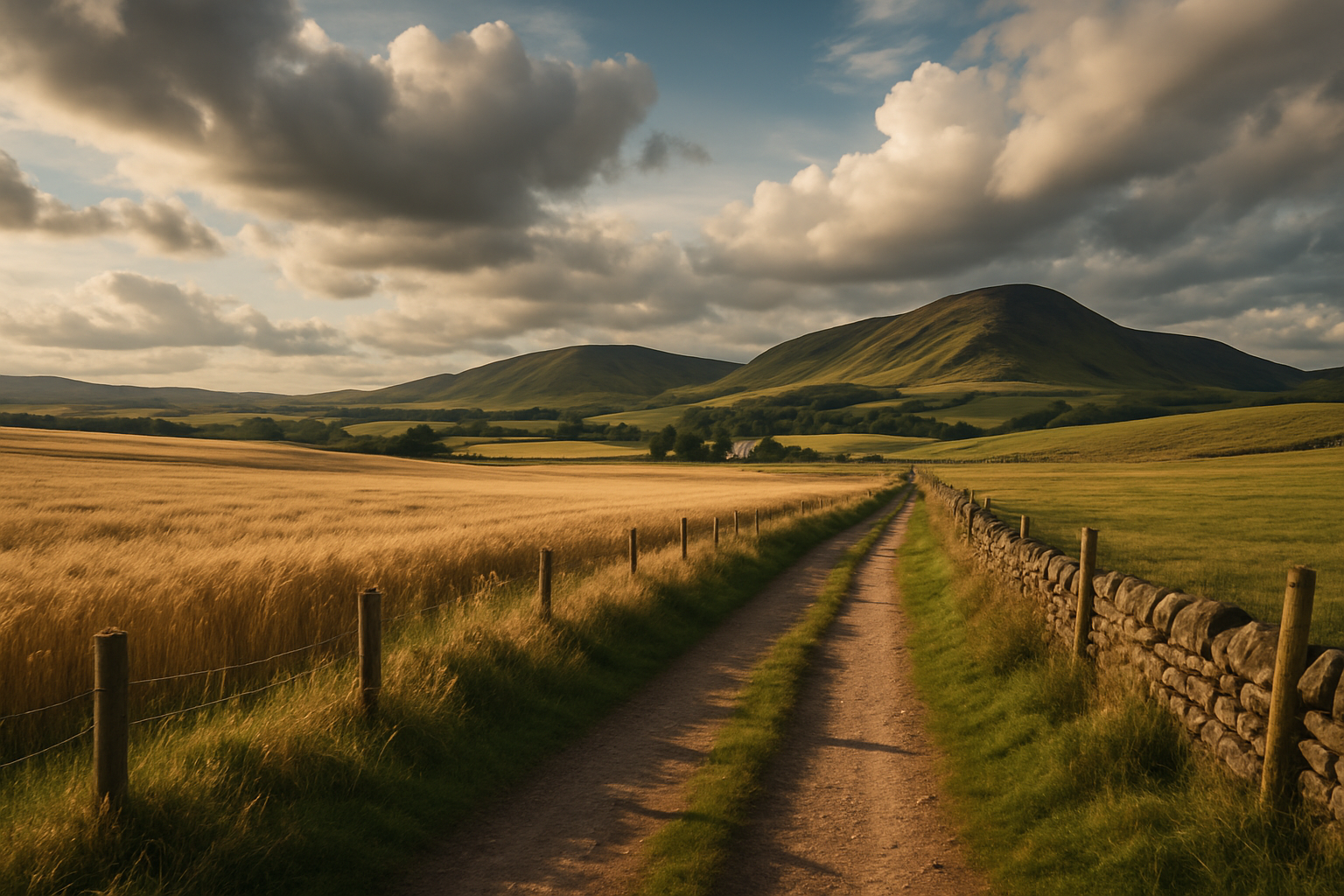
Midlothian occupies Scotland's central Lowlands, stretching southward from Edinburgh across approximately 350 square kilometres of varied terrain. The region's northern boundary follows the city's expanding edge, where Georgian terraces and Victorian suburbs give way to open countryside. To the south, the Pentland Hills rise in moorland ridges reaching over five hundred metres, their windswept slopes providing backdrop to the fertile valleys below. The eastern and western boundaries, less dramatically defined, merge with East Lothian and West Lothian respectively across agricultural landscapes that have sustained human habitation for millennia.
The topography creates distinct zones influencing settlement patterns and economic activity. The lower ground nearest Edinburgh supports intensive agriculture and suburban development, whilst middle elevations combine arable farming with pasture suited to livestock. The higher reaches, particularly along the Pentland chain, remain largely undeveloped—rough grazing, grouse moors, and reservoirs serving Edinburgh's water needs. This vertical stratification produces microclimates ranging from the relatively mild conditions along the Firth of Forth's influence to exposed uplands where snow lingers well into spring.
Water courses define Midlothian's internal geography with the precision that drainage systems impose upon landscapes. The North Esk and South Esk rivers, rising in the Pentland foothills, flow northward through the county before converging at Dalkeith and continuing toward the sea. These waterways historically powered mills, provided transport routes, and created the natural defences that early settlements exploited. Smaller streams—the Gore Water, the Glencorse Burn, countless unnamed tributaries—contribute to a drainage network that has shaped both agricultural practice and the underground water movements proving significant for certain specialised activities.
The soils vary from the heavy clays of lower ground, excellent for cereal cultivation when properly drained, to thinner upland soils supporting rough pasture and heath. Pockets of particularly fertile earth occur where geological conditions created natural advantages, whilst exposed outcrops of coal-bearing strata provided the mineral wealth that would transform Victorian Midlothian into an industrial landscape before subsequent decline returned much of the county to agricultural purposes.
Ancient Roots and Medieval Development
Human presence in Midlothian extends to the earliest periods of Scottish prehistory. The landscape bears traces of Neolithic farmers, Bronze Age metalworkers, and Iron Age tribal societies whose hill forts and burial mounds punctuate the higher ground. Castle Rock, the volcanic plug upon which Edinburgh Castle stands, has witnessed continuous habitation since approximately 900 BCE, making it one of Britain's longest-occupied sites. These ancient peoples left physical marks that subsequent generations built upon without fully erasing—stone circles, carved rocks, and defensive earthworks whose original purposes scholars continue debating.
The Roman presence in Scotland during the first and second centuries touched Midlothian's northern reaches, where military roads and temporary camps supported campaigns against the unconquered tribes beyond. The Antonine Wall, briefly the empire's northern frontier, passed through neighbouring territory, whilst Midlothian itself occupied the contested zone between Roman order and Celtic resistance. This liminal status—between worlds, between powers, between certainties—would prove characteristic of the region's subsequent history.
Medieval Midlothian emerged as Edinburgh grew from fortress to capital. David I, that great transforming monarch of the twelfth century, established the patterns that would shape the region for centuries—granting royal burgh status to Edinburgh, founding abbeys whose ruins still punctuate the landscape, and creating the feudal structures binding land to lord to crown. Dalkeith acquired its own burgh status, becoming the county's second settlement and administrative centre that would eventually host the Buccleuch family's Dalkeith Palace.
The burghs that developed during this period—Edinburgh, Dalkeith, and smaller market centres—provided the commercial infrastructure supporting an agricultural hinterland. Weekly markets brought farmers and merchants together; annual fairs drew traders from across Scotland and beyond. The road network, following ancient tracks improved for medieval traffic, connected Midlothian to the broader Scottish economy whilst the county's position along routes to England ensured strategic significance during the frequent conflicts between the two kingdoms.
The Scottish Enlightenment
The eighteenth century transformed Edinburgh into the "Athens of the North," and Midlothian benefited from proximity to this intellectual explosion. The Scottish Enlightenment, flourishing roughly between 1730 and 1790, produced a concentration of genius that reshaped Western thought. David Hume revolutionised philosophy; Adam Smith founded modern economics; James Hutton established geology as a science; Joseph Black discovered carbon dioxide and latent heat. These luminaries and dozens of others gathered in Edinburgh's taverns, clubs, and drawing rooms, their ideas spreading through the educated classes of surrounding Midlothian.
The physical transformation accompanying intellectual ferment reshaped Edinburgh's appearance. The North Bridge, completed in 1772, connected the cramped Old Town to the open ground beyond the Nor Loch, enabling construction of James Craig's New Town—a planned development of geometric precision and neoclassical elegance. Georgian terraces of honey-coloured stone lined broad avenues and gracious squares, the architectural expression of Enlightenment ideals in built form. Midlothian's prosperous classes increasingly maintained Edinburgh town houses whilst retaining country estates in the surrounding countryside.
The Enlightenment's rational discourse coexisted with older traditions that Midlothian's rural areas preserved. Herbalists continued practising healing arts that predated scientific medicine; artisans maintained craft traditions stretching back centuries; and beneath respectable surfaces, networks of less visible enterprise flourished. The region's proximity to Edinburgh meant that new ideas circulated rapidly whilst sufficient distance permitted continuation of practices the capital's increasingly policed streets might discourage.
The Stewart Sisters' Edinburgh
Among the countless families inhabiting eighteenth-century Edinburgh, the Stewarts of the Old Town occupy singular importance in dimensional history. Angus Stewart, a blacksmith whose forge served practical needs, and his wife Morag MacKenzie, a skilled seamstress, produced four daughters whose collective destiny would extend Edinburgh's influence across realms contemporary philosophy could not imagine.
Elspeth Morag Stewart arrived first, born on 17 May 1738 at the precise moment of 11:11—a detail acquiring significance only in retrospect. Euphemia, known as Effie, followed on 3 November 1742. Katrina arrived on 12 February 1744, whilst Violet completed the quartet on 8 August 1746—just months after the catastrophic Jacobite defeat at Culloden had reshaped Scotland's political landscape forever.
The sisters' Edinburgh childhood ended with Angus Stewart's death in 1754. Elspeth found employment at Moira MacKenzie's Emporium of Fashion on the High Street, where she worked alongside Agnes Fraser, born in the Old Town on 17 April 1720. In 1762, the Stewart sisters received Guardian appointments, initiating a migration that would carry Midlothian's essence across dimensional boundaries. When Elspeth established New Edinburgh in Clivilius, she transplanted the accumulated wisdom of her birthplace—its architectural sensibilities, communal traditions, and blend of practical craft with intellectual ambition.
The Campbell Family Establishment
The Campbell presence in Midlothian developed parallel to Edinburgh's rise, though the family occupied no prominent position in historical records. They were solid merchant stock initially—shopkeepers, clerks, minor tradespeople contributing to commercial life without leaving significant marks. Their respectability was unremarkable, their ambitions modest, their faith conventionally Presbyterian. What distinguished successive Campbell generations was a particular capacity for preservation—of documents, of traditions, of knowledge that others dismissed or deliberately suppressed.
William Douglas Campbell, born at the Campbell Estate in Morningside on 2 August 1845, represented a generation whose quiet stewardship established patterns his descendants would follow. His parents, Robert James Campbell and Anne Isabella MacDonald, maintained the estate as repository for materials whose significance extended beyond apparent content. The day of William's birth was unremarkable to the wider world but heavy with the layered silence of a family bound to history, secrecy, and inherited duty.
The estate itself maintained continuity across generations through accumulated practices rather than specific properties. The Campbells learned to handle documents with reverence, to preserve what others discarded, to maintain connections with networks operating beyond conventional commerce. Each generation added to the archive, deepened the understanding, extended the reach of preservation efforts whose ultimate purpose remained partially obscured even to those performing them.
By the twentieth century, the Campbell family had established the Morningside property that would become central to their operations. Campbell Estate occupied approximately six acres along Braid Hills Drive, positioned where Edinburgh's southern suburbs transition towards the Braid Hills and open countryside beyond. The late-seventeenth-century Georgian manor, built from local sandstone, housed generations whilst concealing underground networks, reinforced greenhouses, and centuries of accumulated secrets.
Alasdair William Campbell and Dalkeith
On 22 February 1948, in the austere aftermath of the Second World War, Alasdair William Campbell entered the world in Dalkeith—the historic market town where the North and South Esk rivers converge. His father Angus Robert Campbell, a schoolmaster known for exacting standards, instilled discipline and self-sufficiency. His mother Margaret Ellen MacKenzie, an amateur historian whose passion for genealogical research bordered on obsession, planted the seeds of what would become Alasdair's life work.
The Dalkeith that shaped Alasdair's childhood was transitioning from Victorian market town to Edinburgh satellite. The traditional industries sustaining earlier generations faced challenges as agricultural patterns shifted and retail patterns changed. Yet the town's educational traditions remained strong, and Alasdair's intellectual gifts found early recognition. His path led to George Heriot's School in Edinburgh, then the University of Edinburgh for Scottish History and Archival Studies.
By 1975, Alasdair had established himself as one of Scotland's leading archival historians, working at the National Library restoring and analysing lost historical records. His specialisation in hidden histories—undocumented Jacobite strongholds, underground networks, suppressed records—made him valuable to those seeking understanding of Scotland's less-documented past. His marriage that same year to Moira Jane Fraser, a botanist completing postgraduate work at Edinburgh, united two complementary forms of preservation: his through manuscripts, hers through living seeds.
The couple established their home at Campbell Estate, raising four children in an environment where intellectual pursuit and practical cultivation intertwined naturally. Daniel Alistair Campbell arrived on 3 September 1976, born at Simpson Memorial Maternity Pavilion in Edinburgh. Fiona Alexandra followed on 12 May 1979, Ewan James on 4 November 1982, and Colin Fraser on 29 June 1985. Each absorbed something of their parents' dedication to stewardship whilst finding individual expression for inherited values.
The Campbell Estate and Its Secrets
Campbell Estate represented more than comfortable residence—it embodied generations of accumulated knowledge and careful adaptation. The main house, constructed in the 1690s, contained formal reception rooms, the library functioning as intellectual heart, and the kitchen where Daniel would eventually develop his distinctive coffee blends. The property's strategic positioning along Braid Hills Drive provided commanding views across Edinburgh whilst mature screening vegetation afforded privacy.
The greenhouse complex, occupying approximately half an acre in the property's lower reaches, housed the estate's deepest secrets. The main structure, built in the 1880s with reinforced glass considerably thicker than standard specifications, contained hybrid specimens in its rear sections that defied conventional classification. The cultivation medium sustaining these plants had been transported from Clivilius—soil visually indistinguishable from ordinary growing medium but possessing properties conventional analysis could not explain.
Beneath the estate's visible architecture lay passages and chambers whose extent seemed disproportionate to the six-acre footprint. The deepest passages, carved through bedrock, followed natural geological features and connected to Edinburgh's extensive underground networks through routes extending several miles northward. Later additions, constructed during the Jacobite period, created chambers suitable for temporary accommodation or material storage. The most recent tunnels, Victorian and early twentieth century, connected the main house cellars directly to the greenhouse complex.
Daniel Campbell and the Next Generation
Daniel Alistair Campbell inherited his family's preservation obligations whilst developing new expressions for traditional values. Following Eloise's death on 19 November 2016, he returned to Campbell Estate with his three daughters—Isla Margaret, born 17 December 2006; Maeve Jane, born 9 March 2008; and Rowan Eloise, born 27 October 2010. The relocation in early 2017 brought multiple generations under closer proximity, with Alasdair and Moira constructing a cottage on the estate grounds in 2018–2019.
Daniel's establishment of the Leaf and Bean café in Morningside created public interface for the family's botanical expertise. The speciality coffee blends incorporating unique ingredients from the estate's greenhouse operations attracted attention from discerning customers—and eventually from less welcome observers. The Skye variation's premature blooming in late March 2025, a botanical phenomenon Moira recognised immediately as warning, signalled disturbance that the family's historical records documented in coded references.
The Edinburgh Castle Artisan Food Festival on 5–6 April 2025 brought the Campbell family to display their distinctive coffee creations beneath the castle's ancient stones. The festival's success attracted not merely customers but surveillance from multiple parties. The Campbells' carefully prepared booth, the queue of customers seeking their unique blends, the attention from observers whose interest exceeded casual curiosity—all contributed to the sense that their long-maintained secrecy was eroding.
The Attack and Its Aftermath
The catastrophic fire consuming Campbell Estate on 7 April 2025 destroyed centuries of accumulated history, knowledge, and material culture irreplaceable by any insurance settlement. The attack, coordinated by the White Rose Society through operatives including individuals the family had trusted, struck when Alasdair and Moira were abroad—their whereabouts in Geneva raising questions that subsequent investigation would pursue.
The flames engulfing the main house spread with terrifying speed, consuming the upper floors where all bedrooms were located. The ground floor, including the irreplaceable library archives, the testing room with specialised equipment, and the kitchen serving as domestic heart, suffered complete destruction. The greenhouse complex, targeted specifically, suffered catastrophic damage as reinforced glass shattered and iron frameworks twisted under heat.
The underground network survived largely intact, stone construction providing protection that wooden floors and plaster walls could not match. The cottage, positioned approximately 150 yards distant through woodland providing natural firebreak, survived through distance and its status as insufficiently important for attackers' attention. It stood amongst ruins as both loss and continuity—the only Campbell building remaining habitable.
The Clivilius soil, exposed amidst greenhouse ruins, persisted in ways ordinary growing medium would not. Despite contamination, despite Scottish weather, despite absence of controlled conditions, the soil retained properties suggesting it remained fundamentally different. Whether this unique cultivation medium could support future operations remained unknown, but its survival offered hope amidst devastation.
Midlothian's Broader Significance
Beyond the Campbell tragedy, Midlothian continues its role as territory where ordinary existence and extraordinary forces intersect. Edinburgh's institutions—the university, the medical school, the libraries and archives—continue cultivating minds that may yet reshape understanding of what existence encompasses. The cobblestones witnessing David Hume's philosophical perambulations and William Brodie's nocturnal expeditions continue witnessing lives that will prove significant in ways contemporaries cannot imagine.
The county's towns and villages, from Dalkeith's market square to Penicuik's paper-making heritage, preserve patterns established over centuries. Newer settlements, the commuter developments housing Edinburgh's expanding professional classes, lack the historical depth of older communities but contribute to Midlothian's contemporary character. The Pentland Hills continue their ancient watch over the lowlands below, their slopes providing recreational escape for city dwellers whilst concealing whatever secrets their remote valleys might harbour.
The region remains what it has always been: territory where boundaries prove more permeable than casual observation suggests. Between Edinburgh's urban intensity and the Borders' rural traditions, between respectable surface and hidden depths, between documented history and suppressed knowledge, Midlothian occupies the liminal space where transformation occurs. The Campbell family's catastrophic loss represents not ending but transition—a violent rupture in patterns that will eventually find new expression, whether in Midlothian's soil or across dimensional boundaries where New Edinburgh awaits those who find their way.







