Michael Yat-Sen Chen
Born in Hobart on 8 March 1994, Michael Yat-Sen Chen represents a new generation of Tasmanian law enforcement officers shaped by academic preparation rather than traditional apprenticeship. His progression from Legal Studies enthusiast at Hobart College through a distinguished Police Studies degree to the Tasmania Police Academy's Class of 2016 established a foundation of methodical dedication that would characterise his service. Assigned to Glenorchy Police Station in July 2018, Chen arrived just days before one of Tasmania's most complex investigations unfolded.
Early Life and Family Background
Michael Yat-Sen Chen was born on 8 March 1994 at the Royal Hobart Hospital, the second child of Raymond Wei-Lin Chen, an electrical engineer, and Susan Mei-Ling Chen (née Wong), an accountant who had migrated from Hong Kong with her parents in 1985. The family resided in the suburb of Lenah Valley, where the young Michael would spend his formative years in a household that valued education, civic responsibility, and the quiet discipline of professional achievement.
The Chen family had established themselves firmly within Hobart's small but close-knit Chinese-Australian community. Raymond's work with the Hydro-Electric Commission connected the family to Tasmania's industrial heritage, whilst Susan's partnership in a Sandy Bay accounting practice provided exposure to the intricacies of law and regulation that would later influence their son's career aspirations. Michael's older sister, Jennifer, pursued medicine at the University of Melbourne, setting an expectation of academic excellence that Michael would channel in his own distinctive direction.
From early childhood, Michael exhibited an unusual attentiveness to fairness and procedure. Family recollections describe a boy who would referee disputes between neighbourhood children with earnest gravity, who asked pointed questions about why rules existed rather than simply following them, and who absorbed television crime dramas with the analytical intensity other children reserved for sport. His grandmother, Helen Wong, herself a former nurse who had navigated the complexities of establishing a new life in Tasmania, recognised in her grandson a temperament suited to service—a quiet watchfulness that sought to protect rather than dominate.
Secondary Education at Hobart College
Michael's enrolment at Hobart College in 2010 marked the beginning of a focused trajectory toward law enforcement. The institution, established in 1913 as Tasmania's first state high school, maintained a reputation for academic rigour that suited his systematic approach to learning. His selection of Legal Studies, English, and Physical Education as core subjects reflected an emerging understanding that policing demanded both intellectual and physical preparation.
The Legal Studies curriculum introduced Michael to the frameworks that would define his professional life—criminal law, civil procedure, and the philosophical foundations of justice within democratic society. His teacher, Margaret Holloway, later recalled a student who asked questions beyond the syllabus, who wanted to understand not merely what the law stated but how it functioned in practice, what happened when procedure met human complexity. This curiosity distinguished Michael from classmates who approached the subject as purely academic exercise.
Physical Education provided counterbalance to intellectual pursuits, developing the fitness and discipline that police work would demand. Michael represented Hobart College in cross-country running, finding in the sport an outlet for the methodical persistence that characterised his personality—long-distance running rewarded exactly the qualities he possessed: endurance, mental focus, and the capacity to maintain effort when immediate reward remained distant.
He completed his Tasmanian Certificate of Education in 2012 with results that positioned him comfortably for university admission. More significantly, his years at Hobart College had crystallised a vocational certainty that many of his peers still lacked. While others deliberated between career options, Michael Chen knew precisely what he intended to become.
University of Tasmania and the Police Studies Degree
The Bachelor of Social Science (Police Studies) at the University of Tasmania, commenced in February 2013, represented a relatively recent addition to Australian law enforcement preparation. The programme's philosophical foundation—that academic understanding should precede rather than merely supplement practical training—placed Michael within an evolving conception of police professionalism. He embraced this approach with characteristic thoroughness.
The Sandy Bay campus provided an environment where theoretical understanding developed alongside practical awareness. Courses in criminology, sociology, and behavioural psychology provided frameworks for understanding the human complexity that officers encountered daily. Legal units deepened the foundations established at Hobart College, whilst community policing modules introduced the relationship-building approaches that contemporary law enforcement increasingly emphasised.
Michael's involvement with the Police Studies Association extended beyond passive membership. He served on the organising committee from his second year, coordinating guest speaker events that brought serving officers to campus and fundraising initiatives that connected students with community organisations. These activities revealed leadership capabilities that might have remained hidden in purely academic settings—a capacity to coordinate others, to manage competing demands, and to maintain focus on larger objectives whilst attending to practical details.
The distinction with which he graduated in December 2016 reflected sustained effort rather than exceptional brilliance. Michael Chen was not the most naturally gifted student in his cohort, but few matched his consistency, his willingness to revisit material until understanding was complete, his meticulous attention to assignment requirements. These qualities—the capacity for thorough, sustained effort—would prove more valuable in police work than intellectual flash.
Tasmania Police Academy: Class of 2016
On 1 February 2016, Michael Chen passed through the gates of the Tasmania Police Academy in Rokeby as one of thirty-one recruits commencing training. The cohort held particular significance within institutional history: twelve members, including Michael, arrived having completed the University of Tasmania's Police Studies degree, marking the first intake where substantial academic qualification preceded practical training for a significant proportion of recruits. This shift sparked debate among veteran officers who watched the ceremony via live stream from stations across the island, some questioning whether university preparation could substitute for traditional learning-through-doing.
The academy's purpose-built facilities—simulated streetscapes, high-speed driving tracks, virtual reality training suites—provided environments where theoretical knowledge met practical application. Michael's first VR experience placed him in a domestic violence scenario escalating toward child endangerment, his decision-making recorded and analysed in ways that would have been impossible for previous generations of recruits. Biometric monitoring tracked stress responses that traditional observation might miss, part of an emerging understanding that officer wellbeing directly influenced public safety.
Senior Instructor Sarah Blackwood introduced the cohort to electronic learning platforms that transformed training methodology. Interactive case studies, bodycam footage analysis, and psychological profiling software became daily tools. Michael adapted readily to these technologies, his systematic nature finding expression through digital organisation that impressed instructors. His room overlooked the tactical training ground where, in twelve weeks, he would demonstrate arrest techniques prioritising minimal force over maximum control—a philosophical shift that distinguished contemporary policing from earlier approaches.
His room-mate, a former professional footballer whose career had ended with a knee injury, would struggle with this philosophical dimension despite superior physical capabilities. Michael's own contributions proved different in character—quiet strategic thinking during collaborative exercises, consistent performance across both academic and practical assessments, and the capacity to support struggling cohort members without condescension. By graduation, twenty-seven of the original thirty-one remained. Two had resigned citing family pressures, one had failed psychological re-evaluation, and one had transferred to nursing after discovering that carrying a weapon contradicted deeply held beliefs. Michael Chen was not among those who departed.
Probationary Service at Hobart Police Station
The twelve-month probationary period commencing in early 2017 at Hobart Police Station provided the transition from training to service. The Southern Division's central facility, with its proximity to the state's administrative heart, exposed probationary officers to the full spectrum of urban policing: public order incidents in the CBD, property crimes across inner suburbs, traffic management around the waterfront, and the steady flow of minor matters that constituted the fabric of daily police work.
Michael rotated through General Duties, Traffic, and Community Policing divisions, each placement building competencies that academy training could only approximate. The reality of shift work, of interrupted sleep and altered social rhythms, tested physical endurance. The emotional weight of witnessing domestic violence, of confronting addiction's consequences, of managing mental health crises without medical training—these experiences revealed dimensions of policing that academic preparation had described but could not replicate.
Supervisors' performance reviews consistently noted dedication, professionalism, and quick learning ability. Michael's reports demonstrated the thoroughness that had characterised his academic work, his evidence handling reflected training that minimised contamination risks, and his witness statements captured details that less meticulous officers might overlook. Yet these same reviews occasionally noted areas for development: a tendency toward procedural rigidity that could impede rapport-building, a seriousness that some members of the public found intimidating rather than reassuring, a reluctance to exercise discretion even when circumstances warranted flexibility.
The probationary period concluded successfully in early 2018, Michael Chen's confirmation as Constable representing the completion of a journey begun years earlier at Hobart College. The question of his next assignment remained open, various divisional postings available within the Southern Command structure.
Assignment to Glenorchy Police Station
The transfer to Glenorchy Police Station in July 2018 placed Michael within a facility whose institutional history stretched back to 1895, when Constable Samuel Walker had first established law enforcement presence in what was then an agricultural settlement. The modern premises on Main Road bore little resemblance to the original wooden structure, yet the station's fundamental mission remained unchanged: serving and protecting a community that had transformed from rural farmland to industrialised municipality.
Michael joined a personnel complement that reflected the diversity of contemporary policing requirements. Sergeant David Mitchell, whose salt-and-pepper hair and physical presence embodied the station's accumulated experience, provided supervisory continuity connecting historical ethos to modern practice. Senior Constable Emma Thompson brought an approachability to public-facing duties that complemented Michael's more reserved demeanour. Constable Liam Fraser's Irish family background and sturdy reliability added another dimension to the team. Together, they represented the blend of experience and fresh perspective that effective stations required.
The Glenorchy municipality presented policing challenges distinct from central Hobart. Industrial areas along Main Road generated commercial security concerns, residential neighbourhoods required community engagement approaches, and the socioeconomic diversity of the population demanded cultural competence across varied interactions. Michael's systematic approach proved valuable for the documentation and evidence-handling aspects of general duties, whilst his colleagues' experience helped navigate the interpersonal dimensions that remained less natural to him.
Physical Appearance and Personal Bearing
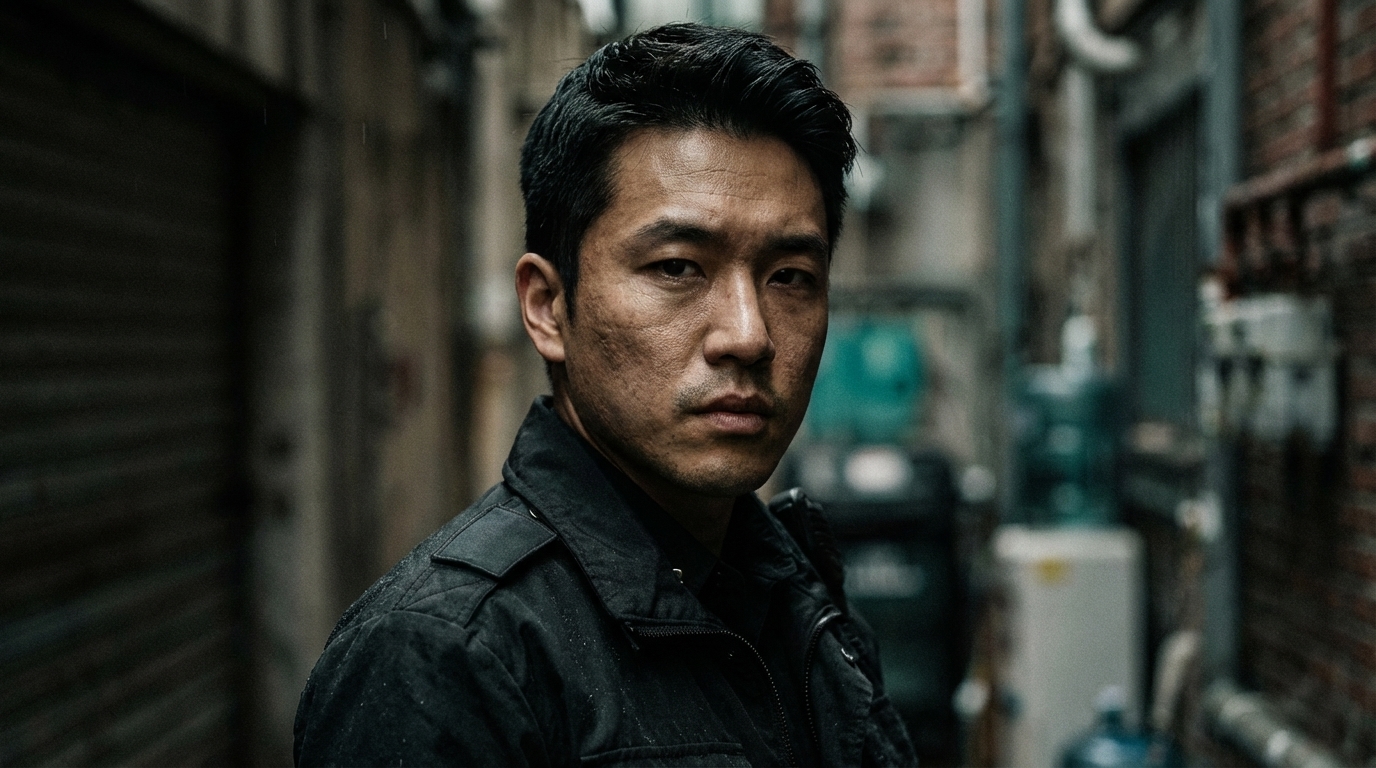
At five feet ten inches, Michael Chen possessed a slim, wiry frame that suggested endurance rather than raw strength—the build of a distance runner rather than a sprinter. His short black hair, maintained with the precision he applied to all aspects of his professional presentation, framed sharp brown eyes that colleagues described as attentive, even watchful. There was an earnestness to his youthful features that could read as inexperience to those who mistook surface for substance.
He wore his uniform with visible pride, ensuring that every element met regulation standards, that badges sat precisely positioned, that shoes maintained the shine instilled during academy training. This meticulousness extended beyond mere appearance to encompass the equipment and documentation that officers carried—his pocket notebook remained organised, his belt kit arranged for efficient access, his patrol vehicle maintained in condition that passing inspections had never required.
The overall impression was of a young man deeply invested in representing his profession well, perhaps too deeply aware of the weight his uniform carried. Some members of the public found this seriousness reassuring; others found it slightly intimidating, the earnest intensity of youth not yet tempered by the pragmatic flexibility that experience eventually brings.
Character and Professional Approach
Michael Chen approached police work as a vocation demanding continuous development rather than a job requiring mere competence. His participation in specialised training opportunities reflected genuine commitment to professional growth, not merely career advancement. He studied operational debriefs with the same attention he had once applied to university coursework, seeking to extract lessons from both successes and failures.
This dedication existed alongside certain limitations that honest assessment required acknowledging. Michael's systematic nature, so valuable for evidence handling and procedural compliance, could manifest as inflexibility when circumstances demanded adaptive response. His comfort with structure sometimes struggled against the ambiguity that real-world policing regularly presented. His seriousness, though marking genuine commitment, occasionally impeded the casual rapport that facilitated community relationships.
He maintained few close friendships among his colleagues, not from any antisocial tendency but from a natural reserve that limited social interaction to professional contexts. After shifts, when others gathered at local establishments to decompress, Michael typically returned to the Lenah Valley home he still shared with his parents, finding restoration in familiar surroundings rather than social engagement. This pattern attracted occasional good-natured teasing from colleagues but little genuine concern—many officers maintained boundaries between professional and personal lives.
His relationship with his family remained close despite the demands of shift work. Sunday dinners at the Chen household continued when rosters permitted, connecting Michael to the community networks his parents had built over decades. His grandmother Helen, now in her eighties, took particular pride in her grandson's uniform, seeing in his service an expression of values she had brought from Hong Kong half a century earlier.







