Michael James Marshall
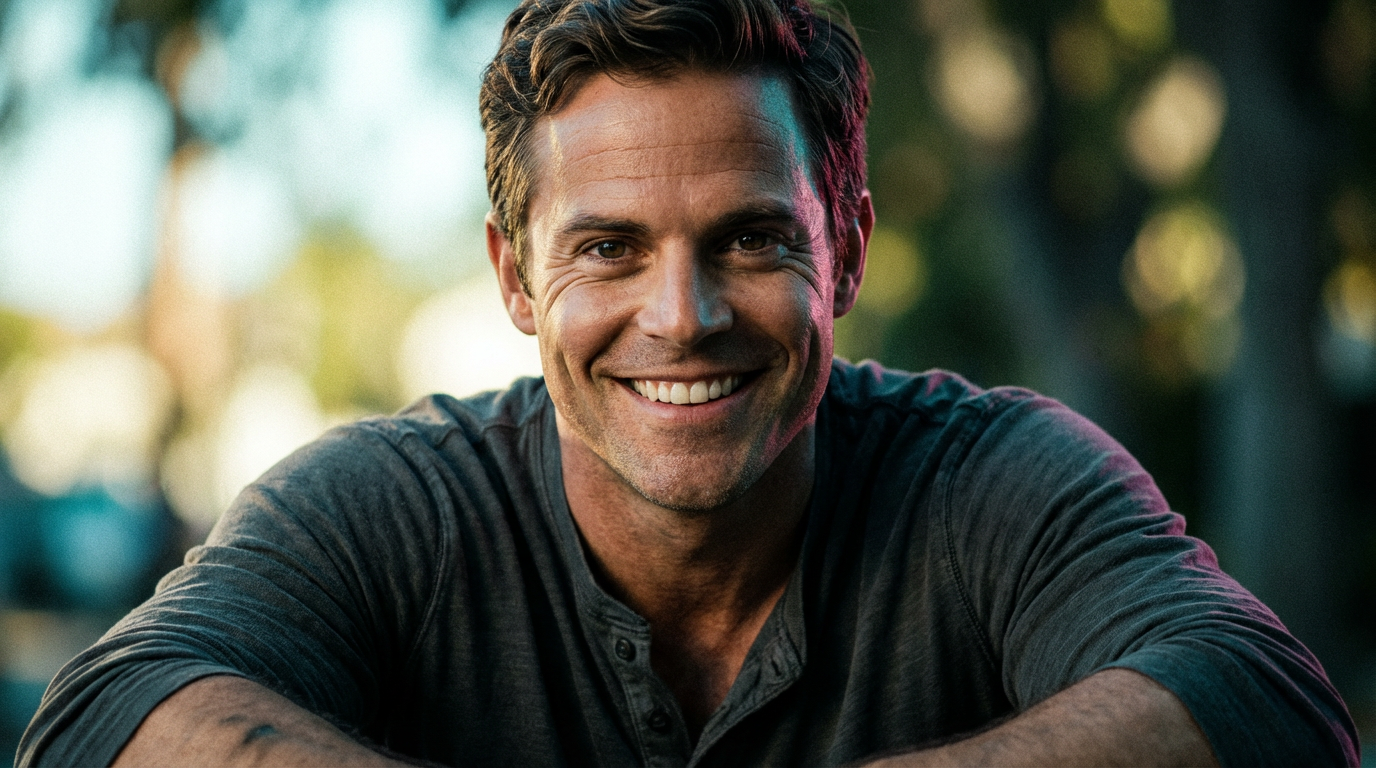
Michael James Marshall was born on 22nd June 1984 in Salt Lake City, Utah, the second of six children of insurance adjuster Gregory Marshall and schoolteacher Margaret Jensen. The family's most easygoing member, he trained in aviation maintenance at Salt Lake Community College, served a Latter-day Saint mission in Calgary, Canada, and built a career as a senior aircraft technician at SkyWest Airlines at Salt Lake City International Airport. He married paramedic Sarah Novak in 2014, and their two children, Owen and Lily, inherited his mechanical curiosity.
The Pressure Valve
Michael James Marshall was born on 22nd June 1984 at LDS Hospital in Salt Lake City, Utah, the second child of Gregory Alan Marshall and Margaret Louise Marshall (née Jensen). He arrived two and a half years after David, into a household that had already begun to organise itself around expectations, and his first significant contribution to the Marshall family dynamic was to demonstrate that expectations could be cheerfully, comprehensively ignored without the world ending.
Gregory, born on 2nd April 1955, had been a lifeguard and swim instructor before settling into a career as an insurance adjuster, and he brought to fatherhood the same disciplined earnestness he brought to risk assessment — every milestone monitored, every behaviour calibrated against a standard that existed more clearly in his head than it did in any parenting manual. Margaret, born on 19th August 1958, taught third grade at Wasatch Elementary with a patience that extended seamlessly into the home, though with two sons under three she discovered that patience was a resource with a finite supply. David, the eldest, had already established himself as the kind of child who made parenting look deceptively simple — obedient, serious, quietly deferential to the household's rhythms. Michael, by contrast, was the kind of child who took the toaster apart at age four to see how it worked and then reassembled it with one screw left over, a surplus he presented to Margaret with a grin that suggested he considered the disassembly a complete success regardless.
The Marshall household in the Avenues neighbourhood expanded around Michael in stages he mostly absorbed without drama. Rachel Ann arrived on 5th March 1986, two years his junior and already, from infancy, possessed of an organisational ferocity that Michael found impressive and slightly alarming. William Jacob followed on 12th September 1989, quiet and intense, a boy who would disappear into the discipline of competitive swimming with a focus that Michael admired but could not replicate. Eric Daniel came on 9th November 1992, watchful and analytical, content with a chessboard and the company of his own calculations. And Jared Nathan, the youngest, arrived on 15th May 1995, screaming with the specific enthusiasm of a child who intended to be heard, and Michael — eleven years old, already the family's most reliable source of comic relief — held his baby brother and announced that the Marshall household had finally produced someone louder than him.
In a family where each child seemed to arrive with an assignment — David the achiever, Rachel the organiser, Will the athlete, Eric the analyst, Jared the adventurer — Michael's role was less defined and more essential. He was the pressure valve. When Gregory's expectations tightened around one sibling or another, when the atmosphere at the dinner table shifted from structured to strained, it was Michael who produced the remark, the observation, the perfectly timed absurdity that allowed everyone to exhale. This was not a talent he developed. It was something closer to instinct — the second child's intuition that the household's equilibrium depended on someone not taking it all quite so seriously, and that the someone might as well be him.
Gregory's discipline, which David absorbed and Jared would later resist, landed on Michael and slid off. Not because Michael was defiant — he completed his chores, attended church, maintained the minimum academic standard that avoided scrutiny — but because he met correction with a good-natured compliance that gave Gregory nothing to push against. You couldn't argue with a boy who agreed with you before you'd finished the sentence and then went back to doing exactly what he'd been doing, slightly more carefully. Margaret understood her second son better than Gregory did. She saw in Michael's easy manner not laziness but a kind of emotional intelligence that the rest of the family, in their various intensities, lacked. He read rooms. He knew when to joke and when to be quiet. He knew, without being told, which sibling needed what and when. These were not qualities that appeared on report cards, but Margaret valued them more than grades.
Grease and Gravity
Michael entered Wasatch Elementary in 1989, joining the school where his mother taught third grade. His academic performance was consistently middling — not poor enough to prompt intervention, not strong enough to prompt celebration. Teachers described him as sociable, well-liked, and "full of potential," the last phrase deployed with the same hopeful vagueness it would later be applied to Jared. Michael's intelligence was real but non-academic. He understood systems by taking them apart, not by reading about them. His science fair projects were the most mechanically ambitious in his year — a working pulley system in fourth grade, a crude hydraulic press in fifth — and they earned him respectable marks and the particular attention of shop teachers who recognised a different kind of aptitude.
At Bryant Middle School, which he attended from 1995, the mechanical interests deepened. He spent lunch breaks in the school's technology workshop, where a patient instructor named Mr Galvez let him tinker with small engines and electrical circuits. Michael discovered in the logic of machines something that formal education had never offered him: a world where problems had definitive solutions, where a thing either worked or it didn't, where the satisfaction of a correctly diagnosed fault was as immediate and physical as the click of a component slotting into place. He was, by temperament and talent, a mechanic. He just hadn't yet found the machines worthy of his attention.
West High School, which Michael entered in 1997, provided both clarity and complication. He performed adequately in core subjects, excelled in the school's limited shop classes, and developed a social life that was expansive in a way David's had never been. Michael was popular — not with the sharp-edged popularity of the athletic or the wealthy, but with the warmer, more durable currency of a boy who was genuinely interested in people and who could make anyone laugh. He played basketball without distinction and guitar without formal training, picked up both skills with the breezy competence of someone for whom physical coordination came naturally, and put neither down permanently because neither required the kind of sustained commitment that felt, to Michael, like a cage.
He also discovered, during a career day visit in his junior year, what he wanted to do with his life. A representative from a regional airline spoke about aviation maintenance — the inspection, repair, and overhaul of commercial aircraft — and something in the description caught Michael with a force that no classroom lesson ever had. The scale of the machines. The precision of the work. The non-negotiable consequences of error. Aircraft maintenance was not tinkering; it was craft at the highest stakes, where the difference between a properly torqued bolt and a careless one was measured in human lives. Michael went home that evening and announced at dinner that he intended to work on aeroplanes. Gregory, who had hoped for something more conventionally ambitious, said nothing. Margaret said it sounded wonderful. David, home from his first year of university, raised an eyebrow and asked whether Michael had considered the mathematics involved. Michael said he had, which was a lie, and that he'd figure it out, which turned out to be true.
He graduated from West High in the spring of 2001, his academic record unremarkable and his sense of direction, for the first time, clear.
The Easy Missionary
Michael enrolled in the Aviation Maintenance Technology programme at Salt Lake Community College in the autumn of 2001, beginning the coursework and practical training required for certification by the Federal Aviation Administration. The work suited him immediately — the combination of theoretical study and hands-on application, the disciplined sequences of inspection and repair, the tools whose names he learned with a pleasure that bordered on affection. His instructors noted a student who was methodical in the workshop and easily distracted in the lecture hall, but whose practical skills were among the strongest in the cohort.
He was eighteen months into the programme when the question of a mission could no longer be deferred. David had served in Chile. Rachel was preparing for her own service. Gregory's expectation was unambiguous, and Michael — who had spent his entire life avoiding confrontation by meeting it with compliance — submitted his mission papers in the spring of 2003 and received his call to the Canada Calgary Mission that summer. He deferred his aviation studies, packed a single suitcase, and departed in August with the good-natured acceptance of a man who understood that two years of missionary service was the price of peace with his father and that the price, all things considered, was manageable.
Canada suited Michael in ways that surprised nobody who knew him. The Calgary Mission covered southern Alberta, a landscape of prairie and foothills that bore a certain resemblance to the mountain West he'd grown up in, populated by people whose reserve and politeness Michael navigated with his characteristic ease. He was not, by any measure, the mission's most fervent proselytiser. He did not experience the spiritual epiphanies that some missionaries described, nor the grinding crises of faith that others endured. He simply showed up, day after day, with a warmth and genuineness that made people willing to listen even when they had no intention of converting. His companions liked him. His mission president valued his steadiness. The families he taught remembered him fondly, not for the doctrines he delivered but for the way he fixed the kitchen tap while he was there, or the joke he told that made the children laugh so hard they forgot to be suspicious of the strangers in white shirts.
He returned to Salt Lake City in August 2005, twenty-one years old, and resumed his aviation maintenance programme at Salt Lake Community College without the existential recalibration that missions produced in some of his siblings. The experience had been good. He was glad he'd gone. He didn't think about it much afterwards, which was perhaps the most Michael thing about it.
Torque and Clearance
Michael completed his FAA Airframe and Powerplant certification in the spring of 2007 and was hired within weeks by SkyWest Airlines, the regional carrier headquartered in St George, Utah, whose fleet of Bombardier and Embraer regional jets serviced routes across the western United States. His assignment was to the airline's maintenance base at Salt Lake City International Airport, a posting that kept him close to the family while immersing him in the work he had been building toward since career day at West High.
The reality of aviation maintenance was less glamorous and more satisfying than its description suggested. Michael's days began before dawn in hangars that were cavernous, fluorescent-lit, and cold in winter. He inspected landing gear, replaced hydraulic actuators, troubleshot avionics systems, and performed the hundred small verifications that kept aircraft safe between the larger scheduled overhauls. The work demanded a combination of technical knowledge, physical dexterity, and absolute attention to detail — every task documented, every component traceable, every signature on a maintenance log carrying the implicit promise that the aircraft was safe to fly. Michael thrived. The casual, shrugging exterior that his family knew concealed a professional seriousness that his colleagues recognised immediately. In the hangar, there was no room for approximation, and Michael, who had spent his life treating most things lightly, discovered that having one thing he treated with total gravity was not a burden but a relief.
He advanced steadily. By 2012, he held a senior technician role overseeing a small team of mechanics, his practical expertise supplemented by a growing ability to diagnose complex faults that eluded more theoretically trained colleagues. His hands, which Margaret still remembered taking apart the toaster, had become instruments of remarkable precision — capable of feeling a worn bearing through a glove, of sensing a misalignment that gauges hadn't yet registered. His supervisors described him as the mechanic you wanted on the difficult jobs, the one who'd stay past his shift to solve a problem rather than pass it to the next crew, not out of martyrdom but because leaving a puzzle unfinished was physically uncomfortable to him.
He met Sarah Ellen Novak at a barbecue hosted by a colleague in the summer of 2011. Sarah, born in 1986, was a paramedic with the Salt Lake City Fire Department — a woman whose daily life, like Michael's, revolved around competence under pressure and the unsentimental management of systems that had to work. She was direct, funny, and entirely unimpressed by charm, which presented Michael with the novel experience of having to be interesting rather than merely likeable. Their courtship unfolded over eighteen months of dinners, hikes, and a mutual discovery that two people who spent their working lives keeping other people safe could, in each other's company, stop performing and simply exist.
They married on 10th May 2014 at a ceremony in the Avenues house backyard that Margaret spent weeks preparing and that Michael, characteristically, described afterwards as "nice." Gregory approved of Sarah — her competence and practicality aligned with the virtues he valued — and Margaret loved her with the uncomplicated warmth she extended to anyone who made her children happy. The ceremony was held outside the temple, a decision that reflected both Sarah's non-member status and Michael's own quiet accommodation with a faith he practiced without intensity. Gregory noticed. He chose not to raise it, which was, by Gregory's standards, an act of considerable restraint.
Their son, Owen Gregory Marshall, was born on 3rd March 2016, and their daughter, Lily Margaret Marshall, followed on 19th October 2018. Michael approached fatherhood with an ease that simultaneously delighted and bewildered his own parents. He was patient without being permissive, present without being anxious, and capable of producing the kind of physical, roughhousing joy that his own father had never quite managed. Owen, who inherited his father's mechanical curiosity, was taking apart household items by the age of four with a proficiency that made Michael proud and Sarah exasperated. Lily, more temperamentally aligned with her mother, regarded the disassembly with the cool assessment of someone already calculating the cleanup.
The One They Called
Michael and Sarah settled in a modest ranch house in the Rose Park neighbourhood, ten minutes from the airport and fifteen from the Avenues, a proximity that made Michael the most physically accessible of the Marshall siblings and, by extension, the most frequently called upon. He was the brother who helped Will move furniture after Lisa's departure. He was the brother who drove Jared to the airport for his seasonal postings. He was the brother who sat with Gregory in the hospital waiting room when a minor cardiac episode in 2021 required an overnight stay, not because the other siblings didn't care but because Michael was there, and being there was the thing he had always been best at.
His relationship with Jared was the family's most uncomplicated bond. Michael had recognised in his youngest brother, from Jared's earliest childhood, a kinship of temperament — both were hands-on, both were restless in classrooms, both found meaning in physical work rather than abstraction. When Jared returned from his wandering years, it was Michael who suggested he try mechanical work, and when that led to the repair shop job that preceded Jared's nomadic period, Michael took a quiet satisfaction in having opened a door even if Jared ultimately walked through a different one. They spoke on the phone without agenda, saw each other at family gatherings without the weighted subtext that characterised some sibling relationships, and shared the particular ease of two people who had never needed to explain themselves to each other.
With Will, the connection was different — deeper and more careful. Michael had watched his younger brother's marriage, his quiet flourishing, and then the slow devastation of Lisa's departure with the helpless attention of a man who could fix aircraft but couldn't fix grief. He showed up at Will's house in the months after Lisa left, not with Jared's coffee and Saturday-morning constancy but with practical offerings: a repaired gutter, a rewired light switch, a working knowledge of Will's ageing furnace that meant the call at two in the morning on a January night went to Michael rather than to a contractor. It was love expressed in the language he knew best — the language of things that worked because someone had taken the time to make them work.
The Clivilius revelation had landed on Michael with the particular disorientation of a man whose understanding of the world was fundamentally mechanical. Portals to other dimensions did not fit within any system he could inspect, diagnose, or repair. He processed the information the way he processed most things that exceeded his technical framework: he accepted it, filed it under "things I can't fix," and turned his attention to what he could. He could be present for Will. He could make sure Gregory and Margaret were handling it. He could keep his own household steady, his own children safe, his own aircraft airworthy. These were not grand responses to an impossible situation. They were Michael's responses, and they were enough.
At forty-one, Michael James Marshall was the Marshall sibling least likely to appear in anyone's account of the family's dramatic arc. He had no corner office in Denver, no consulting partnership, no canyon-and-mountain adventures, no wounded solitude. He had a house in Rose Park with a garage full of tools and a wife who loved him without needing to understand his family's complications. He had two children who disassembled things and a career that required him to put them back together. He had the phone number of every sibling saved in his favourites and the particular distinction of being the one they all called when they needed something done rather than something said. The toaster he'd taken apart at four was long gone, but the impulse remained: Michael Marshall looked at broken things and made them work. It was not the most dramatic vocation. It was, in its quiet way, the most necessary.







