Mia Rose Anderson
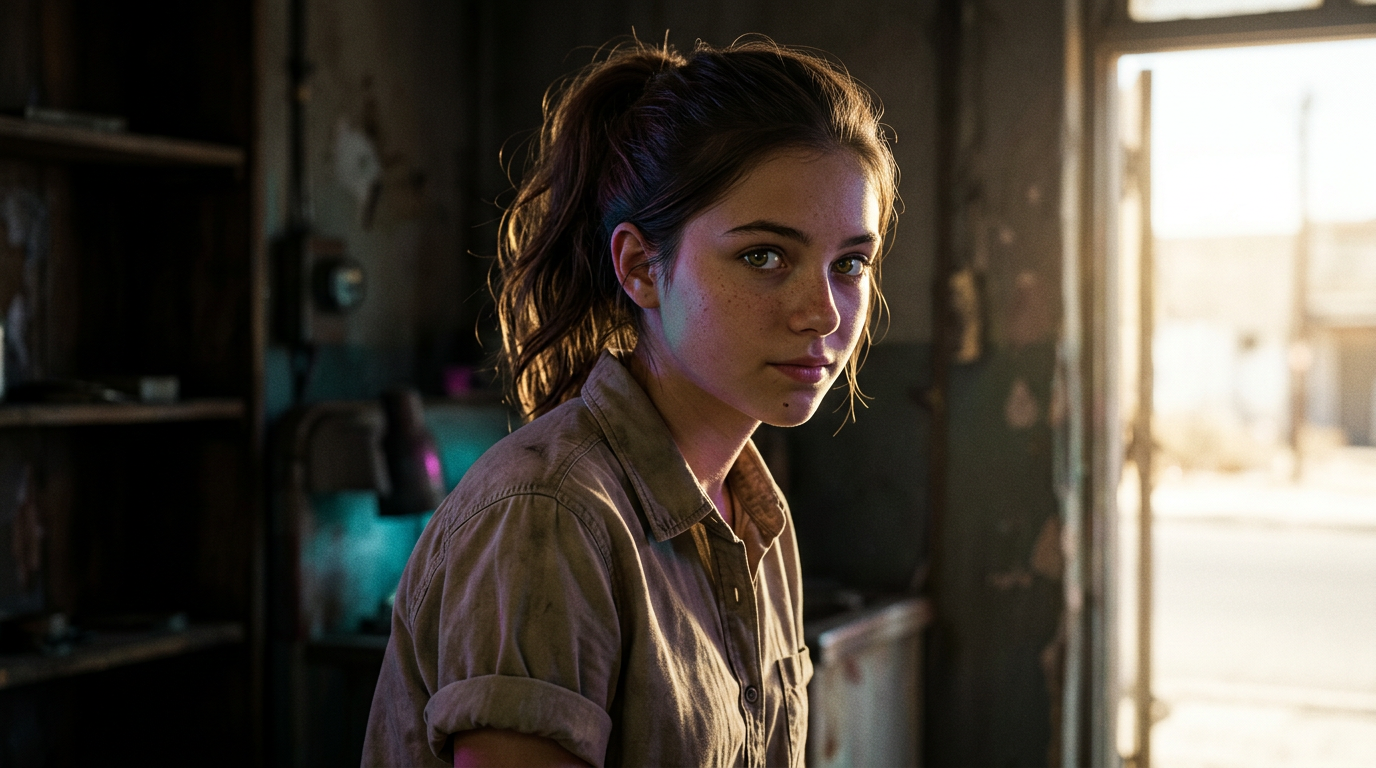
Mia Rose Anderson, born on 23 May 2009 in Brisbane, was the youngest child and only daughter of David Anderson, an environmental consultant, and Claire Anderson, a veterinary nurse. She grew up in Ashgrove with her older brothers Jack and Oliver. After the Brisbane school bus passed through a Portal into Clivilius on 5 August 2018, Mia applied her instinct for animal observation to the unfamiliar fauna of the new world, building a comprehensive set of behavioural field notebooks that became a valued resource for the growing settlement of Bixbus.
The Youngest Anderson
Mia Rose Anderson was born on 23 May 2009 at the Mater Mothers' Hospital in South Brisbane, the third child and only daughter of David Matthew Anderson, an environmental consultant, and Claire Elizabeth Anderson (née Mitchell), a veterinary nurse. The family lived in a weatherboard cottage in Ashgrove, a quiet inner suburb where the backyards were large enough for dogs and the streets were lined with jacarandas that dropped purple carpets across the footpaths every October. Mia arrived five years after her eldest brother, Jack David Anderson, born on 11 September 2003, and three years after the middle child, Oliver James Anderson, born on 27 March 2006.
David worked for a small consultancy in Fortitude Valley that assessed environmental impact for development applications — wetlands, koala corridors, sediment runoff into waterways. The work was steady rather than lucrative, and he approached it with the methodical patience of a man who believed that evidence, properly gathered, could change minds. He had grown up on a cattle property near Emerald, in central Queensland, where his parents, Graham and Patricia Anderson, had run beef on red soil country for three decades. David was the youngest of four — three brothers ahead of him — and the only one who had left the land.
He had studied environmental science at the University of Queensland and never returned to cattle work, though he kept his father's leather hat on a hook behind the back door and wore it on weekends when he mowed the lawn.
Claire had grown up in Ipswich, the daughter of Robert Mitchell, a fitter and turner at the Amberley RAAF base, and Denise Mitchell (née Holt), a school receptionist. She was the eldest of two — her brother, Steven, four years younger, worked as a paramedic on the Gold Coast. Claire had trained as a veterinary nurse at the TAFE in Ipswich and worked at a mixed-practice clinic in Toowong, where the caseload split roughly evenly between suburban pets and the occasional farm animal whose owner had driven in from the Lockyer Valley with a sick calf in the back of a ute.
She was good at her work — calm in emergencies, patient with anxious owners, practical about outcomes. She did not sentimentalise animals. She respected them, which was different, and the distinction shaped the household Mia grew up in.
The Ashgrove cottage was, at any given time, home to at least one dog, one cat, and whatever temporary resident Claire had brought home from the clinic — a possum with a broken leg, a galah that had flown into a window, a litter of kittens whose mother had been hit by a car. Jack and Oliver tolerated the animals. Mia absorbed them. She was three when she began following her mother's care routines without being asked — refilling water bowls, checking bandages, sitting beside recuperating animals with the silent attentiveness of a child who had decided that proximity was a form of medicine.
She was the smallest of the three Anderson children and the loudest, a combination that produced a particular domestic dynamic. Jack, steady and even-tempered, ignored her provocations with the benign indifference of a teenager whose interests had migrated to rugby league and his phone. Oliver engaged — the two of them argued with a fluency and commitment that David described, without affection, as exhausting. The arguments were never serious. They were the friction of two similar temperaments occupying the same house, and they ended as quickly as they began, usually when one of them said something that made the other laugh.
Fox Leggings and Field Guides
Mia entered Brisbane Grammar School in Prep in 2017, one year behind Jack, who was in Year 9, and three years behind Oliver, who was in Year 7. The bursary scheme that had brought several of the bus children to the school was not one the Andersons had used — David and Claire managed the fees through a combination of careful budgeting and the particular financial stubbornness of parents who believed the school's outdoor education programme was worth the strain on the mortgage.
Her teachers found her likeable and difficult to pin down. Her reading was strong — she consumed books about animals with the appetite of a child who treated the school library as a professional resource. Her writing was enthusiastic, detailed when the subject engaged her, and prone to tangents that wandered so far from the original topic that marking them required a kind of interpretive patience. Her numeracy was adequate. Not poor, not strong — the middling competence of a child whose attention was allocated entirely on the basis of interest, and whose interest in mathematics was precisely zero.
She drew constantly. Not with artistic ambition — the drawings were functional, record-keeping by other means. She drew the birds she saw on the walk to school, the insects in the playground, the neighbourhood cats whose territories she had mapped in a notebook she kept in her schoolbag. The drawings were labelled with names she looked up in a secondhand field guide her father had given her, and the labels were annotated with behavioural observations: "sits on same fence post every morning," "chases the brown one but not the black one," "comes when Mrs Kerrigan puts food out but won't eat if she watches." She was nine years old, and the observations were crude, but they were systematic, and the system was entirely her own invention.
She had opinions about everything and expressed them with a confidence that her teachers found alternately charming and trying. She corrected a classmate who called a magpie-lark a mudlark. She argued with a substitute teacher about whether snakes were slimy. She told Oliver, at the dinner table, that his claim about sharks being dangerous was statistically ignorant, a phrase she had picked up from David's work conversations and deployed without fully understanding its weight. Claire, who recognised her daughter's tendency to mistake certainty for knowledge, told her that being right was not the same as being kind, and Mia accepted the correction without changing her behaviour.
The field trip to D'Aguilar National Park was announced in July 2018. Mia, by then in Year 4, responded with an excitement that was notable mainly for its specificity. She did not want to go camping. She did not care about the campfire or the marshmallows or the sleeping bags. She wanted to see quoll habitat. She had read that the D'Aguilar range contained spotted-tailed quoll populations, and the prospect of observing one in the wild produced a level of focused preparation that her classroom work had never generated. She packed her field guide, her notebook, and a pencil case containing six sharpened pencils, because she intended to draw what she saw and she did not trust a single pencil to survive the trip.
Something Broke Besides the Bus
The bus departed Brisbane Grammar School on the morning of Saturday, 4 August 2018. Mia was seated in the middle section, next to a window, her notebook open on her lap. She had spent the first hour of the journey drawing the landscape as it changed from suburban to semi-rural, her annotations growing more frequent as the vegetation thickened and the species she could identify through the glass became more interesting than the ones she already knew.
At D'Aguilar, she was in her element in a way that the classroom had never produced. During the guided nature walk, she asked Susan Clarke questions that were specific enough to draw a pause before the answer — about the undergrowth composition, about the absence of certain birds she had expected to hear, about the scat she found on a trail and identified, correctly, as belonging to something larger than a possum. She did not find a quoll. She did not seem disappointed. The looking had been the point.
The bus departed the park on the morning of 5 August for the return journey. Mia had her notebook open again, the pages from the previous day filled with sketches and notes she intended to organise when she got home.
The bus passed through a Portal that opened across a road in the Brisbane suburbs and collided with vehicles on the far side, in the landscape of Clivilius. The impact threw Mia sideways into the window. Her left shoulder struck the glass with a force that cracked the pane and dislocated the joint — a sharp, immediate wrongness that she felt before she understood it, the arm hanging at an angle that her body recognised as incorrect before her mind caught up. Her notebook flew from her hands. The field guide, which had been wedged between her thigh and the seat, fell to the floor and was lost beneath the wreckage of displaced bags and broken fittings.
She did not scream. She sat in the seat with her left arm hanging wrong and her right hand gripping the seat back ahead of her, and she breathed in the careful, controlled way that she had seen her mother breathe when handling injured animals at the clinic — slow, deliberate, a rhythm imposed on panic. An adult reached her and immobilised the arm against her body with a folded jumper. The pain was a white, grinding presence that occupied her entire left side and made thinking about anything else an act of will.
She did not cry until later that evening, when the shoulder had been reduced and strapped and the pain had dulled to a heavy ache, and someone asked if she wanted to call her mother. The question, in that place, was nonsensical — there was no phone, no line, no mother to call — and the gap between the kindness of the question and the impossibility of its answer broke something in Mia that the crash itself had not touched. She cried quietly, her face turned away from the other children, and she did not mention her mother again for weeks.
The Quiet Notebook
The dislocated shoulder healed. The field guide was gone — buried in the wreckage of the bus, unrecoverable, its absence a loss that Mia felt more acutely than she could explain, because the guide had been her father's and it had contained his handwriting in the margins, notes from his own student fieldwork twenty years earlier, and those notes were now as unreachable as the man who had written them.
In the first weeks at the Bixbus settlement, Mia was quiet in a way that her brothers would not have recognised. The child who argued at dinner tables and corrected substitute teachers moved through the camp with a contained watchfulness that the adults interpreted as resilience and that was, in fact, a kind of reorientation. She was looking. She had always been looking — at birds, at insects, at the neighbourhood cats and their territories — and the habit did not stop because the world had changed. It adapted. She looked at the landscape of Clivilius with the same systematic attention she had once applied to the streets of Ashgrove, and what she saw was not familiar, but it was observable, and observation was the only skill she had that still worked.
She entered the Learning Grove in September 2018, nine years old, and Jenny Triffett placed her in an ability group that matched her reading strength and accommodated her mathematical indifference. Her academic work was competent without being exceptional — solid reading, clear writing when she chose to be clear, numeracy that she endured rather than engaged with. What Triffett noticed was the notebook. Mia had acquired a new one within the first week — salvaged paper bound with string — and she filled it not with schoolwork but with drawings of things she had seen in the landscape around the settlement.
The afternoon practical sessions drew her to the Haven of Wilds, as everyone expected. What nobody expected was what she did there. Lucas White, who had arrived at Haven of Wilds before her and whose work was physical — feeding, mucking out, monitoring the health of the animals — operated with the steady, hands-on competence of a boy whose value lay in what he could do. Mia's value lay in what she could see.
She did not gravitate toward the pens or the feeding schedules. She sat at the edges of the enclosures and watched, and what she watched was not the animals' needs but their behaviour — how they moved, when they moved, what triggered changes in activity, which animals associated with which.
The distinction between Mia's work and Lucas's was not immediately obvious to the adults supervising Haven of Wilds, who saw two children interested in animals and assumed the interest was the same. It was not. Lucas cared for animals. Mia studied them. The difference was temperamental and it was fundamental.
Lucas adjusted feed ratios by observing which animals ate less; Mia recorded why they ate less, noting correlations with weather, season, proximity to other species, and disturbances from settlement construction. Her notes were disorganised, her handwriting was poor, and her conclusions were sometimes wrong. But the observations themselves were careful, repeated, and genuinely useful — the Haven of Wilds supervisors began consulting her field notes when animals behaved unpredictably, because Mia had often recorded the precursors to the behaviour weeks before it occurred.
Patterns in the Margins
The transition to Bixbus School in late 2019 gave Mia a permanent building in which to be academically middling and practically exceptional. Her mornings were spent in classrooms where her reading remained strong, her writing remained tangential, and her mathematics remained the grudging minimum required to avoid intervention. Her teachers knew her pattern. They did not try to change it. The ability-based system meant she advanced where she was strong and received patient, undemanding instruction where she was not, and the arrangement suited a child whose intelligence was real but narrowly allocated.
Her afternoons were spent entirely at the Haven of Wilds, where her role had evolved from observer to something closer to resident naturalist. She maintained a growing collection of field notebooks — the salvaged-paper originals replaced, as Bixbus developed, by proper bound volumes — in which she documented the behaviour of every species the settlement had encountered. The notebooks were cross-referenced by date, location, weather conditions, and a categorisation system she had invented herself, borrowing loosely from the format she remembered from her father's field guide.
She was ten when she began the system. By twelve, she had four volumes. By fourteen, the volumes occupied a shelf in her quarters and represented the most comprehensive behavioural record of Bixbus fauna that the settlement possessed.
The work was solitary in a way that Mia's earlier life had not been. At the Ashgrove cottage, she had been surrounded — brothers, parents, animals, the noise and friction of a household that was never quiet. At Bixbus, she had friends, she was not isolated, but the hours she spent watching animals at the edges of enclosures and in the scrubland beyond the settlement's perimeter were hours spent alone, and the solitude changed her.
She became less argumentative. Not because the opinions had softened — they had not — but because the habit of watching had taught her that most things revealed themselves if you waited long enough, and the waiting required a patience that arguing did not.
She missed her family in a way that was specific to being the youngest. Jack and Oliver had been her daily irritants, her sparring partners, the people whose presence she had never thought to value because it had seemed permanent. Her mother's hands, competent and unsentimental, handling an injured animal with the same calm she applied to a grazed knee. Her father's voice explaining sediment maps at the kitchen table while Mia pretended not to listen and absorbed every word. The losses were particular and they surfaced at unexpected moments — a gesture by an adult that resembled her mother's, an evening light that looked like the light in the Ashgrove backyard, the absence of the dinner-table arguments that had structured her evenings for as long as she could remember.
She did not speak about these things. She wrote about them in the back pages of her field notebooks, in entries that were not labelled and not cross-referenced and that she would not have shown to anyone who asked. The front of the notebooks was science. The back was everything else.
The City and the Sanctuary
Bixbus grew. The settlement that Mia had arrived at as a nine-year-old — shipping containers, communal meals, dust — became something she could not have predicted. The Arlington's twin towers rose against the skyline in 2019. The railroad to Brierly was completed in 2020. By the time Mia was fourteen, the place she lived was no longer a settlement but a city, with residential complexes that climbed above the treeline along the river. The transformation happened around her with a speed that made the early days feel like someone else's memory, and in some ways they were — the nine-year-old who had sat at the edge of an enclosure with a salvaged notebook bore little resemblance to the teenager who walked paved streets to a proper school building and checked her field notes against the settlement's growing scientific infrastructure.
The Haven of Wilds remained her anchor, but her work had expanded beyond its fences. The Bixbus Wildlife Sanctuary, established as the city's conservation efforts formalised, drew on the kind of behavioural data that Mia had been collecting for years. She was not the sanctuary's principal researcher — she was fifteen, and the adults who ran the operation had qualifications and experience she did not — but her notebooks were consulted, her observations were cited, and her understanding of animal behaviour was treated with a seriousness that would have surprised her Year 4 teachers at Brisbane Grammar, who had seen a chatty girl with fox-print leggings and a tendency to correct people.
Her social world at sixteen was small and deliberate. She kept a handful of close friendships, maintained with the same patient attention she applied to her field observations. She was still opinionated — the dinner-table arguers of Ashgrove had produced a permanent tendency — but the opinions were better informed now, grounded in years of watching and recording, and she deployed them with a precision that her younger self had lacked. She laughed easily. She could be sharp. She was not unkind, but she had inherited her mother's intolerance for sentimentality about animals, and she corrected people who anthropomorphised Clivilius fauna with a directness that was occasionally bruising.
The Clivilius National University's Conservation Biology programme was the obvious next step, and Mia knew it. She had visited the campus along the south-eastern banks of the Bixbus River, walked through the Environmental Sciences building, and looked at the curriculum with the focused assessment of a student who already knew what she wanted to study and was evaluating whether the institution could teach her anything she had not already taught herself. The answer, she conceded, was yes — the programme's research methods and data analysis components addressed the precise weakness in her self-taught approach. Her field observations were good. Her ability to analyse them systematically was not, and she was honest enough to recognise the gap.







