Mia Lifen Chen
Mia Lifen Chen, born on 7 August 1988 at the Burnside War Memorial Hospital in Adelaide, was the second child of Wei Chen, a draughtsman who had emigrated from Guangzhou, and pharmacist Jing Chen (née Huang). She studied forensic and analytical science at Flinders University before joining the South Australia Police in 2009, building a career as a forensic crime scene specialist. Married to secondary school teacher James Robert Ashworth, she had two children and held the rank of Senior Constable in the Crime Scene Examination Unit.
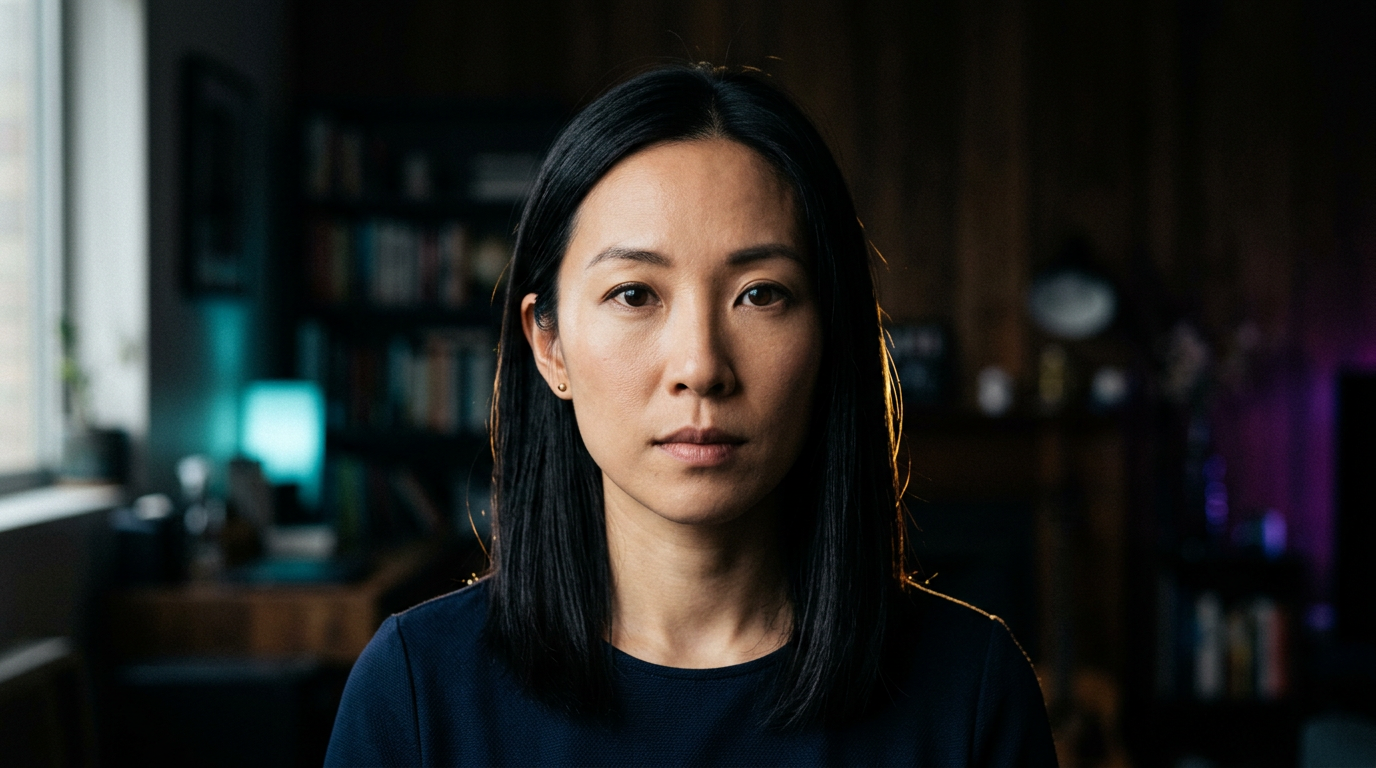
The Pharmacist's Daughter
Mia Lifen Chen was born on 7 August 1988 at the Burnside War Memorial Hospital in the eastern suburbs of Adelaide, the second child and only daughter of Wei Chen and Jing Chen (née Huang). Wei had arrived in Australia in 1982 from Guangzhou on a skilled migration visa, carrying qualifications in mechanical engineering that the University of Adelaide declined to recognise in full. He spent his first two years in the country completing bridging courses while working night shifts at a packaging factory in Regency Park, and by 1985 had secured a position as a draughtsman at an engineering consultancy in the city. He would remain a draughtsman for twenty-three years. The title never reflected his capability, and he never said so.
Jing had trained as a pharmacist at the Sun Yat-sen University in Guangzhou and followed Wei to Adelaide in 1984, six months after their marriage. Her qualifications transferred more readily than his, and after completing the Australian Pharmacy Examining Council examinations she found work at a community pharmacy in Norwood. She stayed there for three decades, dispensing medication and offering quiet, precise health advice to customers who came to trust her judgment as much as their doctor's. The pharmacy's owner, an elderly Greek man named Stavros Papadimitriou, treated Jing like a colleague rather than an employee, and the warmth of that small shop on The Parade became one of the fixed points of Mia's childhood.
The family lived on a tree-lined street in Kensington, in a red brick semi-detached house that Wei and Jing had purchased in 1987 with a deposit saved over five years of careful, almost austere budgeting. The house was modest by the standards of the eastern suburbs — two bedrooms, a narrow kitchen, a backyard just large enough for Jing's vegetable garden — but the suburb itself carried a respectability that mattered to Jing more than she would have admitted. Kensington was not wealthy. It was orderly, quiet, and close to good schools, and for a woman who had left everything familiar at twenty-six to follow a husband to a country she had never seen, these qualities constituted a kind of safety.
Mia's older brother, David Wei Chen, born on 19 January 1986, was the child who fulfilled their parents' ambitions without apparent effort or resentment. He was academically gifted in the way that made teachers use the word "exceptional" in reports — top of his year in mathematics and physics at Marryatville High School, a recipient of a National Science Olympiad medal in Year 11, and eventually a graduate of medicine at the University of Adelaide. David became a radiologist. He married a paediatric registrar named Sarah Lin, bought a house in Toorak Gardens, and produced two children whose photographs occupied the central position on Jing's mantlepiece. He was, in the economy of a Chinese immigrant household, the proof that the sacrifice had been worth it.
Mia was not David. The comparison was never stated so bluntly — Wei and Jing were not cruel parents — but it was present in the house like furniture, something you navigated around without discussing. Mia was intelligent, diligent, and quietly observant, but she was not the kind of student who set exam curves or won academic prizes. She worked hard for marks that David achieved without visible effort, and the discrepancy taught her something that would prove more useful than any academic distinction: that competence was a practice, not a gift, and that the person who noticed what others missed was more valuable than the person who already knew the answer.
The Quiet Notebook
Mia attended Marryatville High School from 2001 to 2005, following David by two years. The school was a co-educational government school in the eastern suburbs with a strong academic reputation, particularly in the sciences, and it drew students from across the metropolitan area through its specialist music programme. Mia was not a music student. She was a science student who happened to sit still long enough to be good at everything without being exceptional at anything — a pattern that frustrated her teachers, who sensed potential she was not deploying, and satisfied her parents, who measured success in percentiles.
What distinguished Mia at school was not academic performance but a habit of observation that her biology teacher, a meticulous woman named Dr. Patricia Holloway, was the first to name explicitly. Mia kept a notebook — not for class notes, but for things she noticed. The way condensation formed differently on the inside of the science lab windows depending on how many students were in the room. The pattern of shoe prints in the mud near the oval after rain. The fact that the library's fluorescent lights flickered at a specific frequency that changed when the air conditioning switched on. None of these observations had any practical application. All of them revealed a mind that processed the physical world with unusual attentiveness to detail.
Dr. Holloway encouraged Mia to consider forensic science — a discipline that married observation with methodology in exactly the way Mia's mind seemed to work. The suggestion landed. Mia had not previously considered a career in any specificity; like many teenagers, she had drifted toward the default expectations of her household, which pointed toward medicine, pharmacy, or engineering. Forensic science was none of these things, and Jing's response to the idea was a silence that lasted three days, which was how Jing expressed serious displeasure without saying a word that could later be quoted back at her.
Wei, who was quieter than Jing in most things but occasionally decisive in ways that settled an argument before it started, told Mia that she should study what interested her. He did not elaborate. He did not need to.
Trace Evidence
Mia enrolled in the Bachelor of Forensic and Analytical Science at Flinders University in 2006, a three-year degree that combined chemistry, biology, and the procedural framework of criminal investigation. The course was rigorous and specific — it trained students not merely in laboratory technique but in the chain of evidence, the legal standards for forensic testimony, and the particular discipline of observing a scene without contaminating it. Mia excelled. The coursework demanded exactly the qualities she possessed: patience, precision, and the ability to look at a scene and see what was there rather than what she expected to find.
She graduated in 2008 with first-class honours and a thesis on latent fingerprint recovery from porous surfaces, a piece of work that her supervisor described as methodologically impeccable and characteristically understated. The thesis reflected Mia's approach to everything: thorough, careful, and entirely devoid of the self-promotion that might have brought it wider attention.
The decision to join the police rather than pursue a research career or a position in a forensic laboratory surprised her parents and puzzled her brother. David, who understood ambition only in its vertical form — promotion, publication, professional standing — could not see why Mia would choose a uniformed service over a laboratory. Mia could not explain it in terms David would have found satisfying. What she knew was that forensic science in a laboratory was abstracted — samples arrived in bags, stripped of context, reduced to molecular components. She wanted to see the scene. She wanted to stand in the room where something had happened and read it the way other people read text, and for that she needed to be the person who arrived first, not the person who received the evidence afterwards.
She entered the South Australia Police Academy in early 2009 and graduated in November of the same year. Her instructors noted her discipline, her attention to procedural detail, and a composure under simulated pressure that bordered on unreadable — Mia did not panic, but she also did not display the visible calm that reassured others. She was simply still. Whether this constituted a strength or a limitation depended on the situation.
Blue Gloves
Mia was assigned to general duties at the Norwood police station, covering the eastern suburbs where she had grown up. She served two years in uniform before being selected for the Crime Scene Services section, a specialist unit within the South Australia Police responsible for the forensic examination of crime scenes, evidence collection, and the preparation of forensic reports for court proceedings. The posting was unusual for an officer with only two years of general duties — most candidates had five or more — but Mia's degree and her performance during initial crime scene training made her a natural fit.
She spent the next six years in Crime Scene Services, from 2012 to 2018, working across the metropolitan area. The work was painstaking, unglamorous, and psychologically demanding in ways that the forensic science degree had not prepared her for. A textbook described blood spatter patterns. A crime scene contained blood spatter patterns and the smell of what had produced them, and the sound of someone's family in the next room, and the knowledge that the precision of your work would determine whether the person responsible was convicted or walked free. Mia handled the psychological weight the same way she handled everything: by focusing on the task, by being meticulous, by trusting the process.
Her colleagues in Crime Scene Services respected her technical skill, which was formidable, and found her personally opaque, which was accurate. Mia was not unfriendly. She answered questions, participated in team briefings, attended the occasional social function. But she did not volunteer information about herself, did not engage in the casual personal disclosure that constituted the social currency of a police station, and did not appear to need the camaraderie that most officers relied on to manage the cumulative stress of the work. She was, in the words of one colleague who meant it as a compliment, "the best person you'd ever worked with and the hardest person to know."
She was promoted to Senior Constable in 2016, a recognition of consistent, high-quality service and the specialist expertise she had built. By that point she had processed hundreds of crime scenes, provided forensic testimony in over forty court cases, and trained a cohort of newer officers in evidence preservation techniques. She was twenty-eight and had never received a formal complaint, never lost an exhibit, never had a forensic finding successfully challenged under cross-examination. The record was remarkable. It was also, she understood, the product of care rather than brilliance — she simply refused to rush, refused to assume, refused to touch anything until she had looked at it long enough to be certain of what she was seeing.
The Shed Wall
On 1 August 2018, Mia was one of four officers dispatched to a residential property in Craigmore under Detective Kelly Muscat's operational command, acting on intelligence that a suspected serial killer was heading for the property. The team — Muscat, Mia, Constable Aaron Hughs, and Constable Jack Ridley — arrived to find a lived-in house with no occupants. The interior presented the controlled disorder of a household that bought in bulk: shelving half-cleared of food stores, a trolley of toilet paper, a white barrel on the rear patio. One officer remarked that the family appeared to be preppers. Kelly Muscat noted the assessment.
Mia moved along the side of the garden shed while the others worked the interior and the street. It was a habit — she gravitated toward the periphery of a scene, the edges where things accumulated that the main search might overlook. The blood was on the shed wall, smeared at a height consistent with an adult's arm. Fresh. Not dried, not oxidised, not old. She photographed it, marked it, and reported the finding to Muscat. The discovery changed the nature of the call entirely. A prepper household could be dismissed. A prepper household with unexplained fresh blood could not.
What followed — the two men vaulting the rear fence, Hughs's pursuit through the reserve, the impossible empty alley behind the Craigmore Shopping Centre — happened at a pace that left Mia at the shed, securing the scene she had just escalated. She did not see the chase. She did not see the alley. What she had was the blood, and when the forensic results confirmed it was Luke Smith's, she also had the confirmation that her observation had been the pivot point of the entire operation. The blood on the shed wall was the single piece of physical evidence that connected the house to Jenkins's intelligence from Hobart.
The experience confirmed what Mia had always believed about her role: that the person who found the evidence mattered as much as the person who chased the suspect, even if the two were never valued equally. She filed her report, catalogued the samples, and moved on to the next scene. The alley troubled Hughs. The operational outcome troubled Kelly Muscat. The blood on the shed wall, and the fact that it was there at all, troubled Mia — not as a mystery but as an anomaly, a trace that raised more questions than the investigation could answer.
The House That Worked
Mia met James Robert Ashworth at a mutual friend's barbecue in Norwood in November 2013, four years into her police career. James was a secondary school English teacher at Glenunga International High School, thirty at the time, a man from country South Australia — his parents ran a mixed farm near Strathalbyn — who had moved to Adelaide for university and never returned. He was talkative, warm, and disorganised in the way of people who were fundamentally competent but could not keep a calendar. Mia found the disorganisation baffling and the warmth disarming, and the combination produced in her something she had not expected: the desire to be around someone who was nothing like her.
They married on 15 March 2016 at the Adelaide Botanic Garden, a small ceremony attended by forty guests. Jing wore the expression of a woman who had opinions about the groom's family — the Ashworths were friendly, rural, and entirely unfamiliar with the social codes Jing had spent thirty years maintaining — but who had decided, on balance, that her daughter's happiness outweighed the satisfaction of voicing them. Wei shook James's hand and told him to look after Mia, which was the most Wei had ever said about his daughter's personal life.
Their first child, Oliver James Ashworth-Chen, was born on 2 December 2017. Their second, Grace Lifen Ashworth-Chen, followed on 28 April 2020. The children carried both surnames because Mia insisted and James agreed without argument — he understood, in a way that did not require explanation, that the name was not about him. It was about Jing and Wei, about the journey from Guangzhou to Kensington, about the fact that a name was the one thing you could carry across an ocean and still have when you arrived.
The marriage worked. This was notable primarily because Mia had never expected it to. She had grown up watching Wei and Jing maintain a household with efficiency and mutual respect but very little visible affection — they did not argue, did not touch in front of the children, did not discuss their feelings because feelings were not, in the economy of their household, a category that required discussion. Mia had absorbed this model so completely that the experience of being married to a man who said "I love you" before leaving for work every morning required a kind of recalibration she found both welcome and exhausting.
She was a good mother in the way she was a good forensic officer: attentive, thorough, and more comfortable with the logistical demands of the role than the emotional ones. She packed lunches with the precision of someone preparing an exhibit bag. She attended every school event, arrived on time, sat in the correct seat, and left with the correct child. What she found harder — what James gently and repeatedly pointed out — was the part that could not be scheduled: the spontaneous cuddle, the bedtime story that went off-script, the willingness to sit on the floor and do nothing productive with a child who wanted only her presence, not her competence.
James did not frame this as criticism. He framed it as observation, which was the language Mia understood. She heard him. She tried. The trying was visible and sometimes effortful, and Grace, who was too young to notice, benefited from it without knowing. Oliver, who was old enough to sense the difference between a mother who was present and a mother who was practising being present, loved her with the uncomplicated trust of a child who did not yet understand that love could be a skill some people had to learn.
The Quiet Register
After Craigmore, Mia returned to Crime Scene Services and continued the work she had been doing for six years. She processed scenes, collected evidence, wrote reports, and testified in court with a composure that barristers found impossible to rattle and juries found impossible to read. She was promoted to the rank of First Class Constable in 2019, a recognition of specialist service, and was appointed to a senior forensic role within the Crime Scene Examination Unit, supervising a team of four officers responsible for major crime scenes across the northern and eastern suburbs.
The supervisory role suited her technical skills and exposed her interpersonal limitations. Mia could teach an officer how to process a scene with a precision that bordered on artistry. She could not, with the same facility, ask them how they were coping after a particularly difficult callout, or recognise that a team member's declining performance was a symptom of burnout rather than carelessness. She learned to do these things — James helped, Francesca-like, by asking her questions about her team the way she asked questions about a crime scene, until she developed the habit of observation in a social register — but the learning was effortful and never became instinctive.
Jing, who had retired from the pharmacy in 2021 at sixty-three, helped with the children two days a week and maintained a commentary on Mia's domestic arrangements that was delivered in Cantonese and therefore, Jing believed, invisible to James. It was not invisible to James, who had learned enough Cantonese over eight years of marriage to understand the general direction of his mother-in-law's observations, if not their precise wording. He found this amusing. Mia found it mortifying in a way that was itself a kind of intimacy — the specific embarrassment of being known by two people who loved you from entirely different directions.
Wei had been diagnosed with type 2 diabetes in 2018 and managed it with the same quiet discipline he applied to everything, adjusting his diet without complaint and walking forty minutes every morning along the Kensington cycle path. He was seventy and still working part-time as a consultant draughtsman, not because he needed the money but because the work gave his days a structure that retirement would not. Mia understood this. She had inherited her father's relationship with routine — the need for a framework, for things in their correct place, for the day to proceed in an order that could be anticipated and controlled.
By thirty-seven, Mia Lifen Chen lived in a three-bedroom house in Beulah Park with a husband who loved her in a way she was still learning to receive, two children whose lives she managed with forensic precision and whose emotional needs she attended to with increasing, if imperfect, grace. She held the rank of Senior Constable in the Crime Scene Examination Unit of the South Australia Police, where she was regarded as one of the most capable forensic officers in the state and one of the least likely to tell you anything about herself that was not directly relevant to the task at hand.
She drove to Kensington on Saturdays for lunch with her parents, where Jing served dishes that had not changed in thirty years and Wei asked Oliver about school in a way that suggested he was asking about more than school. David and Sarah came when they could, which was not often, and when they did the conversation settled into the particular rhythm of a family that had achieved everything it set out to achieve and did not quite know what to do with the silence that followed.
Mia did not mind the silence. She had spent her entire career listening to what silence contained — the trace evidence of lives that had passed through a space and left marks that only patience could reveal. She brought the same attention to her family, to her marriage, to the small house in Beulah Park where James left his marking on the kitchen table and Oliver's school shoes were never where she had put them and Grace drew pictures on the backs of envelopes that Mia kept in a drawer in her desk at work because throwing them away was unthinkable and putting them on the fridge was a kind of display she had not yet learned to be comfortable with.







