Maxwell Alastair Blackwood
Maxwell Alastair Blackwood (1940–1974) was the son of Dr Alastair Prometheus Blackwood and the second Chief Executive of the Obsidian Healthcare Group, a position he held for three years before his unexplained death in Sydney at the age of thirty-three. Groomed from childhood for institutional succession, educated at Scotch College, the University of Melbourne, and the London School of Economics, he inherited an organisation whose visible operations he modernised and whose concealed dimensions he discovered too late to survive.
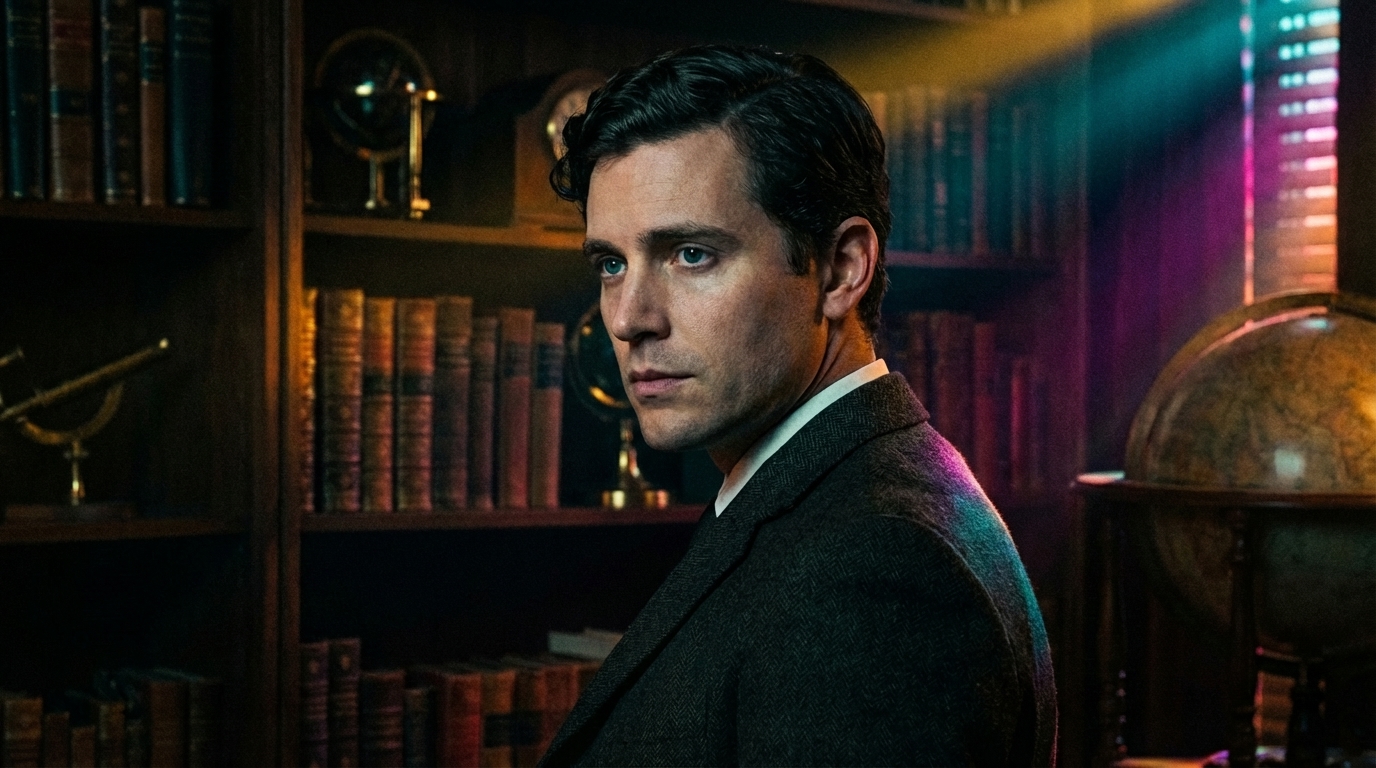
The Engineered Son
Maxwell Alastair Blackwood was born on 12 June 1940 in Melbourne, the first child of Dr Alastair Prometheus Blackwood, founder of the Obsidian Healthcare Group, and Margaret Helen Blackwood, née Stevenson, the daughter of a Melbourne financier whose social connections and sustained discretion provided the domestic architecture within which Alastair's career operated. Maxwell's arrival was registered by his father with the particular satisfaction of a man who regarded lineage as an instrument of institutional continuity — the heir had arrived, and the succession planning that Alastair approached with the methodical attention he brought to experimental protocols could begin.
His sister Victoria Evelyn followed on 4 March 1943. The household in which both children grew up was substantial, affluent, and governed by a father whose presence was intermittent and whose absences were not explained. The residence accommodated laboratories, locked study rooms, and a greenhouse whose botanical contents Alastair cultivated with an attention he did not extend to his domestic relationships. Margaret managed the household, the children's upbringing, and the social programme that Alastair's professional position required, compensating as far as compensation was possible for a father whose engagement with his son operated according to institutional criteria rather than parental ones and whose engagement with his daughter was more limited still.
Education
Maxwell attended Scotch College in Melbourne, where he excelled in the sciences — particularly chemistry and biology — and demonstrated the leadership capabilities that his father's assessment protocol valued. He was an active member of the debating team and the rowing club, his performances in both reflecting the strategic thinking and competitive energy that Alastair's early evaluation of his son had identified as the qualities most useful for the role he was being prepared to occupy. He graduated with honours in 1957, the academic achievement confirming what the assessment had predicted without revealing whether the boy's capabilities reflected genuine aptitude or the particular form of compliance that sustained paternal attention produced in a child who had learned that his father's interest was contingent upon his performance.
In 1958, Maxwell enrolled at the University of Melbourne to pursue a Bachelor of Commerce with a focus on business and management — a discipline that diverged from the medical and scientific training that the Blackwood family's recent history might have suggested and that reflected Alastair's calculation that Obsidian's next leader would need administrative capabilities rather than clinical ones. The father had built the organisation's scientific foundations; the son would manage its institutional expansion. Maxwell graduated with distinction in 1962, his academic record confirming the trajectory that Alastair's planning had established.
He travelled to the United Kingdom in 1963 to attend the London School of Economics, where he completed a Master of Business Administration with a specialisation in healthcare management. The London years broadened Maxwell's perspective in ways that his father's curriculum had not anticipated — exposure to international healthcare systems, to institutional governance structures whose transparency exceeded what Obsidian's culture permitted, and to colleagues whose assumptions about the relationship between corporate leadership and public accountability differed from the assumptions Maxwell had absorbed in Melbourne. He graduated with honours in 1964 and returned to Australia equipped with both the knowledge his father required and the questions his father had not intended him to develop.
Obsidian
Maxwell joined the Obsidian Healthcare Group in 1965 as a junior executive, entering the organisation whose leadership he had been prepared for since childhood. Under Alastair's mentorship — a term that described the process more palatably than "direction" or "installation" — he rotated through departments, absorbing operational knowledge and demonstrating the strategic capabilities that his education had developed. His approach to administrative modernisation was genuine and effective: he streamlined processes, improved efficiency, and brought to Obsidian's management practices a professionalism that the organisation's founder-led culture had not previously required. By 1968, he had been promoted to Director of Operations, overseeing the daily management of Obsidian's expanding network of facilities.
The promotion placed Maxwell at the boundary between the organisation's public operations and its private ones. The distinction had existed since Obsidian's founding — the visible infrastructure of hospitals, clinics, and research partnerships coexisting with restricted facilities, undisclosed programmes, and research activities whose nature was communicated only to personnel whose clearances Alastair personally controlled. Maxwell's operational authority brought him into proximity with the boundary in ways that his earlier, more circumscribed roles had not, and the questions that his London education had generated — about governance, about transparency, about the relationship between institutional authority and institutional accountability — acquired a specificity that abstract discussion had not provided.
Marriage and Family
Maxwell married Evelyn Rose Harris in 1965, the same year he joined Obsidian. Evelyn, born on 4 March 1942, was the daughter of a Melbourne family whose connections intersected with the Stevenson networks that Margaret's social management had maintained. The marriage was, by the standards of both families, appropriate — commercially connected, socially conventional, and conducted with the expectation that Evelyn would occupy the role that Blackwood wives had occupied for generations: the management of the domestic world that the husband's institutional life required.
Their daughter, Evelyn Rose Blackwood, was born on 19 August 1967. Maxwell proved a more attentive father than his own had been — the comparison was not difficult to surpass — and the domestic life he built with Evelyn during the late 1960s provided a stability whose value he appreciated with the particular awareness of a man who had grown up in a household where stability was maintained through concealment rather than through genuine safety. He took his family sailing along the Australian coast on weekends, collected contemporary art with an enthusiasm that suggested aesthetic sensibility rather than investment strategy, and supported charitable organisations focused on healthcare and education with a generosity that reflected both genuine conviction and the institutional expectation that Obsidian's leadership should demonstrate public beneficence.
Chief Executive
Maxwell succeeded his father as Chief Executive of the Obsidian Healthcare Group in 1971. The transition was the culmination of the succession plan that Alastair had designed and executed across three decades — the son installed in the position the father had built, the institutional architecture transferring from founder to heir with the precision that Alastair brought to every project whose outcome he considered consequential. Alastair withdrew from operational leadership into what was described as an advisory role and what constituted, in practice, a retreat into the private research programme whose intensity his son's assumption of administrative responsibility was supposed to facilitate.
Maxwell's tenure was characterised by visible achievement and invisible deterioration. The visible achievements were genuine — he expanded Obsidian's healthcare services, enhanced patient care standards, forged partnerships with leading medical institutions, and modernised administrative systems with the competence that his education and operational experience had prepared him to provide. The organisation grew under his leadership, its public reputation strengthening and its institutional footprint expanding across the Australian healthcare landscape.
The invisible deterioration operated on a different register. Maxwell's access to the organisation's restricted operations, which his Chief Executive authority nominally encompassed, revealed dimensions of Obsidian's activities that his earlier positions had not exposed and that his father's succession planning had not prepared him to manage. The nature of what Maxwell discovered — or the extent to which discovery constituted the accurate term for a process that may have involved deliberate disclosure, graduated exposure, or the staged revelation of information whose timing served his father's purposes rather than his own — was never publicly established. What was observed, by those close to him, was a change.
Victoria Evelyn noticed it first. The warmth that had characterised Maxwell's personality compressed under pressures whose nature he did not discuss. His conversations with his sister became shorter, more guarded, the ease of their childhood replaced by the caution of a man who had learned that information required management even within family relationships. Evelyn noticed the deterioration in domestic terms — later nights, increased alcohol consumption, a restlessness during weekends that the sailing trips could no longer alleviate. Margaret noticed it through the lens of a woman who had spent thirty-five years observing what proximity to Alastair's work produced in the people who encountered it. None of them asked the questions whose answers might have explained the change, because the Blackwood household's established relationship to questions — that they were not asked, or if asked, were not answered — extended to the son as thoroughly as it had defined the father.
Death
Maxwell Alastair Blackwood died on 3 May 1974 in Sydney. He was thirty-three years old. The death was sudden. The circumstances were not publicly explained. The official record provided a cause whose administrative adequacy was not matched by its investigative thoroughness, and the questions that the death generated — about what Maxwell had been doing in Sydney, about the nature of the work that had consumed the increasingly fraught final months of his tenure, about whether the death was the consequence of medical event, institutional exposure, or something whose classification the available categories could not accommodate — were not answered by the official record and were not pursued by the parties whose authority to pursue them was compromised by their proximity to the institution whose activities the pursuit would have examined.
He was survived by his wife Evelyn, his daughter Evelyn Rose — who was six years old — his sister Victoria Evelyn, and his parents Alastair and Margaret. His father's response to the death was to withdraw further into the private research programme that had defined his career, the intensification suggesting either that the work was more important than the grief or that the work and the grief were connected in ways that conventional bereavement could not address. His mother bore the loss in the silence that had characterised her relationship to every dimension of her husband's career that she had not been permitted to comprehend. His sister left Melbourne within the year and did not return.







